candy

March: Job 1


I've lined up work at Transworld with Dapper Cadaver again this March (it's a Haunted House Convention, despite the fact that its name sounds like that of a Transvestite/Transgender one). I had a great time last year selling fake/safe weapons, corpses, body-parts, unpainted "budget bodies", medical tools and lab equipment, animal skeletons, animals in jars, etc.


It is an industry convention so most people are there shopping for a particular Haunt. Maybe a major one at a theme park or rented venue, maybe a year-round spooky attraction or "dark ride," or maybe one of the many seasonal haunts built on private property by people who love the spooky and startling. Whenever someone came by the booth I'd ask them what their theme was. Alien/Paranormal themes were going out of fashion, Asylum/Hospital and CarnEvil/Circus/Evil Clown themes were still going strong, and there were some great themes like Haunted Shoreline/Beach, Haunted Hikes (some of these were pretty creative), and as always there were weird classics like Evil Christmas and Evil Children/Babies.

I think my favorite theme that I heard about last year was Haunted Kitchen. I really liked talking to the planner and giving them ideas.... they ordered a ton of butchered animals and weapons from us so it was all good. We talked about having a scary maze with farm animals, then butchers and a scary slaughter/meat room (maybe evil Audrey 2-like vegetables in another part of the maze--lol), then chefs and a scary kitchen with fake knives and twisting egg beaters as weapons, scary fake fire and ovens with people in them and things, some corny Sweeny Tod kinds of cannibalism scenes, etc. At the end there would be a fake body stuffed with pulled-pork and redder-than usual BBQ sauce, sausage links as intestines, and so on. The were going to have a whole edible horror-buffet. Awesome.

My mom thought the whole event and what I was doing was "so gross and weird....but you were always like that. I don't get it." I told her to think of it this way: there were plenty of guys out there that would want my body, probably only for a night or two, and wouldn't be honest about their intentions. Here at the convention, I was surrounded by monsters, demons, and ghouls telling me that they want my SOUL--and FOREVER. Isn't that sweet Mommie?

I got a kick out of telling people things like: "Yeah, you could buy a pair of bloody severed legs for $90, arms for $65, a severed head.....why not just buy the whole body for $300 and then you can cut it up however you want? I'll even thrown in some intestines and that castration device you've been playing with over there."

More photos Collapse )
candy

Fashion Rant: White Tie

Over the years I have been building a "white tie" ensemble, inspired by Marlene Dietrich and Fred Astaire.


I have a tailored wool tuxedo with tails from the 1920s, an only-worn-by-me black silk Finchley collapsable top hat from the 1920s/1930s, a white pique wing collared shirt, a white silk and a white cotton pique waistcoat (one is from 1865!), silk button-on suspenders, vintage patent leather tuxedo shoes (from a costume shop that was going out of business), vintage men's sock garters, silk dress socks, and only need a few more items: mainly a pique bowtie and a stud/cufflink set for the shirt and waistcoat.

I always try to research new looks or styles before attempting to pull them off--especially formal, traditional, or cultural styles. There are people you may offend, and some things you can't fake. As my best friend Steelee said when discussing the topic with him: "You can't just go putting feathers on your head 'til you done fired off hella arrows. Just showing that you want to educate yourself on something before trying to be a part of it, shows humility. Acting like you can hack it without knowing the history might be a little conceited."

Case in point; how NOT to wear white tie:


No surprise that Bush is once again presenting himself like an idiot, but there are four major things wrong with his outfit (to be fair, Prince Philip is also guilty of one of them):

1. The waistcoat/vest should NEVER extend below the bottom of the coat.

2. Bush is wearing the wrong kind of collar, it should always be a wing collar.

3. The trousers are supposed to be worn at the waist, not hips. This would also prevent the pleats from billowing out, the crotch from looking so low and "stressed", and the bunching at the ankles of the trouser legs.

4. The shirt sleeve is supposed to show at least 3/4", sticking out from the jacket.

Even Young Frankenstein has more class and refinement than Bush, going so far as to find an appropriately large pique bowtie:

candy

Coon Songs

I guess 1928 was an interesting year for African American music (see my previous entry). It was also the year that Paul Robeson (a Phi Beta Kappa and well-known football player at Rutgers) sang "Old Man River" in his London appearance in “Show Boat,” with its original lyrics: “Niggers all work on the Mississippi, niggers all work while the white folk play.” He eventually changed the lyrics to “There’s an old man called the Mississippi, that’s the old man that I'd like to be.” By the time Frank Sinatra sang it, it went: “Here we all work along the Mississippi,” and so a Jerome Kern-Oscar Hammerstein II slave song changes into an All-American classic.


Even in the context of the show, it's weird to think of talented and respected African-Americans singing lyrics like that, and the wild popularity of all the "Jim Crow" and Minstrel BS.

In October of 1927, Al Jolson (America's most famous and highest paid white superstar who was also considered "the first openly Jewish man to become an entertainment star in America"; he performed in "blackface") spoke the first words ever spoken in a popular moving picture (called "The Jazz Singer"): “Wait a minute, wait a minute. You ain’t heard nothin’ yet!” True, it was huge technological breakthrough for the movie industry, but at the same time it showed that "coon songs" and that kind of racial mockery were heavily ingrained in American culture.

Here is Al Jolson as seen in "The Jazz Singer":


"Coon" was a wildly popular genre of music that emerged in the 1880s, with "coon songs" usually presented in a comic form, often "in dialect" and included songs like: "The Coons are on Parade" (1883), “All Coons Look Alike To Me" (1899), "Coon, Coon, Coon" (1901), “Every Race Has A Flag But The Coon,” and "Oh, You Coon" (1908). There was even a children's lullaby: "You'se Just a Little Nigger, Still You'se Mine All Mine."

By the mid-1880s, coon songs were a national craze; over 600 such songs were published in the 1890s. The most successful songs sold millions of copies. To take advantage of the fad, composers would "add words typical of coon songs to previously published songs and rags." So weird......

Here are some pictures of sheet music from the time:


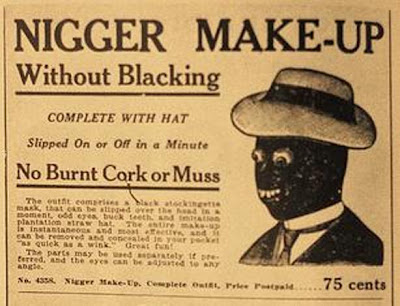
A costume advertisement from the "Coon" heyday:


There is a good essay here on the subject which mentions that:

Long before Kate Smith became, arguably, an American icon of patriotism for her rendition of Irving Berlin’s “God Bless America,” she was screeching into a recorder’s microphone, “Someone had to pick the cotton, someone had to pick the corn, someone had to slave and be able to sing, that’s why darkies were born.”

Major record companies for years had been producing records for black audiences called “race records,” I learned later. Then, in the early ‘50s, Jerry Wexler, a musical columnist for Billboard magazine, coined the term “Rhythm and Blues” to replace the confusingly titled product called “race records.”

The author believes that the worst of the "coon songs" was "If the Man in Moon Were a Coon." I actually have an early recording of this song by Ada Jones, one of the most popular female recording artists of the "acoustic era." The song was recorded in 1905 and sold over three million copies.

No song, in my opinion, is more egregious, more lamentable, more unforgivable than “If The Man In The Moon Were A Coon.” Recorded by Tommy Dorsey and The Clambake Seven in 1937 for Victor, it featured Jack Leonard, who crooned these words like a love song: “If the man in the moon were a coon, coon, coon, what would you do? He would fade with the shades of silvery moon, moon, moon, away from you. No roamin’ round the park at night, no spooning in the bright moonlight, if the man in the moon were a coon, coon, coon.” Recorded for the other side of “Josephine,” it was pulled after the first release and never played again.

Download/listen to the ultra-rare “If The Man In The Moon Were A Coon” recorded by Tommy Dorsey and The Clambake Seven in 1937 here.

You can read even more about Coon Songs on the Wikipedia Page where I learned that whites weren't the only ones writing them: Important African-American composers of coon songs include: Ernest Hogan (who wrote "All Coons Look Alike to Me," the most famous coon song), Sam Lucas (who wrote the most racist early coon songs by modern standards), Sidney Perrin, Bob Cole (who wrote dozens of songs, including "I Wonder What The Coon's Game Is?" and "No Coons Allowed"), and Bert Williams and George Walker.

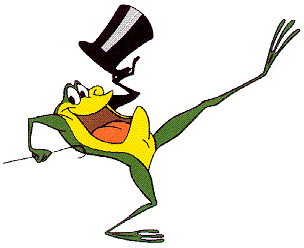
[With all this in mind, makes it even more ridiculous that the WB, a television network which targets an African-American audience would choose an amphibious embodiment of Al Jolson as its mascot, right?]


**UPDATE**

While at a screening of "Captain Blood" at the famous Million Dollar Theater in Los Angeles, I got to see, touch and smell the very curtain that Al Jolson performed in front of in The Jazz Singer:

candy

Lesbian Blues from 1928

Unique in American history is an assertive song of lesbian self-affirmation and defiance, "Prove It on Me Blues." Written, performed, and recorded in 1928 by the famous early blues singer Ma Rainey, this extraordinary song of resistance features a woman-loving woman who proclaims her sexual interest in females and challenges the world to "prove it on me."

Sung in the first person by Rainey in the character of a collar-and-tie-wearing, man-disdaining butch, "Prove It on Me Blues" is a rare and wonderful rebel anthem. (See below for lyrics.)

In 1925, just three years before she recorded "Prove It on Me Blues," Rainey was reportedly arrested when Chicago police raided a wild party, catching Ma and the chorus girls from her show in "a state of undress". Blues singer and former lover Bessie Smith is said to have bailed Rainey out of jail.

Surprisingly, the illustration and text of the record company's original 1928 ad for "Prove It on Me Blues" explicitly links the singer/narrator Rainey with the "bull-dyke" character whose song she sang.

The ad pictures a large woman in a collar and tie, tailored suit jacket, and masculine-looking hat and vest, talking to two slender women in femme drag; a policeman watches. The ad's text, which identifies the large woman in the illustration as Rainey, coyly asks:
What's all this? Scandal? Maybe so, but you wouldn't have thought of it "Ma" Rainey. But look at that cop watching her! What does it all mean? But "Ma" just sings "Prove It on Me."

At the very time when Radclyffe Hall's The Well of Loneliness was being suppressed in the United States as obscene, African-American audiences could apparently appreciate lesbianism in a performer and a song's narrator. "Songs of unconventional sexuality," says Sandra Lieb in her book Mother of the Blues, "were not unusual in the blues and in live black entertainment." Nor were raunchy songs of conventional sex.

Rainey's own composition "Sissy Blues" was a matter-of-fact complaint by a woman whose male lover was stolen by a "sissy" man, "Miss Kate. " Several recordings exist of a song about lesbians, "Bull Dyker's Dream."

Most telling, perhaps, at the bottom of the ad for "Prove It on Me Blues," is a record-company offer of "favorite spirituals." Pious hymns coexisted peacefully in the same Afro-American universe as this bawdy musical boast of lesbianism.

Another thing that may have made songs like these more accessible was the state of the economy. Around 1928, provocative and suggestive material appeared in blues recordings as record companies tried to reverse the decline is sales that resulted from competition with ration and the new phenomenon of "talking pictures."

Ma in the center

Lyrics: Ma Rainey: "Prove It On Me Blues"

Went out last night, had a great big fight, everything seemed to go on wrong.
I looked up, to my surprise, the gal I was with was gone.

Where she went, I don’t know--I mean to follow everywhere she goes.
Folks say I’m crooked. I didn’t know where she took it, I want the whole world to know.

They say I do it, ain’t nobody caught me, sure got to prove it on me.
Went out last night with a crowd of my friends, they must’ve been women, ‘cause I don’t like no men.

It’s true I wear a collar and a tie, makes the wind blow all the while.
Don’t you say I do it, ain’t nobody caught me, you sure got to prove it on me.

Say I do it, ain’t nobody caught me, sure got to prove it on me.

I went out last night with a crowd of my friends, It must’ve been women, ‘cause I don’t like no men. Wear my clothes just like a fan, talk to the gals just like any old man.

Cause they say I do it, ain’t nobody caught me, sure got to prove it on me.


Cthulhu kitties

Fools Be Assuming Thangs.

Humpty Dumpty sat on a wall,
Humpty Dumpty had a great fall.
All the king's horses and all the king's men
Couldn't put Humpty together again
...does not tell us at all that Humpty was an egg.

However it's etymology has a number of variations, and it was in Lewis Carroll's 1871 book "Through the Looking Glass" (that used this rhyme), where the book's illustrator John Tenniel first drew Humpty as an egg, sitting on a wall.

An 1810 version of the rhyme also does not state that the subject is an egg:
Humpty Dumpty sate on a wall,
Humpty Dumpty had a great fall;
Threescore men and threescore more,
Cannot place Humpty dumpty as he was before.


"Humpty dumpty" was an eighteenth-century reduplicative slang for a short and clumsy person.