rocky41_7: (Default)
[personal profile] rocky41_7

Title: The Rediscovery of America: Native Peoples and the Unmaking of U.S. History
Author: Ned Blackhawk
Genre: History

On yesterday’s commute home I concluded The Rediscovery of America: Native Peoples and the Unmaking of U.S. History by Ned Blackhawk. This is a history novel which focuses on the relationship between Native Americans and the United States, from the initial colonization efforts of Europeans to modern day.

I think the thing this book does best, and I think what it was trying to do, is make indigenous Americans active participants in history. Everyone knows that they were victims of countless atrocities, first at the hand of European invaders and later by the United States government, but they are often reduced to the role of passive victim: people to whom things simply happened. Not so, says Blackhawk. Native Americans were shapers of history as much as anyone else, and he brings their role and influence to the forefront here.

One of the things this pushes back on hard is the idea of inevitability: that what happened to the indigenous people of North America was always going to happen. We can see, throughout this book, so many moments when things could have been different if the right people had chosen differently.

It also is very revealing as to the sources of anti-indigenous violence in the decades before and after the American Revolution. It was in many cases, the settlers who were pushing hardest for violence and dispossession of the native peoples, not the government. Of course, the government agreed in the end, but both the British and later the American government initially wanted more diplomatic relationships with Native American tribes—but the settlers, fueled by bigotry, greed, and fear, lobbied hard for a more severe approach, and in the end, they won.

It’s also an incredibly detailed chronicle of native resistance to colonization and how hard Native Americans have fought for centuries to preserve their cultures and be allowed to simply exist as they wish. The breadth and variety of techniques they have employed to this end are truly remarkable. Knowing more about the modern legal struggles of the tribes is also a useful tool for looking at where to go next.

Some reviews found the book dry; personally, I can’t disagree that it was dry, but I did not find its dryness a problem. It is a historical chronicle, not a novel, and it does its job very well. It is well-researched and a thorough survey. I think it does well balancing covering a large swath of history with many different peoples and conflicts while also digging in a bit to certain specifics. I found it deeply engaging and I think the country would be better off if everyone had a better understanding of this material.

My only complaint is that it does end a little abruptly, but it had to stop somewhere.


vamp_ress: (Default)
[personal profile] vamp_ress
Another really good month. Definitely more hits than misses!

McMurtry, Larry: Lonesome Dove. Simon & Schuster Audio. 2025
What an epic undertatking! I (and I'm not a native speaker) decided on the audiobook and doubted my sanity during the first two hours. I always need a bit of time to get used to a certain dialect - and this one comes in a nice Texan drawl. Or at least I suppose that this is what I was hearing, LOL. But even through I struggled through some of the language I enjoyed this so very much. I've rarely read something so out of my comfort zone that turns out to be so very addictive. If you like a tale with a lot of characters that are all fleshed out into the tiniest detail, then try this book. And don't let yourself dissuaded by the fact that this is a western!

Dunmore, Helen: The Siege. Penguin. 2001.
I picked this out of a little library without knowing anything about the author or the plot. Turns out this was actually nominated for the Women's Prize back when it was still called the Orange Prize.I liked this and will definitely look for more by the author. This is a convincing piece of historical fiction set during WWII (not my favourite setting) and the siege of Leningrad. If you're interested in a story that's not political or military but that deals with the experience of the normal, everyday people during war, this is one that won't disappoint.

Swarthout, Glendon: The Shootist. Books in Motion. 2010.
Another western but this one isn't nearly as excellent as Lonesome Dove. The premise is pretty cool: An aging gunslinger learns that he only has weeks to live. So he decides to go out with a bang. This tries to come with a surprise twist, but it's neither surprising nor much of a twist. The author didn't do much with his great idea.

Shafak, Elif. Honour. Penguin. 2013.
I read The Island of Missing Trees a while ago and always planned on trying more of Shafak's writing. So this was my next pick and again it was very good. A tough subject matter, but it's told so interestingly and with so much compassion that it swept me away. If you like early Isabel Allende, Shafak could be something for you!

Hari, Johann. Stolen Focus. Crown. 2023.
This guy proves his point (which is that we can't pay attention) by going on every possible tangeant in his book. Wouldn't recommend.

rocky41_7: (Default)
[personal profile] rocky41_7
Title: Together in Manzanar: The True Story of a Japanese Jewish Family in an American Concentration Camp 
Author: Tracy Slater
Genre: Non-fiction, history

It seems timely to read about America’s past experience with unjust detention of people based on perceived threats to national security, so last night I finished Together in Manzanar by Tracy Slater, a true story about one of the families in a Japanese internment camp during WWII. The situation of the Yonedas was somewhat unusual as they were a mixed-race family—Karl Yoneda was a Japanese-American citizen and his wife Elaine was white and Jewish.

The Yonedas make for a very interesting case study in what happened in the camps because a) their mixed-race family status (including their 3-year-old son, Tommy) made it clear how little the American military had really thought about this plan, given how thrown-off they were by the mere existence of mixed-raced families; and b) Karl and Elaine had been vocal social activists well before they were imprisoned in the Manzanar camp, speaking up for labor rights, racial justice, and participating in Communist advocacy. They had the language, tools, and knowledge to speak up and speak out, and they did.

Slater has done her research and provides a thorough list of sources at the end of the book, which include interviews with the Yonedas’ grandchildren as well as their own diaries and news clippings.

Together in Manzanar provides an in-depth look at the politics within the Japanese-American community at this time, both leading up to the camps and within. It ably tackles the question of “Why did they go? Why wasn’t there resistance?” (There was.) For the Yonedas in particular, the importance of an Axis defeat was difficult to overstate: as horror stories of German atrocities in Europe began to trickle out, they knew that a German or Japanese take-over of the United States would almost undoubtedly lead to Elaine and their son Tommy going into a death camp.

It provides a three-dimensional look at the discussions on the ground at the time, as well as following up with details from interviews Karl and Elaine gave many years later reflecting back on their statements and advocacy at the time.

I wasn’t a huge fan of the writing style, but this is one of those books you read for content, not style. It jumps around from perspectives in a way that’s occasionally confusing, but I also appreciated getting some more background information on some of those in the camp who opposed the Yonedas’ view on cooperating with the US government. Slater does a good job showing how each person highlighted got to their perspective and why the tension both within the camps and in the world generally at the time put everyone so on edge.

The book is also helpful for reminding us of the names of the hateful racists (architect Karl Bendetsen) who propagated this plan and then later tried to lie about why it was implemented or how bad it was. It’s also a useful reminder that when these people were released, they didn’t get to just waltz back into the lives they had been living before being imprisoned. Many of them were forcibly resettled further into the US, away from the coastal cities where they had lived, and forced to restart their lives from scratch, away from their communities and businesses.

It just seemed like a particularly relevant time to remember this.


vamp_ress: (Default)
[personal profile] vamp_ress

Duras, Marguerite: Abahn Sabana David. Open Letter Books. 2016.
I've bought this years ago in a bundle with several Duras-books and I must say, I've no idea what I read here. I think the word one uses for something like this nowadays is: word salad. At least it was short.

Riddle, John: Contraception and Abortion from the Ancient World to the Renaissance. Harvard University Press. 1992.
This was delightful. I actually bought this for fic research, but I thoroughly enjoyed it even apart from the excellent info it provided. The author's thesis is that - contrary to popular belief - people in antiquity and well beyond had very detailed knowledge about contraception (and abortion). Later, this knowledge was lost. The assumption is that this loss was caused by Christian religion and its rigid moral standard. Fascinating!

Steinbeck, John: The Grapes of Wrath. Penguin. 2006.
I read "Of Mice and Men" as a teenager and was absolutely blown away. I always meant to give Steinbeck another go and find a few more favourites. I went with "The Grapes of Wrath" because this is argueably his magnus opus. And boy, did I hate it. Maybe it's an unpopular opinion, but this book didn't age well. The most interesting thing about it is the fact that it's widely popular and acclaimed in the U.S. despite its openly communist agenda. (Mind you, not that there's anything wrong with a communist agenda, per se - but my understanding is that the U.S. and communist ideas don't mix well.)

Donaldson, David Santos: Greenland. Amistad. 2022.
This was such a missed chance. The blurb says this is a novel within a novel about E.M. Forster's love affair with an Egyptian tram conductor, but I learnt basically zero about that. Everything about Forster and his affair read like an author self-insert (or maybe a protagonist self-insert, since the protagonist is also the author of the book within a book). I took basically nothing away from the read expect maybe the info that black gay men in New York are obnoxious and annoying. (Sorry to all N.Y. gay men ...)

Moore, Kate: The Radium Girls. Simon & Schuster. 2016.
God, this was painful (pun intended). This is such an important book with such a strong sujet, but the execution wasn't even mid it was infuriatingly bad. The writing had the level of a romance book you buy at a whim at a train station. It was that bad. Moore clearly wanted to write a kitschy novel - every character here (and there are way too many) was introduced by bodily features. Women have dazzling smiles and men have strong arm muscles. Paired with the subject matter of the book this approach made me gag. The book needed to be written, but Kate Moore was the wrong woman for the job, sorry.

Johnson, Denis: Train Dreams. Picador. 2012.
I had never read anything by Denis Johnson but right after finishing this I bought another of his works. This was so good! It deals with the life of a man in the Idaho Panhandle throughout the 20th century. It starts in 1917 and ends in the 1960s with his death. In the nostalgia this evokes it reminded me a little of Harrison's "Legends of the Fall" which is equally panoramic in its approach and shows a time not too long ago but ultimately lost and absolutely alien to us now. Fantastic read!
 

vamp_ress: (Default)
[personal profile] vamp_ress
Lots of middling stuff in December with one notable exception:

Parrott, Ursula: Ex-Wife. Faber & Faber. 2024.
Discovered, once again through Lost Ladies of Lit (my favourite literary podcast by MILES) this novel from the roaring 1920s gets compared to The Great Gatsby a lot. In my opinion, this is the better book. Bold, outspoken, modern - Ex-Wife (despite the stupid title) is an excellent novel and I'd love for more of Parrott's work to get re-issued. Alas, I can't find anything anywhere. Such a shame!

Schweblin, Samantha: Little Eyes. Riverhead Books. 2020.
For years after Covid I couldn't touch dystopias, even though I've always loved that genre. I'm slowly getting back to those novels (very tentatively), but this was just not IT. It should definitely have been a short story. This isn't so much a novel as it is a collection of interconnected stories in the same world where smart plushies invade people's most intimate spaces. The novel wants to say so many things, but it never really goes there. Additionally, while I think the basic premise sounds plausible to a lot of people it simply doesn't hold up under scrutiny. I won't deny that something like this would appeal both to voyeurists and exhibitionists. But that's about it. The most shocking thing about this novel is the fact that it was on the longlist for the International Booker.

Bridle, James: New Dark Age. Technology, Knowledge and the End of the Future. Verso. 2018.
Bridle sometimes goes on the wildest tangeants (I now know more about Peppa Pig than I ever wanted to know) and his own interests show clearly (he seems overly interested in air travel), but overall this was a riveting and thought-provoking read. I thoroughly enjoyed following him on his journey through the history of technology.

Wood, Benjamin: Seascraper. Viking. 2025.
This novel is set in the 1960s, but it reads like it's the 1660s. Nice language and prose, but it sounds too much like a creative-writing-class for my taste with no actual plot to carry all these fancy words over the finish-line. The last 25% did not seem to belong with the rest of the book and stood out like a sore thumb. If you want to give this a go either way, I'd recommend the audiobook. Well read (and sung) by the author himself.

Whitehead, Colson: Underground Railroad. Doubleday. 2016.
My least successful Whitehead so far, maybe "only" because I'm not American and I couldn't really tell when he was being faithful to the history of slavery and when he was making stuff up. That considerably lessened my enjoymend and what I could take away from the novel. Also, he wasn't doing himself any favours with the many voices and POVs he used throughout. I've been looking forward to reading Underground Railroad for years now, but I must say that this - sadly - was a letdown.
petrea_mitchell: (Default)
[personal profile] petrea_mitchell
It's gift card season and there are a couple sorts of books I would like to get with mine, but I don't even know what sorts of terms to start searching on.

1) Something about different legal systems and the philosophies that go with them. How they shape how people think about what the law is even for, and so forth. Would prefer to focus on modern systems, but historical examples are fine if they help illuminate the present. (E.g. I have come across mentions a few times that things work in such and such a way in France or its former colonies because they were shaped by the Napoleonic code.)

2) How the governments of really huge cities/metropoles work.

Blogs or newsletters are okay too. But no podcasts or YouTube series unless they're scripted, please.
vamp_ress: (Default)
[personal profile] vamp_ress
In hindsight, it seems my November was horror-reading month. I swear, I hadn't planned it this way, but I won't complain. 

Purcell, Laura: Bone China. Bloomsbury. 2019.
I've been reading her books for a few years now, picking one up every autumn. She's a contemporary author, but she writes in the vein of gothic fiction - there are a lot of remote mansions and haunted castles in her books. Bone China features a remote manor on a cliff, an unreliable narrator and the question of what is truly happening and what is actually only taking place in the protagonist's head. Purcell is really good with the psychological horror. If that's your kind of thing you should definitely check her out.

Moreno-Garcia, Silvia: Mexican Gothic. Del Rey. 2020.
This was my first time with a novel by Moreno-Garcia. I felt that thematically, this was all over the place. Apart from the fact that it's horror it also tried to tackle themes like racism, classism, eugenics and mysoginy, but it didn't spend enough time on any of these themes to make it worthwhile. Additionally, this has a historical setting (the 1950/1960s) even though this is never fully realised and you wonder why the author chose to take this route (probably only to constantly talk about the dress the protagonist was wearing, I don't know). And when we got to the bottom of why the house was "haunted" I basically got off the plane - this is a personal thing of course, but I found this rather silly instead of terrifying. What I really liked was the gothic vibes she managed to evoke while describing the house. The atmosphere and the creepy dreams (that only get creepier as the story progresses) were my highlights.

Tremblay, Paul: Horror Movie. HarperAudio. 2024.
Tremblay simply has the best audiobook productions and this was top-notch as well. If you want to give this novel a try, do yourself a favour and consider the audiobook! I can't say that I fully bought into the "haunted set" idea and most of the characters felt flat and hardly realised, but Tremblay is really good with mixed media. There are several POVs and a screenplay in this. But the novel wasn't overly scary or frightening.

Feito, Virginia: Victorian Psycho. Audible Audio. 2025.
As a project this is very well done and successful, but as a book on its own I find it forgettable. As the title says this marries American Psycho to a Jane Eyre-like plot. The language was the most interesting thing about this, because just like in American Psycho the narration starts off very tame and proper only to get more unhinged as the story progresses. I think that progression was the highlight of the novel and very well done. On the other hand, it was riffing off what Ellis has already done decades ago, so I'm not sure how much of the credit (besides the idea of the Victorian setting) can really go to Feito. In the end, mostly a fanfiction remix even if it's executed extremely well.

Kröger, Lisa & Anderson, Melanie R.: Monster, She wrote! The Women Who Prioneered Horror and Speculative Fiction. Quirk Books. 2018.
Let's start this by saying that this is a beautifully done book. It was quite obviously typeset before the pandemic and before paper became scarce and expensive - there's a lot of free and waste of space here and it's wonderful to see a book "breathe" like that. Happens rarely enough. Sadly, this nonfiction read didn't fully give me what I had expected. Yes, I filled up my TBR because the authors truly manage to find a lot of hidden gems. But I had definitely expected more literary criticism, more in-depth analysis. In the end, this was pretty much snorkeling just below the surface.

Doerr, Anthony: Cloud Cuckoo Land. Scribner. 2021.
I only read this because Ben from Ben reads good gave this a glowing review. Half an hour into the (German) audiobook of 16 hours I thought this would be 16 hours of pure torture. In the end, it wasn't quite that bad, but I can't say that the book and I had a successful time with each other. The "hook" - the Greek epic connecting all the different timelines was as silly as the title suggests and had I known that this would fully be shouldered by kid and teenage protagonists I would have opted out before I even started. I just didn't care for any of it. Okay, that's not true. I cared for the poor beasts of burden who died somewhere in the middle - but even that was mostly the author emotionally manipulating the reader, so I don't know what to make of this.

huxleyenne: (little luna)
[personal profile] huxleyenne
Full Title: 生き甲斐  Ikigai: Giving Every Day Meaning and Joy

Author: Yukari Mitsuhashi

First Published: In Great Britain by Kyle Books, an Imprint of Octopus Publishing Group LtD, 2018

"The Japanese word ikigai is formed of two Japanese characters, or kanji: 'iki' [生き], meaning life, and 'gai' [甲斐], meaning value or worth. Ikigai, then, is the value of life, or happiness in life. Put simply, it's the reason you get up in the morning." - That's the summary on the back of the book. 

This is a quick and thoughtful read. I'm a distractable person with a wandering mind, and it still only took me about an hour to reread this cover to cover. Here are some thoughts. 

Call it morbid curiosity or a guilty pleasure, but I read self-help books sometimes, including bad ones. It's a good idea to take life advice books with a grain of salt, and perhaps Ikigai is no different. Even so, I like this book. Nothing felt out of place or without meaning. There are no religious undertones that I noticed, nor does the author have the attitude that your purpose in life is to make money. She does her best to show the reader what the "value of life" means to her, and the anecdotes she used from others are brief, but effective. 

I think perhaps my favorite thing the author said was toward the end, on page 89: "I think having ikigai ensures that I will never be bored until the day I die. Maybe that's happiness. You keep chasing your ikigai and one day you just die." This made me think of hobbies we passionately engage with and why we have them. If I had to call anything my ikigai, it would probably be writing fanfiction.  

A book like this has its place if you need a quick boost, or moment to think deeply about what you love and why it gets you out of bed in the morning. It doesn't have to be a job or family, though it can be those things. It just has to be true, and yours. Reading this feels meditative, in a way.
stonepicnicking_okapi: record player (recordplayer)
[personal profile] stonepicnicking_okapi
[Feel free to comment about and/or drop recommendations of biographies or autobiographies of musicians from any musical genre.]

cover miles autobiography

Title: Miles: The Autobiography
Authors: Miles Davis with Quincy Troupe
Format: Audiobook, 17 hours, Narrator: Dion Graham
Format: Text, 441 pages with 32 pages of black and white photos
Genre: Autobiography

I am a home caregiver and one of my clients is a jazz musician and listening to this autobiography of Miles Davis was an excellent starting point for many interesting conversations with him. I like jazz music, but I can’t say I am very knowledgeable.

I prefer audiobook versions whenever readily available to me via my public library’s app, and when I saw that the narrator for this book had also narrated The Wager by David Grann, which I had listened to and enjoyed very much, then I immediately put it on hold in my library’s system.

The good, the bad, and the ugly.

The good.

The narration is excellent.

Miles Davis reveals that following an operation to remove a grown on his larynx in 1956, he raised his voice to make a point with a record company manager when he wasn’t supposed to be talking at all, and “After that incident, my voice had this whisper to it that has been with me ever since.” And Graham reproduces that deep baritone whisper for 17 hours to good effect. And the way the book is written, in first-person conversational style, with slang, cursing, occasional sighs and huffs, and informal sentence structure, creates the illusion that the reader is listening in on a long, long ramble by Miles himself.

For example, it’s much more effective to hear the sentence Yeah, man, B was funnier than a motherfucker. spoken in certain voice with a certain pitch and rhythm than it is to read it without those things.

The good, the bad, the ugly )

I am glad I read it [listened to it], but I can’t wholeheartedly recommend it to anyone. For me, it served its purpose and was, at times, enlightening and enjoyable.
merrileemakes: A cartoon of a dreaming sheep, with yarn for fleece on a purple background (Default)
[personal profile] merrileemakes
There's 2 more works from the itch Curated Collections About LGBTQIA list that I want to highlight.


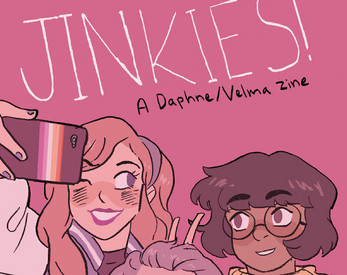
Jinkies! A Daphne/Velma Zine by Elise Schuenke

More an art book than a story but it contains utterly adorable snippets from the life of 2 gorgeous and adventerous women. There's fun encounters, domestic scenes and bonus Buzzfeed Unsolved references. I am 100% here for these feels.

If you like Elise's style I also recommend her other works Starcrossed and Still Here.


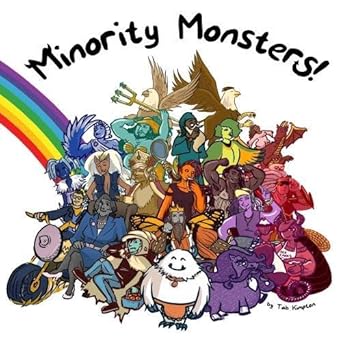
Minority Monsters by Tab Kimpton

Description: Greetings explorers, and welcome to Alphabet Soup Land! Want to learn about the not-so-invisible Bisexual Unicorn? The secrets of the Asexual Succubus? Or the previously unfathomable fathoms of the Genderqueer Merperson? If so, you’re in the right place! Packed full with comics of mythical monsters, field notes and information sections; this spotters guide of LGBT* and Queer creatures is the perfect companion for any adventurer.

Review: This is such a wholesome and fun approach to describing the different flavours of humans. But it's also quite nuanced and introduces some of the common mythconceptions and misunderstandings around different identities. The art is fun, colourful and inclusive. It might read a little condescending at times, but I mostly read that as minority fatigue. For an entry price of pay what you want it's worth checking out, even if only for a moment of dopamine.
rocky41_7: (Default)
[personal profile] rocky41_7
Title: The Originalism Trap: How Extremists Stole the Constitution and How We the People Can Take it Back
Author: Madiba K. Deenie
Genre: Non-fiction, politics

This one is not likely to be of much interest to non-Americans. This weekend I blew through The Originalism Trap: How Extremists Stole the Constitution and How We the People can Take it Back by Madiba K. Dennie. This book delves into the originalism theory of constitutional interpretation, why it's far more ahistorical than its adherents want you to believe, and some tracks we could take to counter it.

If you aren't familiar, "originalism" is a theory of constitutional interpretation that says in order to understand the Constitution, we must interpret it as closely as we can to how the original writers would have interpreted it. It posits itself as the most true-to-history and unbiased way to interpret the Constitution. It was also a fringe theory for decades, until relatively recent political winds brought it to the forefront.

Originalism traps us in the mindset of 18th century wealthy white men and refuses to let us progress any further. Originalism says if we didn't have the right then, we can't have it now. Originalism cherry-picks its history to conveniently arrive at a conservative goalpost no matter what the real story is. I wrote an essay in grad school on why originalism is horseshit, so this book was of particular interest to me.

Dennie does a great job making this book accessible to everyone. I would strongly recommend this as a read for any one in the legal or legal-adjacent professions, but I think anyone can read and pick up what Dennie is laying down here. She summarizes the history of originalism as well as deep-diving into its most recent developments (this book was published in 2024, so it's quite recent).

Originalism has a way of making itself seem inevitable, but Dennie reveals with researched ease how untrue that is; she shows the hypocrisy and insincerity of the theory over and over. 

Dennie doesn't stop at "here's what's wrong" either--she has proposal and suggestions for how to counter the outsized influence of this once-disfavored theory and what we as citizens can do to push back against it. On the whole, while there is obviously anger and frustration in this book--feelings I share!--there is also a lot of hope and optimism. Dennie calls herself an optimist at heart, and it shows. This is not a doom-and-gloom book foreseeing an indefinite miserable political future for liberals and anyone who wants to expand rather than contract the depth and breadth of our rights. It is a justified call-out to political opportunists seeking to dress their partisanship up as rationalism, but it is also an essay on how it doesn't have to be this way.

At a brief 218 pages (plus bibliography), The Originalism Trap is easy to recommend to any fellow Americans, both as a way to understand where we're at, and a way forward, hopefully out of this extremist quagmire. Dennie can occasionally be irreverent in a way I feel detracts rather than adds to her argument, but she is also dealing with incredibly dry material that the average reader will probably struggle to stay engaged with, so I can forgive it. Very glad I picked this one up and I left feeling hopeful that there is an achievable alternative to where we are now.


silversea: Asian woman reading (Reading)
[personal profile] silversea


Title: Know My Name
Author: Chanel Miller
Genre: Memoir
Content warning: Sexual assault

“I am a victim, I have no qualms with this word, only with the idea that it is all that I am.”

A memoir by Chanel Miller, whom you may know as Emily Doe from her famous victim statement in 2016 after her assailant, Brock Turner, was sentenced to 6 months in jail. In 2019, Miller revealed her identity along with a new book about her sexual assault, the lasting trauma from it, her fight for justice, and her ongoing recovery.

This is an excellent memoir, starting from the day Miller was assaulted and the morning she woke up without any memories of the assault to the world's responses to her victim statement that went viral and the changes in the judiciary system. Like in the victim statement, Miller did not shy away from sharing vulnerable moments, such as her depression isolating her from family and friends, but also gradually learning how to heal through friends, therapy, and new hobbies.

Review )
huxleyenne: (deal me in)
[personal profile] huxleyenne
Full Title: Amusing Ourselves to Death: Public Discourse in the Age of Show Business

Author: Neil Postman

First Published: In the United States of America by Viking, an Imprint of Penguin Random House LLC, 1985

Today I would like to briefly discuss a book I first read two and a half years ago, but has undoubtedly rocked my world, shaken my perception of entertainment, and every television/Internet-connected screen in which I find myself parked and glued.

This book, published in 1985, is as relevant as ever 40 years later, despite being a critical discourse on American television and its role in society.

Postman digs into all sorts of media, none of which he bombards with more side-eye than television news, which he basically regards as the apex of brainrot back in the 1980s, and quite frankly, I think he’s right.

I grew up in America, raised on a glut of television programs and commercials. If I had read his book any time before late 2016, I would have assumed this author was just kind of poo poo and anti-tech, or perhaps I would have likened him to the same kind of people who blame violence in schools on video games. I cannot see myself reading and accepting Postman’s work before 2016.

Now? Of all authors I’ve ever read in my life, I don’t think any have predicted America’s future with haunting accuracy the way Brave New World by Aldous Huxley has. It was Postman’s work that led me to Huxley (I already read Orwell in school by the time I found Postman, but Huxley was new to me.)

The value of reading Amusing Ourselves to Death in 2025 is that it can give readers, both open-minded Americans and folks in other countries, a picture of how it came to be that we, the people, are so easily influenced and swayed by hypnotic video media, and why that might be. It’s like, most of us see it, but don’t quite have the words for it. Instead, many people would lazily dismiss this as mere ignorance/stupidity and walk away feeling superior for the sake of feeling superior, probably.

I'm not here to express a "superior" or "heightened" awareness, as it were, but I am here to encourage everyone to think about what they watch, why, and how it might affect them. I think everyone has a right to know, especially because propagandists and advertisers don't want us to. It's not in the best interest of their bloated wallets for us to think critically about media consumption.

Anyway, Postman, a man who considered himself a “media ecologist,” expressed many concerns regarding television (and many of those concerns apply to how we use the Internet as well.) He has serious doubts about its ability to educate people, especially when education is the intent. He doesn’t regard it as a good source of information at all, least of all that which we call “news.” Heck, this man Postman, especially his 1980s self, would probably argue that a solid half hour of someone swimming in poo is of higher intellectual value than Fox News from an entirely unironic point of view.

As with any nonfiction book, I wouldn’t encourage anyone to read this and take it as gospel. It’s here to help you think, open your eyes, and draw your own conclusions, which is what Postman himself would want, I believe.

Postman was a critic with plenty of critics, and rightly so, I’m sure. Even so, he’s given me so much to think about, and I don’t know for sure if he’s the driving force or just a little piece of the puzzle, but the way I watch television now is different. I don’t know if I’d call it heightened awareness or disillusionment, but I’m relieved to have a voice from the decade in which I was born to give words to much of what I’ve been thinking of news, programs, and memetic culture over the past ten years. Take Postman's work with a grain of salt if you must, but do give him a chance if social sciences and humanities are of interest to you. Thank you.
rocky41_7: (Default)
[personal profile] rocky41_7

Title: How I Survived a Chinese "Reeducation" Camp: A Uyghur Woman's Story
Author: Gulbahar Haitiwaji with Rozenn Morgat
Genre: Nonfiction, memoir

Some books you read not for the experience of reading them, but for the information within. Such is the case with Gulbahar Haitiwaji's memoir, How I Survived a Chinese "Reeducation" Camp: A Uyghur Woman's Story. As the title suggests, this is a first-person account of Haitiwaji's experience in Xinjiang, where she was subjected to "reeducation" on suspicion of terroristic activity. This book was written with the help of Rozenn Morgat and Haitiwaji's daughter Gulhumar, and translated from French by Edward Gauvin.

To quickly summarize for anyone unaware, the Uyghurs (also spelled "Uighur") are an ethnic minority in China, inhabiting the northwestern region of Xinjiang, which is quite large. They are predominantly Muslim; speak Uyghur, a Turkic language; and frequently have more culturally in common with neighboring Kazakhstan and Tajikistan than with the Han in eastern China. For many decades, the Chinese government has viewed Uyghurs with suspicion and since the 1950s has continually ramped up levels of surveillance against Xinjiang. I wrote a paper on this situation in graduate school several years ago concluding that China is enacting a slow genocide against Uyghurs, with the intent of fully wiping out their culture.

Uyghurs are subjected to relentless video surveillance, intrusive police home visits, regularly summoned to the police station for interrogation without any suspicion of a real crime, forcibly sterilized, and punished for any excessive displays of religiosity such as wearing a hijab or visiting mosque too frequently. Some years ago, "reeducation schools" entered the picture.


Read more... )


rocky41_7: (Default)
[personal profile] rocky41_7
Title: Consent: A Memoir
Author: Vanessa Springora
Genre: Nonfiction, memoir

We're back to the "Women in Translation" rec list, with book #10: Consent: A Memoir by Vanessa Springora, translated from French by Natasha Lehrer. This autobiographical novel is the story of Springora's sexual abuse as a young teenager at the hands of Gabriel Matzneff, a well-regarded and prolific French writer, who was in his late forties when he entered a romantic and sexual relationship with Springora (called "V" in the book).

The rest of this review is under the cut, given the nature of the content.

Read more... )

sixbeforelunch: stack of books, no text (books)
[personal profile] sixbeforelunch
Can anyone recommend a non-fiction book about the Napoleonic Wars that's more focused on the sociology and politics of the era than the nitty gritty of the battles? High level overviews of the various engagements are fine but my eyes glaze over when confronted with twenty pages of detailed battle descriptions and military tactics. Unfortunately most people who write war histories tend to want to talk way more about that sort of thing than I have patience for.
spiralsheep: Sheep wearing an eyepatch (Default)
[personal profile] spiralsheep
If you read a "Raynor Winn" book and enjoyed it or it helped you in any way then I'm extremely glad for you (especially because any positive result came 100% from you yourself) - but you might want to stop reading here because the remainder of this post is not positive about the author or her books.

The real Salt Path (link to The Observer): how a blockbuster book and film were spun from lies, deceit and desperation.

The Salt Path-ological liar, The Wild Lies, and Landlies )
anehan: Elizabeth Bennet with the text "sparkling". (Default)
[personal profile] anehan
Title: Censored: A Literary History of Subversion and Control
Authors: Matthew Fellion and Katherine Inglis
Genre: non-fiction

As a consequence of realising that hey, interlibrary loans exist and are actually pretty cheap, I've been reading a book called Censored: A Literary History of Subversion and Control by Matthew Fellion and Katherine Inglis.

The book is a survey of the history of censorship of literature mainly in the UK and the US, presented through case studies of individual censored works, though many of the chapters discuss censorship of similar books more broadly. The oldest case is the censorship of the early English translations of the Bible; the newest the censorship of Chicanx literature in Arizona in the 2010s.

The book takes a broad view of censorship. It doesn't just deal with censorship by the state, but also other forms of censorship, such as self-censorship and the chilling effect that censorship exerts on the literary landscape as a whole.

I'm not going to talk about it in any great detail. It's really well-written -- very accessible to a lay reader, without feeling like it's been dumbed-down -- so go read it if the topic interests you.

Some thoughts on censorship of literature based on this book )
petrea_mitchell: (Default)
[personal profile] petrea_mitchell
Full title: 1 Dead in Attic: After Katrina
Author: Chris Rose
Publisher: Simon & Schuster, 2007

Note: I planned for this to be one of my reviews all the way back in August when I signed up for the review-a-thon. The fact that it is now timely is just serendipity, I swear.

1 Dead in Attic is a collection of columns written by Chris Rose for the New Orleans Times-Picayune, starting from just after Hurricane Katrina and continuing until more than a year afterward.

It reads like a post-apocalyptic epistolary novel, but covering the messy middle time that few post-apocalyptic novels deal with, between the event itself and the distant future when the society has healed itself. The New Orleans of 1 Dead in Attic is a city in progress-- favorite businesses now sitting abandoned, damaged homes waiting on insurance checks, vanished acquaintances who might be dead or might just have moved away. Even several months after The Thing, as he calls it, as the world's attention has turned away and the big local events have been resurrected, Rose is able to give some friends a look at still-wrecked neighborhoods, and they encounter a jazz funeral for someone who passed away in the storm, just now being buried. Column after column notes the still-visible brown mark left by the height of the flood.

There are some light notes, particularly early on. There are tales of petty revenge over improper fridge disposal, and the magical moments when the toilets work again and Rose first encounters a working traffic light. But rebuilding is a long, grim slog.

Rose counts himself lucky because he and his family were able to evacuate to Vicksburg for the actual storm, their house was hardly damaged, and his wife and kids are able to stay with relatives in Maryland so the kids can go to school in a normal environment. But in the final act of the book, he is forced to admit that he too is a victim of Katrina, as the separation from his family and the constant focus on the aftermath of the storm take their psychological toll.

1 Dead in Attic is a powerful book, and a very informative book if you want to understand what parts of North Carolina will be going through in the months ahead, but it is not a happy book. Don't read this if you're already feeling down.
ysabetwordsmith: Cartoon of me in Wordsmith persona (Default)
[personal profile] ysabetwordsmith
Recipes from the World of H. P. Lovecraft: Inspired by Cosmic Horror
Hardcover – July 25, 2023
by Olivia Luna Eldritch


This cookbook draws inspiration from H.P. Lovecraft and the Cthulhu Mythos. In addition to photographs of delicious food, it also features a lot of eldritch horror illustrations, some black-and-white, some full color. There's also a good deal of information about Lovecraft, his writing, his eating and hosting preferences. So there's an interesting mix of actually eldritch-themed recipes and others that are inspired by things he liked or his home territory. The chapters are Breaking Fast, Lighter Bites, Strange Feastings, Toothsome Sweets, Potions & Concoctions.
Read more... )

Profile

a nook just for the books

July 2026

S M T W T F S
    1 234
567 891011
12131415161718
19202122232425
262728293031 

Syndicate

RSS Atom

Most Popular Tags

Style Credit

Expand Cut Tags

No cut tags
Page generated Jul. 11th, 2026 12:40 am
Powered by Dreamwidth Studios