Machine Learning for Engineers
Machine learning adapts using data to gain experience. It is a convergence of linear algebra, statistics, optimization, and computational methods for computer systems to infer relationships and make decisions from data.
Examples of machine learning are now common and are expected to further influence transportation, entertainment, retail, and energy industries. This engineering course reviews theory and applications of machine learning to engineering applications with a survey of unsupervised and supervised learning methods.
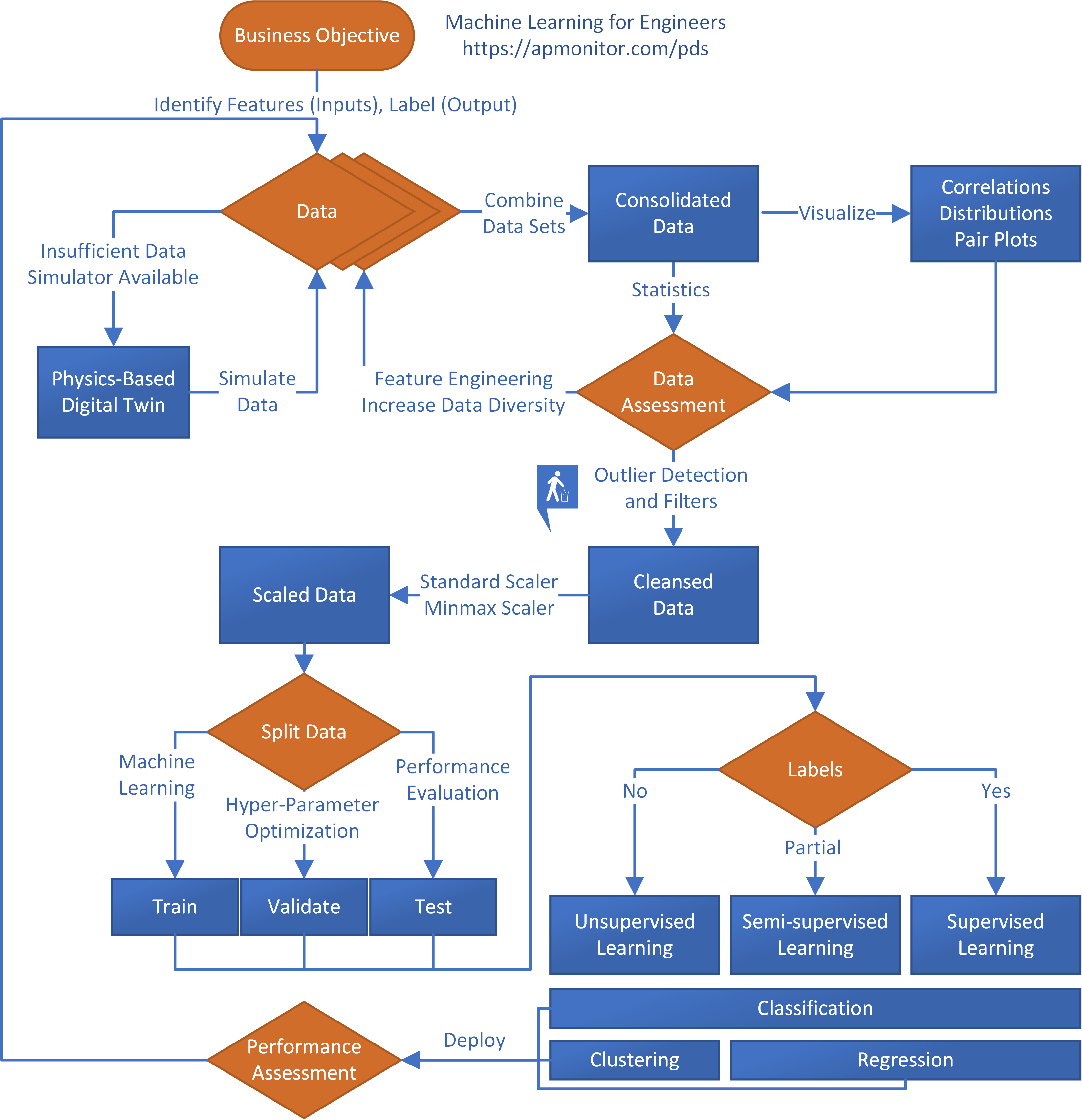
The course combines mathematical details with several case studies that provide an intuition for machine learning with methods for classification, regression, and dimensionality reduction. A second phase of the course is a hands-on group project. The engineering problems and theory guide the student towards a working fluency in state-of-the-art methods implemented in MATLAB and Python.
Related Topics
- Engineering-specific programming (Python, Matlab) with treatment of numerical methods.
- Machine Learning for Engineers: building mathematical models for classification and regression based on training data to make empirical predictions or decisions.
- Cybersecurity for Engineers: assessing and mitigating risks from computer-based adversarial attacks on engineered systems.
- Data Science: using scientific methods, processes, algorithms and systems to extract knowledge and insights from data.
- Data Visualization: creating graphical representations of data to extract insights.
- Internet of Things: building cyber-physical systems that connect microcontrollers, sensors, actuators, and other embedded devices. Includes mechatronics, embedded systems, distributed systems, and networking.
- High Performance Computing: programming high-performance computers (e.g., supercomputers, cloud computing) to tackle computationally-intensive engineering problems.
Professor
 John D. Hedengren
 Office: 330L EB, 801-422-2590
 john.hedengren [at] byu.edu
 Office hours M, W, Fr 10-11 AM (after class), 330L EB
 Connect on LinkedIn

John Hedengren leads the BYU PRISM group with interests in combining data science, optimization, and automation with current projects in hybrid nuclear energy system design and unmanned aerial vehicle photogrammetry. He earned a doctoral degree at the University of Texas at Austin and worked 5 years with ExxonMobil Chemical prior to joining BYU in 2011.
Course on  GitHub
- Overview
- Syllabus
- Schedule
- 4-Day Course
- Course Project
- Startup Incubator
- Resources
- Install Python
- Install Packages
- AI Ethics
Exams
Data Engineering
- Overview
- 1️⃣ Gather Data
- 2️⃣ Statistics
- 3️⃣ Visualize
- 4️⃣ Cleanse
- 5️⃣ Features
- 6️⃣ Balance
- 7️⃣ Scale
- 8️⃣ Split
- 9️⃣ Deploy
- 🔟 Apps
Agentic Engineering
Classification
Supervised Learning
- AdaBoost
- Decision Tree
- k-Nearest Neighbors
- Logistic Regression
- Naïve Bayes
- Neural Network Classifier
- Random Forest
- Stochastic Gradient Descent
- Support Vector Classifier
- XGBoost Classifier
Unsupervised Learning
Regression
- Overview
- Linear Regression
- k-Nearest Neighbors
- Support Vector Regressor
- Gaussian Processes
- Neural Network Regressor
- XGBoost Regressor
Time-Series
Computer Vision
Applications
- Overview
- TCLab Help
- 1. Overview
- 2. Import Data
- 3. Statistics
- 4. Visualize
- 5. Prepare Data
- 6. Regression
- 7. Features
- 8. Classification
- 9. Interpolation
- 10. Solve Equations
- 11. Differential Equations
- 12. Time Series
- Final TCLab Project
Related Courses
- 🎓 Begin Python
- 🎓 Begin Matlab
- 🎓 Begin Java
- 🎓 Engineering Computing
- 🎓 Data Science
- 🎓 Data-Driven Engineering
- 🎓 Machine Learning
- 🎓 Control (MATLAB)
- 🎓 Control (Python)
- 🎓 Optimization
- 🎓 Dynamic Optimization