Zabuyelite
A valid IMA mineral species
This page is currently not sponsored. Click here to sponsor this page.

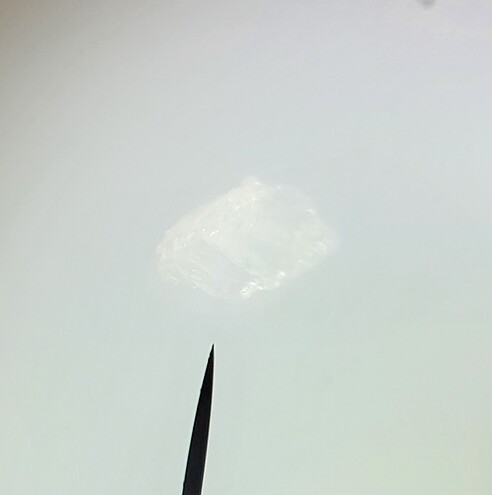
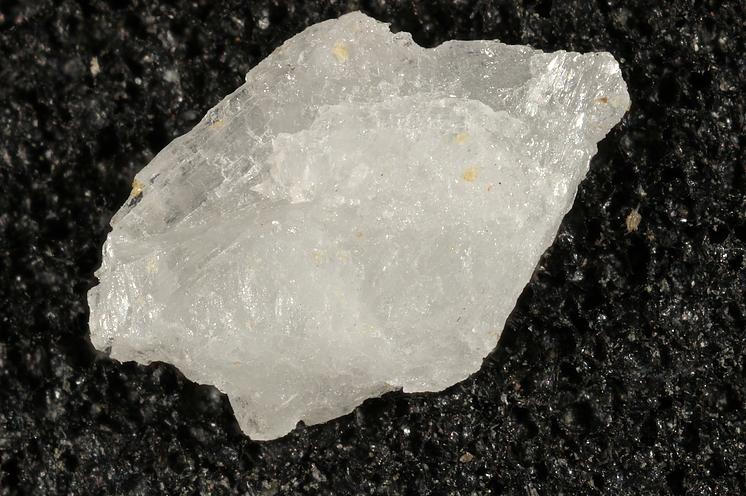

About Zabuyelite
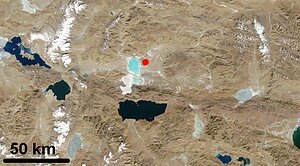
Satellite photo showing Lake Zabuye and other lakes
Chabyer Caka, Zhongba Co., Xigazê Prefecture, Tibet, China
Chabyer Caka, Zhongba Co., Xigazê Prefecture, Tibet, China
Formula:
Li2CO3
Colour:
Colourless
Lustre:
Sub-Vitreous
Hardness:
3
Specific Gravity:
2.09
Crystal System:
Monoclinic
Name:
Named in 1987 by Mianping Zheng and Wengao Liu for the type locality, the Zhabuye Salt Lake, Nagri, Tibet, China.
Has been found as very tiny microscopic colorless inclusions in microscopic fluid-bearing inclusions in spodumene.
Unique Identifiers
Mindat ID:
4380
Long-form identifier:
mindat:1:1:4380:5
IMA Classification of Zabuyelite
Classification of Zabuyelite
5.AA.05
5 : CARBONATES (NITRATES)
A : Carbonates without additional anions, without H2O
A : Alkali carbonates
5 : CARBONATES (NITRATES)
A : Carbonates without additional anions, without H2O
A : Alkali carbonates
14.1.6.2
14 : ANHYDROUS NORMAL CARBONATES
1 : A(XO3)
14 : ANHYDROUS NORMAL CARBONATES
1 : A(XO3)
11.1.1
11 : Carbonates
1 : Carbonates of the alkali metals and ammonium
11 : Carbonates
1 : Carbonates of the alkali metals and ammonium
Mineral Symbols
As of 2021 there are now IMA–CNMNC approved mineral symbols (abbreviations) for each mineral species, useful for tables and diagrams.
| Symbol | Source | Reference |
|---|---|---|
| Zab | IMA–CNMNC | Warr, L.N. (2021). IMA–CNMNC approved mineral symbols. Mineralogical Magazine, 85(3), 291-320. doi:10.1180/mgm.2021.43 |
Physical Properties of Zabuyelite
Sub-Vitreous
Transparency:
Transparent
Colour:
Colourless
Streak:
White
Hardness:
3 on Mohs scale
Tenacity:
Brittle
Cleavage:
Perfect
Perfect {100} and moderate {011}.
Perfect {100} and moderate {011}.
Density:
2.09(1) g/cm3 (Measured) 2.096 g/cm3 (Calculated)
Comment:
Zemann (1957)
Optical Data of Zabuyelite
Type:
Biaxial (-)
RI values:
nα = 1.4285 nβ = 1.5672 nγ = 1.5743
2V:
Measured: 25° , Calculated: 22°
Max. Birefringence:
δ = 0.146
Based on recorded range of RI values above.
Based on recorded range of RI values above.
Interference Colours:
The colours simulate birefringence patterns seen in thin section under crossed polars. They do not take into account mineral colouration or opacity.
Michel-Levy Bar The default colours simulate the birefringence range for a 30 µm thin-section thickness. Adjust the slider to simulate a different thickness.
Grain Simulation You can rotate the grain simulation to show how this range might look as you rotated a sample under crossed polars.
The colours simulate birefringence patterns seen in thin section under crossed polars. They do not take into account mineral colouration or opacity.
Michel-Levy Bar The default colours simulate the birefringence range for a 30 µm thin-section thickness. Adjust the slider to simulate a different thickness.
Grain Simulation You can rotate the grain simulation to show how this range might look as you rotated a sample under crossed polars.
Surface Relief:
Moderate
Dispersion:
none
Optical Extinction:
Y = b, Z ∧ c = 10°.
Chemistry of Zabuyelite
Mindat Formula:
Li2CO3
Element Weights:
Elements listed:
Crystallography of Zabuyelite
Crystal System:
Monoclinic
Class (H-M):
2/m - Prismatic
Space Group:
B2/b
Setting:
C2/c
Cell Parameters:
a = 8.361(1) Å, b = 4.976(2) Å, c = 6.193(3) Å
β = 114.69(3)°
β = 114.69(3)°
Ratio:
a:b:c = 1.68 : 1 : 1.245
Unit Cell V:
234.10 ų (Calculated from Unit Cell)
Z:
4
Morphology:
Pyramidal-terminated prismatic crystals.
Twinning:
(100)
Crystal Structure
Load
Unit Cell | Unit Cell Packed
2x2x2 | 3x3x3 | 4x4x4
Unit Cell | Unit Cell Packed
2x2x2 | 3x3x3 | 4x4x4
Show
Big Balls | Small Balls | Just Balls | Spacefill
Polyhedra Off | Si Polyhedra | All Polyhedra
Remove metal-metal sticks
Big Balls | Small Balls | Just Balls | Spacefill
Polyhedra Off | Si Polyhedra | All Polyhedra
Remove metal-metal sticks
Display Options
Black Background | White Background
Perspective On | Perspective Off
2D | Stereo | Red-Blue | Red-Cyan
Black Background | White Background
Perspective On | Perspective Off
2D | Stereo | Red-Blue | Red-Cyan
View
CIF File Best | x | y | z | a | b | c
CIF File Best | x | y | z | a | b | c
Rotation
Stop | Start
Stop | Start
Labels
Console Off | On | Grey | Yellow
Console Off | On | Grey | Yellow
Data courtesy of the American Mineralogist Crystal Structure Database. Click on an AMCSD ID to view structure
| ID | Species | Reference | Link | Year | Locality | Pressure (GPa) | Temp (K) |
|---|---|---|---|---|---|---|---|
| 0010813 | Zabuyelite | Effenberger H, Zemann J (1979) Verfeinerung der kristallstruktur des lithiumkarbonates, Li2CO3 Zeitschrift fur Kristallographie 150 133-138 |  | 1979 | 0 | 293 | |
| 0013246 | Zabuyelite | Idemoto Y, Richardson J W, Koura N, Kohara S, Loong C K (1998) Crystal structure of (LixK1-x)2CO3 (x = 0,0.43,0.5,0.62,1) by neutron powder diffraction analysis Journal of Physics and Chemistry of Solids 59 363-376 | 1998 | synthetic | 0 | 293 | |
| 0013247 | Zabuyelite | Idemoto Y, Richardson J W, Koura N, Kohara S, Loong C K (1998) Crystal structure of (LixK1-x)2CO3 (x = 0,0.43,0.5,0.62,1) by neutron powder diffraction analysis Journal of Physics and Chemistry of Solids 59 363-376 | 1998 | synthetic | 0 | 293 | |
| 0013248 | Zabuyelite | Idemoto Y, Richardson J W, Koura N, Kohara S, Loong C K (1998) Crystal structure of (LixK1-x)2CO3 (x = 0,0.43,0.5,0.62,1) by neutron powder diffraction analysis Journal of Physics and Chemistry of Solids 59 363-376 | 1998 | synthetic | 0 | 293 |
CIF Raw Data - click here to close
X-Ray Powder Diffraction
Powder Diffraction Data:
| d-spacing | Intensity |
|---|---|
| 4.164 Å | (85) |
| 3.797 Å | (19) |
| 3.029 Å | (25) |
| 2.918 Å | (80) |
| 2.812 Å | (100) |
| 2.627 Å | (30) |
| 2.488 Å | (18) |
| 2.431 Å | (40) |
| 2.276 Å | (20) |
| 2.256 Å | (12) |
| 2.116 Å | (4) |
| 2.081 Å | (7) |
| 2.012 Å | (2) |
| 1.910 Å | (2) |
| 1.893 Å | (2) |
| 1.867 Å | (17) |
| 1.8205 Å | (1) |
| 1.8121 Å | (4) |
| 1.6208 Å | (4) |
| 1.5959 Å | (7) |
| 1.5858 Å | (2) |
| 1.5804 Å | (4) |
| 1.5723 Å | (4) |
| 1.5652 Å | (8) |
| 1.5469 Å | (10) |
Comments:
Synthetic material. Zemann, J. (1957) Die Kristallstruktur von Li2CO3. Acta Crystallographica, v. 10, p. 664-666. ICDD 9-359
Geological Environment
Paragenetic Mode(s):
| Paragenetic Mode | Earliest Age (Ga) |
|---|---|
| Stage 4b: Highly evolved igneous rocks | >3.0 |
| 34 : Complex granite pegmatites |
Type Occurrence of Zabuyelite
General Appearance of Type Material:
Crystals 1.5 to 20 µm long embedded in halite in rock-salt layers, and as doubly terminated crystals in precipitates. Typically 0.1 to 0.5 mm long, 0.03 to 0.15 mm wide, and 0.02 to 0.5 mm thick; crystals up to 1.2 mm long have been observed.
Place of Conservation of Type Material:
National Museum for Geology, Beijing, China, number M09542.
Geological Setting of Type Material:
Periphery of a Li-rich salt lake.
Associated Minerals at Type Locality:
Synonyms of Zabuyelite
Other Language Names for Zabuyelite
Common Associates
Associated Minerals Based on Photo Data:
Related Minerals - Strunz-mindat Grouping
| 5.AA.10 | Natrite | Na2CO3 |
| 5.AA.10 | Gregoryite | (Na2,K2,Ca)CO3 |
| 5.AA.15 | Nahcolite | NaHCO3 |
| 5.AA.20 | Kalicinite | KHCO3 |
| 5.AA.25 | Teschemacherite | (NH4)HCO3 |
| 5.AA.30 | Wegscheiderite | Na5H3(CO3)4 |
Fluorescence of Zabuyelite
Not fluorescent.
Other Information
Notes:
Slightly soluble in water, reacts vigorously with dilute HCl.
Health Risks:
No information on health risks for this material has been entered into the database. You should always treat mineral specimens with care.
Internet Links for Zabuyelite
mindat.org URL:
https://www.mindat.org/min-4380.html
Please feel free to link to this page.
Please feel free to link to this page.
Search Engines:
External Links:
References for Zabuyelite
Reference List:
Zemann, J. (1957) Die Kristallstruktur von Li2CO3. Acta Crystallographica, 10 (10) 664-666 doi:10.1107/s0365110x57002297
Effenberger, H., Zemann, J. (1979) Verfeinerung der Kristallstruktur des Lithiumkarbonates, Li2CO3. Zeitschrift für Kristallographie, 150 (1). 133-138 doi:10.1524/zkri.1979.150.1-4.133
Idemoto, Yasushi, Richardson, James W., Koura, Nobuyuki, Kohara, Shinji, Loong, Chun-K. (1998) Crystal structure of (LixK1−x)2CO3 (x = 0, 0.43, 0.5, 0.62, 1) by neutron powder diffraction analysis. Journal of Physics and Chemistry of Solids, 59. 363-376 doi:10.1016/s0022-3697(97)00209-6
Localities for Zabuyelite
 symbol to view information about a locality.
The
symbol to view information about a locality.
The Locality List
 - This locality has map coordinates listed.
- This locality has estimated coordinates.
ⓘ - Click for references and further information on this occurrence.
? - Indicates mineral may be doubtful at this locality.
- This locality has map coordinates listed.
- This locality has estimated coordinates.
ⓘ - Click for references and further information on this occurrence.
? - Indicates mineral may be doubtful at this locality.
 - Good crystals or important locality for species.
 - World class for species or very significant.
(TL) - Type Locality for a valid mineral species.
(FRL) - First Recorded Locality for everything else (eg varieties).
- World class for species or very significant.
(TL) - Type Locality for a valid mineral species.
(FRL) - First Recorded Locality for everything else (eg varieties).
All localities listed without proper references should be considered as questionable.
Brazil | |
| Thomas et al. (2011) |
Canada | |
| 153-155. +3 other references |
China | |
| Li et al. (2009, December) |
| Lei et al. (2025) | |
| Qian Wu et al. (2013) |
| Mianping Zheng and Wengao Liu (1987) +2 other references |
Denmark | |
| Thomas et al. (2011) |
Mozambique | |
| Thomas et al. (2010) |
Portugal | |
| Lima et al. (2003) |
USA | |
| Anderson et al. (1994) |
Zimbabwe | |
| Anderson et al. (2001) |
| Anderson et al. (2001) |
Quick NavTopAbout ZabuyeliteUnique IdentifiersIMA Classification Classification Mineral SymbolsPhysical Properties Optical Data Chemistry Crystallography Crystal StructureX-Ray Powder DiffractionGeological EnvironmentType Occurrence SynonymsOther LanguagesCommon AssociatesStrunz-MindatFluorescence Other InformationInternet Links References Localities Locality List
Tanco Mine, Bernic Lake, Lac-du-Bonnet area, Manitoba, Canada