Abhurite
A valid IMA mineral species
This page is currently not sponsored. Click here to sponsor this page.
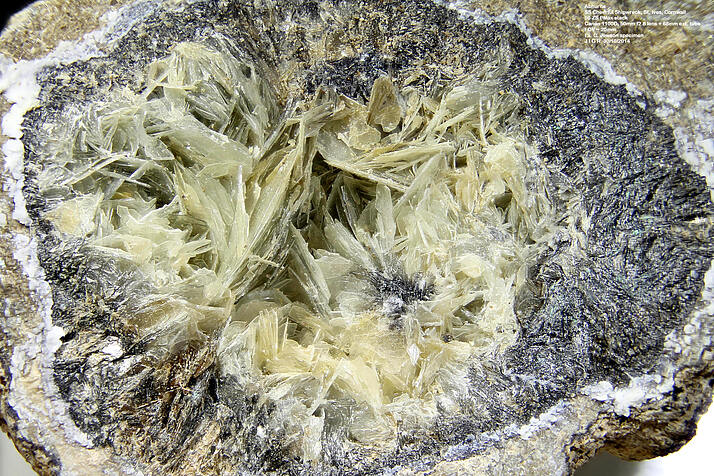
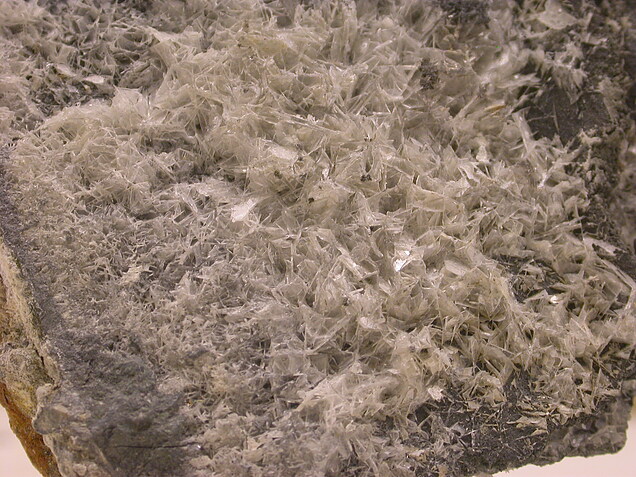
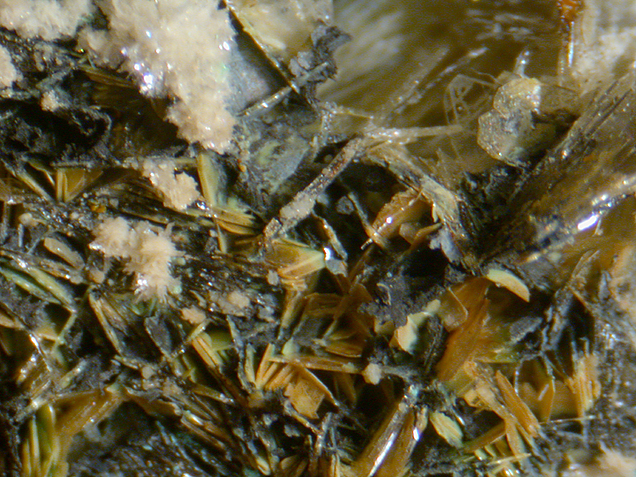
About Abhurite

Abhur Bay
Formula:
Sn21Cl16(OH)14O6
Colour:
Colourless
Hardness:
2
Specific Gravity:
4.42
Crystal System:
Trigonal
Name:
Named as a new mineral by Matzko et al. (1985), after its discovery locality, in the Sharm Abhur Cove, Jiddah (Jeddah), Red Sea, Mintaqat Makkah, Saudi Arabia. However, the mineral was first described by Griffin et al. (1977) as a new basic tin chloride found on pewter plates from a shipwreck off Hidra island, Norway. It was published, but not formally admitted to the IMA.
A tin hydroxychloride mineral.
This mineral is formed from the reaction of pure tin with sea water, and has exclusively been associated with tin ingots from shipwrecks. If discovered today it would be unlikely this would be accepted as a true mineral.
This mineral is formed from the reaction of pure tin with sea water, and has exclusively been associated with tin ingots from shipwrecks. If discovered today it would be unlikely this would be accepted as a true mineral.
Unique Identifiers
Mindat ID:
4
Long-form identifier:
mindat:1:1:4:2
IMA Classification of Abhurite
Approved
IMA Formula:
Sn2+21O6(OH)14Cl16
Approval year:
1983
First published:
1977
Classification of Abhurite
3.DA.30
3 : HALIDES
D : Oxyhalides, hydroxyhalides and related double halides
A : With Cu, etc., without Pb
3 : HALIDES
D : Oxyhalides, hydroxyhalides and related double halides
A : With Cu, etc., without Pb
10.5.9.1
10 : OXYHALIDES AND HYDROXYHALIDES
5 : Am(O,OH)pXq
10 : OXYHALIDES AND HYDROXYHALIDES
5 : Am(O,OH)pXq
8.8.1
8 : Halides - Fluorides, Chlorides, Bromides and Iodides; also Fluoborates and Fluosilicates
8 : Halides of Pb
8 : Halides - Fluorides, Chlorides, Bromides and Iodides; also Fluoborates and Fluosilicates
8 : Halides of Pb
Mineral Symbols
As of 2021 there are now IMA–CNMNC approved mineral symbols (abbreviations) for each mineral species, useful for tables and diagrams.
| Symbol | Source | Reference |
|---|---|---|
| Abh | IMA–CNMNC | Warr, L.N. (2021). IMA–CNMNC approved mineral symbols. Mineralogical Magazine, 85(3), 291-320. doi:10.1180/mgm.2021.43 |
Physical Properties of Abhurite
Transparency:
Transparent
Comment:
opalescent
Colour:
Colourless
Streak:
White
Hardness:
2 on Mohs scale
Hardness Data:
Measured
Tenacity:
Fragile
Cleavage:
None Observed
Fracture:
Hackly
Density:
4.42 g/cm3 (Measured) 4.417 g/cm3 (Calculated)
Optical Data of Abhurite
Type:
Uniaxial (+)
RI values:
nω = 2.06 nε = 2.11
Max. Birefringence:
δ = 0.050
Based on recorded range of RI values above.
Based on recorded range of RI values above.
Interference Colours:
The colours simulate birefringence patterns seen in thin section under crossed polars. They do not take into account mineral colouration or opacity.
Michel-Levy Bar The default colours simulate the birefringence range for a 30 µm thin-section thickness. Adjust the slider to simulate a different thickness.
Grain Simulation You can rotate the grain simulation to show how this range might look as you rotated a sample under crossed polars.
The colours simulate birefringence patterns seen in thin section under crossed polars. They do not take into account mineral colouration or opacity.
Michel-Levy Bar The default colours simulate the birefringence range for a 30 µm thin-section thickness. Adjust the slider to simulate a different thickness.
Grain Simulation You can rotate the grain simulation to show how this range might look as you rotated a sample under crossed polars.
Surface Relief:
Moderate
Chemistry of Abhurite
Mindat Formula:
Sn21Cl16(OH)14O6
Element Weights:
Elements listed:
Chemical Analysis
wt%
| 1 | 2 | |
|---|---|---|
| Sn | 74.6 % | 73.4 % |
| Cl | 14.9 % | 15.7 % |
| O | 10.1 % | 11.0 % |
| H | 0.4 % | 0.4 % |
| Total: | 100 % | 100.5 % |
Sample references:
| ID | Type | Locality | Reference | Notes |
|---|---|---|---|---|
| 1 | Theoretical | Sharm Abhur Cove, Jiddah, Mecca Region, Saudi Arabia | ||
| 2 | Type Specimen | " " | Sn content measured by wet chemical analysis, Cl content with an ion-selective electrode, H content with a CHN analyzer, O content by neutron activation analysis. |
Crystallography of Abhurite
Crystal System:
Trigonal
Class (H-M):
3 2 - Trapezohedral
Space Group:
R3 2
Cell Parameters:
a = 10.0175 Å, c = 44.014 Å
Ratio:
a:c = 1 : 4.394
Unit Cell V:
3,825.08 ų (Calculated from Unit Cell)
Z:
3
Morphology:
Thin, six-sided crystals, platy to tabular on (0001), showing {0115} and {0001}. As cryptocrystalline crusts.
Twinning:
on {0001}
Comment:
Space group from synthetic material (Von Schnering et al., 1981).
Crystal Structure
Load
Unit Cell | Unit Cell Packed
2x2x2 | 3x3x3 | 4x4x4
Unit Cell | Unit Cell Packed
2x2x2 | 3x3x3 | 4x4x4
Show
Big Balls | Small Balls | Just Balls | Spacefill
Polyhedra Off | Si Polyhedra | All Polyhedra
Remove metal-metal sticks
Big Balls | Small Balls | Just Balls | Spacefill
Polyhedra Off | Si Polyhedra | All Polyhedra
Remove metal-metal sticks
Display Options
Black Background | White Background
Perspective On | Perspective Off
2D | Stereo | Red-Blue | Red-Cyan
Black Background | White Background
Perspective On | Perspective Off
2D | Stereo | Red-Blue | Red-Cyan
View
CIF File Best | x | y | z | a | b | c
CIF File Best | x | y | z | a | b | c
Rotation
Stop | Start
Stop | Start
Labels
Console Off | On | Grey | Yellow
Console Off | On | Grey | Yellow
Data courtesy of the American Mineralogist Crystal Structure Database. Click on an AMCSD ID to view structure
| ID | Species | Reference | Link | Year | Locality | Pressure (GPa) | Temp (K) |
|---|---|---|---|---|---|---|---|
| 0015835 | Abhurite | Schnering H G, Nesper R, Pelshenke H (1981) Sn21Cl16(OH)14O6, das sogenannte basische zinn(II)-clorid Zeitschrift fur Naturforschung B36 1551-1560 | 1981 | synthetic | 0 | 293 |
CIF Raw Data - click here to close
X-Ray Powder Diffraction
Powder Diffraction Data:
| d-spacing | Intensity |
|---|---|
| 2.5313 Å | (100) |
| 2.8175 Å | (50) |
| 2.8915 Å | (70) |
| 3.244 Å | (35) |
| 3.271 Å | (35) |
| 3.404 Å | (50) |
| 4.139 Å | (50) |
Reference:
Comments:
Recorded on type material
Geological Environment
Paragenetic Mode(s):
| Paragenetic Mode | Earliest Age (Ga) |
|---|---|
| Stage 7: Great Oxidation Event | <2.4 |
| 47a : [Near-surface hydration of prior minerals] | |
| 47g : [Halogen-bearing surface weathering minerals] | |
| 47h : [Near-surface oxidized, dehydrated minerals] | |
| Stage 10b: Anthropogenic minerals | <10 Ka |
| 57 : Other minerals formed by human processes |
Geological Setting:
On tin ingots corroded by sea-water
Type Occurrence of Abhurite
General Appearance of Type Material:
Blister-like protuberances.
Place of Conservation of Type Material:
Royal Ontario Museum, Toronto, Canada
National Museum of National History, Washington, DC, USA
National Museum of National History, Washington, DC, USA
Geological Setting of Type Material:
On the surface of a tin ingot recovered from a ship wrecked possibly 100 years ago.
Associated Minerals at Type Locality:
Synonyms of Abhurite
Other Language Names for Abhurite
Common Associates
Associated Minerals Based on Photo Data:
| 1 photo of Abhurite associated with Atacamite Group |
Related Minerals - Strunz-mindat Grouping
| 3.DA. | Parahibbingite | Fe2(OH)3Cl |
| 3.DA. | Centennialite | CaCu3Cl2(OH)6 · nH2O (n ~ 0.7) |
| 3.DA. | Bounahasite | Cu+Cu2+2(OH)3Cl2 |
| 3.DA. | Muonionalustaite | Ni3(OH)4Cl2 · 4H2O |
| 3.DA.05 | Melanothallite | Cu2Cl2O |
| 3.DA.10c | Haydeeite | Cu3Mg(OH)6Cl2 |
| 3.DA.10b | Clinoatacamite | Cu2(OH)3Cl |
| 3.DA.10c | Paratacamite | Cu3(Cu,Zn)(OH)6Cl2 |
| 3.DA.10c | Kapellasite | Cu3Zn(OH)6Cl2 |
| 3.DA.10c | Leverettite | Cu3Co(OH)6Cl2 |
| 3.DA.10a | Hibbingite | Fe2+2(OH)3Cl |
| 3.DA.10c | Paratacamite-(Ni) | Cu3(Ni,Cu)(OH)6Cl2 |
| 3.DA.10a | Kempite | Mn2+2(OH)3Cl |
| 3.DA.10c | Tondiite | Cu3Mg(OH)6Cl2 |
| 3.DA.10a | Atacamite | Cu2(OH)3Cl |
| 3.DA.10b | Belloite | Cu(OH)Cl |
| 3.DA.10c | Misakiite | Cu3Mn(OH)6Cl2 |
| 3.DA.10b | Iyoite | MnCuCl(OH)3 |
| 3.DA.10c | Kuliginite | Fe3Mg(OH)6Cl2 |
| 3.DA.10c | Gillardite | Cu3Ni(OH)6Cl2 |
| 3.DA.10b | Unnamed (Cu-Zn Chloride Hydroxide) | CuZnCl(OH)3 |
| 3.DA.10b | Botallackite | Cu2(OH)3Cl |
| 3.DA.10c | Herbertsmithite | Cu3Zn(OH)6Cl2 |
| 3.DA.15 | Claringbullite | Cu4ClF(OH)6 |
| 3.DA.15 | Barlowite | Cu4BrF(OH)6 |
| 3.DA.20 | Simonkolleite | Zn5Cl2(OH)8 · H2O |
| 3.DA.25 | Buttgenbachite | Cu19(NO3)2(OH)32Cl4 · 2H2O |
| 3.DA.25 | Connellite | Cu19(SO4)(OH)32Cl4 · 3H2O |
| 3.DA.35 | Ponomarevite | K4Cu4Cl10O |
| 3.DA.40 | Calumetite | CaCu4(OH)8Cl2 · 3.5H2O |
| 3.DA.40 | Anthonyite | Cu(OH,Cl)2 · 3H2O |
| 3.DA.45 | Khaidarkanite | Cu4Al3(OH)14F3 · 2H2O |
| 3.DA.50 | Bobkingite | Cu5Cl2(OH)8 · 2H2O |
| 3.DA.55 | Avdoninite | K2Cu5(OH)4Cl8 · H2O |
| 3.DA.60 | Droninoite | Ni6Fe3+2(OH)16Cl2 · 4H2O |
| 3.DA.70 | Chrysothallite | K6Cu6Tl3+Cl17(OH)4 · H2O |
| 3.DA.70 | Dioskouriite | CaCu4Cl6(OH)4 · 4H2O |
| 3.DA.75 | Feodosiyite | Cu11Mg2Cl18(OH)8 · 16H2O |
| 3.DA.80 | Romanorlovite | K8Cu6Cl17(OH)3 |
Other Information
Health Risks:
No information on health risks for this material has been entered into the database. You should always treat mineral specimens with care.
Industrial Uses:
none
Internet Links for Abhurite
mindat.org URL:
https://www.mindat.org/min-4.html
Please feel free to link to this page.
Please feel free to link to this page.
Search Engines:
External Links:
References for Abhurite
Reference List:
Schnering, Hans Georg von, Nesper, Reinhard, Pelshenke, Hermann (1981) Sn21Cl16(OH)14O6, das sogenannte basische Zinn(II)-chlorid [1] / Sn21Cl16(OH)14O6, the So-called Basic Tin(II) Chloride. Zeitschrift für Naturforschung B, 36. 1551-1560 doi:10.1515/znb-1981-1214
Matzko, John J.; Evans, Howard T. Jr.; Mrose, Mary E.; Aruscavage, Philip (1985) Abhurite, a new tin hydroxychloride mineral, and a comparative study with basic tin chloride. The Canadian Mineralogist, 23 (2). 233-240
Edwards, R., Gillard, R. D., Williams, P. A. (1992) The stabilities of secondary tin minerals: abhurite and its relationships to Sn(II) and Sn(IV) oxides and oxyhydroxides. Mineralogical Magazine, 56 (383) 221-226 doi:10.1180/minmag.1992.056.383.08
Localities for Abhurite
 symbol to view information about a locality.
The
symbol to view information about a locality.
The Locality List
 - This locality has map coordinates listed.
- This locality has estimated coordinates.
ⓘ - Click for references and further information on this occurrence.
? - Indicates mineral may be doubtful at this locality.
- This locality has map coordinates listed.
- This locality has estimated coordinates.
ⓘ - Click for references and further information on this occurrence.
? - Indicates mineral may be doubtful at this locality.
 - Good crystals or important locality for species.
 - World class for species or very significant.
(TL) - Type Locality for a valid mineral species.
(FRL) - First Recorded Locality for everything else (eg varieties).
- World class for species or very significant.
(TL) - Type Locality for a valid mineral species.
(FRL) - First Recorded Locality for everything else (eg varieties).
All localities listed without proper references should be considered as questionable.
Indonesia | |
| MacLeod et al. (2001) |
Jamaica | |
| Dunkle (2002) |
Norway | |
| W. L. Griffin et al. (1977) +1 other reference |
Saudi Arabia (TL) | |
| Matzko et al. (1985) |
UK | |
| Golley et al. (1995) |
| National Museum of Wales collection |
USA | |
| Dunkle (2002) |
| Dunkle (2002) +1 other reference |
Quick NavTopAbout AbhuriteUnique IdentifiersIMA Classification Classification Mineral SymbolsPhysical Properties Optical Data Chemistry Chemical AnalysisCrystallography Crystal StructureX-Ray Powder DiffractionGeological EnvironmentType Occurrence SynonymsOther LanguagesCommon AssociatesStrunz-MindatOther InformationInternet Links References Localities Locality List
SS Cheerful wreck site, Cornwall, England, UK