Barahonaite-(Al)
A valid IMA mineral species
This page is currently not sponsored. Click here to sponsor this page.
About Barahonaite-(Al)
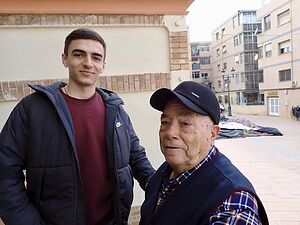
Antonio Barahona (right) and his grandson.
Formula:
(Ca,Cu,Na,Fe3+,Al)12Al2(AsO4)8(OH,Cl)x · nH2O
Colour:
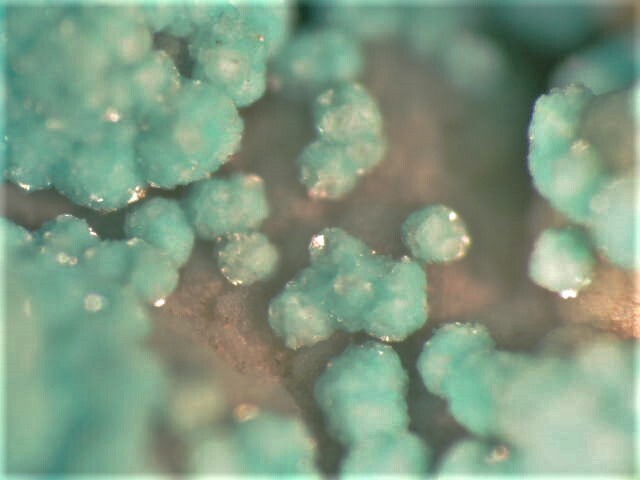
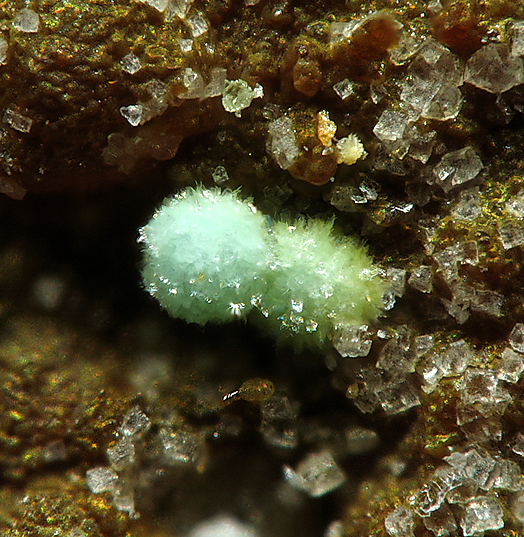
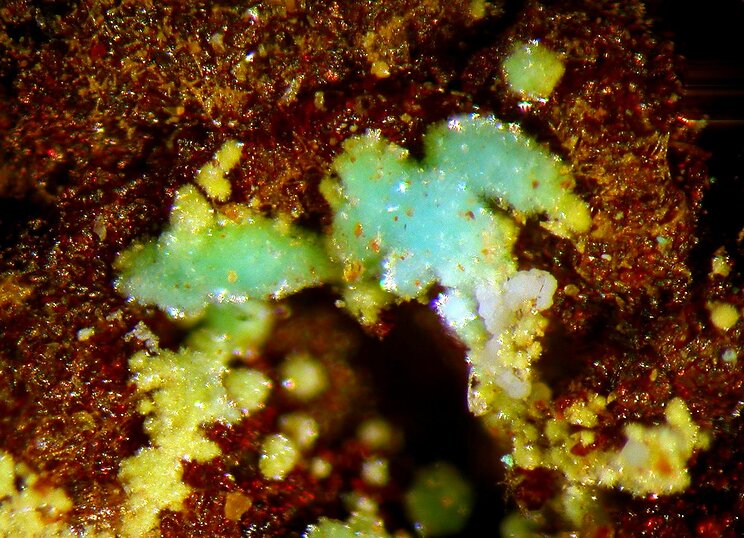
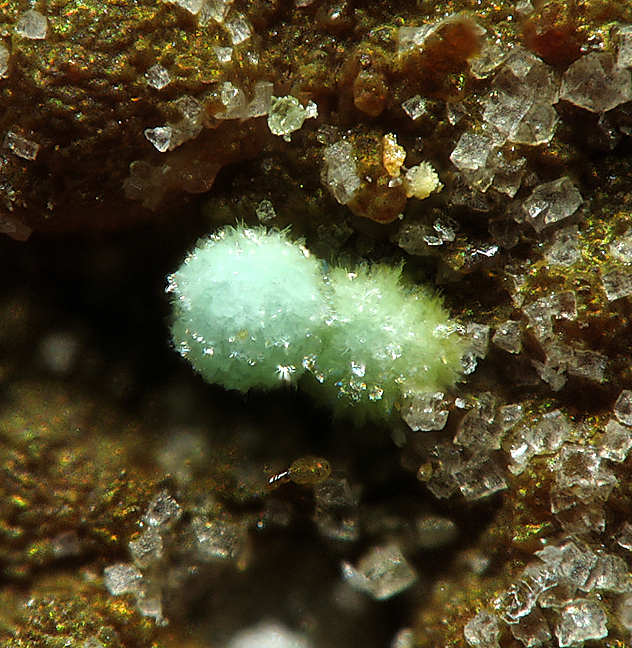
Pale blue
Lustre:
Vitreous
Specific Gravity:
3.03
Crystal System:
Monoclinic
Name:
Named for Antonio Barahona (1937- ), Spanish mineral collector and micromounter, who first noticed that this material might be a new mineral.
Type Locality:
Smolianinovite group (?).
The Al analogue of barahonaite-(Fe).
May appear visually similar to attikaite.
The Al analogue of barahonaite-(Fe).
May appear visually similar to attikaite.
Unique Identifiers
Mindat ID:
31728
Long-form identifier:
mindat:1:1:31728:9
IMA Classification of Barahonaite-(Al)
Classification of Barahonaite-(Al)
8.CH.60
8 : PHOSPHATES, ARSENATES, VANADATES
C : Phosphates without additional anions, with H2O
H : With large and medium-sized cations, RO4:H2O < 1:1
8 : PHOSPHATES, ARSENATES, VANADATES
C : Phosphates without additional anions, with H2O
H : With large and medium-sized cations, RO4:H2O < 1:1
40.6.4.1
40 : HYDRATED NORMAL PHOSPHATES,ARSENATES AND VANADATES
6 : (AB)5(XO4)4·xH2O
40 : HYDRATED NORMAL PHOSPHATES,ARSENATES AND VANADATES
6 : (AB)5(XO4)4·xH2O
Mineral Symbols
As of 2021 there are now IMA–CNMNC approved mineral symbols (abbreviations) for each mineral species, useful for tables and diagrams.
| Symbol | Source | Reference |
|---|---|---|
| Bho-Al | IMA–CNMNC | Warr, L.N. (2021). IMA–CNMNC approved mineral symbols. Mineralogical Magazine, 85(3), 291-320. doi:10.1180/mgm.2021.43 |
Physical Properties of Barahonaite-(Al)
Vitreous
Transparency:
Transparent, Translucent
Colour:
Pale blue
Streak:
White
Hardness Data:
Could not be measured
Comment:
Not determinable, crusts are easily scratched with a fingernail, likely due to disaggregation rather than true hardness.
Tenacity:
Brittle
Density:
3.03 g/cm3 (Measured) 2.98(9) g/cm3 (Calculated)
Comment:
Calculated value depends on the value of H2O that is used.
Optical Data of Barahonaite-(Al)
Type:
Biaxial (-)
RI values:
nα = 1.616(2) nγ = 1.622(2)
Max. Birefringence:
δ = 0.006
Based on recorded range of RI values above.
Based on recorded range of RI values above.
Interference Colours:
The colours simulate birefringence patterns seen in thin section under crossed polars. They do not take into account mineral colouration or opacity.
Michel-Levy Bar The default colours simulate the birefringence range for a 30 µm thin-section thickness. Adjust the slider to simulate a different thickness.
Grain Simulation You can rotate the grain simulation to show how this range might look as you rotated a sample under crossed polars.
The colours simulate birefringence patterns seen in thin section under crossed polars. They do not take into account mineral colouration or opacity.
Michel-Levy Bar The default colours simulate the birefringence range for a 30 µm thin-section thickness. Adjust the slider to simulate a different thickness.
Grain Simulation You can rotate the grain simulation to show how this range might look as you rotated a sample under crossed polars.
Surface Relief:
Moderate
Comments:
Interference color is grey to yellow.
Presumed to be biaxial (–), analogous to the optic sign
for barahonaite-(Fe).
β was not determined.
Presumed to be biaxial (–), analogous to the optic sign
for barahonaite-(Fe).
β was not determined.
Chemistry of Barahonaite-(Al)
Mindat Formula:
(Ca,Cu,Na,Fe3+,Al)12Al2(AsO4)8(OH,Cl)x · nH2O
Crystallography of Barahonaite-(Al)
Crystal System:
Monoclinic
Class (H-M):
2/m - Prismatic
Space Group:
P2/b
Cell Parameters:
a = 9.972 Å, b = 22.44 Å, c = 5.272 Å
β = 92.9°
β = 92.9°
Ratio:
a:b:c = 0.444 : 1 : 0.235
Unit Cell V:
1,178.21 ų (Calculated from Unit Cell)
Morphology:
Plates, commonly curved, with a maximum size of ~50 µm in diameter and thickness <1 µm.
X-Ray Powder Diffraction
Powder Diffraction Data:
| d-spacing | Intensity |
|---|---|
| 22.0 Å | (100) |
| 11.16 Å | (70) |
| 4.983 Å | (50) |
| 3.655 Å | (25) |
| 3.333 Å | (45) |
| 3.003 Å | (30) |
| 2.767 Å | (30) |
Geological Environment
Paragenetic Mode(s):
| Paragenetic Mode | Earliest Age (Ga) |
|---|---|
| Stage 7: Great Oxidation Event | <2.4 |
| 47a : [Near-surface hydration of prior minerals] | |
| 47d : [Arsenates, antimonates, selenates, bismuthinates] | |
| 47g : [Halogen-bearing surface weathering minerals] |
Type Occurrence of Barahonaite-(Al)
General Appearance of Type Material:
Beads, coalesced beads, and crusts of submillimetric thickness whose surfaces commonly glisten because of the presence of plates, up to 50 µm in diameter (Utah), and razor-thin, tabular, composite crystals, up to 20 µm long (Spain). The crystal units are somewhat divergent, and the texture varies from rosette to boxwork-like.
Place of Conservation of Type Material:
Canadian Museum of Nature at Ottawa, Ontario, Canada, number CMNMC 85719.
Geological Setting of Type Material:
An oxidation mineral occurring as coatings and within closely spaced fractures in weathered siliceous and micaceous host-rocks.
Associated Minerals at Type Locality:
Synonyms of Barahonaite-(Al)
Other Language Names for Barahonaite-(Al)
Common Associates
Associated Minerals Based on Photo Data:
| 6 photos of Barahonaite-(Al) associated with Conichalcite | CaCu(AsO4)(OH) |
| 5 photos of Barahonaite-(Al) associated with Alumolukrahnite | Ca[CuAl](AsO4)2(H2O,OH)2 |
| 5 photos of Barahonaite-(Al) associated with Barahonaite-(Fe) | (Ca,Cu,Na,Fe3+,Al)12Fe3+2(AsO4)8(OH,Cl)x · nH2O |
| 3 photos of Barahonaite-(Al) associated with Allophane | (Al2O3)(SiO2)1.3-2 · 2.5-3H2O |
| 1 photo of Barahonaite-(Al) associated with Olivenite | Cu2(AsO4)(OH) |
| 1 photo of Barahonaite-(Al) associated with Arsenocrandallite | CaAl3(AsO4)(AsO3OH)(OH)6 |
| 1 photo of Barahonaite-(Al) associated with Coronadite | Pb(Mn4+6Mn3+2)O16 |
| 1 photo of Barahonaite-(Al) associated with Arsenogoyazite | SrAl3(AsO4)(AsO3OH)(OH)6 |
| 1 photo of Barahonaite-(Al) associated with Cobaltarthurite | CoFe3+2(AsO4)2(OH)2 · 4H2O |
| 1 photo of Barahonaite-(Al) associated with Goethite | Fe3+O(OH) |
Related Minerals - Strunz-mindat Grouping
| 8.CH.05 | Natrowalentaite | [Fe3+0.5Na0.5(H2O)6][NaAs3+2(Fe3+2.33W6+0.67)(PO4)2O7] |
| 8.CH.05 | Walentaite | Fe3+3(P0.84As0.16O4)2(O,OH)6As3+2.56Ca0.42Na0.28Mn2+0.35Fe2+0.30O6.1(OH)0.9(H2O)0.9 |
| 8.CH.05 | Halilsarpite | [Mg(H2O)6][CaAs3+2(Fe3+2.67Mo6+0.33)(AsO4)2O7] |
| 8.CH.10 | Anapaite | Ca2Fe2+(PO4)2 · 4H2O |
| 8.CH.15 | Picropharmacolite | Ca4Mg(AsO4)2(HAsO4)2 · 11H2O |
| 8.CH.20 | Dittmarite | (NH4)Mg(PO4) · H2O |
| 8.CH.20 | Niahite | (NH4)Mn2+(PO4) · H2O |
| 8.CH.25 | Taranakite | K3Al5(PO3OH)6(PO4)2 · 18H2O |
| 8.CH.25 | Francoanellite | K3Al5(PO3OH)6(PO4)2 · 12H2O |
| 8.CH.25 | Macivorite | (NH4)3Al5(PO3OH)6(PO4)2 · 18H2O |
| 8.CH.30 | Schertelite | (NH4)2MgH2(PO4)2 · 4H2O |
| 8.CH.35 | Hannayite | (NH4)2Mg3H4(PO4)4 · 8H2O |
| 8.CH.40 | Hazenite | KNaMg2(PO4)2 · 14H2O |
| 8.CH.40 | Struvite-(K) | KMg(PO4) · 6H2O |
| 8.CH.40 | Struvite | (NH4)Mg(PO4) · 6H2O |
| 8.CH.45 | Rimkorolgite | (Mg,Mn)5(Ba,Sr,Ca)(PO4)4 · 8H2O |
| 8.CH.50 | Bakhchisaraitsevite | Na2Mg5(PO4)4 · 7H2O |
| 8.CH.55 | Smolyaninovite | Co3Fe3+2(AsO4)4 · 11H2O |
| 8.CH.55 | Fahleite | CaZn5Fe3+2(AsO4)6 · 14H2O |
| 8.CH.60 | Barahonaite-(Fe) | (Ca,Cu,Na,Fe3+,Al)12Fe3+2(AsO4)8(OH,Cl)x · nH2O |
| 8.CH.70 | Epifanovite | NaCaCu5(PO4)4[AsO2(OH)2] · 7H2O |
| 8.CH.75 | Esdanaite-(Ce) | NaMnCe(PO4)2 · 4H2O |
Fluorescence of Barahonaite-(Al)
Not fluorescent.
Other Information
Notes:
Readily soluble without effervescence in 10% HCl at room temperature.
Health Risks:
No information on health risks for this material has been entered into the database. You should always treat mineral specimens with care.
Internet Links for Barahonaite-(Al)
mindat.org URL:
https://www.mindat.org/min-31728.html
Please feel free to link to this page.
Please feel free to link to this page.
Search Engines:
External Links:
References for Barahonaite-(Al)
Reference List:
Viñals, J., Jambor, J. L., Raudsepp, M., Roberts, A. C., Grice, J. D., Kokinos, M., Wise, W. S. (2008) Barahonaite-(Al) and barahonaite-(Fe), new Ca-Cu arsenate mineral species, from Murcia Province, southeastern Spain, and Gold Hill, Utah. The Canadian Mineralogist, 46 (1) 205-217 doi:10.3749/canmin.46.1.205
Localities for Barahonaite-(Al)
 symbol to view information about a locality.
The
symbol to view information about a locality.
The Locality List
 - This locality has map coordinates listed.
- This locality has estimated coordinates.
ⓘ - Click for references and further information on this occurrence.
? - Indicates mineral may be doubtful at this locality.
- This locality has map coordinates listed.
- This locality has estimated coordinates.
ⓘ - Click for references and further information on this occurrence.
? - Indicates mineral may be doubtful at this locality.
 - Good crystals or important locality for species.
 - World class for species or very significant.
(TL) - Type Locality for a valid mineral species.
(FRL) - First Recorded Locality for everything else (eg varieties).
- World class for species or very significant.
(TL) - Type Locality for a valid mineral species.
(FRL) - First Recorded Locality for everything else (eg varieties).
All localities listed without proper references should be considered as questionable.
Chile | |
| www.mindat.org (n.d.) |
| According to Dr. Tony Kampf +1 other reference | |
Greece | |
| Kolitsch et al. (2014) |
Spain (TL) | |
| Viñals et al. (2008) |
USA | |
| Viñals et al. (2008) |
| Thorne (n.d.) +1 other reference |
Quick NavTopAbout Barahonaite-(Al)Unique IdentifiersIMA Classification Classification Mineral SymbolsPhysical Properties Optical Data Chemistry Crystallography X-Ray Powder DiffractionGeological EnvironmentType Occurrence SynonymsOther LanguagesCommon AssociatesStrunz-MindatFluorescence Other InformationInternet Links References Localities Locality List
Gold Hill Mine, Gold Hill, Gold Hill Mining District, Tooele County, Utah, USA