Parkinsonite
A valid IMA mineral species
This page is currently not sponsored. Click here to sponsor this page.

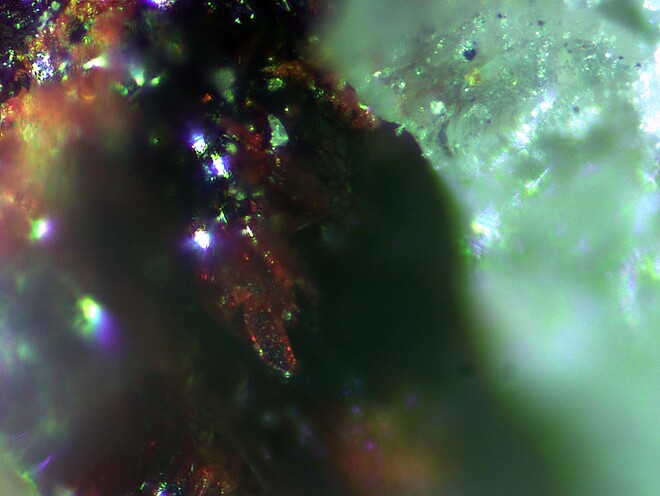
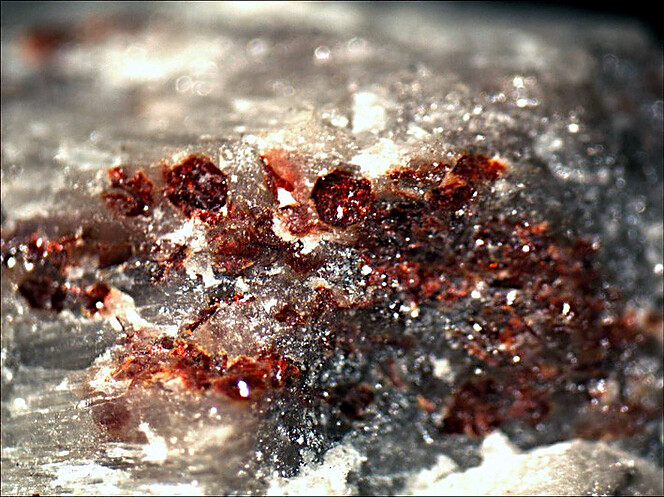


About Parkinsonite
Formula:
Pb7MoO9Cl2
Colour:
Bright red, purplish red, brownish red
Lustre:
Adamantine, Resinous, Pearly
Hardness:
2 - 2½
Specific Gravity:
7.32
Crystal System:
Tetragonal
Name:
For British mineral collector and dealer, Reginald F.D. Parkinson (20 May 1928, Battersea, Wandsworth - 13 March 1993, Bristol), who found the mineral.
Unique Identifiers
Mindat ID:
3123
Long-form identifier:
mindat:1:1:3123:9
IMA Classification of Parkinsonite
Approved
IMA Formula:
Pb7MoO9Cl2
Approval year:
1991
First published:
1994
Classification of Parkinsonite
3.DB.40
3 : HALIDES
D : Oxyhalides, hydroxyhalides and related double halides
B : With Pb, Cu, etc.
3 : HALIDES
D : Oxyhalides, hydroxyhalides and related double halides
B : With Pb, Cu, etc.
10.5.11.1
10 : OXYHALIDES AND HYDROXYHALIDES
5 : Am(O,OH)pXq
10 : OXYHALIDES AND HYDROXYHALIDES
5 : Am(O,OH)pXq
Mineral Symbols
As of 2021 there are now IMA–CNMNC approved mineral symbols (abbreviations) for each mineral species, useful for tables and diagrams.
| Symbol | Source | Reference |
|---|---|---|
| Pkn | IMA–CNMNC | Warr, L.N. (2021). IMA–CNMNC approved mineral symbols. Mineralogical Magazine, 85(3), 291-320. doi:10.1180/mgm.2021.43 |
Pronunciation of Parkinsonite
Pronunciation:
| Play | Recorded by | Country |
|---|---|---|
| Jolyon Ralph | United Kingdom |
Physical Properties of Parkinsonite
Adamantine, Resinous, Pearly
Transparency:
Translucent
Colour:
Bright red, purplish red, brownish red
Streak:
Scarlet to grenadine-red
Hardness:
2 - 2½ on Mohs scale
Hardness:
VHN50=122 kg/mm2 - Vickers
Tenacity:
Sectile
Cleavage:
Perfect
{001}, perfect; {100}, possible, fair
{001}, perfect; {100}, possible, fair
Density:
7.32 g/cm3 (Measured) 7.39 g/cm3 (Calculated)
Optical Data of Parkinsonite
Type:
Uniaxial (-)
RI values:
nω = 2.58 nε = 2.42
Max. Birefringence:
δ = 0.160
Based on recorded range of RI values above.
Based on recorded range of RI values above.
Interference Colours:
The colours simulate birefringence patterns seen in thin section under crossed polars. They do not take into account mineral colouration or opacity.
Michel-Levy Bar The default colours simulate the birefringence range for a 30 µm thin-section thickness. Adjust the slider to simulate a different thickness.
Grain Simulation You can rotate the grain simulation to show how this range might look as you rotated a sample under crossed polars.
The colours simulate birefringence patterns seen in thin section under crossed polars. They do not take into account mineral colouration or opacity.
Michel-Levy Bar The default colours simulate the birefringence range for a 30 µm thin-section thickness. Adjust the slider to simulate a different thickness.
Grain Simulation You can rotate the grain simulation to show how this range might look as you rotated a sample under crossed polars.
Surface Relief:
Moderate
Anisotropism:
Weak to moderate
Bireflectance:
Moderate
Colour in reflected light:
gray
Internal Reflections:
deep red to red-orange
Pleochroism:
Strong
Comments:
O = brownish red; E = greenish yellow
Chemistry of Parkinsonite
Mindat Formula:
Pb7MoO9Cl2
Element Weights:
Elements listed:
Crystallography of Parkinsonite
Crystal System:
Tetragonal
Cell Parameters:
a = 3.9992(3) Å, c = 22.514(3) Å
Ratio:
a:c = 1 : 5.63
Unit Cell V:
360.08 ų (Calculated from Unit Cell)
Z:
2
Comment:
Point Group: 4/m 2/m 2/m, 42m, 4mm, or 422; Space Group: I4/mmm, I42m, I4m2, I4mm, or I422.
X-Ray Powder Diffraction
Powder Diffraction Data:
| d-spacing | Intensity |
|---|---|
| 2.983 Å | (100) |
| 2.816 Å | (78) |
| 1.989 Å | (75) |
| 1.658 Å | (51) |
| 1.586 Å | (33) |
| 3.507 Å | (32) |
| 1.263 Å | (24) |
Geological Environment
Paragenetic Mode(s):
| Paragenetic Mode | Earliest Age (Ga) |
|---|---|
| Stage 7: Great Oxidation Event | <2.4 |
| 47g : [Halogen-bearing surface weathering minerals] | |
| 47h : [Near-surface oxidized, dehydrated minerals] |
Type Occurrence of Parkinsonite
Co-Type Localities:
General Appearance of Type Material:
As bladed crystals, to 0.3 mm, and crystalline aggregates
Place of Conservation of Type Material:
The Natural History Museum, London, England, 1987,478–479.
Associated Minerals at Type Locality:
Synonyms of Parkinsonite
Other Language Names for Parkinsonite
Common Associates
Associated Minerals Based on Photo Data:
| 15 photos of Parkinsonite associated with Mendipite | Pb3Cl2O2 |
| 6 photos of Parkinsonite associated with Chloroxiphite | Pb3CuO2Cl2(OH)2 |
| 6 photos of Parkinsonite associated with Mereheadite | Pb47Cl25(OH)13O24(CO3)(BO3)2 |
| 4 photos of Parkinsonite associated with Lead-bearing Aragonite | (Ca,Pb)CO3 |
| 3 photos of Parkinsonite associated with Diaboleite | Pb2CuCl2(OH)4 |
| 3 photos of Parkinsonite associated with Calcite | CaCO3 |
| 3 photos of Parkinsonite associated with Manganese Oxides | |
| 2 photos of Parkinsonite associated with Paralaurionite | PbCl(OH) |
Related Minerals - Strunz-mindat Grouping
| 3.DB. | Rickturnerite | Pb7O4[Mg(OH)4](OH)Cl3 |
| 3.DB.05 | Diaboleite | Pb2CuCl2(OH)4 |
| 3.DB.10 | Pseudoboleite | Pb31Cu24Cl62(OH)48 |
| 3.DB.15 | Boleite | KPb26Ag9Cu24(OH)48Cl62 |
| 3.DB.20 | Cumengeite | Pb21Cu20Cl42(OH)40 · 6H2O |
| 3.DB.25 | Bideauxite | Pb2AgCl3(F,OH)2 |
| 3.DB.30 | Chloroxiphite | Pb3CuO2Cl2(OH)2 |
| 3.DB.35 | Hematophanite | Pb4Fe3O8(OH,Cl) |
| 3.DB.40 | Janchevite | Pb9V5+(O10.25◻0.75)Cl2.5 |
| 3.DB.40 | Asisite | Pb7SiO9Cl2 |
| 3.DB.45 | Eddavidite | Cu12Pb2O15Br2 |
| 3.DB.45 | Murdochite | Cu12Pb2O15Cl2 |
| 3.DB.50 | Yedlinite | Pb6Cr3+Cl6(O,OH,H2O)8 |
| 3.DB.55 | Siidraite | Pb2Cu(OH)2I3 |
Other Information
Health Risks:
No information on health risks for this material has been entered into the database. You should always treat mineral specimens with care.
Internet Links for Parkinsonite
mindat.org URL:
https://www.mindat.org/min-3123.html
Please feel free to link to this page.
Please feel free to link to this page.
Search Engines:
External Links:
References for Parkinsonite
Reference List:
Symes, R. F., Cressey, G., Griddle, A. J., Stanley, C. J., Francis, J. G., Jones, G. C. (1994) Parkinsonite, (Pb,Mo,□)8O8Cl2, a new mineral from Merehead Quarry, Somerset. Mineralogical Magazine, 58 (390) 59-68 doi:10.1180/minmag.1994.058.390.06
Jambor, John L., Roberts, Andrew C., Vanko, David A. (1994) New Mineral Names. American Mineralogist, 79 (9-10) 1009-1014
Symes, R. F., Cressey, G., Griddle, A. J., Stanley, C. J., Francis, J. G., Jones, G. C. (1994) Parkinsonite, (Pb,Mo,□)8O8Cl2, a new mineral from Merehead Quarry, Somerset. Mineralogical Magazine, 58 (390) 59-68 doi:10.1180/minmag.1994.058.390.06
Localities for Parkinsonite
 symbol to view information about a locality.
The
symbol to view information about a locality.
The Locality List
 - This locality has map coordinates listed.
- This locality has estimated coordinates.
ⓘ - Click for references and further information on this occurrence.
? - Indicates mineral may be doubtful at this locality.
- This locality has map coordinates listed.
- This locality has estimated coordinates.
ⓘ - Click for references and further information on this occurrence.
? - Indicates mineral may be doubtful at this locality.
 - Good crystals or important locality for species.
 - World class for species or very significant.
(TL) - Type Locality for a valid mineral species.
(FRL) - First Recorded Locality for everything else (eg varieties).
- World class for species or very significant.
(TL) - Type Locality for a valid mineral species.
(FRL) - First Recorded Locality for everything else (eg varieties).
All localities listed without proper references should be considered as questionable.
Namibia | |
| Belendorff (2006) +1 other reference |
UK (TL) | |
| Symes et al. (1994) +2 other references |
| Mineralogical Magazine: 58:59-68. +3 other references |
USA | |
| PXRD analyzed by Tony Kampf. +1 other reference |
Quick NavTopAbout ParkinsoniteUnique IdentifiersIMA Classification Classification Mineral SymbolsPronunciation Physical Properties Optical Data Chemistry Crystallography X-Ray Powder DiffractionGeological EnvironmentType Occurrence SynonymsOther LanguagesCommon AssociatesStrunz-MindatOther InformationInternet Links References Localities Locality List
Torr Works Quarry, Cranmore, Mendip, Somerset, England, UK