Mackayite
A valid IMA mineral species - grandfathered
This page is currently not sponsored. Click here to sponsor this page.


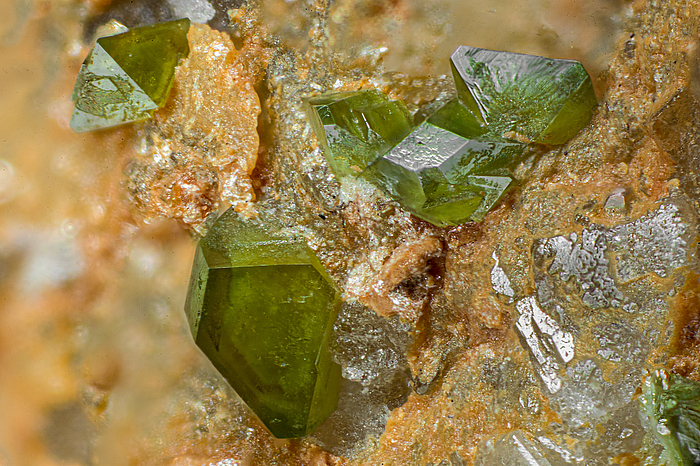
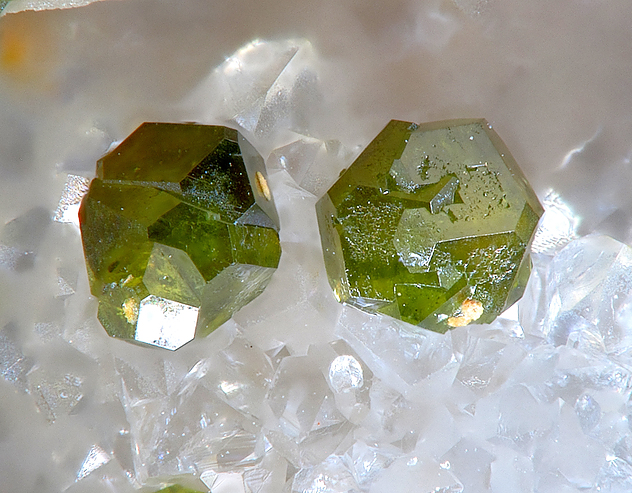
About Mackayite
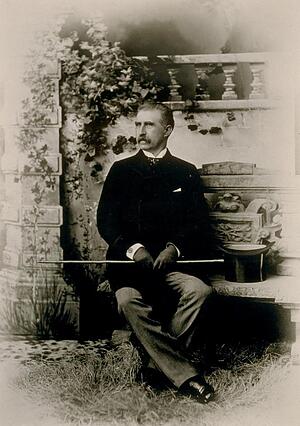
John William Mackay
Formula:
Fe3+(Te4+2O5)(OH)
Colour:
Pale bottle-green, olive green, brownish green, greenish black; greenish yellow to yellowish green in transmitted light.
Lustre:
Vitreous
Hardness:
4½
Specific Gravity:
4.86
Crystal System:
Tetragonal
Name:
For John William Mackay (1831-1902), Irish-American financier and mine operator on the Comstock lode, Nevada, who endowed the School of Mines of the University of Nevada (also honored by naming the school the Mackay School of Mines).
This page provides mineralogical data about Mackayite.
Unique Identifiers
Mindat ID:
2511
Long-form identifier:
mindat:1:1:2511:5
IMA Classification of Mackayite
Approved, 'Grandfathered' (first described prior to 1959)
IMA Formula:
Fe3+Te4+2O5(OH)
First published:
1944
Classification of Mackayite
4.JL.10
4 : OXIDES (Hydroxides, V[5,6] vanadates, arsenites, antimonites, bismuthites, sulfites, selenites, tellurites, iodates)
J : Arsenites, antimonites, bismuthites, sulfites, selenites, tellurites; iodates
L : Tellurites with additional anions, without H2O
4 : OXIDES (Hydroxides, V[5,6] vanadates, arsenites, antimonites, bismuthites, sulfites, selenites, tellurites, iodates)
J : Arsenites, antimonites, bismuthites, sulfites, selenites, tellurites; iodates
L : Tellurites with additional anions, without H2O
34.6.1.1
34 : SELENITES, TELLURITES AND SULFITES
6 : Anhydrous Selenites, Tellurites and Sulfites containing Hydroxyl or Halogen
34 : SELENITES, TELLURITES AND SULFITES
6 : Anhydrous Selenites, Tellurites and Sulfites containing Hydroxyl or Halogen
28.3.23
28 : Selenites, Selenates, Tellurites, and Tellurates
3 : Tellurites
28 : Selenites, Selenates, Tellurites, and Tellurates
3 : Tellurites
Mineral Symbols
As of 2021 there are now IMA–CNMNC approved mineral symbols (abbreviations) for each mineral species, useful for tables and diagrams.
| Symbol | Source | Reference |
|---|---|---|
| Mky | IMA–CNMNC | Warr, L.N. (2021). IMA–CNMNC approved mineral symbols. Mineralogical Magazine, 85(3), 291-320. doi:10.1180/mgm.2021.43 |
Physical Properties of Mackayite
Vitreous
Transparency:
Transparent
Colour:
Pale bottle-green, olive green, brownish green, greenish black; greenish yellow to yellowish green in transmitted light.
Streak:
Pale green
Hardness:
4½ on Mohs scale
Tenacity:
Brittle
Fracture:
Sub-Conchoidal
Density:
4.86 g/cm3 (Measured) 5.32 g/cm3 (Calculated)
Optical Data of Mackayite
Type:
Uniaxial (+)
RI values:
nω = 2.19(2) nε = 2.21(2)
Max. Birefringence:
δ = 0.020
Based on recorded range of RI values above.
Based on recorded range of RI values above.
Interference Colours:
The colours simulate birefringence patterns seen in thin section under crossed polars. They do not take into account mineral colouration or opacity.
Michel-Levy Bar The default colours simulate the birefringence range for a 30 µm thin-section thickness. Adjust the slider to simulate a different thickness.
Grain Simulation You can rotate the grain simulation to show how this range might look as you rotated a sample under crossed polars.
The colours simulate birefringence patterns seen in thin section under crossed polars. They do not take into account mineral colouration or opacity.
Michel-Levy Bar The default colours simulate the birefringence range for a 30 µm thin-section thickness. Adjust the slider to simulate a different thickness.
Grain Simulation You can rotate the grain simulation to show how this range might look as you rotated a sample under crossed polars.
Surface Relief:
Moderate
Pleochroism:
Visible
Comments:
Dichroic:
O = Green
E = Yellowish green
O = Green
E = Yellowish green
Chemistry of Mackayite
Mindat Formula:
Fe3+(Te4+2O5)(OH)
Element Weights:
Elements listed:
Crystallography of Mackayite
Crystal System:
Tetragonal
Class (H-M):
4/mmm (4/m 2/m 2/m) - Ditetragonal Dipyramidal
Space Group:
I41/acd
Cell Parameters:
a = 11.704 Å, c = 14.895 Å
Ratio:
a:c = 1 : 1.273
Unit Cell V:
2,040.37 ų (Calculated from Unit Cell)
Z:
16
Morphology:
Short prismatic [001] to pyramidal {112}; pseudocubic, pseudododecahedral.
Crystal Structure
Load
Unit Cell | Unit Cell Packed
2x2x2 | 3x3x3 | 4x4x4
Unit Cell | Unit Cell Packed
2x2x2 | 3x3x3 | 4x4x4
Show
Big Balls | Small Balls | Just Balls | Spacefill
Polyhedra Off | Si Polyhedra | All Polyhedra
Remove metal-metal sticks
Big Balls | Small Balls | Just Balls | Spacefill
Polyhedra Off | Si Polyhedra | All Polyhedra
Remove metal-metal sticks
Display Options
Black Background | White Background
Perspective On | Perspective Off
2D | Stereo | Red-Blue | Red-Cyan
Black Background | White Background
Perspective On | Perspective Off
2D | Stereo | Red-Blue | Red-Cyan
View
CIF File Best | x | y | z | a | b | c
CIF File Best | x | y | z | a | b | c
Rotation
Stop | Start
Stop | Start
Labels
Console Off | On | Grey | Yellow
Console Off | On | Grey | Yellow
Data courtesy of the American Mineralogist Crystal Structure Database. Click on an AMCSD ID to view structure
| ID | Species | Reference | Link | Year | Locality | Pressure (GPa) | Temp (K) |
|---|---|---|---|---|---|---|---|
| 0014758 | Mackayite | Pertlik F, Gieren A (1977) Verfeinerung der kristallstruktur von mackayite Fe(OH)[Te2O5] Neues Jahrbuch fur Mineralogie, Monatshefte 1977 145-154 | 1977 | synthetic | 0 | 293 | |
| 0015634 | Mackayite | Pertlik F (1969) Hydrothermalsynthese, formel und struktur von mackayit, Fe(OH)[Te2O5] Tschermaks Mineralogische und Petrographische Mitteilungen 13 219-232 | 1969 | synthetic | 0 | 293 |
CIF Raw Data - click here to close
X-Ray Powder Diffraction
Powder Diffraction Data:
| d-spacing | Intensity |
|---|---|
| 3.17 Å | (100) |
| 1.61 Å | (90) |
| 3.32 Å | (80) |
| 4.95 Å | (70) |
| 2.72 Å | (70) |
| 2.21 Å | (70) |
| 3.75 Å | (60) |
Geological Environment
Paragenetic Mode(s):
| Paragenetic Mode | Earliest Age (Ga) |
|---|---|
| Stage 7: Great Oxidation Event | <2.4 |
| 47e : [Vanadates, chromates, manganates] | |
| 47h : [Near-surface oxidized, dehydrated minerals] |
Geological Setting:
Zone of oxidation in Au-Te deposits.
Type Occurrence of Mackayite
General Appearance of Type Material:
Occurs in small, well developed crystals in vugs and seams.
Place of Conservation of Type Material:
American Museum of Natural History, New York City, New York, USA, T24594.
Harvard University, Cambridge, Massachusetts, USA, 97444, 97950.
Harvard University, Cambridge, Massachusetts, USA, 97444, 97950.
Geological Setting of Type Material:
Zone of oxidation in Au-Te deposits.
Associated Minerals at Type Locality:
Other Language Names for Mackayite
Common Associates
Associated Minerals Based on Photo Data:
| 9 photos of Mackayite associated with Emmonsite | Fe3+2(TeO3)3 · 2H2O |
| 7 photos of Mackayite associated with Quartz | SiO2 |
| 4 photos of Mackayite associated with Cliffordite | (UO2)Te4+3O7 |
| 3 photos of Mackayite associated with Blakeite | Fe3+2[TeO3]3 (?) |
| 2 photos of Mackayite associated with Jarosite | KFe3+3(SO4)2(OH)6 |
| 2 photos of Mackayite associated with Schmitterite | (UO2)(TeO3) |
| 2 photos of Mackayite associated with Pyrite | FeS2 |
| 1 photo of Mackayite associated with Native Tellurium | Te |
| 1 photo of Mackayite associated with Sonoraite | Fe3+(TeO3)(OH) · H2O |
| 1 photo of Mackayite associated with Paratellurite | TeO2 |
Related Minerals - Strunz-mindat Grouping
| 4.JL. | Tomiolloite | Al12(Te4+O3)5[(SO3)0.5(SO4)0.5](OH)24 |
| 4.JL.05 | Rodalquilarite | Fe2(TeO2OH)3(TeO3)Cl |
| 4.JL.15 | Mroseite | CaTe4+(CO3)O2 |
| 4.JL.20 | Pingguite | Bi6Te2O15 |
| 4.JL.25 | Tlapallite | (Ca,Pb)3CaCu6[Te4+3Te6+O12]2(Te4+O3)2(SO4)2 · 3H2O |
| 4.JL.30 | Girdite | H2Pb3(Te4+O3)(Te6+O6) |
| 4.JL.40 | Bodieite | Bi2(TeO3)2(SO4) |
Other Information
Health Risks:
No information on health risks for this material has been entered into the database. You should always treat mineral specimens with care.
Internet Links for Mackayite
mindat.org URL:
https://www.mindat.org/min-2511.html
Please feel free to link to this page.
Please feel free to link to this page.
Search Engines:
External Links:
References for Mackayite
Reference List:
Frondel, Clifford, Pough, Fred H. (1944) Two new tellurites of iron: mackayite and blakeite. With new data on emmonsite and "durdenite.". American Mineralogist, 29 (5-6) 211-225
Gaines, RV (1965) Nuevos Datos Sobre Mackayita. Boletín de la Sociedad Geológica Mexicana, 28 (2). 75-82 doi:10.18268/bsgm1965v28n2a2
Localities for Mackayite
 symbol to view information about a locality.
The
symbol to view information about a locality.
The Locality List
 - This locality has map coordinates listed.
- This locality has estimated coordinates.
ⓘ - Click for references and further information on this occurrence.
? - Indicates mineral may be doubtful at this locality.
- This locality has map coordinates listed.
- This locality has estimated coordinates.
ⓘ - Click for references and further information on this occurrence.
? - Indicates mineral may be doubtful at this locality.
 - Good crystals or important locality for species.
 - World class for species or very significant.
(TL) - Type Locality for a valid mineral species.
(FRL) - First Recorded Locality for everything else (eg varieties).
- World class for species or very significant.
(TL) - Type Locality for a valid mineral species.
(FRL) - First Recorded Locality for everything else (eg varieties).
All localities listed without proper references should be considered as questionable.
Chile | |
| Back et al. (1999) +2 other references |
Finland | |
| Lips (2006) |
Mexico | |
| Thorne (n.d.) |
| Anthony et al. (2016) | |
| Panczner (1987) | |
| Lapis 2001 (1) | |
USA | |
| Bideaux et al. (1960) +1 other reference |
| Bideaux et al. (1960) +1 other reference |
| Eckel et al. (1997) |
| Castor et al. (2004) |
| Castor et al. (2004) | |
| Rocks & Minerals. Nov. 1999. +2 other references |
| Frondel et al. (1944) +2 other references | |
| Frondel et al. (1944) +1 other reference | |
| Walstrom (n.d.) +1 other reference |
Quick NavTopAbout MackayiteUnique IdentifiersIMA Classification Classification Mineral SymbolsPhysical Properties Optical Data Chemistry Crystallography Crystal StructureX-Ray Powder DiffractionGeological EnvironmentType Occurrence Other LanguagesCommon AssociatesStrunz-MindatOther InformationInternet Links References Localities Locality List
San Miguel Mine, Moctezuma, Moctezuma Municipality, Sonora, Mexico