Kolovratite
A valid IMA mineral species - grandfathered - questionable
This page is currently not sponsored. Click here to sponsor this page.
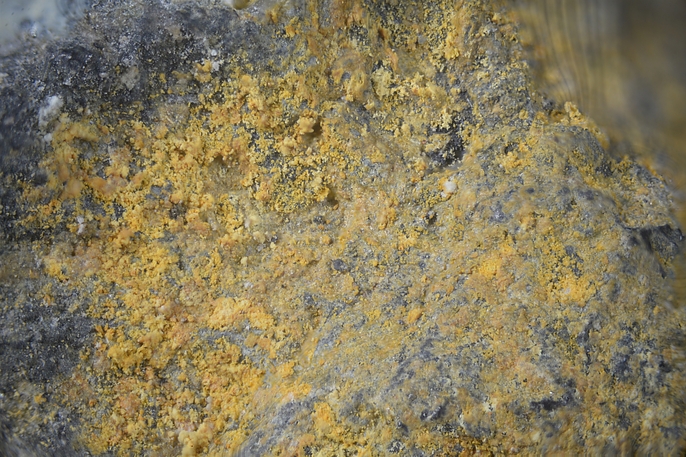
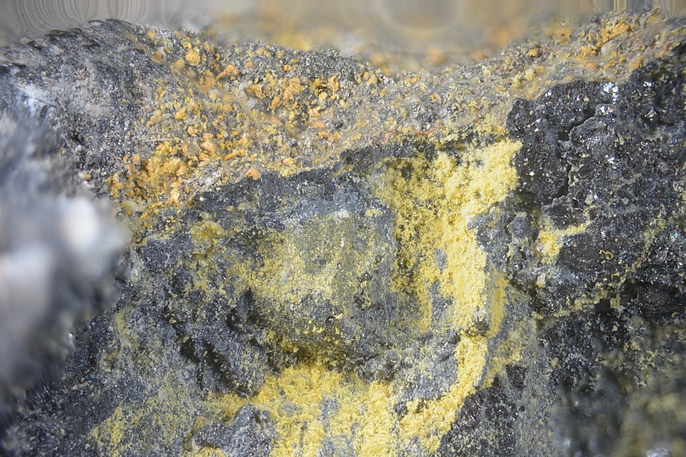

About Kolovratite
Formula:
NixZny(VO4)0.67(x+y) · nH2O
Colour:
Citrine-yellow, greenish yellow
Lustre:
Vitreous
Hardness:
2 - 3
Name:
After Lev Stanislovich Kolovrat-Chervinckii (Лев Станиславович Коловрат-Червинский) (4 (16) December 1884, Russian Empire - 24 January 1921, Russian Empire), Russian physicist and radiologist, Mineralogical Laboratory, Russian Academy of Science, St. Petersburg, Russia, who studied the Tyuya-Muyun uranium deposit, Kyrgyzstan.
According to Jambor & Lachance (1962), kolovratite is a hydrous zinc-nickel vanadate, or perhaps silico-vanadate, rather than a nickel vanadate as originally reported.
Probably needs a reinvestigation with modern methods.
Occurs in quartz schists and carbonaceous slates.
Probably needs a reinvestigation with modern methods.
Occurs in quartz schists and carbonaceous slates.
Unique Identifiers
Mindat ID:
2242
Long-form identifier:
mindat:1:1:2242:8
IMA Classification of Kolovratite
Approved, 'Grandfathered' (first described prior to 1959), Questionable
IMA Formula:
(Ni,Zn)x(VO4) · nH2O
Classification of Kolovratite
8.CB.50
8 : PHOSPHATES, ARSENATES, VANADATES
C : Phosphates without additional anions, with H2O
B : With only medium-sized cations, RO4:H2O = 1:1
8 : PHOSPHATES, ARSENATES, VANADATES
C : Phosphates without additional anions, with H2O
B : With only medium-sized cations, RO4:H2O = 1:1
40.5.13.1
40 : HYDRATED NORMAL PHOSPHATES,ARSENATES AND VANADATES
5 : AXO4·xH2O
40 : HYDRATED NORMAL PHOSPHATES,ARSENATES AND VANADATES
5 : AXO4·xH2O
21.4.27
21 : Vanadates (and vanadates with arsenate or phosphate)
4 : Vanadates of U, Mn, Fe or Ni
21 : Vanadates (and vanadates with arsenate or phosphate)
4 : Vanadates of U, Mn, Fe or Ni
Mineral Symbols
As of 2021 there are now IMA–CNMNC approved mineral symbols (abbreviations) for each mineral species, useful for tables and diagrams.
| Symbol | Source | Reference |
|---|---|---|
| Klv | IMA–CNMNC | Warr, L.N. (2021). IMA–CNMNC approved mineral symbols. Mineralogical Magazine, 85(3), 291-320. doi:10.1180/mgm.2021.43 |
Physical Properties of Kolovratite
Vitreous
Transparency:
Translucent
Colour:
Citrine-yellow, greenish yellow
Streak:
Pale yellow.
Hardness:
2 - 3 on Mohs scale
Tenacity:
Brittle
Fracture:
Irregular/Uneven, Conchoidal
Optical Data of Kolovratite
Type:
Biaxial
RI values:
nβ = 1.577 n = 1.577(5)
Birefringence:
Low.
Max. Birefringence:
δ = 0.000
Based on recorded range of RI values above.
Based on recorded range of RI values above.
Interference Colours:
The colours simulate birefringence patterns seen in thin section under crossed polars. They do not take into account mineral colouration or opacity.
Michel-Levy Bar The default colours simulate the birefringence range for a 30 µm thin-section thickness. Adjust the slider to simulate a different thickness.
Grain Simulation You can rotate the grain simulation to show how this range might look as you rotated a sample under crossed polars.
The colours simulate birefringence patterns seen in thin section under crossed polars. They do not take into account mineral colouration or opacity.
Michel-Levy Bar The default colours simulate the birefringence range for a 30 µm thin-section thickness. Adjust the slider to simulate a different thickness.
Grain Simulation You can rotate the grain simulation to show how this range might look as you rotated a sample under crossed polars.
Surface Relief:
Low
Dispersion:
very weak
Comments:
Parallel extinction
Chemistry of Kolovratite
Mindat Formula:
NixZny(VO4)0.67(x+y) · nH2O
Crystallography of Kolovratite
Morphology:
Occurs as fibrous and felted aggregates, in botryoidal crusts and thin incrustations.
Comment:
Crystal Data: n.d. Point Group: n.d.; Space Group: n.d. Z = n.d
X-Ray Powder Diffraction
Powder Diffraction Data:
| d-spacing | Intensity |
|---|---|
| 11.6 Å | (s) |
| 5.83 Å | (s) |
| 3.88 Å | (s) |
| 2.62 Å | (mw) |
| 2.57 Å | (mw) |
| 2.39 Å | (mwb) |
| 1.52 Å | (mw |
Geological Environment
Paragenetic Mode(s):
| Paragenetic Mode | Earliest Age (Ga) |
|---|---|
| Stage 5: Initiation of plate tectonics | <3.5-2.5 |
| 40 : Regional metamorphism (greenschist, amphibolite, granulite facies) | |
| Stage 7: Great Oxidation Event | <2.4 |
| 47a : [Near-surface hydration of prior minerals] | |
| 47e : [Vanadates, chromates, manganates] |
Type Occurrence of Kolovratite
Geological Setting of Type Material:
quartz schists and carbonaceous slates.
Other Language Names for Kolovratite
Common Associates
Associated Minerals Based on Photo Data:
| 3 photos of Kolovratite associated with Ankinovichite | (Ni,Zn)Al4(V5+O3)2(OH)12 · 2.5H2O |
| 3 photos of Kolovratite associated with Volborthite | Cu3(V2O7)(OH)2 · 2H2O |
Related Minerals - Strunz-mindat Grouping
| 8.CB. | Krupičkaite | Cu6[AsO3(OH)]6 · 8H2O |
| 8.CB.05 | Ermeloite | Al(PO4) · H2O |
| 8.CB.05 | Serrabrancaite | MnPO4 · H2O |
| 8.CB.10 | Nyholmite | Cd3Zn2(AsO3OH)2(AsO4)2 · 4H2O |
| 8.CB.10 | Villyaellenite | (Mn,Ca)Mn2Ca2(AsO3OH)2(AsO4)2 · 4H2O |
| 8.CB.10 | Giftgrubeite | CaMn2Ca2(AsO4)2(AsO3OH)2 · 4H2O |
| 8.CB.10 | Hureaulite | Mn2+5(PO3OH)2(PO4)2 · 4H2O |
| 8.CB.10 | Miguelromeroite | Mn2+5(AsO3OH)2(AsO4)2(H2O)4 |
| 8.CB.10 | UM1997-09-AsO:CaHMgZn | (Mg,Ca,Zn)5(AsO4)2(HAsO4)2 · 4H2O |
| 8.CB.15 | Krautite | Mn(HAsO4) · H2O |
| 8.CB.20 | Cobaltkoritnigite | Co(AsO3OH) · H2O |
| 8.CB.20 | Magnesiokoritnigite | Mg(AsO3OH) · H2O |
| 8.CB.20 | Koritnigite | Zn(AsO3OH) · H2O |
| 8.CB.25 | Yvonite | Cu(HAsO4) · 2H2O |
| 8.CB.30 | Geminite | Cu2+(AsO3OH) · H2O |
| 8.CB.35 | Schubnelite | Fe3+VO4 · H2O |
| 8.CB.40 | Radovanite | Cu2Fe3+(AsO4)(HAs3+O3)2 · H2O |
| 8.CB.45 | Kazakhstanite | Fe3+5V4+3V5+12O39(OH)9 · 9H2O |
| 8.CB.60 | Honzaite | Ni2(AsO3OH)2 · 5H2O |
| 8.CB.60 | Burgessite | Co2(H2O)4[AsO3(OH)]2(H2O) |
| 8.CB.65 | Cardite | Zn5.5(AsO4)2(AsO3OH)(OH)3 · 3H2O |
Other Information
Notes:
Slightly radioactive.
Health Risks:
No information on health risks for this material has been entered into the database. You should always treat mineral specimens with care.
Internet Links for Kolovratite
mindat.org URL:
https://www.mindat.org/min-2242.html
Please feel free to link to this page.
Please feel free to link to this page.
Search Engines:
External Links:
References for Kolovratite
Reference List:
Localities for Kolovratite
 symbol to view information about a locality.
The
symbol to view information about a locality.
The Locality List
 - This locality has map coordinates listed.
- This locality has estimated coordinates.
ⓘ - Click for references and further information on this occurrence.
? - Indicates mineral may be doubtful at this locality.
- This locality has map coordinates listed.
- This locality has estimated coordinates.
ⓘ - Click for references and further information on this occurrence.
? - Indicates mineral may be doubtful at this locality.
 - Good crystals or important locality for species.
 - World class for species or very significant.
(TL) - Type Locality for a valid mineral species.
(FRL) - First Recorded Locality for everything else (eg varieties).
- World class for species or very significant.
(TL) - Type Locality for a valid mineral species.
(FRL) - First Recorded Locality for everything else (eg varieties).
All localities listed without proper references should be considered as questionable.
Kyrgyzstan (TL) | |
| Palache et al. (1951) +2 other references |
| Palache et al. (1951) |
Uzbekistan | |
| Pekov (1998) |
Quick NavTopAbout KolovratiteUnique IdentifiersIMA Classification Classification Mineral SymbolsPhysical Properties Optical Data Chemistry Crystallography X-Ray Powder DiffractionGeological EnvironmentType Occurrence Other LanguagesCommon AssociatesStrunz-MindatOther InformationInternet Links References Localities Locality List
Uch-Kurgan, Ferghana Valley, Osh Region, Kyrgyzstan