Hydrodresserite
A valid IMA mineral species
This page is currently not sponsored. Click here to sponsor this page.



About Hydrodresserite
Formula:
BaAl2(CO3)2(OH)4 · 3H2O
Colour:
Colorless
Lustre:
Vitreous
Hardness:
3 - 4
Specific Gravity:
2.80
Crystal System:
Triclinic
Member of:
Name:
Named in 1977 by John Leslie Jambor, Ann Phyllis Sabina [Stenson], and Bozidar Darko Sturman in allusion to it being a fully hydrated equivalent of dresserite.
Type Locality:
Isostructural with:
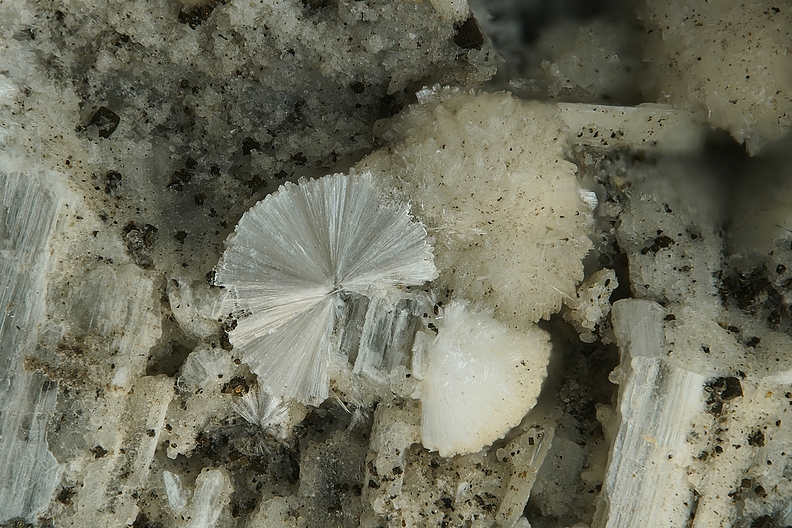
Visually similar to dresserite. In contrast to dresserite, hydrodresserite's characteristic features are that it forms coarser bladed crystals with sloped terminations, resulting in rougher spheres, and hydrodresserite crystals are more translucent than dresserite.
Despite extensive discussion in the type description about the instability of hydrodresserite at atmospheric conditions, samples analyzed by single-crystal X-ray diffraction decades after being collected (analyzed c. 2019; C. Emproto) have yielded unit cell metrics consistent with hydrodresserite type material. Therefore, while hydrodresserite may indeed lose some amount of water spontaneously, this does not always correspond to a conversion to dresserite.
Despite extensive discussion in the type description about the instability of hydrodresserite at atmospheric conditions, samples analyzed by single-crystal X-ray diffraction decades after being collected (analyzed c. 2019; C. Emproto) have yielded unit cell metrics consistent with hydrodresserite type material. Therefore, while hydrodresserite may indeed lose some amount of water spontaneously, this does not always correspond to a conversion to dresserite.
Unique Identifiers
Mindat ID:
1972
Long-form identifier:
mindat:1:1:1972:5
IMA Classification of Hydrodresserite
Approved
Approval year:
1976
First published:
1977
Classification of Hydrodresserite
5.DB.15
5 : CARBONATES (NITRATES)
D : Carbonates with additional anions, with H2O
B : With large and medium-sized cations
5 : CARBONATES (NITRATES)
D : Carbonates with additional anions, with H2O
B : With large and medium-sized cations
16b.2.2.1
16b : HYDRATED CARBONATES CONTAINING HYDROXYL OR HALOGEN
2 : AmBn(XO3)pZqxH2O & with (m+n):p = 3:2
16b : HYDRATED CARBONATES CONTAINING HYDROXYL OR HALOGEN
2 : AmBn(XO3)pZq
11.7.13
11 : Carbonates
7 : Carbonates of Al
11 : Carbonates
7 : Carbonates of Al
Mineral Symbols
As of 2021 there are now IMA–CNMNC approved mineral symbols (abbreviations) for each mineral species, useful for tables and diagrams.
| Symbol | Source | Reference |
|---|---|---|
| Hdrs | IMA–CNMNC | Warr, L.N. (2021). IMA–CNMNC approved mineral symbols. Mineralogical Magazine, 85(3), 291-320. doi:10.1180/mgm.2021.43 |
Physical Properties of Hydrodresserite
Vitreous
Transparency:
Transparent
Colour:
Colorless
Streak:
White
Hardness:
3 - 4 on Mohs scale
Cleavage:
Perfect
{010} and {210}.
{010} and {210}.
Density:
2.80(2) g/cm3 (Measured) 2.817(1) g/cm3 (Calculated)
Optical Data of Hydrodresserite
Type:
Biaxial (-)
RI values:
nα = 1.502(2) nβ = 1.594(1) nγ = 1.595(1)
2V:
Measured: 17° (1), Calculated: 10°
Max. Birefringence:
δ = 0.093
Based on recorded range of RI values above.
Based on recorded range of RI values above.
Interference Colours:
The colours simulate birefringence patterns seen in thin section under crossed polars. They do not take into account mineral colouration or opacity.
Michel-Levy Bar The default colours simulate the birefringence range for a 30 µm thin-section thickness. Adjust the slider to simulate a different thickness.
Grain Simulation You can rotate the grain simulation to show how this range might look as you rotated a sample under crossed polars.
The colours simulate birefringence patterns seen in thin section under crossed polars. They do not take into account mineral colouration or opacity.
Michel-Levy Bar The default colours simulate the birefringence range for a 30 µm thin-section thickness. Adjust the slider to simulate a different thickness.
Grain Simulation You can rotate the grain simulation to show how this range might look as you rotated a sample under crossed polars.
Surface Relief:
Moderate
Dispersion:
relatively strong
Chemistry of Hydrodresserite
Mindat Formula:
BaAl2(CO3)2(OH)4 · 3H2O
Element Weights:
Crystallography of Hydrodresserite
Crystal System:
Triclinic
Class (H-M):
1 - Pinacoidal
Space Group:
P1
Cell Parameters:
a = 9.7545(5) Å, b = 10.4069(5) Å, c = 5.6322(3) Å
α = 95.695°, β = 92.273°, γ = 115.643°
α = 95.695°, β = 92.273°, γ = 115.643°
Ratio:
a:b:c = 0.937 : 1 : 0.541
Unit Cell V:
510.71 ų (Calculated from Unit Cell)
Z:
2
Morphology:
Crystals are elongate [001], terminated (102), with prominent {010} and narrow {210}.
Crystal Structure
Load
Unit Cell | Unit Cell Packed
2x2x2 | 3x3x3 | 4x4x4
Unit Cell | Unit Cell Packed
2x2x2 | 3x3x3 | 4x4x4
Show
Big Balls | Small Balls | Just Balls | Spacefill
Polyhedra Off | Si Polyhedra | All Polyhedra
Remove metal-metal sticks
Big Balls | Small Balls | Just Balls | Spacefill
Polyhedra Off | Si Polyhedra | All Polyhedra
Remove metal-metal sticks
Display Options
Black Background | White Background
Perspective On | Perspective Off
2D | Stereo | Red-Blue | Red-Cyan
Black Background | White Background
Perspective On | Perspective Off
2D | Stereo | Red-Blue | Red-Cyan
View
CIF File Best | x | y | z | a | b | c
CIF File Best | x | y | z | a | b | c
Rotation
Stop | Start
Stop | Start
Labels
Console Off | On | Grey | Yellow
Console Off | On | Grey | Yellow
Data courtesy of the American Mineralogist Crystal Structure Database. Click on an AMCSD ID to view structure
| ID | Species | Reference | Link | Year | Locality | Pressure (GPa) | Temp (K) |
|---|---|---|---|---|---|---|---|
| 0005186 | Hydrodresserite | Szymanski J T (1982) The crystal structure of hydrodresserite BaAl2(CO3)2(OH)4.3H2O The Canadian Mineralogist 20 253-262 |  | 1982 | 0 | 293 |
CIF Raw Data - click here to close
X-Ray Powder Diffraction
Powder Diffraction Data:
| d-spacing | Intensity |
|---|---|
| 8.52 Å | (100) |
| 3.42 Å | (70) |
| 3.10 Å | (60) |
| 4.26 Å | (50) |
| 8.75 Å | (40) |
| 9.30 Å | (30) |
| 5.32 Å | (30) |
Reference:
Comments:
Francon quarry, Québec, Canada. Data from the type description.
Geological Environment
Paragenetic Mode(s):
| Paragenetic Mode | Earliest Age (Ga) |
|---|---|
| High-? alteration and/or metamorphism | |
| 31 : Thermally altered carbonate, phosphate, and iron formations |
Type Occurrence of Hydrodresserite
General Appearance of Type Material:
White spheres and hemispheres which average about 2 mm in diameter and consist of radiating fibrous, colorless crystals.
Place of Conservation of Type Material:
Type material is stored at the Royal Ontario Museum (specimen M34547), and in the National Mineral Collection, Geological Survey of Canada (No. 13936).
Geological Setting of Type Material:
Alkalic sill.
Associated Minerals at Type Locality:
Synonyms of Hydrodresserite
Other Language Names for Hydrodresserite
Relationship of Hydrodresserite to other Species
Member of:
Other Members of Dresserite Group:
| Alumohydrocalcite | CaAl2(CO3)2(OH)4 · 4H2O | Tric. 1 : P1 |
| Dresserite | BaAl2(CO3)2(OH)4 · H2O | Orth. mmm (2/m 2/m 2/m) |
| Dundasite | PbAl2(CO3)2(OH)4 · H2O | Orth. mmm (2/m 2/m 2/m) |
| Grguricite | CaCr2(CO3)2(OH)4 · 4H2O | Tric. 1 : P1 |
| Kochsándorite | CaAl2(CO3)2(OH)4 · H2O | Orth. mmm (2/m 2/m 2/m) : Pnma |
| Petterdite | PbCr3+2(CO3)2(OH)4 · H2O | Orth. mmm (2/m 2/m 2/m) |
| Strontiodresserite | SrAl2(CO3)2(OH)4 · H2O | Orth. mmm (2/m 2/m 2/m) |
| Unnamed (Ca-analogue of Petterdite) | CaCr3+2(CO3)2(OH)4 · H2O |
Common Associates
Associated Minerals Based on Photo Data:
| 10 photos of Hydrodresserite associated with Weloganite | Na2Sr3Zr(CO3)6 · 3H2O |
| 6 photos of Hydrodresserite associated with Dawsonite | NaAlCO3(OH)2 |
| 5 photos of Hydrodresserite associated with Quartz | SiO2 |
| 5 photos of Hydrodresserite associated with Baryte | BaSO4 |
| 4 photos of Hydrodresserite associated with Dresserite | BaAl2(CO3)2(OH)4 · H2O |
| 3 photos of Hydrodresserite associated with Calcite | CaCO3 |
| 3 photos of Hydrodresserite associated with Nannoniite | Al2(OH)5F |
Related Minerals - Strunz-mindat Grouping
| 5.DB. | Grguricite | CaCr2(CO3)2(OH)4 · 4H2O |
| 5.DB.05 | Para-alumohydrocalcite | CaAl2(CO3)2(OH)4 · 6H2O |
| 5.DB.05 | Nasledovite | PbMn3Al4(CO3)4(SO4)O5 · 5H2O |
| 5.DB.05 | UM1977-02-CO:AlCaH | Ca6Al2(CO3)3O6 · 32H2O |
| 5.DB.05 | Alumohydrocalcite | CaAl2(CO3)2(OH)4 · 4H2O |
| 5.DB.10 | Kochsándorite | CaAl2(CO3)2(OH)4 · H2O |
| 5.DB.10 | Dresserite | BaAl2(CO3)2(OH)4 · H2O |
| 5.DB.10 | Dundasite | PbAl2(CO3)2(OH)4 · H2O |
| 5.DB.10 | Unnamed (Ca-analogue of Petterdite) | CaCr3+2(CO3)2(OH)4 · H2O |
| 5.DB.10 | Petterdite | PbCr3+2(CO3)2(OH)4 · H2O |
| 5.DB.10 | Strontiodresserite | SrAl2(CO3)2(OH)4 · H2O |
| 5.DB.10 | Montroyalite | Sr4Al8(CO3)3(OH,F)26 · 10-11H2O |
| 5.DB.20 | Schuilingite-(Nd) | PbCu(Nd,Gd,Sm,Y)(CO3)3(OH) · 1.5H2O |
| 5.DB.25 | Sergeevite | Ca2Mg11(CO3)9(HCO3)4(OH)4 · 6H2O |
| 5.DB.30 | Szymańskiite | [H3O]+8[Hg2]2+8(Ni,Mg)6[CO3]12(OH)12 · 3H2O |
| 5.DB.35 | Lusernaite-(Y) | Y4Al(CO3)2(OH)10F · 6H2O |
| 5.DB.40 | Putnisite | SrCa4Cr3+8(CO3)8SO4(OH)16 · 23H2O |
Other Information
Notes:
The mineral is readily soluble in dilute HCl.
Special Storage/
Display Requirements:
Display Requirements:
Hydrodresserite is unstable at most atmospheric conditions and dehydrates to dresserite.
Health Risks:
No information on health risks for this material has been entered into the database. You should always treat mineral specimens with care.
Internet Links for Hydrodresserite
mindat.org URL:
https://www.mindat.org/min-1972.html
Please feel free to link to this page.
Please feel free to link to this page.
Search Engines:
External Links:
References for Hydrodresserite
Reference List:
Jambor, J. L., Sabina, A. P., Sturman, B. D. (1977) Hydrodresserite, a new Ba-Al carbonate from a silicocarbonatite sill, Montreal Island, Quebec. The Canadian Mineralogist, 15 (3) 399-404
Localities for Hydrodresserite
 symbol to view information about a locality.
The
symbol to view information about a locality.
The Locality List
 - This locality has map coordinates listed.
- This locality has estimated coordinates.
ⓘ - Click for references and further information on this occurrence.
? - Indicates mineral may be doubtful at this locality.
- This locality has map coordinates listed.
- This locality has estimated coordinates.
ⓘ - Click for references and further information on this occurrence.
? - Indicates mineral may be doubtful at this locality.
 - Good crystals or important locality for species.
 - World class for species or very significant.
(TL) - Type Locality for a valid mineral species.
(FRL) - First Recorded Locality for everything else (eg varieties).
- World class for species or very significant.
(TL) - Type Locality for a valid mineral species.
(FRL) - First Recorded Locality for everything else (eg varieties).
All localities listed without proper references should be considered as questionable.
Canada (TL) | |
| 176-178. +3 other references |
Quick NavTopAbout HydrodresseriteUnique IdentifiersIMA Classification Classification Mineral SymbolsPhysical Properties Optical Data Chemistry Crystallography Crystal StructureX-Ray Powder DiffractionGeological EnvironmentType Occurrence SynonymsOther LanguagesRelationshipsCommon AssociatesStrunz-MindatOther InformationInternet Links References Localities Locality List
Francon quarry, Montréal, Québec, Canada