Cuprobismutite
A valid IMA mineral species - grandfathered
This page is currently not sponsored. Click here to sponsor this page.


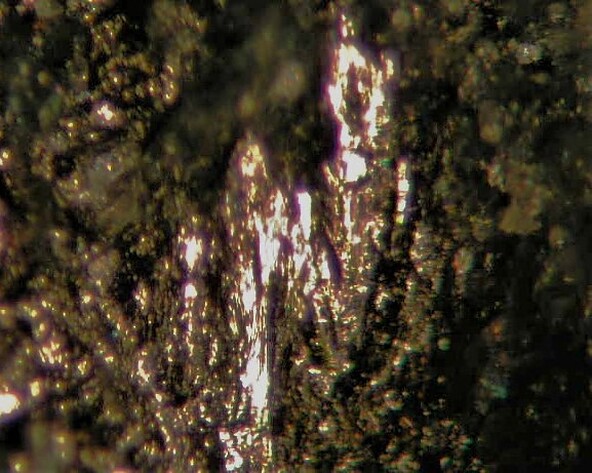

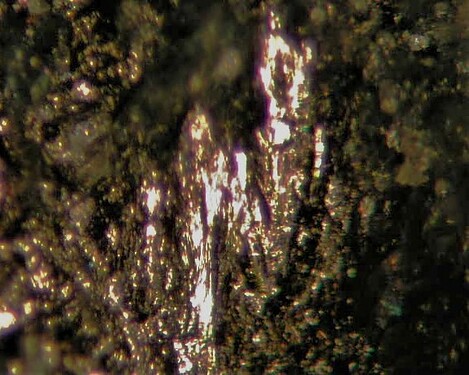
About Cuprobismutite
Formula:
Cu8AgBi13S24
Colour:
Dark bluish-grey
Lustre:
Metallic
Specific Gravity:
6.36
Crystal System:
Monoclinic
Member of:
Name:
In allusion to its content of copper and bismuth.
Unique Identifiers
Mindat ID:
1177
Long-form identifier:
mindat:1:1:1177:4
IMA Classification of Cuprobismutite
Approved, 'Grandfathered' (first described prior to 1959)
First published:
1884
Classification of Cuprobismutite
2.JA.10a
2 : SULFIDES and SULFOSALTS (sulfides, selenides, tellurides; arsenides, antimonides, bismuthides; sulfarsenites, sulfantimonites, sulfbismuthites, etc.)
J : Sulfosalts of PbS archetype
A : Galena derivatives with little or no Pb
2 : SULFIDES and SULFOSALTS (sulfides, selenides, tellurides; arsenides, antimonides, bismuthides; sulfarsenites, sulfantimonites, sulfbismuthites, etc.)
J : Sulfosalts of PbS archetype
A : Galena derivatives with little or no Pb
3.8.2.1
3 : SULFOSALTS
8 : 1 < ø < 2
3 : SULFOSALTS
8 : 1 < ø < 2
5.1.8
5 : Sulphosalts - Sulpharsenites and Sulphobismuthites (those containing Sn, Ge,or V are in Section 6)
1 : Sulpharsenites etc. of Cu
5 : Sulphosalts - Sulpharsenites and Sulphobismuthites (those containing Sn, Ge,or V are in Section 6)
1 : Sulpharsenites etc. of Cu
Mineral Symbols
As of 2021 there are now IMA–CNMNC approved mineral symbols (abbreviations) for each mineral species, useful for tables and diagrams.
Please only use the official IMA–CNMNC symbol. Older variants are listed for historical use only.
Please only use the official IMA–CNMNC symbol. Older variants are listed for historical use only.
| Symbol | Source | Reference |
|---|---|---|
| Cbit | IMA–CNMNC | Warr, L.N. (2021). IMA–CNMNC approved mineral symbols. Mineralogical Magazine, 85(3), 291-320. doi:10.1180/mgm.2021.43 |
| Cbs | The Canadian Mineralogist (2019) | The Canadian Mineralogist (2019) The Canadian Mineralogist list of symbols for rock- and ore-forming minerals (December 30, 2019). download |
Physical Properties of Cuprobismutite
Metallic
Transparency:
Opaque
Colour:
Dark bluish-grey
Density:
6.36 g/cm3 (Measured) 6.24 g/cm3 (Calculated)
Optical Data of Cuprobismutite
Anisotropism:
Distinct
Reflectivity:
| Wavelength | R1 (%) | R2 (%) |
|---|---|---|
| 400nm | 31.8% | 35.2% |
| 440nm | 33.1% | 36.4% |
| 480nm | 34.9% | 37.6% |
| 520nm | 35.4% | 38.4% |
| 560nm | 36.2% | 39.4% |
| 600nm | 36.8% | 40.1% |
| 640nm | 37.2% | 40.4% |
| 680nm | 37.2% | 40.5% |
| 700nm | 37.2% | 40.5% |
Graph shows reflectance levels at different wavelengths (in nm). Peak reflectance is 40.5%.
R1 shown in black, R2 shown in red
Chemistry of Cuprobismutite
Mindat Formula:
Cu8AgBi13S24
Element Weights:
Elements listed:
Crystallography of Cuprobismutite
Crystal System:
Monoclinic
Class (H-M):
2/m - Prismatic
Space Group:
B2/m
Setting:
C2/m
Cell Parameters:
a = 17.520(1) Å, b = 3.926(3) Å, c = 15.261(1) Å
β = 100.18(1)°
β = 100.18(1)°
Ratio:
a:b:c = 4.463 : 1 : 3.887
Unit Cell V:
1,033.18 ų (Calculated from Unit Cell)
Z:
2
Morphology:
Massive, prismatic crystals, thin blades
Crystal Structure
Load
Unit Cell | Unit Cell Packed
2x2x2 | 3x3x3 | 4x4x4
Unit Cell | Unit Cell Packed
2x2x2 | 3x3x3 | 4x4x4
Show
Big Balls | Small Balls | Just Balls | Spacefill
Polyhedra Off | Si Polyhedra | All Polyhedra
Remove metal-metal sticks
Big Balls | Small Balls | Just Balls | Spacefill
Polyhedra Off | Si Polyhedra | All Polyhedra
Remove metal-metal sticks
Display Options
Black Background | White Background
Perspective On | Perspective Off
2D | Stereo | Red-Blue | Red-Cyan
Black Background | White Background
Perspective On | Perspective Off
2D | Stereo | Red-Blue | Red-Cyan
View
CIF File Best | x | y | z | a | b | c
CIF File Best | x | y | z | a | b | c
Rotation
Stop | Start
Stop | Start
Labels
Console Off | On | Grey | Yellow
Console Off | On | Grey | Yellow
Data courtesy of the American Mineralogist Crystal Structure Database. Click on an AMCSD ID to view structure
| ID | Species | Reference | Link | Year | Locality | Pressure (GPa) | Temp (K) |
|---|---|---|---|---|---|---|---|
| 0005923 | Cuprobismutite | Topa D, Makovicky E, Balic-Zunic T (2003) Crystal structures and crystal chemistry of members of the cuprobismutite homologous series of sulfosalts The Canadian Mineralogist 41 1481-1501 |  | 2003 | Felbertal Austria | 0 | 293 |
CIF Raw Data - click here to close
X-Ray Powder Diffraction
Powder Diffraction Data:
| d-spacing | Intensity |
|---|---|
| 3.10 Å | (100) |
| 2.73 Å | (60) |
| 3.65 Å | (40b) |
| 4.31 Å | (30) |
| 1.961 Å | (30) |
| 1.719 Å | (30) |
| 6.24 Å | (20) |
Comments:
Hall’s Valley, Colorado, USA. An analysis is also given in Nuffield (1952).
Geological Environment
Paragenetic Mode(s):
| Paragenetic Mode | Earliest Age (Ga) |
|---|---|
| High-? alteration and/or metamorphism | |
| 33 : Minerals deposited by hydrothermal metal-rich fluids (see also [#12]) |
Geological Setting:
Quartz veins
Type Occurrence of Cuprobismutite
General Appearance of Type Material:
Small slender crystals, generally bronzed by oxidation and deeply striated. Occasionally they are joined together laterally, forming thin corrugated plates.
Place of Conservation of Type Material:
Harvard University, Cambridge, Massachusetts, USA, number 94989.
National Museum of Natural History (Smithsonian), Washington, D.C., USA, number 92902.
National Museum of Natural History (Smithsonian), Washington, D.C., USA, number 92902.
Associated Minerals at Type Locality:
Other Language Names for Cuprobismutite
Relationship of Cuprobismutite to other Species
Member of:
Other Members of Cuprobismutite Homologous Series:
Common Associates
Associated Minerals Based on Photo Data:
| 1 photo of Cuprobismutite associated with Cannonite | Bi2(SO4)O(OH)2 |
| 1 photo of Cuprobismutite associated with Bismuthinite | Bi2S3 |
| 1 photo of Cuprobismutite associated with Feldspar Group | |
| 1 photo of Cuprobismutite associated with Anglesite | PbSO4 |
Related Minerals - Strunz-mindat Grouping
| 2.JA. | Ferdowsiite | Ag8(Sb5As3)S16 |
| 2.JA. | Luboržákite | Mn2AsSbS5 |
| 2.JA. | Sangenaroite | Ag8(Sb8-xAsx)SΣ16 |
| 2.JA.05a | Pavonite | AgBi3S5 |
| 2.JA.05b | Grumiplucite | HgBi2S4 |
| 2.JA.05c | Kudriavite | (Cd,Pb)Bi2S4 |
| 2.JA.05d | Cupromakovickyite | Cu4AgPb2Bi9S18 |
| 2.JA.05e | Benjaminite | Ag3Bi7S12 |
| 2.JA.05i | Livingstonite | HgSb4S6(S2) |
| 2.JA.05h | Mozgovaite | PbBi4S7 |
| 2.JA.05 | Dantopaite | Ag5Bi13S22 |
| 2.JA.05a | Cupropavonite | Cu0.9Ag0.5Pb0.6Bi2.5S5 |
| 2.JA.05 | Selenodantopaite | Ag5Bi13Se22 |
| 2.JA.05g | Borodaevite | Ag5(Bi,Pb,Fe)8(Sb,Bi)2S17 |
| 2.JA.05a | Cupromakopavonite | Ag3Cu8Pb4Bi19S38 |
| 2.JA.05d | Makovickyite | Cu1.12Ag0.81Pb0.27Bi5.35S9 |
| 2.JA.05f | Mummeite | Cu0.58Ag3.11Pb1.10Bi6.65S13 |
| 2.JA.10b | Kupčíkite | Cu3.4Fe0.6Bi5S10 |
| 2.JA.10d | Pizgrischite | (Cu,Fe)Cu14PbBi17S35 |
| 2.JA.10c | Hodrušite | Cu8Bi12S22 |
| 2.JA.10e | Padĕraite | Cu7[(Cu,Ag)0.33Pb1.33Bi11.33]S22 |
| 2.JA.15 | Schapbachite | Ag0.4Pb0.2Bi0.4S |
| 2.JA.15 | Cuboargyrite | AgSbS2 |
| 2.JA.20 | Matildite | AgBiS2 |
| 2.JA.20 | Volynskite | AgBiTe2 |
| 2.JA.20 | Bohdanowiczite | AgBiSe2 |
Other Information
Notes:
Soluble in HNO3. Also soluble in HCl, with precipitation of silver chloride.
Heating in closed tube gives a sublimate of sulfur. On charcoal it gives a strong bismuth reaction.
Heating in closed tube gives a sublimate of sulfur. On charcoal it gives a strong bismuth reaction.
Health Risks:
No information on health risks for this material has been entered into the database. You should always treat mineral specimens with care.
Internet Links for Cuprobismutite
mindat.org URL:
https://www.mindat.org/min-1177.html
Please feel free to link to this page.
Please feel free to link to this page.
Search Engines:
External Links:
References for Cuprobismutite
Reference List:
Ramdohr, Paul (1969) The Ore Minerals and their Intergrowths. Pergamon Press, Oxford. 1174pp. doi:10.1016/c2013-0-10027-x
Topa, D., Makovicky, E., Balić-Žunić, T. (2003) Crystal structures and crystal chemistry of members of the cuprobismutite homologous series of sulfosalts. The Canadian Mineralogist, 41 (6) 1481-1501 doi:10.2113/gscanmin.41.6.1481
Prek, Jaroslav, Miku, Tomás, Makovicky, Emil, Chovan, Martin (2005) Cuprobismutite, kupcikite, hodrushite and associated sulfosalts from the black shale hosted Ni-Bi-As mineralization at Cierna Lehota, Slovakia. European Journal of Mineralogy, 17 (1) 155-162 doi:10.1127/0935-1221/2005/0017-0155
Pieczka, A., Golebiowska, B. (2012) Cuprobismutite homologues in granitic pegmatites from Szklarska Poreba, Karkonosze Massif, southwestern Poland. The Canadian Mineralogist, 50 (2). 313-324 doi:10.3749/canmin.50.2.313
IZUMINO, Yuya, NAKASHIMA, Kazuo, NAGASHIMA, Mariko (2014) Cuprobismutite group minerals (cuprobismutite, hodrušhite, kupčíkite and padĕraite), other Bi–sulfosalts and Bi–tellurides from the Obari mine, Yamagata Prefecture, Japan. Journal of Mineralogical and Petrological Sciences, 109 (4) 177-190 doi:10.2465/jmps.140129
Localities for Cuprobismutite
 symbol to view information about a locality.
The
symbol to view information about a locality.
The Locality List
 - This locality has map coordinates listed.
- This locality has estimated coordinates.
ⓘ - Click for references and further information on this occurrence.
? - Indicates mineral may be doubtful at this locality.
- This locality has map coordinates listed.
- This locality has estimated coordinates.
ⓘ - Click for references and further information on this occurrence.
? - Indicates mineral may be doubtful at this locality.
 - Good crystals or important locality for species.
 - World class for species or very significant.
(TL) - Type Locality for a valid mineral species.
(FRL) - First Recorded Locality for everything else (eg varieties).
- World class for species or very significant.
(TL) - Type Locality for a valid mineral species.
(FRL) - First Recorded Locality for everything else (eg varieties).
All localities listed without proper references should be considered as questionable.
Argentina | |
| Putz et al. (2009) |
| Brodtkorb (2002) |
| Testa et al. (2018) |
Australia | |
| Skirrow (1993) |
Austria | |
| Lapis 29 (5) |
Bolivia | |
| Royal Ontario Museum specimen # M13339 | |
| Royal Ontario Museum specimen # M13339 |
Bulgaria | |
| Cook et al. (2002) |
| Cook et al. (2002) |
Canada | |
| Hood et al. (1991) |
China | |
| Zhou et al. (2018) |
Czech Republic | |
| Sejkora et al. (2021) +1 other reference |
| Anthony et al. (1990) |
France | |
| Lheur et al. (2011) |
| Wittern et al. (1997) |
| Bari (1982) | |
| Ruhlmann (1978) |
| R. Pierrot |
Germany | |
| Lapis 1984 (1) |
| Walenta (1992) |
| Walenta (1989) +1 other reference |
| Lorenz et al. (2007) |
| web.archive.org (2001) |
| Weiß (1990) +1 other reference |
Greece | |
| Stergiou et al. (2021) |
| Triantafyllidis (2019) |
Indonesia | |
| Nur et al. (2012) |
Iran | |
| Mousavi Motlagh et al. (2024) |
Japan | |
| IZUMINO et al. (2014) |
| Nagashima et al. (2021) |
Morocco | |
| S. Weiß: Lapis 31 (7/8) |
Peru | |
| Baumgartner et al. (2008) |
Poland | |
| Pieczka et al. (2012) +2 other references |
| Karwowski et al. (2012) |
Portugal | |
| Gustavo Pereira Fernandes |
Romania | |
| Cook et al. (2002) +1 other reference |
| Shimizu et al. (1998) | |
| Shimizu et al. (1998) | |
| Shimizu et al. (1998) | |
| Cook et al. (2002) |
| Ciobanu +3 other references |
Russia | |
| Potseluev et al. (2006) |
| Kondratieva et al. (2023) |
Slovakia | |
| Jeleň et al. (2012) |
| Koděra (1986) |
| Mikuš T. (dipl.práca) +2 other references |
Switzerland | |
| Meisser (2012) |
| Ansermet (2012) |
| Picot et al. (1977) |
USA | |
| MarekC pers. coll. 2017-2018 |
| Eckel et al. (1997) |
| Amer.J.Sci. (1884) +1 other reference |
| USGS PP 223 (Lovering,1950) |
| Vajdak (1997) |
| Vajdak (1997) | |
| Econ Geol (1986) |
| Bullock (1981) +1 other reference | |
| Bullock (1981) |
| Dietrich (1990) |
Quick NavTopAbout CuprobismutiteUnique IdentifiersIMA Classification Classification Mineral SymbolsPhysical Properties Optical Data Chemistry Crystallography Crystal StructureX-Ray Powder DiffractionGeological EnvironmentType Occurrence Other LanguagesRelationshipsCommon AssociatesStrunz-MindatOther InformationInternet Links References Localities Locality List
Grüneau Mine, Schutzbach, Daaden-Herdorf, Altenkirchen, Rhineland-Palatinate, Germany