Jade
A rock subtype
This page is currently not sponsored. Click here to sponsor this page.

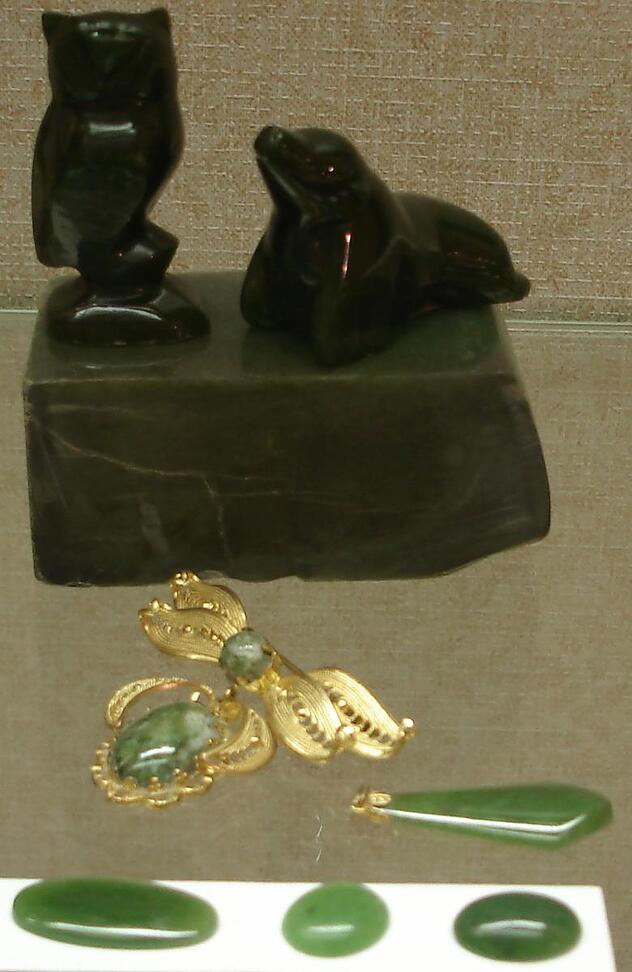
About Jade
Name:
From "piedra de ijada", "stone of the flank", as it was thought to cure kidney pains.
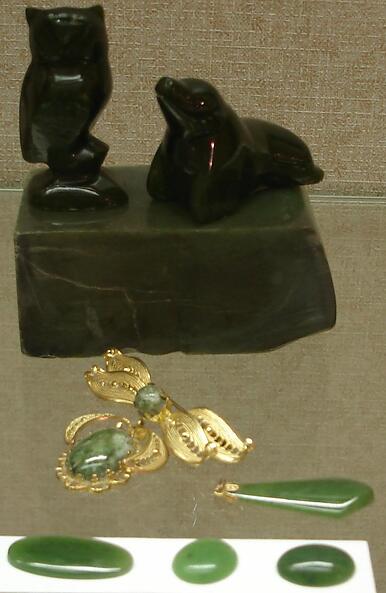
A greenish black to creamy white ornamental stone or gemstone, highly valued in China and Korea.
Translucent emerald-green fei cui jade (known traditionally as 'jadeite jade' but this name is misleading as not all of this jade is mineralogically jadeite) is the most prized variety. Rarely also blue, lavender-mauve, black, red or yellow in colour, depending on mineralogy and impurity elements.
In 1863, French mineralogist Alexis Damour discovered that what at the time was being called jade, were in fact 2 distinct mineral species, namely jadeite and nephrite.
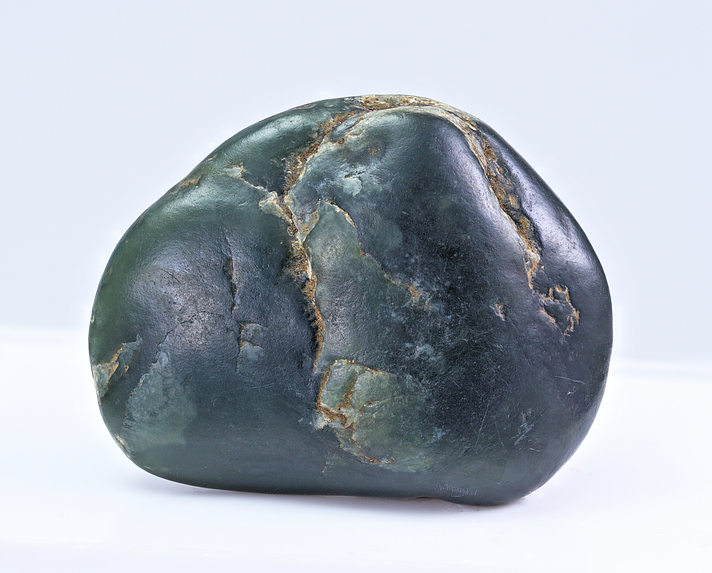
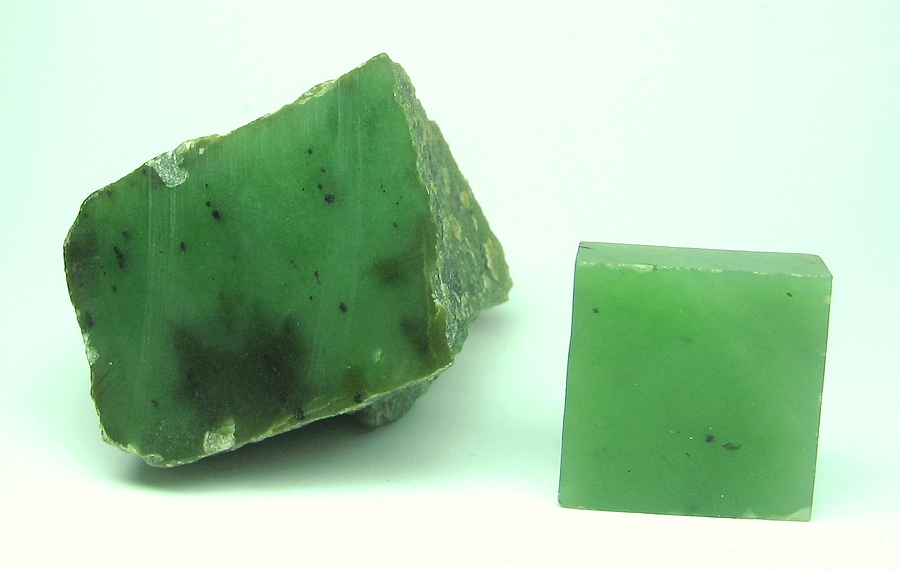
Many different rocks and minerals have been marketed as jade, especially jadeite, nephrite and serpentine, but also green quartz, vesuvianite (californite), carbonates (carbonate jade), Hornfels etc. Gemmologists, however, usually restrict the name to just jadeite and nephrite, both characteristically forming very tough, fine grained rocks. Nephrite is much more common than jadeite, and is a tremolite and/or actinolite-rich rock, and this is why it has been classified here as a type of metamorphic rock rather than a generic term.
Jade from Myanmar has been divided into five groups according to the main mineral constituent of the respective sample (Franz et al., 2014): (1) jadeitites with kosmochlor and clinoamphibole, (2) jadeitites with clinoamphibole, (3) albite-bearing jadeitites, (4) almost pure jadeitites and (5) omphacitites.
 Visit gemdat.org for gemological information about Jade.
Translucent emerald-green fei cui jade (known traditionally as 'jadeite jade' but this name is misleading as not all of this jade is mineralogically jadeite) is the most prized variety. Rarely also blue, lavender-mauve, black, red or yellow in colour, depending on mineralogy and impurity elements.
In 1863, French mineralogist Alexis Damour discovered that what at the time was being called jade, were in fact 2 distinct mineral species, namely jadeite and nephrite.
Many different rocks and minerals have been marketed as jade, especially jadeite, nephrite and serpentine, but also green quartz, vesuvianite (californite), carbonates (carbonate jade), Hornfels etc. Gemmologists, however, usually restrict the name to just jadeite and nephrite, both characteristically forming very tough, fine grained rocks. Nephrite is much more common than jadeite, and is a tremolite and/or actinolite-rich rock, and this is why it has been classified here as a type of metamorphic rock rather than a generic term.
Jade from Myanmar has been divided into five groups according to the main mineral constituent of the respective sample (Franz et al., 2014): (1) jadeitites with kosmochlor and clinoamphibole, (2) jadeitites with clinoamphibole, (3) albite-bearing jadeitites, (4) almost pure jadeitites and (5) omphacitites.
Visit gemdat.org for gemological information about Jade.Unique Identifiers
Mindat ID:
10403
Long-form identifier:
mindat:1:1:10403:8
Classification of Jade
Sub-divisions of Jade
Synonyms of Jade
Other Language Names for Jade
Arabic:يشب
Catalan:Jade
Danish:Jade
Dutch:Jade
Esperanto:Jado
Farsi/Persian:یشم
Finnish:Jade
French:Jade
German:Jade
Hebrew:ירקן
Hindi:हरिताश्म
Hungarian:Jáde
Indonesian:Giok
Italian:Giada
Japanese:ヒスイ
Malay:Jed
Nahuatl:Chālchihuitl
Norwegian:Jade
Polish:Żad
Portuguese:Jade
Russian:Нефрит
Spanish:Jade
Swedish:Jade
Thai:หยก
Turkish:Yeşim
Ukrainian:Жад
Common Associates
Associated Minerals Based on Photo Data:
| 6 photos of Jade associated with Nephrite | |
| 2 photos of Jade associated with Ferro-actinolite-Tremolite Series | |
| 1 photo of Jade associated with Quartz | SiO2 |
| 1 photo of Jade associated with Xiuyan Jade |
Internet Links for Jade
mindat.org URL:
https://www.mindat.org/min-10403.html
Please feel free to link to this page.
Please feel free to link to this page.
References for Jade
Localities for Jade
 symbol to view information about a locality.
The
symbol to view information about a locality.
The Locality List
 - This locality has map coordinates listed.
- This locality has estimated coordinates.
ⓘ - Click for references and further information on this occurrence.
? - Indicates mineral may be doubtful at this locality.
- This locality has map coordinates listed.
- This locality has estimated coordinates.
ⓘ - Click for references and further information on this occurrence.
? - Indicates mineral may be doubtful at this locality.
 - Good crystals or important locality for species.
 - World class for species or very significant.
(TL) - Type Locality for a valid mineral species.
(FRL) - First Recorded Locality for everything else (eg varieties).
- World class for species or very significant.
(TL) - Type Locality for a valid mineral species.
(FRL) - First Recorded Locality for everything else (eg varieties).
All localities listed without proper references should be considered as questionable.
Onot river, Irkutsk Oblast, Russia