











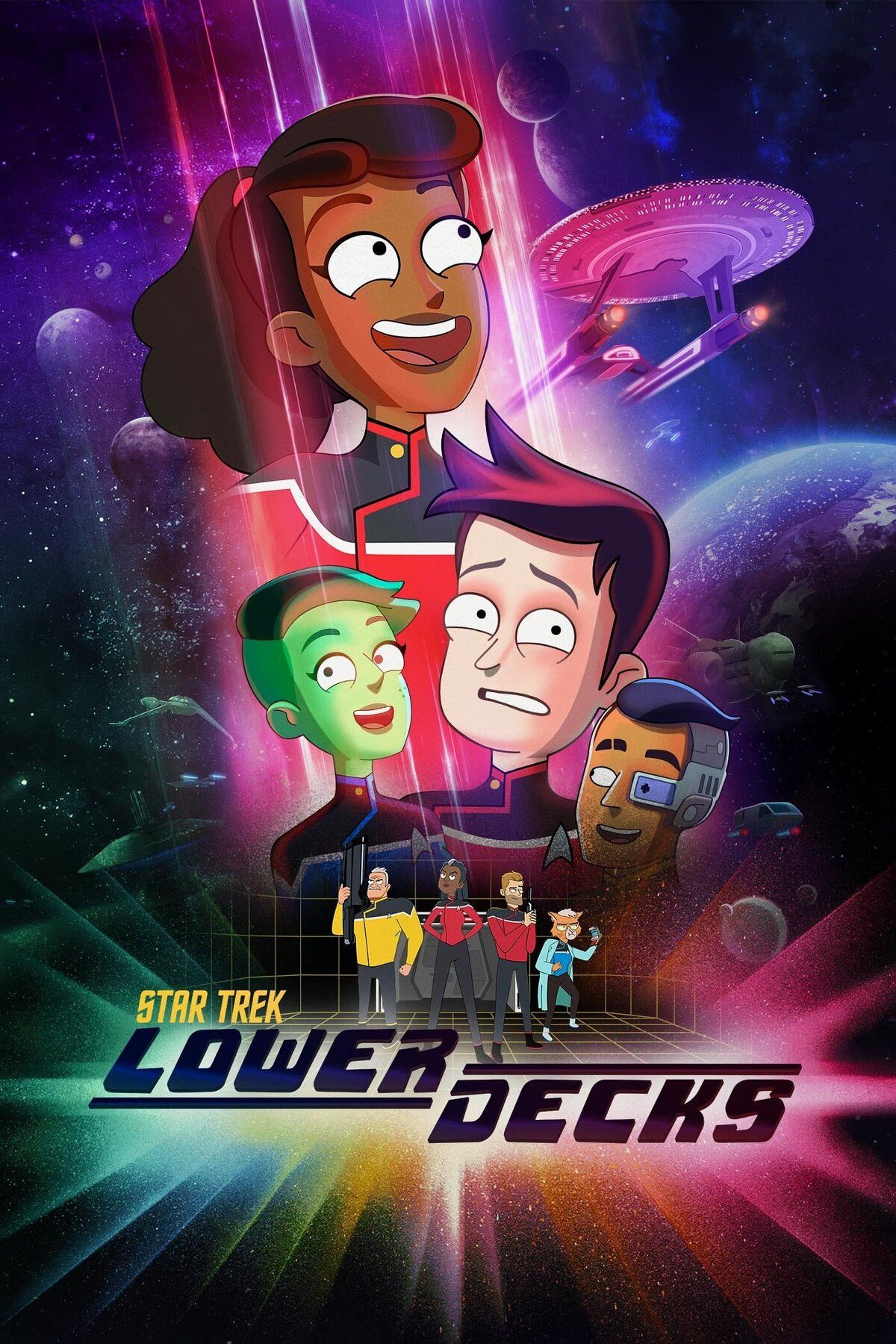
Star Trek: Lower Decks is an American animated Work Com aimed for adults, and set in the Star Trek universe. Created for Paramount+ by Mike McMahan (Rick and Morty, Solar Opposites), it is the first animated series created for CBS All Access, and the first animated Star Trek series since Star Trek: The Animated Series.note
The series follows the exploits of the U.S.S. Cerritos, one of Starfleet's least important ships, in the year 2380. This sets it between Star Trek: Nemesis (2379) and Star Trek: Picard (2399), still years from the collapse of the Romulan Star Empire, a period of relative peace for the Federation shortly after the end of the Dominion War and the return of Voyager to the Alpha Quadrant.
The focus characters are a group of four ensigns on the Cerritos. They are the lowest-ranking members of the ship's crew and underappreciated by everyone above them in rank, but each have immense potential and manage to accomplish great things due to their friendship.
- Beckett Mariner (Tawny Newsome): A rules-breaking rebel with a poor opinion of Starfleet, and the daughter of the ship's captain and a Starfleet Admiral. Brilliant, but Lazy, she is actually a grizzled veteran of Starfleet and often breaks the rules to get things accomplished, but is highly impulsive and has no desire to advance, having apparently been demoted from a higher rank multiple times.
- Brad Boimler (Jack Quaid): A nerdy and rules-abiding Ensign who has served on the Cerritos for a year, but has limited field experience (having only visited five planets, including Earth and Vulcan, in the first episode). He nonetheless thrives under heavy workloads, dreams of becoming a captain and has an encyclopedic knowledge of the galaxy.
- D'Vana Tendi (Noël Wells): A Green-Skinned Space Babe of the Orion species, she is a Plucky Girl nerd who is studying to be a doctor. She is thrilled at the prospect of adventure on the Cerritos but is somewhat oblivious to how dangerous serving in Starfleet can be, and sensitive to the stereotypes associated with Orions.
- Sam Rutherford (Eugene Cordero): A human who was fitted with a Vulcan brain implant that gives him special abilities while also interfering with his emotions. He's a Grease Monkey who's passionate about engineering, and also incredibly optimistic and chipper about every facet of starship life.
The name of the show and general premise is inspired by popular Star Trek: The Next Generation episode "Lower Decks," the same episode which inspired the Lower-Deck Episode trope (of which multiple references have been made in the show itself).
The show debuted on August 6, 2020 initially as a feature for CBS All Access before migrating to Paramount+. International distribution has been handled by varying local networks and other services like Amazon Prime. The second season of Star Trek: Strange New Worlds featured a Crossover with Jack Quaid and Tawny Newsome portraying their characters in live action via a Time Travel mishap.
IDW Publishing started a three-issue Star Trek Lower Decks comic book miniseries written by Ryan North and illustrated by Chris Fenoglio in September, 2022. It was followed by a "Choose Your Own Adventure"-style graphic novel, also written by North, then an 18 issue ongoing series with a rotating series of writers and artists from 2024 to 2026. Ryan North wrote the first two arcs, followed by Tim Sheridan. Shaxs also guest starred in the 2022 ongoing Star Trek comic, with two one-shot issues for both of its crossover stories focusing on him, while an alternate version of Mariner appeared in the Sons of Star Trek miniseries.
The show ended with its fifth season.
Season trailers:
General trope examples:
Why is he troping? What does he know?!:
- 2D Visuals, 3D Effects: The characters and most of the settings are 2D, but the space battles tend to be CGI.
- Accidental Misnaming: Throughout the first season, Boimler's superior officers consistently misremember his name, culminating in Riker calling him "Boomler" in the season finale, even as he's offering him a promotion and transfer to the Titan. As part of his Character Development, this is completely dropped in the second season.
- Aerith and Bob: Names like Jack and Carol sit comfortably next to Anderithio and Bradward. Played with, since the more unusual names are shortened to something more "normal", like Andy and Brad.
- Samanthan (சாமந்தன்) is a traditional Tamil boy's name meaning leader, so Rutherford's a Bob not an Aerith.
- Samanthan (சாமந்தன்
- Affectionate Parody: This is a show that is best appreciated by Trekkies as a number of references, mythology gags, and Easter Eggs can only be appreciated by a super fan of every series. It also suggests how miserable and dangerous being a Red Shirt on a Starfleet vessel might be, and pokes holes at many of the flaws of Starfleet.
- A.I. Is a Crapshoot: Star Trek's favourite trope is back in force!
- In season 1, Rutherford creates Badgey, a Clippy-style helper avatar who, par for the course, develops homicidal daddy issues against his creator and tries to murder him and Tendi on the holodeck. In the season finale, he indirectly causes Shaxs' death, although he does sort of help blow up the Pakled ship. Like a bad Whack-A-Mole, it also makes appearances in a few later episodes sowing chaos in its wake.
- Season 2's “Where Pleasant Fountains Lie” has Boimler escorting a malevolent supercomputer named Agimus back to Starfleet custody. It enslaved an entire civilization and constantly tries to trick Boimler into plugging it into a comms network. Turns out Starfleet has an entire facility devoted to storing evil AIs.
- In a Call-Back to TNG, “No Small Parts” has an exocompnote named Peanut Hamper join the Cerritos crew. She's friendly enough but when push comes to shove she chooses to beam herself into space rather than undertake a dangerous mission to save the ship. After drifting in space for months, she eventually lands on a planet of owl people where she almost gets them all killed arranging a dangerous scavenger attack to make herself look heroic so Starfleet will take her back. Subverted as she's mainly just a narcissist who only joined Starfleet to piss off her dad, rather than doing all this for typical berserk AI reasons.
- In season 3 Admiral Buenamigo unveils new Texas-class fully-automated starships. But since he based their AI on the same code Rutherford used to create Badgey, the ships eventually go rogue and kill him, causing severe damage to Douglas Station, the Cerritos and the U.S.S. Van Citter before they're destroyed.
- Alas, Poor Villain:
- Rutherford's original personality's fate in "Reflection" is portrayed rather somberly. He was a Jerkass who tried to erase Rutherford's current personality, but he was ultimately a victim of Buenamigo who had his mind altered and spent years trapped in his own mind. He ultimately decides the new Rutherford is a better person than he is and chooses to be erased from existence, refusing to let Rutherford merge with him out of fear he'd kill him.
- Nick Locarno, the Big Bad of Season 4, is a ruthless, bullying egomaniac who shoots down any attempt to reason with him. However, while his death is played for humor, Mariner is clearly guilt-ridden that she couldn't save him and his ultimate fate is treated rather somberly.
- Alien Arts Are Appreciated: Both Mariner and Tendi are apparently fans of "Klingon Acid Punk" music.
- Alien Sky:
- Based on a holodeck simulation of the Adashake Center, the Orion sky is green.
- The sky is yellow and the clouds are beige on the Galardonian homeworld.
- Gelrak V has a green sky with green clouds.
- The Alleged Car:
- While the U.S.S. Cerritos is a Cool Starship, she does have her malfunctions. The opening credits show the ship being prone to complete power loss, and in the series premiere, red alert somehow deactivates a certain emergency hatch.
- The shuttle Sequoia, which is a constant presence in the ensigns' repair bay, is a subversion. Despite its battered and patchy appearance, the one time it is needed for an emergency, it does the job quite well. Doesn't mean there aren't still things wrong with it, but it's clearly spaceworthy. In season 5, Rutherford admits that he hasn't been seriously trying to repair it, because he enjoyed the time spent working on it with Tendi rather than the outcome of having a working shuttle. T'Lyn, who hadn't known this and spent an afternoon repairing it to perfect working order, promptly tears it down to the floor plates to make him happy.
- The shuttle sent by Starbase 80 is a dingy brown and really doesn't look like it should have managed to fly to the Cerritos, much less back, in keeping with Starbase 80 being a hellhole.
- Allohistorical Allusion: Mariner cries, "It's the 80s dude! We don't have psychiatric problems!" when ordered to attend therapy; a reference not only to the 2380s, when the show is set, but also to the 1980s, when mental health wasn't considered nearly the issue it is today, and many thought a starship with a counselor onboard was uninspiring.
- Alternate Universe: The main plot of season 5 has an unknown party poking holes in spacetime to alternate universes, leading to several odd variations on the main one: everyone is slightly different, everyone is microscopic, everything is purple, and so forth.
- Amazing Technicolor Population:
- Blue: Andorians, Benzites, Bolians, Taxors.
- Green: Orions, Gelrakians.
- Grey: Drookmani.
- Purple: Galardonians, the inhabitants of Mixtus III, the Dooplers, and a member of an unnamed purple species that also works on the Cerritos.
- Red: At least one of the two residents of Mixtus II has red skin.
- Animation Bump:
- Ransom gets much more detailed animation when he rips off his shirt for the gladiator fight in "Temporal Edict".
- The Cerritos model has been refined and tweaked for season 2, justified in-universe as the result of a refit/repair after being attacked.
- There are two instances of this for Badgey, when he gets closeups, in "A few Badgey's more".
- Amusing Injuries: Gory injuries are almost always Played for Laughs, poking fun at the franchise's depiction of "dermal regenerators" and other futuristic medical devices—often made of some handheld prop with a lightbulb in it. Lower Decks takes it to before-unseen extremes by waving a light even over messy compound fractures for an instant fix, characters being careless about inflicting such injuries due to the ease of healing, and nonchalant conversations continuing while someone has a spear in their shoulder. (There are exceptions, however, such as Freeman's injuries in the first season finale.)
- Anachronism Stew:
- A flashback in "Cupid's Errant Arrow" shows Mariner had been in Starfleet as far back as 2369, but she and her fellow shipmates were in uniforms that wouldn't be in use until 2373. Alternately, they were discussing news from 2369 in 2373 as if it were current. Either way, the situation is odd, although we later see those uniforms are still in use on certain ships such as the Titan.
- A minor one: the music playing in Boimler and Rutherford's Mark Twain holoprogram (which is presumably based on his 1883 book Life on the Mississippi) is Scott Joplin's "Pineapple Rag," a song written in 1908 - well after the heyday of sidewheel steamers, and only two years before Twain's death.
- Archaic Weapon for an Advanced Age: Although a spacefaring civilization, the Gelrakians haven't developed any Ray Guns and still rely on crystal spears when attacking enemies. Crystal battle blades and crystal-embedded clubs are traditional for a Trial by Combat. Although the last may be because their leaders think that they're cool, and their starships are equipped with phasers (although possibly not photon torpedoes, since they're not crystal-based).
- Arch-Enemy: The Gelrakians (a crystal-worshipping society) consider the inhabitants of Mavok Prime (a wood-worshipping society) to be their sworn enemies.
- Art Evolution: The Cel Shading CGI for the Cerritos has evolved since the early episodes. It appears that the Cerritos model was revamped if not replaced entirely, with slight changes to the proportions and adjustments to the lighting scheme, notably giving the name and registry number its own spotlight in season two.
- Artificial World: The Big Bad of Season 4 Nick Locarno has a black market Ferengi Genesis Device, which like in the Star Trek film series, can create planets from nearby matter, with the intent of using it to threaten any starship that attempts to thwart his plans. However, Mariner steals it from him and takes it into deep space, even willing to activate it to keep it from him. She does, but is rescued in the nick of time. When Locarno (who had chased her down) tries to deactivate it, he's stopped by a Ferengi paywall and he, the ship he's on, and the nearby stellar clouds are used to form the new Planet Locarno.
- Art Shift: Being the second Star Trek animated series after Star Trek: The Animated Series, whenever actual images are shown related to the Kirk era it is shown in the Filmation art style rather than the show.
- Aside Glance: The space worm attached to the Cerritos in the opening credits does this as the ship flies past the camera.
- Assuaging Axolotl: Played straight and subverted with the Khwopians. This alien species resembles axolotls, are amphibious and live on a swamp planet. They're ruled by a king, are peaceful, and can be seen in the background of a few shots. In the penultimate episode of the series, the crew are chasing another ship across parallel realities, and crash lands on an alternate universe version of Khwopa. The Khwopians there are aggressive, warlike, and mortally wound Curzon Dax.
- Back from the Dead: Parodied and discussed - Shaxs comes back from the dead in one episode, and nobody discusses it. In particular, Boimler and Mariner point out that this happens to bridge crew all the time.
- Bait-and-Switch: A commonly used trope on the series. A typical sitcom trope would be set up, like the fear of the boss yelling at an underling's request to transfer, only for it to be immediately subverted by him saying he's super happy for the underling and generally being supportive.
- Big Bad: The first two seasons are largely episodic, but feature the Pakleds as an overarching villain. The third and fourth seasons are relatively more serialized, with Admiral Buenamigo and Nick Locarno respectively serving as the orchestrators of most of each season's external conflicts.
- Bloodier and Gorier: While the series is trying to imitate Star Trek: The Next Generation's style, it is not afraid to have blood spray about, while the older series tended to be mostly bloodless. (Usually in the cause of Amusing Injuries, but sometimes—as in the first season finale—the sight of blood is treated gravely.)
- Boring, but Practical: Second Contact may not be as glamorous as First Contact, but it's where the important bureaucratic work gets done.
- Bottled Cool: In "Parth Ferengi's Heart Place" some of the U.S.S Cerritos crew visit Ferenginar the homeworld of the the Ferengi, a Proud Merchant Race which is economically completely different to the Post-Scarcity Economy of Starfleet. Boimler ends up experiencing television commercials for the first time and witnesses an advert for "Slug-O Cola" which depicts a scrawny Ferengi guy becoming more confident and getting bigger ear lobes (the Ferengi equivalent of Bigger Is Better in Bed) so attracting the attention of a woman and gaining sunglasses out of nowhere. The ad even promises that this will literally happen to anyone who drinks the cola.Boimler: [laughing] So they can just lie to everyone?
- Bring Them Around: In "Dos Cerritos", Mariner is knocked out by an alternate version of herself who plans to flee her own reality due to the self-inflicted pressure of being captain. Mariner manages to escape, and tries to plead with the alternate Cerritos crew to help her. They realize she's not their version simply because she said "please", something Captain Becky would never do.
- Bunny-Ears Lawyer: The four protagonists have their unique talents while also being quirky. The senior staff is implied to be the same way.
- Mariner is an Action Girl who's incredibly knowledgeable about the galaxy, but also relentlessly insubordinate as well as prone to acting before thinking.
- Boimler is a stickler for the rules and full of technical knowledge, but a Lovable Coward who has little practical experience.
- Tendi is a Plucky Girl and The Heart of the team, but overly eager to please as well as easily impressed.
- Rutherford is a Cyborg with incredible engineering skill, but horrible at making command decisions as well as interpersonal reactions.
- Burnout by Traumatic Job: The penultimate episode of the entire series shows William Boimler, transporter clone of Cerritos ensign Brad Boimler, has become exhausted due to dealing with rifts in the multiverse that have been popping up throughout the season, having to take on several multiversal refugees, including a veritable army of Harry Kims. It seems to at least partially be commentary from the writers on the overuse of the multiverse as a trope science fiction in recent years.
- Call-Back:
- The computer-worshipping planet of Beta III is revisited almost a century after Starfleet's first visit in the TOS episode "The Return of the Archons".
- An exocomp becomes a new ensign, after having been declared a sentient species sometime after the events of the TNG episode, "The Quality of Life".
- The Pakleds are back, a species only seen once during TNGnote , and one of the most ridiculed, only now they appear to have upgraded to a major threat.
- Riker comes in to save the Cerritos in the U.S.S. Titan, the same ship he was given command of at the end of Star Trek: Nemesis.
- The second season reintroduces the Tamarians, a race first appearing in the Star Trek: The Next Generation episode "Darmok", in the form of Shaxs's replacement, Kayshon. Thankfully, he knows Federation Standard for the most part, only lapsing into metaphors when he can't remember the right word (or when he's flirting).
- That same episode is only the third time in Trek history to show sonic showers.
- Also in the second season, Boimler gets a transporter duplicate after an interference field combined with a second transporter beam materializes one on the ship, and another stuck on the planet. The same thing happened to Riker, as we learn in "Second Chances".
- The episode "Mugato Gumato" reintroduces Mugatos; gorilla-like creatures last seen in the TOS episode, "A Private Little War".
- The cosmic koala mentioned in "Moist Vessel" gets brought up again after Boimler's near death experience in "First First Contact". Tendi, who was present for both comments, is distinctly weirded out by it.
- The Season 4 trailer features Mariner mentioning that "Pike thing [they're] not supposed to talk about."
- In season 4 we learn that the entire show is in fact tied to the TNG episode "Lower Decks", as Mariner was a close friend of Sito Jaxa and was traumatised by her death.
- The comic has numerous references to the show. For example, Season 4’s "Twovix" is brought up when Janeway is conjured as Mariner’s mentor in teaching her how to murder her friends. Janeway used it to show off her skills, while Mariner was freaked out because she couldn’t tell what part of Janeway was the original and what part came from the heightened aggression.
- Canon Immigrant: When Riker's U.S.S. Titan makes her first onscreen appearance, it's still Sean Tourangeau's competition-winning Luna-class design for the covers of the Star Trek: Titan novel series.
- Mr. Broker (from the episode "The Inner Fight") resembles Balok's puppet in TOS: "The Corbomite Maneuver", though he is not a puppet himself, bringing to mind the expanded universe explanation that Balok species is called the Linnik, and the puppet's species is the Dassik as seen in the expanded verse novel The Face of the Unknown.
- The Sphinx Workpod makes its official appearance here, having only been seen in Star Trek: The Next Generation Technical Manual and meant to show up in the TNG pilot, but was too expensive.
- Captain's Log: As is tradition. Used infrequently during season 1, when Freeman was a remote, detached, vaguely antagonistic figure; from season 2 onward, consistent with her depiction as more approachable and relatable, she delivers a log entry in most episodes.
- Cat Folk: T'Ana is a Caitian, a humanoid feline species first seen in The Animated Series. The ship's crew also includes at least one Kzinti, a different humanoid feline species featured in TAS and also mentioned in Star Trek: Picard.
- Cerebus Call-Back: Mariner's self-destructive and reckless behavior is Played for Laughs throughout most of the series. It becomes much more difficult to laugh at it when Season 4 reveals she's a Shell-Shocked Veteran and that these have been symptoms of her PTSD. She's deliberately sabotaging herself because she's terrified of being put into a leadership position where she would have to make decisions that inevitably got people under her command killed.
- Character Exaggeration: Any live-action Trek character who makes a cameo plays an appropriately cartoonish version of themselves. Q's games to try humanity are even more convoluted and annoying, Riker is an incredibly Large Ham who makes constant jazz references, and Tom Paris' reaction to Boimler's temporarily Kazon-like hair is to tackle him immediately. This extends to species as well. The Vulcans are even more stoic and orthodox and the Pakleds are even more stupid.
- Character Regression: Played With Mariner, where she often regresses by showing her worst traits, including rebellion against authority and impulsive actions, over the series from time to time. It's revealed in "The Inner Fight" that Mariner's regression happens due to her still being in grief over losing her friend and classmate in the Dominion War. Thanks to Ma'ah's response that she isn't honoring her friend's memory by being self-destructive, she eventually resolves her trauma.
- Characterization Marches On:
- Early episodes had a much more hostile relationship between the Lower Deckers and the Senior Staff, with the Senior Staff coming off as unfeeling, arrogant jerkasses only looking out for themselves. Come season 2, the depiction of the Senior Staff softened and the relationships between the two groups improved. The Senior Staff kept their quirks, but they were shown to be more competent and well intentioned, with several of them serving as mentors to the main characters. Come season 4, the hostility between the ranks is all but forgotten, with the two groups getting along well and helping each other to improve, perhaps as a deliberate attempt to work on their flaws after a disastrous visit from a journalist that nearly got the entire Cali-class decommissioned.
- The early relationship between Mariner and Boimler was a strong-minded, domineering woman next to a meek, ineffectual man. After a few episodes it evolved to where Mariner still had a lot more field experience but Boimler thrived under pressure and in workaholic conditions. The show also became a bit more ensemble-based with them, Tendi and Rutherford forming a close-knit group rather than just Mariner and Boimler plus their friends. Boimler was also the designated Ascended Fanboy with extensive knowledge of Starfleet history, while that became a trait of near everyone.
- Chekhov's Gun: The batlith that Mariner accidently slices open Boimler's thigh with in the pilot's Cold Open comes back in the Season 1 Finale when Mariner reveals her stockpiles of contraband. She's seen weilding it after arming the other members of the bridge crew with various smuggled weapons.
- The Coconut Effect: Lower Decks continues the Star Trek tradition of forgetting that Starfleet has enlisted personnel, or "crewmen", who serve under the officers. In this case, Acceptable Breaks from Reality are involved, because it would undercut the premise of the show to have the New Meat ensigns giving orders to non-coms.
- Comically Missing the Point: The four are kidnapped by the Excalbians, who want to study the concept of mentorship. To do this, they conjure up each group member’s “perfect mentor” and have them demonstrate mentorship by… staging a battle royale to the death.
- Continuity Cavalcade: Every episode is packed with both Continuity Nods and Mythology Gags, using both Rapid-Fire Comedy in referencing deeper lore along with background Easter Eggs filling the screen at times.
- Continuity Nod: It gained enough entries for its own page after just two episodes.
- Continuity Porn: The series has a huge amount of it with virtually every frame filled with Easter Eggs, references, and homages.
- Continuity Snarl: Slight one. Mariner's flashback to Deep Space 9 shows her and her friends wearing Star Trek: First Contact-era uniforms, yet they are discussing the events of "Descent", which occurred during TNG's sixth season, before those uniforms were introduced.
- Contrived Coincidence: In one timeline, the Vendorians wiped out all bipeds—yet still built their ships to bipedal specifications, simply because they liked the designs. They also casually wear personal phaser-nullification fields despite there being no real reason for it.
- Cool Starship:
- Although she is decidedly one of Starfleet's less glamorous vessels, the U.S.S. Cerritos, the setting of the series, qualifies. Ensign Tendi, in particular, squees as soon as she comes aboard.
- The U.S.S. Vancouver is the starship equivalent of Always Someone Better to the Cerritos; the Lower Deckers are positively gushing over its awesomeness during their visit.
- The U.S.S. Titan is a Beam Spamming Lightning Bruiser of a starship that gets introduced with a Big Entrance Gunship Rescue and a Theme Music Power-Up.
- Cosmic Entity: Assuming that Lieutenant O'Connor's interpretation of the visions he experienced during his ascension is correct, then the universe is balanced on the back of a giant, smiling koala. Called back as a gag in the Season 2 finale, as Boimler mentions seeing a giant koala during an offscreen near-death experience after almost drowning as the result of his spacewalk suit sprung a leak in Cetacean Ops. The koala even appears in the intro card for season 3, visible for a few moments as a part of the nebula in the background.
- Covered in Gunge: Frequently.
- In "Second Contact", many people are covered in Bad Black Barf from the zombies, while Boimler gets covered in milkable Giant Spider spit. Gunge B turns out to be the cure to Gunge A.
- In "Envoys", Boimler, Mariner, and their shuttle quickly get soaked in Mariner's ramen broth and Klingon bloodwine.
- In "Moist Vessel", Mariner gets a face full of lubricant when the turbolift ascends with her on top of it.
- In "Cupid's Errant Arrow", Boimler spills beer all over Brinson after he trips on Jet's foot.
- In "Terminal Provocations", Mariner bumps into T'Ana in the mess hall, which causes the latter to face plant into a plate of nachos; the Caitian complains that it's extremely difficult to remove cheese from fur in the sonic shower.
- In "The Spy Humongous", Boimler covers himself in gunge as part of a Cooldown Hug for Tendi, who had transformed into a giant scorpion monster. Earlier in the same episode, Tendi is eaten and then excreted by a giant sluglike monster, which leaves her covered in slug poop.
- Crazy-Prepared: Discussed. In-universe, Shax has been suggesting for years that anti-tachyon emitters should be standard issue on all starships.
- Crystal Spires and Togas:
- The holodeck recreation of the Adashake Center on Orion depicts a beautiful Shining City with elegant architecture, and its residents are dressed in toga-like clothing.
- The Gelrakians don't wear togas, but there are crystals everywhere on their planet and in their culture, plus their technology is crystal-based.
- Cunning People Play Poker: One season one episodes show the commanding crew of the U.S.S. Cerritos playing poker much like their Enterprise counterparts. Noticeably, however, each player opted to fold each hand, showing an averseness to risk taking.
- Dark Is Not Evil: The Edosian medical expert on the Osler wears dark clothes and is on a dark ship and has a nasty attitude, but in the end he's trying to help the various mutated and anomalous Starfleet officers. He does admit he should consider brightening things up, and his bedside manner is terrible.
- Debris Attack: After negotiations break down with Drookmani scavengers over salvage rights to a debris field containing Federation technology, the Drookmani begin using their tractor beam to hurl chunks of the debris at the Cerritos.
- Deconstruction: The series takes a look at how horrifying and traumatizing some of the events that happen in a typical weekly Star Trek show would be, by presenting them from the perspective of your typical low-level grunt or Red Shirt. This includes opening a story with a Zombie Apocalypse on the U.S.S. Cerritos. Played with as, with the exception of Boimler, the protagonists are entirely unfazed by this.
- Deconstructor Fleet: A great deal of the show's humor would not make sense to you if you were not an enormous fan of the franchise with knowledge of every single series. Jokes are made at the expense of TOS, TNG, DS9, and VOY. Many of these require knowledge of specific episodes' plots and the holes thereof. Lampshaded in the crossover episode with Star Trek: Strange New Worlds, where Una asks if anyone else has noticed that all of Mariner and Boimler's references are 'weirdly specific.'
- Deconstructive Parody:
- It should also be noted that a lot of the jokes in the series make fun of the plotlines that are typical for the series. For example, Boimler goes into a lengthy speech about how he's going to die if he leaves Starfleet (see Mythology Gag) or how Mariner deals with an Energy Being that attempts to take over the ship.
- And yet while elements of the Trek 'Verse are deconstructed, the show pulls a Decon-Recon Switch of sorts by revealing the reasons why Starfleet does what it does and how they keep it all working. That there are logical reasons for "buffer time", or that Starfleet has a contingency plan to treat the unfortunate Red Shirts who survive the occasional transporter accident or alien infection.
- At the beginning of the second season Boimler is on the Titan serving under Captain Riker and he ends up having a meltdown because he was engaged in one dramatic battle after another where they are dealing with a dark, ongoing seasonal threat. Other crew members mention that the Enterprise-D must have been so boring because it dealt with space phenomenon and they would have concerts. Boimler eventually snaps saying he preferred exploration and intellectual pursuits over facing death every day, and Riker himself says he loved going to the concerts "on the D".
- Decon-Recon Switch: While the series spends a decent amount of time showing how horrible a lot of the stuff that goes on in most Trek shows would actually be, it also shows a great love and affection for the franchise as a whole. It also shows that working in Starfleet, while dangerous, can also be a fun adventure if experienced with the right people. Above all things, the point is made that exploration requires further engagement with the societies they discover and humanitarian efforts to leave them in better condition than before they showed up.
- Denial of Resemblance: In "Old Friends, New Planets", when the Cerritos crew encounters Nick Locarno, Rutherford thinks he looks like Tom Paris (both were originally played in live-action, and are voiced on LD, by Robert Duncan McNeill, though they're drawn as having diverged slightly with age). A bewildered Boimler insists he doesn't see the resemblance.Rutherford: They have, like, the same face. They're identical.
Boimler: No, I just don't see it. - Denser and Wackier: By virtue of being a comedy, Lower Decks is far more zany and silly than any past Trek series.
- Distant Sequel: It takes a while to be revealed, but the show — inspired by the trope-naming Lower-Deck Episode — turns out to have very direct connections to that episode. Mariner used to be friends with Sito Jaxa, and the latter character's death during "Lower Decks" was a Cynicism Catalyst for her.
- Double Meaning: The title of the show refers to the four main characters sure, but also to the Cerritos (and the rest of the Cali-class ships). Relegated to Second Contact and other boring duties, they are the "Lower Decks" of Starfleet as a whole. As the show continues, this alternate meaning begins to eclipse the original, particularly as the Ensigns cultivate relationships with the senior staff and are ultimately promoted out of the (literal) lower decks.
- Drama Bomb Finale: pretty much every season so far.
- The season 1 finale, "No Small Parts". The beginning of the episode has Dayton, a quirky captain that we've seen before, fussing over her new ship, and sixty seconds later it has been blown into shreds by a Pakled ambush. The Cerritos warps right into the debris field, finds no survivors, and the captain barely averts the same fate while being severely injured. In order to save the ship, Security Officer Shaxs sacrifices himself and Rutherford loses his memories of the whole season. While there is still plenty of humor, it is an episode that is just as high-stakes and dramatic as any other Star Trek season finale.
- Ditto with the season 2 finale, "First First Contact". In order to save the Archimedes and the planet Lapeeria, the Cerritos crew have to dismantle the ship's outer hull and fly through a deadly Asteroid Thicket unpowered and unprotected. Boimler nearly drowns in the process of removing a defective panel that would've gotten them all killed, Rutherford uncovers a memory that implies his implant wasn't voluntary, and Mariner and her mother finally reconcile their strained relationship amidst all the chaos. And that's not even mentioning the Sudden Downer Ending...
- And season 3's "The Stars at Night" starts with the Starfleet Admiralty threatening to decommission the entire California class, and only escalates from there. Admiral Buenamigo is revealed as an Insane Admiral who masterminded Rutherford's memory loss and used his AI code to create the Texas-class, and engineered the Breen attack on the Cerritos to make his pet project look good. When Freeman finds out, he sics the Aledo on her. Problem is, the AI is a precursor to what Rutherford used to create Badgey, so the ship goes rogue and kills him, awakens two of its sister ships and they start destroying a massive starbase. It takes some quick thinking by the Cerritos crew and Beckett pulling a Big Damn Heroes with all the other Cali ships to save the day, and even though their class is saved from the scrap heap a lot of the starbase personnel are presumably dead. Phew!
- Mike McMahan withheld the titles and story summaries of season 4's last two episodes until each was released, cluing viewers in that something serious happens in the 9th episode. And then that episode, "The Inner Fight", ended with a To Be Continued card, meaning it and "Old Friends, New Planets" are a two-part finale. As such, while both episodes have the show's trademark humor, the drama bomb starts an episode early:
- In "The Inner Fight", Freeman, attempting to distract Mariner with a ridiculously safe mission due to her increasingly reckless behavior, unknowingly sends her to the planet where the command crews of the stolen ships are being dumped by the mystery ship's pilot. Mariner, Boimler, Tendi, and T'Lyn are attacked and end up stranded on the planet, where Mariner ends up in a fight to the death with Ma'ah that's only disrupted by Hostile Weather. While sheltering in a cave with Ma'ah, Mariner ends up admitting the root cause of her Military Maverick behavior: PTSD stemming from Sito Jaxa's death and the Dominion War. After Ma'ah helps her come to terms with her trauma, she rallies the stranded crews together, only to be abducted by and come face-to-face with the mastermind: Nick Locarno. The B-plot is mostly comedic, but is caught in the Drama Bomb because it involves Captain Freeman searching for Locarno to take him into protective custody. The episode ends with Locarno greeting Mariner and saying they'll cause trouble together...
- In "Old Friends, New Planets", Captain Freeman defies orders not to rescue Mariner upon seeing her denounce Locarno on a live subspace broadcast. With the system Mariner is trapped in protected by a "Trynar shield", Tendi approaches her sister D'Erika for a large enough ship to breach it and ends up having to offer to return to Orion in exchange for the ship. As this is happening, Mariner is being chased by Locarno's "Nova Fleet" and trying to reach a lifeless planet to detonate a Genesis Device Locarno was using as a deterrent, but is forced into an ion storm and ends up setting the device off there before being rescued during a confrontation with Locarno, leading to Locarno getting himself killed in a Genesis Wave when he refuses rescue. Mariner arrives on the Cerritos and apologizes for her recent behavior, but then has to say goodbye to Tendi soon after due to the deal with D'Erika.
- Drinking on Duty:
- Buffer time margaritas, baby! Downplayed in that it's probably non-intoxicating sythehol since they got them from the replicator, though it wouldn't be out of character for Mariner to replicate actual alcohol for a single drink.
- In "Cupid's Errant Arrow", Boimler orders a beer in an attempt to impress Brinson, despite still being on duty.
- Driving Question: In season 4, who is behind the mystery ship and its ongoing attacks? Answer: Nick Locarno.
- Early-Installment Weirdness: The first season hadn't quite nailed down all the characters' personality traits.
- Beckett's Establishing Character Moment in "Second Contact" has her drunkedly severely injure Boimler. While irresponsible, Mariner's rule breaking is otherwise shown to never imperil her crew mates and that she cares deeply about them. Relatedly, her interactions with Boimler became less about her messing with him and more of a Cowboy Cop vs By-the-Book Cop dynamic.
- Boimler's favorite part of the ship is the warp engine, this is more a trait of Rutherford and Boimler is instead more interested in sucking up to the command officers.
- Rutherford and Ensign Barnes ignore the Zombie Apocalypse on the ship in "Second Contact" when later episodes show he always takes threats seriously (and frequently panics over them).
- Rutherford's implant glitches were originally blamed on it being Vulcan in origin, but after the first episode, this does not really apply (and later episodes eventually show us there's much more to the implant glitches than even Rutherford knew).
- The senior staff of the Cerritos tends to be dismissive or even cruel to the Lower Deckers at times. For instance, in "Second Contact", Captain Freeman credits Dr. T'Ana for discovering the way to cure the zombie-like state that the crew's in, ignoring how Boimler and Mariner were the ones who found it.
- T'Ana acted more human than feline.
- Shaxs was much more of a Sociopathic Soldier in the first season, before becoming more of a Shell-Shocked Veteran (though no less badass) from the second onward. Apparently, coming Back from the Dead really did a number on him.
- The first season had a bit of Ship Teasing between Mariner and Ransom, albeit of the belligerent variety. From season 2 onward, he's more of a Mentor in Sour Armor toward her, with the romantic tension abandoned.
- Characterisation aside, early in the first season it seemed like all of Starfleet used Cerritos-style uniforms, Admirals showed up wearing a variant, as did a Parliment-class ship's crew and some embassy staff. The TNG-movie black and grey style was first seen in flashback as well. Eventually it was established the style was for the California-class and other ships and starbases used the black and grey uniforms.
- The first season leaned on what a horror working in Starfleet must be, with danger and horrible situations around every turn. Come season 2, the series started leaning more on the fun aspects of life in Starfleet, with the Lower Deckers serving as audience surrogates and expressing their joy for the various aspects of the Star Trek mythos.
- Easygoing Expectant Mother: In "Shades of Green", Tendi accidentally discovers her sister D'Erika is pregnant and, due to being a (at-the-time) former Starfleet officer, panics at the baby's safety, trying to get her sister to settle down despite the fact that the two and their crew are trying to race a house of Blue Orions for the fate of their own house. D'Erika, being a tried-and-true Orion pirate, has no qualms about putting her child in danger since their mother did it with them and had hid the pregnancy in the first place because she knew Tendi would overreact.
- Eccentric Mentor: Pulaski filled this role for Carol during her ensign years. After the USS Illinois command crew was accidentally teleported into the Romulan Empire, Pulaski took charge by leaning into her Cloudcuckoolander tendencies. She ordered the crew to move her things into the captain’s quarters and “rewarded” them with pizza. Believing she planned to abandon them, the crew mutinied and threw her in the brig—where she just did stretches until the crisis passed. When the command crew was saved, Pulaski reassured a guilt-ridden Carol that she wouldn’t be court-martialed, pointing out that Carol and her fellow ensigns had behaved exactly as she expected them to.
- Entendre Failure: In the Season 3 opener, we see Boimler working at a vineyard, one where the grapes are turned into raisins. He is constantly hit on by gorgeous women who use double entendres to flirt with him or try to bang him. However, Boimler acts oblivious to all this, interpreting the entendres as literal, and is actually rather annoyed that the girls keep bothering him with seemingly minor things.
- Episode Title Card: Like TNG, Lower Decks features episode names, and even uses the exact same font from that series.
- "Everybody Laughs" Ending: Parodied in "Second Contact". After the crisis is over, the captain and her senior staff joke about the paperwork as they leave Sickbay— but the camera stays on the four ensigns who are still utterly shell-shocked by the events of the episode.
- Also deconstructed: Freeman, Shaxs, and T'Ana treat the zombie apocalypse as a joke, while Ransom, who was a zombie at the time, is clearly having a breakdown at the thought that he ate human flesh.
- Similarly deconstructed in "I, Excretus," where Shaxs cracks a joke about Boimler's (simulated) assimilation by the Borg and everyone else laughs while Boimler wistfully muses: "They took away everything I was!"
- Everyone Is Bi: Sexuality seems pretty fluid on the Cerritos. Ensign Mariner is openly pansexual ("bad boys, bad girls, bad gender-nonbinary babes..."), and many of the Mauve Shirts are Ambiguously Bi to some degree.
- Every Scar Has a Story: As Mariner recovers in sickbay in "Temporal Edict", Doctor T'Ana clears her to return to duty, but offers to repair the scars on Mariner's body. Mariner refuses the cosmetic procedure, stating "No way. These are my trophies."
- Evil Is Cool: In universe, Mariner's holodeck program has her and her friends playing murderous villains, and Dr. T'Ana's sexual fantasy turns out to be robbing a bank, massacring the police responders, and forcing the customers and staff to watch her having sex.
- Evolving Credits: There is one sequence in the opening credits where the Cerritos comes across a battle of Romulan ships engaging with a Borg Cube, only to turn around and head elsewhere. Each season adds more to the chaos including Pakled Clumpships, a Crystaline Entity, the Whale Probe and the fifth season throws both the green hand of Apollo and the V'Ger cloud into the mix. More subtle things have also been tweaked, including design changes to the Cerritos and the title card adding a trailing energy effect akin to the TNG fifth season title card update.
- Exhausted Eye Bags: Everyone aboard the Cerritos gets these in "Temporal Edict", including the senior staff when they have to correct the mistakes made by the harried crew. The only person who doesn't is Boimler because his workaholic, rules-following nature allows him to excel in an environment with tight deadline pressure. It later evolves into a Running Gag as the characters develop them to signify their stress levels have reached their limit.
- Expy Coexistence: Commander Ransom is an Expy of Will Riker with negative traits exaggerated almost to the point of being a Corrupted Character Copy. Will Riker appeared on the show, flanderized almost to the point of being a
 Shallow Parody.
 - Face Full of Alien Wing-Wong: The Anabaj procreate by injecting their eggs into another person's throat.
- Famed in Story: Given that this a show that gets closer to the ground, for lack of a better term, we see a lot of this throughout the series.
- The crews of basically every previous ship that's been in the franchise (with the exception of the Discovery, due to its mission and its fate both being classified) are treated as celebrities by most of the characters, and there are frequent moments of Hero Worship from most of Beta Shift, and even some of senior staff, whenever someone manages to make a cameo.
- Despite being a post-capitalist society, Starfleet manages to have merchandise based on its ships (though they're implied to be Ferengi in make, as they have branding from Quark on them) We see some in the form of Surprisingly Functional Toys that are models of various ships. It's unclear how the Cerritos managed to get a scale model of itself, but both Deep Space Nine and the Phoenix have similar kits. The comic adaptions show that there are action figures of Spock, and presumably the rest of the crew of Kirk's Enterprise.
- By the 3rd season, the Cerritos and her crew has become legendary amongst the California-class ships, with even the Lower Deckers themselves being regarded as heroes to be looked up to.
- Fantastic Fromage: Rutherford ends up remaking the grakel milk cheese from the Voyager episode "The Learning Curve" to save the ship from being taken over by holograms.
- Fantastic Racism:
- There's a bit more Lampshade Hanging on this being an element of the Trek Verse. Mariner has a much more cosmopolitan view of the galaxy due to being raised on starships, while Boimler has only been to five planets total (counting Earth and Vulcan) and only knows species from books. As such, he often makes numerous mistakes in interacting with aliens that Mariner avoids. This is shown most prominently in "Envoys" when Boimler assumes that a Ferengi is leading them into a trap and is a greedy monster just because he's Ferengi. It's actually a set-up by Mariner to boost his confidence. Subverted in "Terminal Provocations" when Fletcher calls Doctor T'Ana "just a cat in a coat", to which Mariner agrees.
- After the Dominion War, there is lingering resentment towards the Cardassians because no one in the Federation wants to go near the Cardassian homeworld, which is why the peace negotiations have been moved to Vulcan.Admiral: Nobody wants to go to Cardassia Prime. The Cardassians are creeping everyone out.
- In "Crisis Point", Tendi is upset because of the stereotypes associated with Orions, who often happen to be pirates and are famous for their seductive "slave girls", etc.. Though her protest does border on a Suspiciously Specific Denial.Tendi: And for your information, many Orions haven't been pirates for over five years!
- Fake Film Intro: The episode "The Stars at Night" opens with a news report recapping the damning profile on the Cerritos that was the center of the previous episode, going into the main plot when the anchor mentions Captain Freeman, her reputation in tatters after having her daughter transferred thanks to a misunderstanding, having been called by Starfleet Command for questioning.
- Faux Affably Evil:
- Homicidal AI Badgey retains a cheerful, happy-go-lucky demeanor even while going on murderous rampages.
Badgey: [cheerfully] Fun fact! I'm gonna rip your eyes out!
Tendi: That fact wasn't fun!- Peanut Hamper is very good at playing nice, but is monstrously selfish beneath that and very happy to get people killed to save her own neck.
- Admiral Buenamigo, the Big Bad of Season 3. He's a friendly, warm, grandfatherly man, but turns out to be a vain Glory Hound willing to kill or endanger entire colonies of people to get his vanity project off the ground.
- Fauxshadowing: In Season 3, multiple characters express concern that Brad's decision to become "Bold Boimler" is going to get him killed. So far, the Ensign's new-found confidence has served him rather well, with the worst consequence being his death... In a Klingon-themed tabletop role-playing game.
- First Contact:
- Explicitly averted. The U.S.S. Cerritos and her crew are among those charged with carrying out "second contact," the follow-up work with a species and their homeworld after it has been discovered and contact has been made by one of Starfleet's premier front-line exploratory ships.
- In the season 2 finale, Captain Freeman gets to make first contact (her first time doing so) with the Lapeerians, filling for Captain Gomez who was recovering from the day's ordeal in sickbay. It goes very well.
- Foil:
- Boimler and Mariner serve as direct representatives of this, with them having polar opposite personalities.
- Delta Shift is considered this to the protagonists, who are Beta Shift.
- In "Terminal Provocations", the character of Fletcher is introduced as the worst elements of both Boimler and Mariner combined. Despite his affable demeanor, he's a Dirty Coward who always claims that it's Never My Fault, and he doesn't care about any rules while relying on his friends to bail him out. Mariner says that she's different because she would never endanger a fellow crewmate with her rule-breaking (well, except Boimler). Fletcher gets fired from Starfleet.
- The Foodie: The avian-like Klowhakan race has this as their primary hat; their culture values culinary excellence above all else, to the point where their prisons forbid the use of butter, and an amuse-bouche is a traditional greeting on the planet. A pair of Klowhakan food critics serve as the antagonists for the B-Plot of "A Farewell to Farms", where they're revealed to have lost their sense of taste due to the pressure of their jobs.
- Foreshadowing: When Shaxs introduced Rutherford to the security team, he said something about no greater honor than to die beside (the team) in battle. Shaxs dies getting Rutherford to safety in the season finale.
- In Season Four, each of the non-Starfleet ships - Klingon, Romulan, Ferengi, Orion, even Bynar - that are attacked by the mystery ship get introduced via Lower Deck crews openly talking about plotting against their respective captains for control of their own ships. While it's expected of Klingons - whose warrior code encourages Klingon Promotion - and Romulans - established as Properly Paranoid schemers - there's a noticeable thread that gets revealed as a plot by the season's Big Bad Nick Locarno.
- Four-Temperament Ensemble: The four ensigns straightforwardly map to the four humors.
- Mariner: Choleric. Mariner is hot-headed, aggressive, and impulsive. She exhibits Blood Knight characteristics which are tempered by her rebellious nature. Mariner also shows leadership expertise when on away missions and, despite her laziness, is excellent at taking charge when the situation requires it.
- Boimler: Melancholic. Boimler is introverted, moody, and rigid. His away missions often end with him becoming overly self-critical and he falls into depressive moods often. He is deeply insecure, but his perfectionist qualities and devotion to the Cerritos give him some strengths.
- Tendi: Sanguine. Tendi is outgoing, sociable, and optimistic. She's easily the friendliest of the four ensigns and beats Rutherford to this position by being more outgoing and extroverted. Sanguine personality traits are also associated with youth, and Tendi is the rookie on the ship.
- Rutherford: Phlegmatic. Rutherford is calm, stable, and patient. The simple satisfaction that he takes from his job in engineering is all that Rutherford needs to be happy. These traits ended up crashing his date with Barnes, who was annoyed by him being more interested in running a diagnostic than in having sex during a ship-wide crisis.
- Franken-vehicle:
- Resting in one of the USS Cerritos's repair bays is Sequoia, a shuttlecraft built by the main four out of salvaged parts, with Class 6 nacelles mated to a 6A body, dinged panels with mismatched colors, and markings drawn on by hand. Although it hasn't been put into regular service because it's more of a passion project than anything else, Shaxs and Rutherford are forced to use it when the Cerritos is attacked by one of the Pakled warships and a boarding party prevents them from getting to the normal shuttlecraft to board and disable the Pakled ship.
- In "No Small Parts": The Pakleds' new war spaceships are made from parts of other ships. They even show that they can use grappling hooks to attach pieces of wreckage from other ships like the Solvang to their hulls to upgrade and repair on the fly.
- Fun with Acronyms: Ransom refers to Kirk's era as TOS, which he says stands for "Those Old Scientists"
- Geodesic Cast: The four main characters are vaguely mirrored by the four primary bridge officers, and other similar cliques exist on the ship as well, like the Redshirts.
- Genre Shift: This is the first Star Trek series that is primarily a comedy, and only the second series to be animated.
- Girl-on-Girl is Hot: When she comes upon a room full of nude crew during a "Naked Time" holographic training simulation, Mariner is very interested in the two female crew members making out directly in front of her. It helped that one of them was a hologram of Jennifer, who later becomes Mariner's "hot Andorian girlfriend."
- Glitch Episode: A running gag for Rutherford and his cyborg implant in the first season. In "Star Trek: Lower Decks S1E08 "Veritas"", he has to update his implant with Romulan flight manuals. During the multiple updates, he passes out and wakes up after his implant has taken over— Hilarity Ensues as he tries to figure out what the hell it did.
- Green-Skinned Space Babe: Subverted with Tendi, who does not like being thought of as one and hates situations where she's asked to be a sexy Orion.
- Played with as the series progresses, as Tendi has to cope with her legacy as a respected "Mistress of the Winter Constellations" and visits her homeworld where all the other Orion women live up to this trope.
- Groin Attack: In "Strange Energies" a series of these is how Mariner eventually defeats Ransom after he's given god-like powers by the titular strange energies.
- Gruel and Unusual Punishment: The entire Klowhakan race has being The Foodie as their Hat, to the point where butter is forbidden from their prisons.
- Half-Arc Season: Every season after the first:
- Season 2: The Pakleds, previously a largely comical villain from TNG, return and are a persistent thorn in the side of Starfleet, including the Cerritos.
- Season 3: The development of the Texas-class automated starships, headed by Admiral Les Buenamigo, an old friend of Captain Freeman.
- Season 4: An unknown alien vessel is attacking random vessels belonging to the major galactic powers except the Federation, somehow disabling their systems before obliterating their ships — or rather, as it turns out towards the end of the season, faking obliterating the ships to cover hijacking them.
- High-Class Harpsichord: Upon being barred from using the "Twaining" method for conflict resolution by Capt. Freeman, Lt. Boimler and Lt. Rutherford go in another direction when discussing whether to hang an oil painting or a watercolor of the Enterprise-D in their quarters, dressing up as identical Amadeus Mozarts and affecting upper-class accents while seated at twin harpsichords on the holodeck. They end up compromising and opting for an acrylic, to which Boimler suggests they tickle the ivories to celebrate. Rutherford then points out the obvious:Rutherford: Dang! This thing is really hard to play!
- Hijacked by Ganon: Cleverly subverted. Both the first and fourth seasons build up a mysterious villain, but each time they turn out to be minor villains from previous series (the Pakleds and Nick Locarno, respectively).
- Hot Food Hurts:
- In "The Spy Humongous", when Ens. Brad Boimler is trying to calm down Ens. D'Vana Tendi, who has turned into a scorpion after accidentally activating an Etaxian mood shifter he spills a bowl of hot baked beans on his uniform, accidentally burning himself in the progress.
- In "Upper Decks", Dr. T'Ana, after spending the episode subjecting herself to torture to adjust the pain scale in sickbay, (and somehow upping her own pain threshold tolerance to the point where even a phaser set to kill doesn't affect her in the process) is eating with her bridge crew colleagues. She accidentally spills the bowl of hot chowder on herself and exclaims that it hurts. before getting a knowing look from Nurse Westlake. She finally decides to update the pain management protocols in sickbay as a result.
- I Just Want to Be Special: In "Moist Vessel", Lieutenant O'Connor confesses to Ensign Tendi that he was merely pretending to want to ascend so that people would notice him more, and he hoped that this would boost his Starfleet career.O'Connor: Well, since we're gonna die here, I'll just tell you I was never going to ascend. I was faking.
Tendi: What, why?
O'Connor: It's hard to stand out in Starfleet. This gave me an edge. It was my thing. I was the ascension guy. - Ink-Suit Actor: Every voice actor in the opening credits could plausibly play their characters in live-action. The creators of Star Trek: Strange New Worlds took advantage of this with a Crossover episode in which Tawny Newsome's Mariner and Jack Quaid's Boimler jump not only into the past, but into live-action portrayal. The resemblances are not perfect — Mariner's hairstyle had to be revised, for instance — but the complaints about the episode did not center around physical quirks. Overuse of gimmicks aside, there is no reason the same could not be done with the remaining characters. Additionally, the show's animators base background and crowd scene extras on themselves, lending even the non-speaking characters an air of realism.
- Insane Admiral: Admiral Buenamigo in season 3 turns out to be this, as usual for the franchise, but a clever explanation is given for why so many Admirals go off the deep end. Once you get promoted to Admiral rank, you're stuck at Starfleet HQ where a billion other flag officers also are; to others, they may as well be interchangeable desk-bound commanders. Thus, many of them including Buenamigo throw themselves into ill-advised vanity projects in an effort to not be forgotten, but inevitably these projects go off the rails one way or another and often cause the Admiral's downfall.
- This was lampshaded earlier in "Cupid's Errant Arrow" when Ron Docent claimed to know an admiral who was a psycho.
- Averted however by Mariner's father, Admiral Alonzo Freeman, who is a Reasonable Authority Figure through and through.
- In Space, Everyone Can See Your Face: Notable in that, because the show is animated, spacesuit-wearing characters could just be drawn with visible faces beneath mostly transparent visors, but instead the artists depict internal lights illuminating the faces to maintain consistency with the visual style of the live action shows and films.
- Insane Troll Logic: In the comics, Mariner’s response to Ransom telling her he didn’t trust her was to deliberately skirt his orders—to prove how wrong he was not to trust her.Tendi: Um, do you have any Vulcan friends you wanna run that syllogism past, or…?
- Instantly Proven Wrong: In the Season 2 premier after Ransom is hit by the titular strange energies and starts to float, Mariner correctly identifies that he's become endowed with god-like abilities. T'Ana reprimands her and says that she has to run more test before that can be confirmed. Cue Ransom instantly healing himself from the damage of the energy blast (including his uniform), gaining telepathy, Glowing Eyes of Doom, and shooting energy beams all in the span of about 30 seconds. The rest of the episode is him just getting more powerful from there.
- Improbably Predictable: When Boimler returns to the Cerritos after being transporter cloned, Tendi ends up having to pay up to Rutherford for guessing that would be the reason Boimler would end up getting transferred back. When asked how he guessed, Rutherford replies that "it seemed like a Boimler thing to do."
- Internal Reveal: Boimler and Mariner never told Tendi and Rutherford that the Krulmuth-B was actually a Portal to the Past. They just claimed it sent them “nowhere” and did nothing. The truth only came out in the comic when a time traveler started rewriting Federation history.
- The Internet Is for Porn: One of Ensign Mariner's favorite holodeck programs is an all-nude Olympic training facility. Later, Ransom mentions that he had her cleaning the biofilters out of the holodecks, which apparently amounted to removing the various "bodily fluids" that the users have left behind.Ransom: I've got her cleaning [bleep] out of the holodeck's [bleep] filter!
Freeman: Ugh, people really use it for that?
Ransom: Oh yeah, it's mostly for that. - Interspecies Romance:
- Dr. T'Ana (Caitian) and Shaxs (Bajoran) repeatedly express an interest in each other, and T'Ana even asks Mariner if she could get Captain Freeman to sign off on them entering a relationship. Following his Unexplained Recovery in season 2, they become an Official Couple.
- Tendi, like most Orion women seen thus far, seems to have a thing for humans, hooking up (briefly) with O'Connor and carrying an obvious torch for Rutherford.
- Near the end of the Season 2 finale, Mariner asks out Jennifer — an Andorian that she previously disliked — after the latter saves her life.
- Kids Prefer Boxes: In "We'll Always Have Tom Paris," Dr. T'Ana sends Tendi to get a family heirloom. In transit, the heirloom gets wrecked, but T'Ana doesn't care, she only wanted the large wooden box it came in.
- Lampshade Hanging: Much of the series' humor comes from common elements of Trek actually being shocking.
- That the ships can regularly get into horrifying disasters like a Zombie Apocalypse, and this is considered to be a normal part of the ship's duties.
- That the holodeck will most definitely be used by someone (or probably most someone's) for pornnote .
- Mariner basically spells out in "Temporal Edict" that the story is a parody of a Kirk-centric TOS episode.Mariner: Huh, circled by spears. This is a classic. What am I, Kirk? Is this the 2260s? Alright.
- The head Gelrakian breaks down all the usual tropes associated with fighting a giant alien in an arena.
- Ransom calls the Kirk-era the "Tee Oh Ess" period, standing for Those Old Scientists.
- Last-Name Basis: Apparently this has come back into vogue in the 2380s, as characters almost never refer to each other by first name, not even close friends.
- Late-Arrival Spoiler: It's quite hard for anyone who looks into the show before watching it to avoid finding out that Riker, Troi, and the Titan show up at the end of Season 1.
- Legendary in the Sequel: Played for laughs. In the far, far future of the Federation, Miles O'Brien is considered the greatest hero in Starfleet historynote .
- Limited Advancement Opportunities: Zig-Zagged all over the place.
- Mariner has apparently been promoted a number of times and has served on five starships. She always self-sabotages so that she can be busted back to ensign and thus avoid any responsibilities (or, as it turns out, having to send people to their deaths because the Dominion War surrounded her with death before she could fully recover from a friend being killed in action).
- Boimler is an eager young ensign with aspirations of making it to captain. His efforts to fast-track himself are frequently thwarted by Mariner. Until he accepts a promotion to the Titan under the command of Captain Will Riker at the end of season 1. Although this ends up being reversed at the start of season 2.
- Freeman plays the trope the straightest, as the Cerritos is seen as a pretty low-grade command that involves often unglamorous missions. Captains of cooler starships often make cracks at her.
- Likewise, Ransom's career appears to have stagnated at First Officer of the Cerritos. Starfleet does not show any intentions of promoting him to Captain, as showcased in the season 2 finale where it’s stated that if Freeman were to be reassigned, a different captain would take her place.
- According to Admiral Buenemigo's Motive Rant, this is one of the main factors why so many Starfleet admirals like him go crazy; at that rank, the only career choices you get are a Soul-Crushing Desk Job or doing risky, unethical black ops projects and Jumping Off the Slippery Slope. Not that it justifies sending one of his friends into a Breen ambush, nearly causing the Cerritos to be lost with all hands, on purpose, but it's a really toxic work environment.
- Finally, triumphantly averted at the beginning of season 4, when all four main characters are (permanently) promoted to Lieutenant, Junior Grade. Ironically, given that season 4 is set in 2381 and season 1 is set in 2380, this means that they spent only a couple of years (or less) at Ensign, which is an entirely reasonable interval in any real-world military.note This is lampshaded in "Caves", where the Delta Shift ensigns point out that Beta Shift having frequent interactions with the senior staff means they were much likelier to get noticed — and promoted — sooner.
- Lizard Folk: The Anabaj are humanoid aliens with a long forked tongue, a frilled-neck like a chlamydosaurus, and their ability to climb up vertical surfaces is lizard-like.
- Loads and Loads of Races: Since an animated series doesn't have the same limitations as a live-action series (which traditionally relied heavily on Rubber-Forehead Aliens), the Cerritos is a true Federation melting pot, featuring nearly every Federation race, and a few non-Federation ones. If they aren't on the ship, odds are they're on one of the stations or planets they visit.
- Location Theme Naming:
- The California-class ships appear to be all named after lesser-known California cities (Cerritos, Merced, Rubidoux, Alhambra, and Solvang) as a reflection of the strictly second-fiddle missions they specialize in. The San Clemente, mentioned in "Crisis Point" but revealed to not be a real ship, also fits the pattern. The mentioned but unseen Sacramento is named after the capital of California which breaks the pattern but is also considered a prestigious posting by Boimler.
- The shuttlecrafts on the Cerritos (Joshua Tree, Death Valley, Redwood, Kings Canyon, and Yosemite) are all named after national parks in California.
- The U.S.S. Vancouver's shuttlecraft are all named after neighborhoods in Vancouver, BC (Marpole, Fairview and Kitsilano).
- The Texas-class automated ships are all named after cities in Texas: Aledo, Dallas, and Corpus Cristi.
- Lower-Deck Episode: Since the series is about the lower deckers, the trope instead comes into play in the episode "Upper Decks", which focuses on the command staff who usually play second fiddle.
- Mildly Military: Even more so than what is typical in the Trek Verse. The Lower Deckers are a goofy offbeat bunch with more than their fair share of orders-defying antics. Surprisingly averted with Mariner, though, as her shenanigans have apparently gotten to the point that she is about to be cashiered and her own mother is actively seeking a reason to kick her off the ship. Although the fact she's in her own mother's chain of command is its own Artistic License – Military. By the third season the show openly acknowledges some of the military-lite features of Starfleet, but also makes it clear Mariner is on her last options if she wants to continue, forcing her to shape up or get kicked out.
- Minor Crime Reveals Major Plot: Rutherford's creation of Badgey → his uncovering of repressed memories and his original personality → he was involved in the secret creation of Admiral Buenamigo's long-planned Texas-class ships, and directly leads to the destruction of said ships and Buenamigo's Karmic Death.
- Mistaken for Toilet: A Pakled spy accidentally ejects himself from the Cerritos and claims that he mistook the airlock for a toilet. The other characters think that he couldn't have been that stupid, even given Pakleds' generally low intelligence, and that he must have been attempting espionage or sabotage. A Brick Joke ending then reveals that he did, in fact, defecate in the airlock.
- Modesty Towel: There's a recurring extra who walks through the communal bunks wearing nothing but a (very short) towel, showing how there's very little privacy to be had. Mariner at one point complains that he could at least replicate himself a bigger towel. Tendi also wears a (larger) one when talking to Boimler at one point. Privacy is not commonplace in the lower decks.
- More Hero than Thou: Mariner and Ransom get into a scuffle over who should go up against the Gelrakian champion to save their crewmates, much to the bafflement of the Gelrakian leader who keeps reminding them that they're arguing over a fight to the death. It ends when Ransom stabs Mariner in the foot.
- Mundane Utility: The Cerritos crew use phasers as all-purpose cleaning and removal tools.
- Mythology Gag: Has its own page.
- National Weapon: The chief weapon of the Gelrakians is a crystal spear.
- Never Trust a Trailer: In the trailer for season 4, scenes featuring the main characters after they are promoted to Lieutenant, Junior Grade are edited to remove the hollow pips from their collars and make them appear to still be Ensigns.
- No Respect for the Village Idiot: Snell, a Dilmerian, gets this treatment from his fellow Dlimerians despite his best efforts to prove that Mariner, Tendi, and T'lyn are all outsiders. Already seen as a weirdo and a total loser, his obsession with catching the trio in the act causes him to be looked down upon with ridicule by his peers, even though he is correct about them. When he tries to show the townsfolk that they are "witches" by showing them Data's head, Mariner opens her satchel to reveal... a gigantic grape. causing him even more humiliation. Mariner even comments on this as the group is beamed back to the Cerritos, noting that breaking the Prime Directive by revealing Data's head is forbidden, but gaslighting Snell so that the Dilmerians see him as a loser is apparently okay. Data lampshades this:Data: He appeared to be exhibiting traits of what you would call a loser well before he saw my head.
- Non-Standard Character Design: As a reference to the last animated entry in the franchise, TOS-era characters are depicted as they appeared (or would've appeared) in Star Trek: The Animated Series — meaning they're relatively realistic-looking, as opposed to the Rick and Morty-esque style used for everyone else in the show.
- No OSHA Compliance: Safety standards on the Cerritos can be... lax. In the first episode, an emergency hatch somehow locks down during a red alert, which is the opposite of what it should do. There's an access panel in the Cetacean Ops tank that can't be operated by flippers, requiring a risky dive if it ever needs to be opened. On one occasion, Mariner does repairs on a turbolift without taking it offline, and then Shaxs brushes away the "Do Not Enter" sign she put up to keep anyone from using it while she's in the shaft. Then there's the fact that in the event of a power outage the ship computer considers diverting power from the holodeck safety protocols a higher priority than the holodeck itself.
- Not-So-Harmless Villain: The villains of the Season 1 Finale? Pakleds. In the original episode they were introduced back in TNG, they were seen as slow, easily gullible, and only were as strong as whatever tech they managed to steal. But here? They've stolen tech and weapons from several warp-capable species and were able to connect them all together to make ships that can easily severely damage, slice apart and even outright destroy Federation ships. Not only that, but these batch of Pakleds are much more confident and aggressive, even fully willing to beam onto the Cerritos and fight in hand-to-hand combat. Subverted when it's revealed that they were being used by a rogue Klingon as part of a Proxy War. Once their puppet-master is out of the picture, they blew up their own planet and were never heard from again.
- Oddball in the Series: This is the only Star Trek series which is predominantly comedic and its main protagonists are Starfleet ensigns who aren't senior officers.
- Oh, Crap!: In "Small Parts", when Boimler accidentally reveals Mariner's and the Captain's secret relationship to the entire crew of the Cerritos. Captain Freeman becomes enraged and beams Boimler and Mariner directly to the bridge, while Boimler is in the middle of making mocking kissing noises. As soon as he sees Captain Freeman's face he freaks out.
- Once a Season: Every season finale to date features The Cavalry coming in to save the day at the last possible moment. In order, these are:
- Season 1: The USS Titan.
- Season 2: The USS Cerritos, from the perspective of the ship they are rescuing, the Archimedes.
- Season 3: The other 30 California-class starships. Boimler lists every last one of them by name.
- Season 4: The Cerritos again, this time towing an Orion battleship they intend to use as a makeshift mass driver to penetrate a shield barrier to rescue Mariner.
- Once Done, Never Forgotten: In "Veritas", we learn that Dr. Crusher's romance with a Scottish candle ghost is common knowledge among Starfleet. One has to wonder who leaked that to the public.
- Only a Flesh Wound: In the Season 4 trailer Tendi and Mariner go to an Orion Bad Guy Bar only for Mariner to get a throwing knife to the chest and fall behind the counter while Tendi panics, Mariner gets up and explains that that's just part of the ambiance before pulling the knife out and depositing it in a jar with multiple other bloody throwing knives.
- Outhumbling Each Other: A variation occurs in "Hear All, Trust Nothing." Kira and Shaxs served in the Bajoran resistance together, and apparently saved each others' lives multiple times. They basically end up in a fight with each one claiming the other person saved their life more times than the reverse.
- Outlived the Premise:
- The series initially started as a series that focused on four ensigns - Mariner, Boimler, Tendi and Rutherford - dealing with being the bottom rung crew on a bottom rung ship. After three seasons, the four are not only joined by a fifth - T'Lyn - but also earning a Rank Up to Lieutenant Jr. Grade, leaving their old bunk beds.
- As well, the series initially focused on how Starfleet can be horrible when you're not on a live-action hero ship, treating the Cerritos and the rest of the California-class ships as worse than fodder. Season 1's finale put an end to that when the Titan saves them and Season 3 has a Big Damn Heroes moment with all the Cali-class ships.
- Outranking Your Job: The jobs of simple maintenance tasks, such as cleaning the conference room, emptying out the waste container in the holodeck, and removal of excess carbon from the carbon filters should be assigned to enlisted crewman on the Cerritos, instead of the Lower Decks ensigns getting assigned to those duties (more likely as an officer, for example, Ensign Mariner would be delegating those duties to one or more crewman to complete the duties she was assigned to make sure they got completed).
- People Zoo: In the episode "I Have No Bones Yet I Must Flee", the Cerritos gets called to retrieve two humans who have been put on display in a menagerie. The away team gets attacked by an adorable yet deadly creature called the Moopsy which has escaped its cage. It turns out the humans realized how profitable the menagerie was and released the Moopsy on purpose in an attempt to kill the owner and take control.
- The Peter Principle: Mariner ends up an inversion to this trope. She has deliberately kept herself as an ensign through refusing promotions, getting demoted and transferring ships on a constant basis because she has an attitude towards stuffy leadership ignoring the smaller problems and seeking to solve it herself. She has Academy classmates who are captains now. This is shown to be its own problem as someone with zero interest in promotion is fostering an anti-authority sentiment that has left her more interested in being defiant than actually supporting the work, and over time even her closest friends can only be bullied into compliance for so long. The third season makes it clear that Mariner has to shape up and show some initiative if she wants to continue in Starfleet. The fourth season reveals Mariner's issues stem from a fear of The Chains of Commanding. She's dealing with her friend Ensign Sito Jax death from TNG's "Lower Decks" and shortly after the pointless deaths in the Dominion War, and wishes to never be in charge of lives like that. The subsequent events of that season gives her a frame of reference to her bad behavior, and is more open to promotions and leadership positions.
- Pet the Dog: Mariner sets up a situation to help Boimler recover his confidence after his horrible day in "Envoys", even letting him get away with mocking her in front of the rest of the crew later. In "Cupid's Errant Arrow", she goes to extreme lengths to protect him from a girlfriend she's convinced is a secret alien and/or robotic menace.
- Pig Man: The Galardonians are humanoid porcine aliens.
- Place Worse Than Death: Starbase 80 is considered such a terrible place that the mere mention of it is akin to an insult, and Mariner would rather do a job she despises than risk a transfer there. Ransom refers to it as a "hellhole" and would never willingly condemn anyone to it, though he does use the threat to motivate Mariner.
- Planet of Hats: As it's such a major staple of Trek it's only natural that it would show up here and be parodied up one wall and down the other.
- The Gelrakians base their entire social structure around crystals. Their planet is so rich in this substance that giant crystalline deposits dot the whole landscape, their symbol of peace is the honor crystal, the people wear crystal jewelry, their weapons are made out of crystal, their space ships feature enormous crystals that jut out from the top and the bottom, and a humongous adjudication geode is used as a method of execution. The Gelrakian boarding party covers the Cerritos in "crystal graffiti", and a few invaders demand crystals when attempting to break down the doors to the bridge.
- The inhabitants of Mavok Prime are described as a wood-worshiping civilization. Their fertility totem is a piece of wood.
- Chief Engineer Billups is from Hysperia, a planet founded by Renaissance Fair geeks. They have Federation technology, but name everything after medieval terms, and their culture is built around feasts, monarchies, and dragons.
- Discussed in "Crisis Point", where Mariner tries to put all sorts of Orion stereotypes on Tendi. She gets called out for the stereotypes, even if most members of the race are exactly as she depicted. Tendi also says in later episodes that Orion stereotypes are a problem for her career advancement and it was hard for her to even get into the Academy.
- Plug 'n' Play Technology: The Pakleds manage to cobble together some truly fearsome warships using tech from much more powerful races including Klingons, Romulans and even Borg.
- Pointy Ears: Besides the expected Vulcans and Romulans, the inhabitants of Mixtus II and III also have pointy ears.
- Predator Pastiche: K'Ranch (and Kromsapiods in general) are this Played for Laughs, with the intense drive to hunt, glowing green blood, an impressive arsenal of high-tech weapons yet apparent lack of waterproofing for their tech. However, they venerate life, practice catch-and-release, and their trophy from a worthy prey isn't the prey's skull, but a selfie.
- Programmable Matter: The episode "Moist Vessel" has the Crisis of the Week be a substance called "terraforming goo" terraforming the Cerritos. Terraforming goo is a flourescent-orange semisolid that transforms into various plantlife and rock formations (complete with orange crystals). Tendi figures out a signal to change it back into fluid.
- Proud Hunter Race: Kromsapiods are a species of hulking sapient predators with a deep-seated urge to hunt that becomes deeply frustrating if left unaddressed for too long. However, they also respect life above all else, and as such use ritualized, non-lethal "catch and release" hunts to sate their instincts by pursuing willing sapient prey, subduing it non-lethally (although they have no particular qualms about causing reversible injury, which in the 24th Century can be quite a lot), and taking a few pictures to commemorate the occasions before releasing it. The hunt's setup is an involved affair where the prey is given an hour's head start while the Kromsapiod undergoes a ritual, paints their face, and inhales vapor from special candles.
- Purple Is the New Black: Outer space has a purplish hue when seen from the Cerritos windows (such as the ship's lounge or crew quarters).
- Reassigned to Antarctica: Starbase 80. First mentioned in Season 3 as the worst Starbase in the whole fleet— the tech is obsolete to the point where the teleporters aren't safe for organic matter, half of the station got ceded over to the Acamarians due to an issue with an old treaty, it's infested with alien bats... and Starfleet doesn't care enough to even send a ship to try and repair it, making it clear that assignment here is a punitive measure more than anything else. Getting reassigned here is considered a Fate Worse than Death to the point that when Mariner gets sent here after being blamed for the bad press in the penultimate episode of Season 3, she just quits Starfleet instead, and her brief experience here scarred her enough that she declares it cursed. When forced to return here in Season 5, she begs the Cerritos to go to another star base that would take them four-hundred years to reach just so she doesn't have to return.. In the Grand Finale, however, it's subverted: Starbase 80 is the only starbase that can withstand the tachyon energy of the portal to the wider multiverse, because it's so obsolete, so it ultimately becomes the gateway to strange new realities.
- Red Oni, Blue Oni: Mariner and Boimler. Mariner is street-smart and has a ton of experience, but arrogant, hotheaded, and cynical about the divide between Starfleet's ideals and its bureaucracy. Boimler is a stickler for the rules, but inexperienced and prone to panicking in unfamiliar situations, and much more willing to blindly trust in his superiors' judgment no matter what. As the series goes on, the benefits and flaws of their attitudes are examined.
- Redemption Rejection:
- In "A Mathematically Perfect Redemption", after Peanut Hamper is exposed as a Falsely Reformed Villain, Tendi suggests that she could redeem herself for real by saving everyone from the attacking Drookmani. Peanut Hamper immediately shoots her down and flees, leaving everyone to die to save her own neck. Again..
- In "Old Planets, New Friends", Mariner tries to persuade Locarno to stand down.
Locarno: I could've been the best pilot in Starfleet.
Mariner: Don't let that anger define your life. You stunned those crews, you didn't kill them, because deep down, you're not a murderer.
Locarno: I'm sorry, but I really am. - Reimagining the Artifact: The show attempts to explain the often-mocked frequency of Insane Admiral and General Ripper within Starfleet during the 24th century, often used to provide single-episode or arc antagonists in The Next Generation and Deep Space 9. As Admiral Buenamigo's Motive Rant explains, this is because of flaws with Starfleet's career structure and management of senior officers — in an era of general stability within the Federation, ambitious officers promoted to Admiral rank find themselves overseeing mundane operations with little opportunity for further advancement, causing them to become embittered and unstable, or throw themselves into high-risk private projects of questionable morality and utility.
- Reset Button: The first three episodes of season 2 each devote themselves to reversing a major plot development of the first season finale:
- In "Strange Energies", the alliance between Freeman and Mariner is unceremoniously abandoned after they both decide it doesn't suit them. However the two characters get along much better in the second season than they did in the first.
- In "Kayshon, His Eyes Open", after a transporter malfunction, Boimler is reassigned back to the Cerritos so that he and his transporter duplicate aren't serving aboard the same ship and he is demoted back to Ensign. However his brief time on the Titan matured him enough to make him a much more competent officer when he returns, which the other characters notice.
- In "We'll Always Have Tom Paris", Shaxs is mysteriously Back from the Dead for reasons unexplained, in a parody of the many uses of Death Is Cheap throughout franchise history.
- Retraux: The opening credits are a parody of the classic "look at our starship" style of the first four series (even using the TNG font) rather than the more symbolic imagery of Discovery and Picard.
- Ripple-Effect-Proof Memory: Back in the Academy, Tendi invented anti-tachyon field emitters that protect the wearer from changes to the timeline.
- Rubber-Forehead Aliens:
- Tendi is Orion and has green skin, but is otherwise identical in appearance to the human characters.
- Rutherford technically isn't even an alien, but a cyborg, with his cybernetic enhancements resembling the appliances worn by Borg characters.
- Shaxs is Bajoran, with the tell-tale ridges on the bridge of his nose being his only alien feature.
- Rule of Funny:
- The series takes common Trek tropes and exaggerates them immensely for a good time. It's unlikely that any of the characters could get away with being the way they are in a live-action Trek show—and the characters from old shows who get appearances are exaggerated themselves so they fit in with the cartoon absurdity. (Notably, the Pakleds are depicted here in the exact same way as they were during their one episode on TNG, but this time they don't stick out at all.)
- The reason that curse words on this show are bleeped out when the other new Trek shows don't is because it's funnier.
- Characters have intimate knowledge of other Trek episodes, no matter how strange it would be to have that knowledge, for the sake of offhand one-line gags. Lampshaded in the crossover with Strange New Worlds, when the crew of the Enterprise notes that Boimler's and Mariner's references are oddly specific.
- "Run Your Own Race" Aesop: In the subplot of "The Spy Humongous", Ens. Boimler buddies up with a crew of ensigns called the Red Shirts that are vying for a vacant acting captain posting, with Ens. Casey noting that Boimler's experience with Captain Riker aboard the USS Titan being valuable in ranking up. While the Red Shirts decide the best way to go is purely aesthetic, a crisis involving Ens. Tendi and a mood shifting box forces Boimler to spring into action by publicly humiliating himself to calm her down while the other Red Shirts opt to use multiple Rousing Speeches, which results in confusion. Later, Casey tells Boimler he's no longer welcome to the club because he acted like a fool, which Boimler responds by telling him and the other red shirts off by saying that they should "be [their] own captains" instead of trying to model off someone else. Boimler is further vindicated when Cmdr. Ransom commends him for his actions in the mess hall while apathetically giving Casey the Acting Captain role, which Casey barely gets to enjoy before Lt. Shaxs orders him to clean up an airlock that a Pakled used as a toilet.
- Scotty Time: Referenced in-show as "buffer time", used by most of the crew to extend out deadlines so there's no rush and get multiple tasks done at the same time. It's then Deconstructed when Captain Freeman finds out and — thinking her crew is being lazy and hurting her reputation — issues new orders that all tasks be done on-time and as quickly as possible. The Cerritos immediately falls into chaos because the crew becomes overworked and get overwhelmed when emergencies pop up that cannot be handled with a large task backlog. There's also the fact that the people setting the schedules clearly had no idea how long they'd take in the first place since they were always fooled. The ship even gets raided by lower-tech aliens wielding crystal spears because of it. By the episode's end, Freeman resumes letting "buffer time" happen. That said, there are times where "Buffer Time" is clearly being abused, as characters are shown playing full rounds of (bootleg Ferengi) Klingon Dungeons and Dragons during it.
- Screw This, I'm Outta Here: In the title sequence, the Cerritos apparently stumbles into a battle between the Romulans and the Borg (with more factions getting added each season). Once it is targeted by Borg phaser fire, it immediately retreats.
- Seen It All: Because ships like the Enterprise encounter a lot of the weirder stuff first and relay it back to Starfleet, things that were strange and exotic now have established protocols on how to deal with it.
- Self-Deprecation: Lower Decks gleefully and lovingly pokes fun at the franchise's own inherent goofiness. Such as taking pot-shots at the presence of children aboard the ship in The Next Generation when Rutherford manages to get every child aboard the Cerritos sucked into space during a training simulation... which shouldn't even be possible.
- Serial Escalation: Done with the opening credits. In the first season, there's a scene where Romulans are battling a group of Borg Cubes, and the Cerritos is driven off when one of the Cubes fires upon them. In each following season, more players are added to this battle, making it increasingly chaotic. Season 2 throws in the Pakleds opportunistically attacking the Romulans. Season 3 goes a step further by adding a Crystalline Entity that one-shots a Cube. Season 4 throws in a Breen ship chasing a Bird-Of-Prey and the Whale Probe hanging out nearby. Season 5, being the final season, goes for broke by having Apollo's hand grabbing the Cube, V'Ger appearing with its distinctive droning sound, and the Tholians spinning a web around the battle for good measure.
- Shallow Fan: Boimler meets a group of crewmembers who idolize other captains, like Riker, and try to emulate them to move up the chain of command in one episode, and joins their "Red Shirts" club Then when there's a crisis (Tendi gets turned into a scorpion monster due to an alien artifact), all of them react... by standing around trying to give inspiring speeches (simultaneously, resulting in nobody being able to understand them), while Boimler instead comes up with a plan to fix the situation himself via performing slapstick comedy on himself. This causes the other crewmembers to reject him from the "Red Shirts" on the grounds that "real officers wouldn't humiliate themselves," while Boimler rejects them for being shallow and concerned more with how they look than with actually resolving a crisis.
- Shaped Like Itself: When Billups asked Boimler what the Vendorians looked like, he replied, “They look like… Vendorians.”
- She Is Not My Girlfriend: Mariner and Boimler frequently have to deny they are a couple because they hang out almost exclusively together all the time, Mariner in particular seems awfully clingy to him. This is one example that doesn't actually have romantic subtext to it, they are more Vitriolic Best Friends that is mistaken for Belligerent Sexual Tension.
- Ship Tease:
- Boimler/Mariner has a lot of She Is Not My Girlfriend moments and are a lot closer than just two similarly ranked members of a crew should be.
- Rutherford/Tendi has Tendi constantly getting jealous if anyone else shows Rutherford any attention, and later Rutherford goes through a memory wipe and ends up with the goal of ensuring he never again forgets Tendi.
- Mariner gets some Belligerent Sexual Tension with Ensign Sh'reyan that seems to be reciprocated toward the end of Season 2.
- Shout-Out:
- Badgey from "Terminal Provocations" is a parody of Clippy, the notoriously loathed "virtual assistant" from the 1997-2003 versions of Microsoft Office.
- The character of Saul Rubichek is likely a reference to Saul Rubinek, who played Kivas Fajo in the TNG episode, "The Most Toys".
- In the first episode, when asked what sand is, Boimler explains that it "gets everywhere".
- Boimler is from Modesto, California likely as a nod to the hometown of the creator of Trek's historic competing franchise.
- Peanut Hamper rolling through space recalls Wheatley at the end of Portal 2.
- God-Ransom appearing as a disembodied head and hands resembles Andross from Star Fox.
- Rutherford's sudden liking for pears is probably a reference to a Running Gag from Doctor Who where The Doctor hates pears, but often winds up eating them when he loses his memory and can't remember his dislike of them. Similarly, one of Rutherford’s tools first seen in the fifth episode either has the same sound effect as, or just straight up is, the sonic screwdriver. An additional reference in the episode where this happens was Ransom, having gained godlike powers and an ego to match, deciding to turn all the inhabitants of a planet into copies of himself.
- Some of the items in the collector's ship include a roomba, a painting by Piet Mondrian, and the Curiosity Mars rover.
- The station security officers in "An Embarrassment of Dooplers" bear a strong resemblance to Judge Dredd.
- When Rutherford tries to get re-assigned to Security, Shaxs starts a simulation where a group of Borg drones is attacking Rutherford. Since he's completely clueless about hand-to-hand combat, Rutherford allows his cybernetic implant to fully take over. The resulting fight is straight out of Upgrade, including a few moves being directly copied.
- The in-universe holomovie Crisis Point: The Rise of Vindicta is chock-full of various nods toward Star Trek movies under J. J. Abrams and especially their aesthetics, mocking them relentlessly.
- Rutherford is assigned a role of "Bionic 5".
- Shempo, who is there to replace Boimler and drawn in a way to resemble Shemp, rather than Boimler.
- One of the Corazonian painters seen when the clouds start falling in In the Cradle of vexilon looks like Bob Ross.
- The Orion drinking game from "Something Borrowed, Something Green" seems to be based on the Wood Beast scene from Flash Gordon (1980).
- Shown Their Work: While most of Star Trek lore might still be technobabble, the show makes a point of referencing all the different aspects introduced over the years, from famous faces like Sulu and Troi, to lesser known facts like the Cetacean Ops and Gary Mitchell.
- Sickly Green Glow: In the main titles, there's a Space Battle between a dozen Romulan warbirds and six Borg Cubes; the lights of their vessels and their disruptor/phaser fire glow green.
- Silver Spoon Troublemaker: Ensign Beckett Mariner is the rebellious daughter of the U.S.S. Cerritos's captain, Carol Freeman. Mariner is very capable of rising in rank but she frequently sabotages herself through skirting Starfleet protocol in order to stay an ensign. Throughout the first season of the series, Freeman looks for any excuse to have Mariner removed from duty, but never follows through, however they do come to an understanding in the season finale.
- Simple Solution Won't Work: In Issue #6, Rutherford asked why the upper deckers didn’t just go back in time repeatedly to catch the time traveler until they succeeded. A frustrated Shax explained that Starfleet had forbidden it: they were under strict orders not to revisit eras out of fear of paradoxes caused by meeting their past selves.
- Sitcom Arch-Nemesis:
- Beta Shift and Delta Shift do not like each other, but it's not explained what they've done to piss each other off.
- Mariner can't stand Jen, for some reason that's never explained. This ends in the Season 2 finale, where Jennifer saves Mariner's life—and the latter asks out Jen following the event.
- Mariner also does not take to Jet when he's transferred to their shift as a replacement for Boimler, and they're rapidly trying to out-compete each other.
- Small Reference Pools: Downplayed: Ensign Boimler is described as being born in Modesto, California, a town some actual native Californians haven't heard of — although fans of American Graffiti, whose director George Lucas also hails from the city, may have.
- Smart Cetaceans: Cetacean Ops has at least two beluga whale crew who work in navigation, and we see them for the first time in the Season 2 finale.
- Sound-Effect Bleep: Used in spades for all of the heavier swearing, which occurs constantly.
- Status Quo Is God: Done in an intentional, funny and self-referencial way. The second season quickly undoes almost everything which happened in the season one finale: Boimler gets demoted to Ensign and sent back to the Cerritos while his transporter clone stays on the Titan, Mariner stops being her mother's unofficial second-in-command, and Shaxs who sacrificed himself comes back to life without any official explanation given.
- Subverted in season 4. In the first episode of the season, Boimler, Tendi, T'Lyn and Mariner are all promoted to Lieutenant Jr. Grade, with Rutherford getting a promotion to the same rank the next episode. In addition, all of the main characters move out of the bunks they slept in during the first three seasons, with Boimler and Rutherford becoming roommates.
- Stealth Sequel: Season 4 reveals Mariner's character arc to be this to "The First Duty", revealing her reasonings for resistance to promotion were rooted in the fallout of the aforementioned episode, with her friend Sito's later death on a spying mission and the Dominion War serving as a Trauma Conga Line that caused her to lose confidence in the Federation's ability to uphold its idealistic mission in a 24th century that repeatedly demanded more moral greys and sacrifices from Starfleet's officers to maintain the peace. Fittingly, Nicholas Locarno emerges as the Big Bad of the season, forcing Mariner to deal with her issues in the open after four seasons of keeping them buried.
- Storm in a Teacup: In "We'll Always Have Tom Paris", Tendi is tasked by Dr. T'Ana to bring her a Caitian libido post when it looks like the Dr. is in heat. Tendi brings Mariner along to make it a girls' trip but then Mariner accidentally breaks the post. Wacky hijinks ensue as they try to get it fixed but must ultimately abandon the quest and report back to Dr. T'ana. Mariner stages an accident to make it seem as though she broke the post so Tendi doesn't take any blame, but as Tendi is apologizing for the broken post, Dr. T'Ana just dumps the broken pieces on the floor as she was only interested in the box. As a cat person, she just wanted the box to play "If I fits, I sits".
- Story Arc: While the show rejects (and even pokes fun at) the type of heavily serialized storytelling employed by Star Trek: Discovery and Star Trek: Picard, there usually is one major story arc in the background of each season, making its approach a little more akin to that of Star Trek: Deep Space Nine or the latter seasons of Star Trek: Enterprise:
- Season 1 doesn't really have a central story arc per se, though Mariner's trying to hide her identity as Freeman's daughter is a recurring plot point.
- Season 2 focuses around the renewed menace of the Pakleds.
- Season 3 delves into Rutherford's mysterious past, eventually revealing how he came to get his implant.
- Season 4 has the mysterious destructions of ships from various galactic powers, or rather their faking their destructions to join the returning Nick Locarno in forming their own fleet.
- Season 5 deals with incursions from, and occasionally into, parallel universes.
- Suicidal Pacifism: Strangely zigzagged - the command crew seem oddly reluctant to open fire with the Cerritos’s ship borne weaponry, even in situations where it would be completely justified, to the point where the Cerritos doesn’t fire its weapons even once during the first season. On the other hand, on a personal level, the entire cast and crew seem to have zero issues engaging in multiple intense unarmed, melee and phaser fights with hostile forces and characters.
- Take That!: Much of "Kayshon, His Eyes Open" is written as an open critique of how much of Star Trek in recent years has become focused on action and epic serialized story arcs, to the point of having lost the love for science and exploration that had originally been the heart of the franchise, going so far as to have Riker himself stating that he preferred the Enterprise-D with its concerts to the wild action adventure that is his current life aboard the Titan.
- Telepathy: The Anabaj can read other people's thoughts.
- Tertiary Sexual Characteristics: The female characters (except for T'Ana) are drawn with eyelashes and lips, whereas the male characters (except for some aliens like the Galardonians and the Taxors, whose lips are visible) lack these features.
- Theme Music Power-Up: While Cerritos is being basically drawn and quartered, the Titan rides to the rescue, under the command of one Will Riker with the TNG theme in full effect.
- Theme Naming:
- All California-class starships are named after California cities, especially lesser-known ones. The shuttlecraft on the Cerritos are named after state parks.
- Texas-cass ships are named also after lesser known Texan cities.
- Parliament-class ships are named after large Canadian cities.
- Pakleds name everything after their species name usually following the pattern of "Pakled Blank.” Their homeworld is a good example as it’s just called Pakled Planet. This also includes their ships with at least one of them just called Pakled.
- The Theme Park Version: Bozeman, Montana, the site of humanity's first successful warp flight, has been converted into a theme park version of itself. A holographic version of Zephram Cochrane (played once again by James Cromwell) guides guests as they ride a replica of the Phoenix, Earth's first warp-capable ship.
- Thin-Line Animation: Showrunner Mike McMahan is also a producer on Rick and Morty, so it's no surprise that Lower Decks shares a similar animation style.
- Through the Eyes of Madness: The crossover episode with Star Trek: Strange New Worlds established that this series is what the Star Trek universe looks like after drinking Orion Hurricanes.
- Title Drop: "Lower decks" is said on two occasions in the series premiere. The first time, it was a derogatory address of Ensign Tendi, dismissing her as beneath the Lieutenant's notice. The second time was Mariner chanting it in the bar with a sense of pride. The phrase continues to crop up throughout the series as an identifier of the lower-ranked members of the ship.
- Took a Level in Badass:
- The villains for the first season finale are none other than the Pakleds, who have spent the last few decades stealing whatever starship tech they can from powerful races they encountered, including the Borg. They wipe out at least one Federation starship that we see (the Solvang) before they encounter the Cerritos.
- Boimler, following his time on the Titan, becomes far more willing to stand up for himself than in Season 1, and (somewhat) less of a Butt-Monkey to boot.
- The senior staff of the Cerritos in general. In the first season, they were relegated to scut work and largely seen as an unimportant joke. But by the third season, the ship had become legendary in the California class series thanks to their exploits. In the final episode of the season, the Cerritos managed to take down two rogue Texas-class ships on its own, with the rest of the California-class coming to their aid to take down the last ship. By the 4th season, the Cerritos is running important missions for Starfleet, showing just how far the little ship has come.
- Took a Level in Kindness: The Senior Staff were initially presented as a group of arrogant, self centered jerks- likely to emphasize the underdog nature of the main characters and the horrific working conditions in Starfleet. After the first season, the senior staff became more likeable and friendly towards the main cast, with many serving as mentors to the Lower Deckers, to the point where the dismissive, condescending attitude displayed in the first episode would be seen as wildly out of character in the 4th season.
- The Un-Favorite: California-class ships and their crew are treated like this. Despite being relatively new to the fleet, the ships are portrayed as being held together with duct tape and a prayer. The crews are considered throwaway to the point where if a captain were to be promoted to a more prestigious ship, leaving their crew or even their senior staff is considered standard. Despite this, just because they aren't the most prestigious or the most structurally sound, they're still Starfleet. When Captain Freeman is accused of destroying Pakled Planet, Starfleet Intelligence smell a rat and convince Freeman to go with the trial while they get evidence of her innocence, much to Mariner's shock.
-
 Tuckerization: Beckett Mariner is named after Mike McMahan's sister, Beckett Mariner McMahan.
 - Two Lines, No Waiting: Like most TNG-era Trek shows, Lower Decks generally has at least two running plotlines in each episode.
- In season 1, generally Mariner would get the A-plot, with or without Boimler; if Boimler wasn't part of the A-plot he would get the B-plot; and Rutherford and Tendi would either share the B-plot, be divvied between the A-plot and the B-plot, or get a flimsy C-plot which is so slight it's basically a Running Gag.
- Starting in season 2, Mariner is relegated to the B-plot more often, with Boimler either carrying the A-plot by himself or sharing it with other characters; the senior staff also begins to carry their own plotlines, with Freeman, Ransom, Shaxs, and even Billups being given their own stories.
- In season 3, Freeman is allowed to carry multiple A-plots by herself, sometimes relegating the Lower Deckers to the B-plot or even minor roles in their own series.
- Unusual Ears:
- The Galardonians have tube-like ears.
- A few Gelrakians have very long earlobes.
- Unusual Euphemism: After Mariner applies a series of Groin Attacks to de-godify Ransom.Ransom: What was I doing?
Mariner: You tried to eat the ship, sir, and I applied concentrated force to your neutral zone. - Unusual Eyebrows: The Corazonians parody the live-action series' habit of creating "aliens" by applying one weird facial trait, in this case, eyebrows that extend several centimeters beyond the skull.
- Unusually Uninteresting Sight:
- Combined with a hefty dose of Seen It All in "I, Excretus" when Captain Freeman orders the crew to fly into increasingly dangerous situations to scare the scheming inspector into giving them the passing grade they deserve. The inspector is understandably freaking out, while the rest of the crew calmly continues to do their jobs. When she finally caves and Rutherford rights the ship, a shot of the mess hall shows the rest of the crew staring at the blackhole they were almost sucked into with casual boredom for a second before returning to whatever they were doing.
- While on the run from station security who are chasing them for smuggling weapons (unintentionally), Mariner and Boimler end up driving through an open Vulcan shuttle. The two pilots react with stereotypical Vulcan stoicism with one giving a deadpan "fascinating" before they return to fiddling with their control panel.
- Unwinnable Training Simulation:
- Lieutenant Shaxs' standard starting simulation for new recruits is hand-to-hand combat with a dozen Borg drones, which he specifically designed so that he can assess how they handle defeat.
- In "I, Excretus", Shari yn Yem uses this on the crew of the Cerritos to ensure her own job security.
- Vitriolic Best Friends: Mariner and Boimler have a certain "domineering girl and passive guy" dynamic, and because Mariner seems awfully attached to Boimler they have to fend off beliefs they are a couple.
- Virtual Materialization: Like its live-action counterparts, the crew of the Cerritos gets up to some holodeck shenanigans as well.
- A recurring presence in the series is Badgey, an AI that went homicidal after a power surge on the Holodeck of the Cerritos. In its first appearance, "Terminal Provocations", it is confined to the Holodeck as it tries to murder Rutherford and Tendi. When he returns in "A Few Badgeys More", the Drookmani have holo-emitters installed that allow him to function within the ship and allow for two others to appear and gain sentience: Goodgey and Logic-y.
- In Season 2's "I, Excretus", the Cerritos has to undergo training simulations based on previous Star Trek episodes; Boilmer gets trapped in a Borg Encounter which is realistic enough that he believes he's been assimilated before he gets let out.
- In Season 4's "Twovix", the Voyager has been converted into a museum ship, and holographic emitters have been put throughout— and several characters from Voyager's past wreak havoc after a macrovirus is released, causing the ship's systems to go haywire.
- In Season 5's "Fissure Quest", it's revealed that Julian Bashir has an Emergency Medical Hologram modeled after him in another Quantum Reality, and has a mobile emitter that allows him to traverse the Anaximander that's investigating the fissures in reality.
- Voluntary Shapeshifting: The Vendorians can change their form at will.
- Walking Shirtless Scene: One of the lower decks staff has only ever been seen wearing a towel wrapped around his waist in the hallway bunks.
- While You Were in Diapers: In "I Have No Bones Yet I Must Flee," a Romulan Commander tells a subordinate who he suspects of plotting against him that, "I've been stabbing commanders in the back since before your mother killed her first traitor."
- World of Weirdness: A lot of the show's humor comes from the fact that the Star Trek universe is an absolutely bizarre place to live, and that Starfleet crews take this mostly in stride.
- Zerg Rush: How the rogue Texas-class ship was defeated. By bringing 32 versions of the California-class ships to fight all at once.