

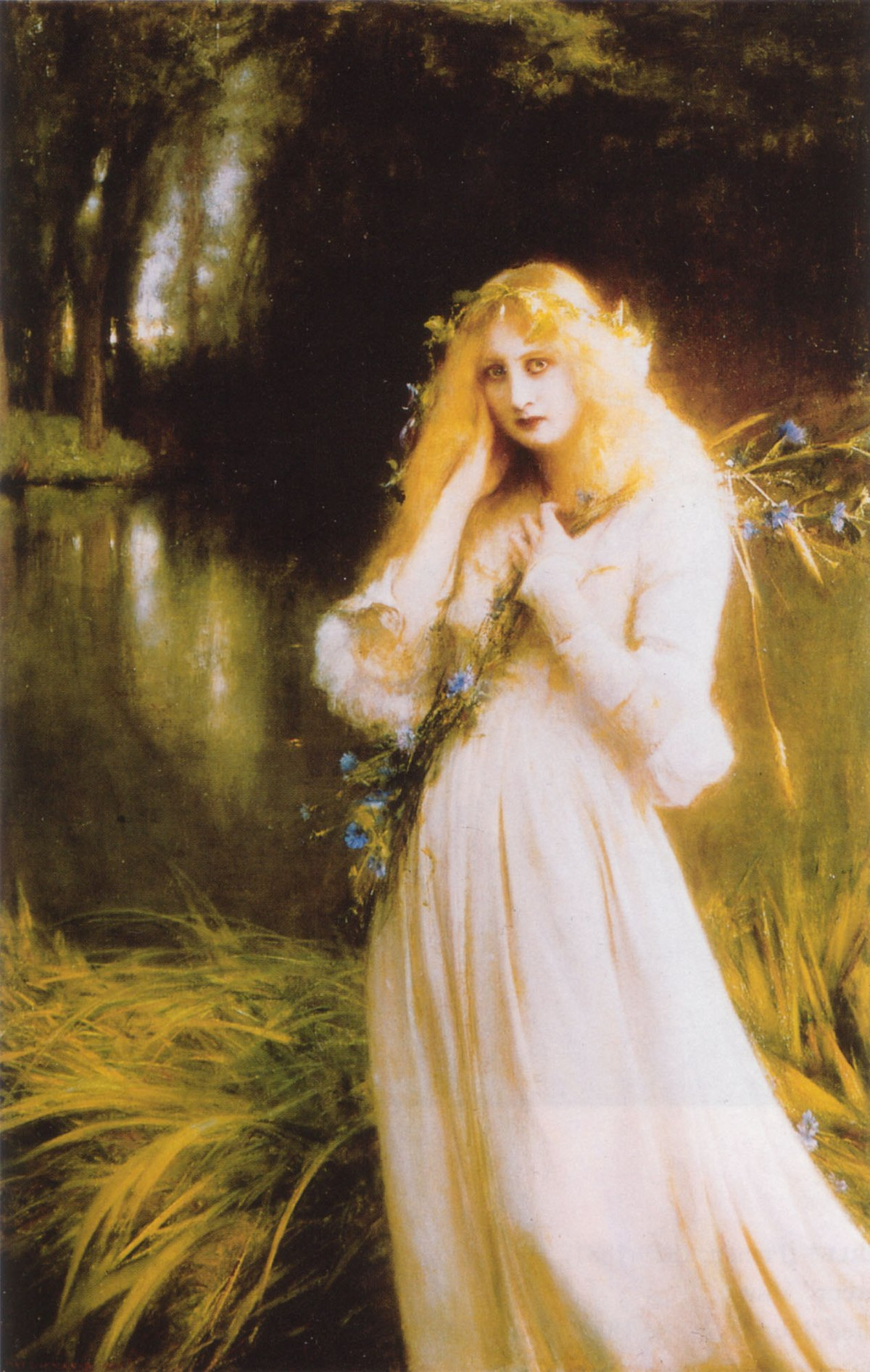
She turns to favour and to prettiness."
In Real Life mental illness is rarely pretty, but in fiction, there's just something about a lovely young woman, often with long, disheveled hair and bare feet, running around babbling lyrically about the strange visions flashing through her deranged mind, singing creepy little rhymes, scattering flowers and occasionally bashing people's heads in.
Maybe this particular cutie was just broken particularly hard, maybe it was an illness or maybe she was born that way, but the result is the same, a tragically beautiful, ethereal waif who's mad as a box of frogs. Her beauty is an important point here, underlining her fragility and the sadness of her fate. She usually talks in riddles and rhymes, can be sad or joyfully happy (or switch between these states). Her mind may be so far gone that she's likely to murder people, but she'll always have clear skin while doing it; at other times, though, her madness may allow her to retain childlike innocence, resulting in her being more kindhearted and compassionate than the "normals". Sometimes, too, she has important knowledge the sane may lack, in which case she'll often have terrible trouble getting anyone to listen (a classical example of Mad Oracle). The original Cassandra from The Iliad was often depicted as a bit of an Ophelia.
It's difficult to pin down the appeal of this trope. Perhaps a strange young maiden communing with nature harkens back to earlier figures like nymphs or pagan witches. Perhaps there is an underlying fetish at the thought that a crazy girl might be awesome in the sack. Or perhaps there's something endearing to men about cradling a girl in your arms and protecting her from the demons in her own head.
There's often a surprisingly artistic bent to The Ophelia's madness; she may sing, dance wildly, or try to paint her delusions. She may wear white and look extra ghostly and wraithlike. She would often be an Unkempt Beauty because crazy people usually don't care about trendy clothes and make-up. The Ophelia is often tied to nature (including walking around barefoot, wearing flowers, etc.), particularly water, probably as a nod to the original Ophelia (in William Shakespeare's Hamlet) who winds flowers in her hair before drowning herself. That last bit can overlap with Instant Oracle: Just Add Water! if she's also a Waif Prophet and/or a Mad Oracle.
The Victorians fell crazy (so to speak) in love with this trope and Ophelias in the form of wronged maidens and deranged brides go pirouetting and flower-strewing through art, poetry, and literature of the period while the "mad scene" for the Innocent Soprano heroine became a staple of opera, especially in France and Italy. They are famously difficult to sing and were often written as a way for a particularly talented singer to show off her technical prowess in a dramatically plausible way. Insanity was linked to female sexuality and desire for independence. In fact, psychiatrists at that time used to encourage female patients in madhouses — especially if they were youthful and pretty — to dress the part and carry sheaves of flowers.
If a male character is shown the same way, odds are good he's very feminine and delicate-looking anyway.
Compare/contrast with Nightmare Fuel Station Attendant, Cloudcuckoolander, Fainting Seer, Ax-Crazy, Mysterious Waif, Waif Prophet, Hysterical Woman, Unstable Powered Woman. For the (usually) "harmlessly kooky" variant see Manic Pixie Dream Girl and Perky Goth. See Cute But Psycho when mental issues are not part of the appeal. A reason for the appeal of the Yandere.
Examples
- Berserk: Casca spends at least two years and two to three full arcs as a nearly mute example of this after going mad from the horrific trauma she suffered during the Eclipse. She recovers somewhat after a visit to Elfheim and a Journey to the Center of the Mind courtesy of the Flowerstorm Queen, but she still has some serious PTSD.
- Black Lagoon:
- To say Roberta lost her shit following her master Diego's death is a very mellow way of putting it. Lots of guns? Check. Boiling blood? Check. Munching on stimulants like candy? Double-check. Hallucinating? Oh yes. Delusions of still serving Garcia in the middle of a gunfight? That too. And that's not even factoring in the gratuitous amounts of evil laughs and slasher smiles. She also goes around toting her weaponry and killing massive amounts of people off while looking pretty in her maid's dress. Subverted in the anime, with her state at the end of the arc.
- Hansel and Gretel are the Creepy Child version of this. They're white-haired, purple-eyed orphans, who were bought by the mafia to star in snuff child porn. "Hansel and Gretel" are their stage identities, while their original selves are long gone. And it's not just psychological, because something has been done to their genitals as well. Indeed, they periodically switch between who plays Hansel and who plays Gretel by exchanging clothes and weapons, and the one who plays Gretel wears a long-haired wig. Their voices change between identities flawlessly, with Hansel only being unable to hold onto one in his dying moments. He died bleeding to death near a fountain, while Gretel expressed a wish to visit the sea, which she got to do and then she received a bullet to the brain. Before arriving, Gretel sang for Rock with a voice the Lagoon Company defined as angelic. Said song, "The World of Midnight", was used as the closing theme for the episode.
- Blade of the Immortal: Manji's sister Machi crosses the Despair Event Horizon and reverts to a child-like stage after Manji kills her husband without knowing who he is. She remains like that until she's murdered in front of her brother by enemy ronin. Her death leads Manji to protect Rin, as he doesn't want to fail her like he failed to Machi.
- Bleach: Momo Hinamori becomes an Ophelia when she is at her lowest point. She sorta begins to get better with time.
- Blue Comet SPT Layzner: Dr. Elizabeth loses her mind and becomes this, since she can barely reconcile her conscience with the fact that she has to build killing weapons. Thankfully, she recovers.
- Blood+: An example of Diva's insanity is when she's giggling, dancing, and prancing around in a cute and regal gown, with her hair down and lacking footwear. In this state, she captures her twin sister and rival Saya and almost kills her.
- Captain Harlock: Miime is a purple-haired, ghostlike innocent alien who likes to play the harp and get drunk. She's unfazed by her human comrades' wacky hijinks, but they're fascinated with her.
- Case Closed:
- Captured in Her Eyes: Ran Mouri temporarily becomes one due to a bad case of Trauma-Induced Amnesia.
- Also, a young woman mentioned in the backstory of the Detectives Koshien arc. More exactly: a mentally and emotionally unstable socialite who committed suicide via hanging herself in a room of her Big Fancy House (nicknamed "the Lavender mansion") in an island near Fukuoka. The "young mistress"'s death was wrongfully catalogued as a murder, however, and the main suspect was her maid Kana Mizoguchi. Poor Kana was the one who fulfilled Ophelia's association with water, however, having thrown herself into the sea after she couldn't prove her innocence.
- In the Kimono Goddess case, the audience actually gets introduced to the episode via a scene in which a beautiful, sad-looking Ophelia throws herself off a building in front of everyone in her women's college. Her name was Sakurako Suzuka, and she ended up that way after being framed for drug trade by two cruel Alpha Bitches, Ema Anzai and Asuka Shibazaki, who already hated her for being a Wide-Eyed Idealist. Five years later, Ema and Asuka would become the case's Asshole Victims at the hands of Eri, Sakurako's estranged older sister.
- Maya Tachibana from the Beautiful Amnesiac Woman filler case, who has lost her memories due to injuries and acts like a textbook case. Then it's subverted: she's a Dark Action Girl who has been hired to kill Kogoro by a dude that got tossed into jail and then escaped, and while her memory loss is genuine at first, she recovers her memories around halfway the episode and then pretends to still be amnesiac so she can corner Kogoro and murder him. Conan barely manages to save Kogoro and then capture her.
- Ceres, Celestial Legend: Kagami Mikage's mother is not well in the head. Kagami himself is a cruel Magnificent Bastard, but his interaction with his mom is pretty much the only Pet the Dog side we see of him.
- Claymore: Ophelia becomes obsessed with getting revenge on her brother's murderer and her polite exterior disappears real fast when people interrupt her. Her death scene after turning into a snake-like awakened being naturally occurred in a lake with her usually-braided hair flowing freely around her.
- Cross Ange: Sylvia goes mad after her sister Angelise is revealed to be a Norma (the one thing shunned by society), her parents are both killed in their attempt to hide the secret, and while her sister is in exile, elder brother Julio, the one responsible, turns Sylvia against her and lures her out of exile by having his sister pull a Wounded Gazelle Gambit. After capturing their disinherited sister, Sylvia laughs hysterically, blames Ange for the death of her parents and demands she apologize for being a Norma as she whips her for before an execution. After Ange escapes, things only get worse. After having a nightmare over what just happened, an attempt to seek comfort from Julio goes south when she spots his secretary (and mole from a dimension of dragonic humanoids) Riza, who promptly captures her and puts her under her thrall, which causes her to scream the name of her once beloved sister. Episodes later, with Julio dead and Embryo freeing her from Riza's control, she's even worse, whipping Riza in retaliation and for failing to bring her what she wanted to read, and buckles under terror when Ange shows up, asking if she plans to kill her like she the rest of her family as she still blames her for. From then on, with nobody else in the Imperial Palace, she looks increasingly unkempt scared for her life as the palace is under siege, and later, the Mana is cut off with her left out of the loop. She is presented in an unsympathetic and cowardly light, as it turns out she was healed from her crippling long ago, but she also undergoes a Trauma Conga Line in a station she is in no way fit for.
- Death Note: Misa Amane. Beautiful? Check. Insane? Check. Puts on pretty dresses and murders people? Definitely. Commits suicide at the end? Yeah.
- Ergo Proxy: "Ophelia": There are liberal amounts of symbolism referencing Ophelia. This includes Re-L's Doppelgänger floating in a lake and pulling the famous pose.
- Fullmetal Alchemist (2003): Rose Thomas is either drugged or hypnotized by Dante. In addition to the other terrible events that traumatized her, this makes the poor woman nearly catatonic, vacant, and either completely still or dancing. But she gets better.
- Future Diary: Yuno Gasai is beautiful and adorable which throws one off when she's killing and mutilating for the sake of Yuki. One scene has her wearing a black dress while mowing down soldiers with a gun.
- Goodbye! I'm Being Reincarnated!: Because of the way Standard Japanese Fantasy Settings work, Angelia is both a Princess Classic and a Shell-Shocked Veteran who's fought on the front lines of a war. The result was a perfectly decent, even naive young woman who commits full-tilt murder enthusiastically and has few sexual scruples. To be fair, her plan is logical and will save a lot of people...she's just wilfully oblivious to the suffering that's necessary to make it happen. And she's unlucky enough to live in a setting where people can only travel interdimensionally by dying first.
- Gundam:
- Mobile Suit Gundam SEED Destiny: Stella Loussier blissfully dances her way through her first scene of the series. Minutes later, she shanks her way through the second. It only goes downhill from there.
- Mobile Suit Gundam ZZ: Kamille Bidan is barely recovering from having been Mind Raped into insanity by Scirocco. And once he reappears in the series, the Colony Drop on Dublin and Hayato's death in battle take place...
- Higurashi: When They Cry: In the manga-only Onisarashi-Hen (Demon Exposing Arc), Natsumi Kimiyoshi becomes this in the epilogue. After failed attempts at living with relatives, later living with Akira Toudou, who married her so she would be able to drop her maiden name and move past her murdering her grandmother and parents, she's consigned to a psychiatric hospital. Though she seems to be doing better, she's actually aware of her crimes, even though Akira is shouldering her guilt for her. By contrast, she was more of a tragic Ophelia with her relatives than after she was moved to the hospital, where she was more of a Madwoman in the Attic.
- Magic Knight Rayearth
- Rayearth OVA: Emeraude sings and makes flower chains at the feet of Zagato, oblivious to his death and the destruction that's carried out on Earth in her name. It was Eagle who put her into this state, however—the girls are able to reach her, and she comes back to reality in time to stop him.
- Alcyone in the second part of the TV series zig-zags between Empty Shell and this trope. When she is captured by Cephiro after having become the Brainwashed and Crazy minion of Debonair, the poor woman is seen despondent and quiet, only reacting at the sight of Lantis — and that's because she's so far gone that she thinks Lantis is Zagato.
- Neon Genesis Evangelion:
- After a Contact Experiment with EVA 02 caused a part of her soul to be sucked into it, Kyouko is left so deeply insane that she would not recognize her daughter, Asuka, at all. Instead, she is convinced that one of Asuka's dolls is really Asuka.
- Perfect Blue:
- Former pop idol Mima tries to break free from her innocent image to make it into serious acting, but she becomes haunted by an always cheery yet aggressive doppelganger of her idol self.
- Rumi Hidaka is Mima's manager and a former idol herself who is obsessed with Mima to the point of dressing as her. She ends up in a mental institution carrying a bouquet of flowers and seeing herself as Mima in a mirror.
- One Piece: Russian is a beautiful, cheerful redheaded woman completely lost it and became this after her son, Gimlet, died of illness and her husband, Doflamingo's subordinate Senor Pink, wasn't at home. The next time she was seen after such a tragedy she was in the hospital, looking as beautiful as always but acting like a dull-eyed Empty Shell... Senor Pink dresses like an adult baby because the now-dead Russian would only react and smile when she saw him in baby clothes, and since she's dead he wants to remember her.
- Ōoku: The Inner Chambers: Shige, Shogun Ienari's consort, loses all her senses after her son is poisoned and she is accused of doing so to frame O-Shiga, Ienari's concubine, for it. Out of it, Shige regularly mistakes Ienari for the deceased son. Except it is all an act to lure her mother-in-law Harusada into a false sense of security so she and O-Shiga, who also had her child poisoned, can get their revenge on Harusada, who is the real poisoner.
- Private Actress:
- Masakazu Ogata, the legal wife of Shiho's father, is a sickly and sad lady who is often alone at her Big Fancy House. Her son Kyousuke tells Shiho that she is "a little mentally unstable", implied to be a consequence of Ogata's constant womanizing on top of already being ill. This is confirmed when, after seeing Shiho, Mrs. Ogata tries to kill herself. When Shiho and Kyosuke try to aid her, she mistakes Shiho for Shiho's mother Sayuri (the better known of Ogata's flings) again and begins to insult and threaten her.
- Later, in the Boarding School two-parter, Ophelia the character becomes vital to the confrontation between Shiho and the murderous Alpha Bitch Kana Juumonji, who scream Hamlet lines to each other with Kana playing Ophelia so perfectly that she's still reciting her lines as she's taken away by the police, her deceit uncovered. Kana/Satoka actually becomes this towards the end, after Shiho successfully scares her into Trauma-Induced Amnesia as specific punishment for having caused the deaths of Misaki and later Yuuichiro's, aside of the people whose deaths she provoked before.
- The Rose of Versailles: Charlotte de Polignac cracks from the pressure on her and right before she commits suicide, acts like a mixture of this and a Creepy Child. She lets her hair down, babbles madly in front of everyone, takes off her shoes, and finally throws herself off a tower, while still giggling and babbling madly.
- Rurouni Kenshin: Tomoe Yukishiro has a fit of this after her fiancé Akira Kiyosato is murdered. The first time she meets Kenshin, she's drunk and her only reaction to getting splattered by the blood of someone Kenshin just eviscerated is to say that he made it rain blood. She then faints.
- Sakura Gari features the young and pretty maid from the Saiki household who becomes this after surviving Sakurako's torture/murder of Souma's lovers, but losing the baby of Souma's that she was pregnant with. The reader meets the girl shortly after Souma attempts to kill himself; she looks pretty but frail and pale in her dark kimono, attempts to speak to the Saikis and then to Masataka to learn what's going on — but then she catches a glimpse of Sakurako herself and has a massive meltdown, screaming for a "white-haired demon" that is around the gardens, so the policemen have to calm her down. Considering that she was tied up in Unwilling Suspension manner, gagged, savagely beaten and then photographed while half-naked and still Bound and Gagged, she can't be blamed.
- Sakura Wars (2000): An Ax-Crazy and openly villainous version is Crimson Miroku. After Sumire kills her and Satan Aoi brings her Back from the Dead, she appears in front of the main cast with her clothes loose, her long hair down, and onlyable to speak a Madness Mantra: "Sumire, Sumire... I want your life... I'll take your life..."
- School-Live!: Yuki is the cute Genki Girl protagonist who just so happens to also be very delusional. Her mind has blocked out the memories that she's living in a Zombie Apocalypse and her friends play along.
- Shigurui: The unsettling fate of Mie Iwamoto after a particularly traumatizing incident. Eventually, she recovers but is still deeply disturbed.
- Tantei Opera Milky Holmes: Cordelia Glauca is a humorous take of this trope, complete with flowers which unexplainably appear on her hair.
- Tokyo Ghoul Re:
- Shuu Tsukiyama's health and mental state degrade seriously and he looks beautiful and frail when he isn't having episodes of violence. This comes after Kaneki's two years-long disappearance has left him very distressed, and it takes him a lot of effort to recover and begin making up to his family for the grief that came with his madness.
- Eto Yoshimura/Sen Takatsuki in the sequel chapter 56. Remember Kankeki's kakuja-induced madness in Kanou's laboratory, complete with the nonsensical ramblings and erratic behavior? Kaneki's attack on Eto drives her into a similar state, and her kakuja body begins undergoing a series of lovely mutations such as extra eyes and mouths on top of mouths. All while she pursues him across the surface of a building, spouting random and confused sentences. It turns a scene that should have been Badass into pure horror. She also varies between trying to kill Kaneki and declaring her love for him while licking his eye. It doesn't help that she's naked and missing her legs. While she keeps appearing with very little left to the imagination, it's during the process of committing utterly horrifying acts of violence. In general, her nudity is secondary to the torture, mind rape, and general mayhem being committed on-screen by her.
- Rize Kamishiro initially looks like a Proper Lady, but is actually a Femme Fatale ghoul who lures men she finds attractive in with her beauty before satisfying her gluttonous nature by eating them or "scrambling their insides" with her kagune.
- When Tooru Mutsuki is captured by Saeki aka Torso, he puts him into a white dress while declaring they are going to get married. Mutsuki's good looks are accentuated by the dress and flowers Torso puts him in and then true horror starts when his past is revealed of him having murdered his abusive father and family, mutilated animals, and cannibalized corpses before he's seen in the present with his dress covered in blood from him having mutilated and dismembered his stalker Torso to death.
- X/1999:
- Kotori Monou became one after seeing her mother Saya die as a little girl. She apparently recovered her mind, but some years later she turned into one full-time when seeing Kamui's aunt Tokiko die in the same way, and spends some time carting around the poor woman's severed head. And then soon after, she dies! And at the hands of her Face Heel Turned older brother! The poor girl can't catch a break...
- Subverted in the TV series: Kotori does shows some signs of this trope when Tokiko dies, but unlike in the manga she falls in a coma. Her subconscious is still active and more or less sane, however, so she begins to use her Dream Weaver powers instead of going crazy; she's still comatose when Fuuma kills her, so she never gets the chance to enact the trope.
- A darker version is Seishirou's mother Setsuka, the previous Sakurazukamori. In the CD dramas she often spoke about things that looked like nonsense, then counteracted with something quite unsettling and did so with a smile.
Setsuka: [has an ikebana arrangement] Camellias. Red camellias.
Seishirou: Your favorite flower.
Setsuka: I love it. I love camellias best when they fall [gets a dreamy look] It falls on the ground.... plop, like a human head. I love it.
- Funguary: Cordyceps may be crazy, but she's an also a beautiful woman in a leotard.
- The Symbolist movement of the 1890s was fond of Ophelia as a subject.
- Ophelia (Millais): Ophelia is a lovely young woman whose insanity means she drowns herself while singing merry songs.
- Aria: Ginny is a post-traumatic fairy. Her cousin Kildare, the protagonist, refers to her as "beautiful and damaged" (or some permutation).
- Batwoman: The villainous Alice has many hallmarks of an Ophelia, dressing in bizarre Victorian-esque clothes, speaking almost entirely in quotes from Alice in Wonderland, carrying a poisoned razor blade in her mouth and frequently having her makeup run down her face. She also turns out to be Beth, Kate's long-lost twin sister, and there's a heavy implication that she underwent serious Mind Rape after she was captured in the shootout that killed their mother when they were 12. And the icing on the cake is that she drowns in the river and essentially commits suicide.
- The Sandman (1989): Delirium is the Anthropomorphic Personification of madness itself and sometimes portrayed this way. (She's considerably scarier on the occasions when she pulls herself together.)
[Some] say that Delirium has no tragedy, but here they speak without reflection. For Delirium was once Delight. And although that was long ago now, even today her eyes are badly matched: one eye is a vivid emerald green, spattered with silver flecks that move. The other eye is vein blue. Who knows what Delirium sees, through her mismatched eyes?
- X-Men: Magik is Colossus's younger sister who was Dragged Off to Hell and given a Plot-Relevant Age-Up. The experience left her a bit mentally unbalanced, and although she Took a Level in Kindness in the present day she's still an Anti-Hero who often alternates between being an endearing Cloud Cuckoolander and a raging Blood Knight.
Magik: There are no snowflakes in Hell.
Colossus: You're Insane!
Magik: Oh, thank you! Thank you! I knew eventually you'd understand. - Yoko Tsuno:
- "The Prey and the Shadow": Everyone thinks that Cecilia, the local Ojou, is one of these after the death of her mother Mary, but she's actually sane, just extremely sheltered, and it's her Evil Uncle who makes everyone think otherwise so he can set her up for an "accidental" death.
- The Devil's Organ: Ingrid is introduced as one but it's just temporary since she was not only depressed by her father's death, but she was drugged by someone else. After an incident where she was thrown into the Rhin but Yoko saved her, she mostly recovers.
- Ambition of the Red Princess: In her human form, Firo is described as having the beauty of an angel with her wings, but beneath her childlike appearance, Firo is an immature brat believing herself to be above any punishment and has an Ax-Crazy attitude problem at anyone that dares insult her.
- Cheating Death: Those That Lived: Arendellian lives in her own little world with her imaginary friend Aaron courtesy of her schizophrenia, and when you're not pushing her triggers, she's rather sweet and gentle in an absentminded way.
- Hemostuck: Feferi is a very beautiful seadweller who spends her days singing to herself, swimming, and having a somewhat tenuous grasp on reality.
- Pony POV Series: Diamond Tiara's mother Golden Tiara - a.k.a. "Screwball" - is like this, a former Blithe Spirit whose mind broke years ago under the pressure of cutthroat high society. However, we later learn that there's a lot more to her...
- Agnes of God: Agnes is rather childlike and naïve, and she also constantly speaks of random things that make sense only after being pieced together. It is unclear whether she was born mentally challenged; she says she was "dropped on her head" as a baby. The local doctor, Martha, is never sure whether Agnes is really mentally challenged or it's a result of her mother's virtually imprisoning her for years.
- The Best of Youth: A pivotal moment at the beginning of the film that ultimately influences their life choices of two brothers is when they meet Giorgia, a mental patient who has been subjected to electrotherapy. One of the brothers, Nikola, comments that they were both kind of in love with Giorgia at the time.
- Constantine (2005): Confined to a mental hospital, Isabel Dodson commits suicide by leaping from a building, plunging through a roof and into a cross-shaped swimming pool where her corpse is found floating with her loose hair flowing freely.
- A Cure for Wellness: Hannah; beautiful, naïve and childlike, complete with a flowing dress and bare feet. She's not mad however though she does turn out to be a Mad Scientist's Beautiful Daughter.
- The Electrical Life of Louis Wain: Marie Wain is a lovely girl who develops schizophrenia and is locked away in an asylum.
- The Haunting (1963): It's left open whether or not Eleanor is mentally ill or she's being haunted by ghosts. She spends the last act of the movie running around in her nightgown with her hair loose too.
- The Innocents: Hinted at with Miss Jessel's ghost. This comes with Fridge Brilliance with the open-ended nature of the story - that Miss Giddens could be imagining the ghosts. She knows that Miss Jessel killed herself after her lover's death - and she's said to have a great imagination. So she's imagining Miss Jessel appearing as a ghostly Ophelia. For added bonuses, she killed herself by jumping into the lake.
- The Lawnmower Man: As Jobe increases in intelligence, he takes a client of his lawnmowing services, a rich widow named Marnie, as a lover, and he eventually brings her to Virtual Space Industries to introduce her to virtual reality. But he's so aggressive during the session that the experience breaks her sanity. When he's mowing her lawn in a later scene, she herself is helplessly sprawled on her bed, giggling at nothing and staring up into space.
- Melancholia: Justine suffers from depression. One symbolic shot has her floating down a river in bridal dress while holding a bridal bouquet in reference to Millais's painting.
- Ophelia: Ophelia starts out perfectly sane, but by the third act she's dancing about in her undershift, randomly bursting into song, giggling or babbling nonsense, handing out flowers and occasionally lashing out physically at people, before drowning herself in the river. This version actually turns out to be a subversion; while Ophelia does temporarily have an emotional breakdown, she is only pretending to be completely insane as part of her plan to undermine and escape Claudius. Everyone but Claudius and Horatio are fooled; Horatio is in on the plan, while Claudius can't do anything too nasty to her because he'll look like an asshole being cruel to a poor, innocent girl gone mad with grief.
- Pan's Labyrinth: Ofelia. Maybe... Averted, in the end: according to Word of God, everything she saw in the Underworld was real.
- Quigley Down Under: Crazy Cora goes between this and being more or less sane. She has very long hair which is sometimes down and tangled, though no flowers or water motif as it takes place in the Australian Outback.
- The Ring:
- Ring 1998: Subverted in the case of Sadako Yamamura. While she is the source of the cursed video tape and died by being trapped in a well, she wasn't insane in the usual definition of the word (though she did have the tendency to make other people insane); the one that fits as Ophelia better is actually Sadako's mother, Shizuko, who was described as weird and liked to babble unintelligible sentences near the sea (the film heavily implies that she conceived Sadako by having an affair with an oceanic deity).
- The Ring (2002): Samara was a Creepy Child who drove horses to commit suicide and her adoptive mother to be confined in a mental facility. Her adoptive and biological mothers (Anna and Evelyn, respectively) are also examples of this: Anna felt remorse for killing Samara and eventually committed suicide by jumping into the sea, while Evelyn tried to drown Samara and as a result is confined to a sanitarium.
- Saving Mr. Banks: Driven mad by her husband's alcoholism and illness, one night Margaret Goff gets mentally confused, walks dreamily out into the night in her long white nightgown to a river, and nearly drowns herself. Her daughter stops her and Margaret is immediately is horrified at what she's almost done.
- Scarface: Gina Montana is Tony's younger sister and he is aggressively protective and controlling of her. When he discovers her post-sex with Manny Ribera, his best friend, he shoots him dead right in front of her, only for her to tearfully reveal that they'd gotten married the previous day. At his mansion that night, amidst the attack by Alejandro Sosa's men, she appears semi-nude and drugged out, telling him he can have her now since he clearly wants her for himself, all the while shooting at him with a revolver. One of the attackers kills her, Tony kills him in turn and then basically loses his mind over her body. Tony is the one who has the swimming pool death.
- Spencer: Diana is portrayed as a beautiful young princess who becomes increasingly unstable from the pressure she feels. She goes from purposefully arriving late at family functions to stick it to her in-laws to wandering around her childhood home at night and hallucinating Anne Boleyn.
- Sucker Punch: Part of the attraction Blue has to Baby Doll is that she appears to be this. But she's really exploiting Obfuscating Stupidity to plot to escape the asylum behind his back. When she's lobotomised, this trope is subverted.
- Sweeney Todd: The Demon Barber of Fleet Street:
- Lucy Barker after her attempt at suicide, brought on by being raped and having her daughter taken away.
- Averted by her daughter Johanna, though, unlike in the stage version (where she becomes a pretty classic case). Movie!Johanna appears to be this in Fogg's Asylum, but on being rescued she turns out to be very lucid, if pessimistic about her chances of happiness.
- Adrian Mole: Eleanor Flood is a beautiful but unbalanced woman who becomes obsessed with Adrian when he hires her as a tutor for his sons. She ultimately burns his house down because he rejected her.
- The Astrologer by Scott G. F. Bailey: Vibeke is a full-blown Expy for Ophelia, as the novel is a Shout-Out to Hamlet. Unlike the original, though, she's having a secret relationship with the King, who has impregnated her, and she commits suicide by burning herself alive atop her father's corpse.
- Beatless: Snowdrop is not technically insane, as she's an android with her own motives, but she seems designed to produce this impression — loose-fitting white dress, long hair, strong association with flowers (in addition to strewing them everywhere, she herself is named after a flower too), and a psychotic-seeming smile given the things she says and does — her flowers cause other hIEs to go insane.
- Black Blade: Celeste Draconi has gone a little crazy as a result of abuse from her husband, who only married her for her power of prophecy. She has taken to getting revenge by withholding details of her prophecies and trying to enact one of her own which says that Victor can be defeated if Deah and Lila join forces against him.
- Black Iris: Most of the female characters echo this archetype, but Laney fits it best, as her fragility and madness is highlighted the most.
- Black Jack by Leon Garfield: Belle is a fragile young girl who's first encountered in a wood, having a vision of "A white tower with a shining top." She's been swinging between gentle strangeness and violent hysteria since an illness in childhood. Much of the drama turns on whether her madness is the result of an illness exacerbated by neglect and isolation (in which case it's assumed to be curable) or hereditary (in which case it's not).
- The Black Obelisk by Erich Maria Remarque: Genevieve Terhoven is schizophrenic and has an alternate personality "Isabelle". In full accordance with the trope, the main character falls in love with her in her crazy "Isabelle" mode when she has visions and speaks in riddles; she also returns his feelings. However, she eventually recovers and returns to her sane "Genevieve" mode, in which she doesn't even remember ever meeting the protagonist.
- The Chronicles of Magravandias: Ellony becomes increasingly unstable after joining the Sisterhood of the Dragon.
- Clocks that Don't Tick: Martha is attractive, daydreams often, and is prone to extreme mood swings.
- Codex Alera: Odiana is an Unhappy Medium, a powerful empath driven completely nuts by slavery, gang-rape, and brainwashing. She's gorgeous, cheerfully open about her own insanity, and way out there. The water motif is filled by her particular magical abilities. Unlike Ophelia, she doesn't drown, but she is certainly willing to make others do so.
- Cold Comfort Farm: Elfine runs around in a green cloak "like a Pharisee of the woods" (i.e., a faerie), making cryptic remarks, until Flora, gives her a makeover and sets her up with a cute guy. Then she's normal.
- A Court of Thorns and Roses: A Court of Wings and Ruin: Elain becomes only semi-lucid, rambling in strange ways, locking herself up, and generally wasting away.
- Daphne (by M.C Beaton): A comedy of errors leads to Simon mistaking Daphne, a perfectly healthy and privileged lady, for a "poor mad Ophelia". In detail...
- Deptford Mice: The Crystal Prison: Alison Sedge was driven insane after the death of her love, Jenkin, stopped taking care of her appearance, and withdrew into her own little dream world.
- Doctor Who:
- Eighth Doctor Adventures: The Blue Angel: The Doctor is basically like this. Since he's the Eighth Doctornote , the prettiness and long, unkempt hair are a given, and he's rather sickly and delicate, he wanders barefoot through his garden (in the snow, even!), and either all of Doctor Who is actually just his psychotic delusions, or he's a Waif Prophet Dreaming the Truth. And, like Ophelia, he's pregnant. Sort of.
- Doctrine of Labyrinths:
- Melusine: Wizard and former prostitute Felix Harrowgate is a delicate and beautiful man who goes mad from Mind Rape and wanders around saying things that people either don't understand or don't believe, sometimes to their peril.
- The Mirador: The beautiful Vincent Demabrien is a subversion, as his affinity for ghosts makes him seem insane, but he really isn't.
- Dragonlance: Raistlin and Caramon's mother never was quite sane and it was likely her latent magic that drove her mad. She's described as being ethereal, beautiful and will often talk to people who aren't there or randomly start dancing. Eventually she slipped into an episode that killed her when she couldn't be woken up.
- The Dresden Files: Grave Peril: Justine is "mad with emotion" and has racing thoughts, which can only be stilled by specifically Thomas Raith taking her blood. They are introduced attending Bianca St. Claire's ball, for which Justine wears a skimpy flower petal costume accessorized with baby's breath enweaved in her black hair.
- Enchanted: "Full of woe" Wednesday is dreamy and poetical and ends up leaving human lands for the fairy at the end.
- Fair and Tender Ladies by Lee Smith: Silvaney is depicted as ''odd" and is eventually institutionalized and lobotomized. Prior to that, however, she runs around singing and laughing, and is mostly let alone by her family.
- Full Metal Panic!. Kaname acts like this during her Whispered moments, including hallucinations and self-inflicted Clothing Damage.
- Golondrina de Invierno (Chilean, Winter Sparrow): Felix's Missing Mom. Her son describes her as gentle, sweet and a bit sad, and after her death he learns that she spent months in an institution when Felix himself was very young; the discovery causes him to fall in a brief Drowning My Sorrows state, as he believes he has inherited her mental unstability. And he's right: later in the book he mentally collapses, but he ultimately manages to get better.
- Ground Control to Psychoelectric Girl: Erio believes she is an alien. She initially speaks in Creepy Monotone, prefers to spend all her time wrapped up in her futon, and overall has No Social Skills. Erio's belief that she is an alien started after she went missing for six months the previous year. Erio has no memories of what happened during those six months.
- The Hunger Games: Mockingjay:
- Annie Cresta is mentally unstable due to the trauma of being put trough the Hunger Games and being tortured by the Capitol. While she acts normal most of the time, Katniss mentions that she has the habit of gazing at the distance and laughing even when there's nothing funny. Annie also sometimes covers her ears to shut out the remembered sounds from when she was put through her ordeals. She even has Ophelia's water motif, as she came from the fishing district and won her Hunger Games by swimming through her flooded arena while the other tributes drowned.
- Katniss undergoes this after Prim's death. Her internal narration becomes a mess, and she refuses to talk to anyone for some time. It takes her years before she can achieve some semblance of a normal life, but even she notes that she may never be able to fully recover her sanity.
- Hurog has the protagonist's mother. Her abusive husband, and (maybe) life in the Haunted Castle Hurog caused her to drug herself with herbs, but she's not really there when she didn't take something, either. She's fond of her garden and flowers, and occasionally says something that makes sense in a weird way.
- Jonathan Strange & Mr. Norrell: Lady Pole looks like an Ophelia to the casual observer. In fact, she's under an enchantment that forces her to spend every night dancing to exhaustion in Faerie and causes her to speak nonsense whenever she tries to tell anyone about it. Adding to it, once one of her friends is taken away to Faerie to join the dances she attempts revenge on the man responsible with a pistol, though she fails.
- The Kingkiller Chronicle: Auri is a shy young woman who lives underneath The University, hiding from almost everyone. She makes grave but seemingly nonsensical statements and presumably was driven mad by the University's demand on her mental faculties. The companion novella based on her, The Slow Regard of Silent Things, provides more insight into her mind, showing that she believes that all inanimate objects are sapient and is consumed by an OCD-like obsession with rearranging things to make them "right." There are also hints at a Dark and Troubled Past.
- The Lady of the Lake: On her wedding day, Blanche of Devan's husband-to-be is murdered by the men of Clan Alpine. Thereafter, she wanders the highlands decked with flowers, guarding a lock of her bridegroom's hair, and singing. When she encounters Fitz-James and Murdoch, she warns the former that the latter intends to murder him through song. His scheme exposed thus, Murdoch takes a hasty shot at Fitz-James, but misses and kills Blanche instead.
- Love and Freindship: When the husbands of Sophia and Laura suddenly die in front of them, they each exhibit the standard Gothic romance reactions — Sophia swoons, while Laura has a fit of madness. The latter proves the healthier choice, as lying unconscious for two hours on the wet grass gives Sophia a cold that ultimately kills her, and she dies exhorting her friend "Beware of swoons, dear Laura. . . . A frenzy fit is not one quarter so pernicious; it is an exercise to the Body and if not too violent, is I dare say conducive to Health in its consequences—Run mad as often as you chuse; but do not faint."
- The Lunar Chronicles: Princess Winter is considered the most beautiful girl on Luna, more beautiful than her stepmother Queen Levana. The princess is a kind and sweet girl who wants her people to be happy and who is a genuinely loving person, and who suffers from Lunar sickness which leaves her with horrific hallucinations (the walls bleeding, her body turning to ice, people becoming corpses...). She's also worsening her sickness by not using her gift, while well aware of the consequences of continuing to avoid using her powers.
- The Madness of Sweeney has a male example in the titular character. King Suibhne's madness consists of wandering the Irish countryside reciting poetry.
- Margaret Atwood has an interest in the trope:
- The Blind Assassin: Deconstructed. The narrator's sister, Laura, is a beautiful, intensely spiritual young woman given to loopy statements, odd activities like painting "the colour of people's souls" onto old photographs and falling/jumping into rivers. She seems incapable of fending for herself and is revealed on the first page to have driven a car off a bridge, killing herself, at the age of twenty-five. However it later appears that it's only in the arid context of pre-war upper class society that she can't function, and there are people who have a vested interest in discrediting her insights as mere insane babble.
- The Robber Bride: Charis has also exhibited symptoms of this, the more so during her university days. Arguments can be constructed on both sides of the crazy/not crazy spectrum.
- Les Misérables: Marius compares Eponine to Ophelia,noting that "She had wisps of straw in her hair, not because, like Ophelia, she had gone mad, but because she had spent the night in a stable-loft. And with it all she had grown beautiful!"
- Noli Me Tangere: This is what happens to Sisa after her son Crispin, was killed. All she ever says in the streets before she dies is "Basilio! Crispin!"
- Pareidolia and the Gilded Scar: Multiple characters are deconstructions of this trope.
- A Practical Guide to Evil: 'Agnes was already an odd duck even before getting a Name, and becoming the Augur has only made her more eccentric. She wears a skimpy sundress at court, has a pale, waifish appearance and spends long periods of time staring directly into the sun. It’s not exactly appropriate for court life, but everyone rolls with it because Named play by their own rules.
- The Ring: Subverted in the case of Sadako Yamamura. While she is the source of the cursed video tape and died by being trapped in a well, she wasn't insane in the usual definition of the word (though she did have the tendency to make other people insane); the one that fits as Ophelia better is actually Sadako's mother, Shizuko, who was described as weird and liked to babble unintelligible sentences near the sea.
- The Saxon Stories Uhtred: Thyra gets taken captive after a raid that kills her father. It takes the best part of two years for her brother Ragnall and his foster-brother Uhtred to fulfil the blood-feud with the captors and rescue Thyra. Taken hostage by the family who sexually abused her as an adolescent, Kjartan's family have taken revenge on Thyra by making her a sex slave and subjecting her to repeated gang-rapes. When Uhtred and Ragnall capture the castle where she is being held, they see a wild-eyed scarecrow of a woman with dead flowers tangled in her hair, dressed only a filthy matted cloak. Understandably, her ordeal has driven her crazy. Kjartan and his son, the principal abusers, die horribly.
- Shadow Play by Charles Baxter: Jeanne could have had a touch of this in her young years: she was apparently rather pretty, but lived in her own universe. When she got older, she turned into a Cloudcuckoolander.
- Shutter Island and its film adaptation has Edward Daniels ‒ oh sorry, Andrew Laeddis' wife, Dolores Chanal (AKA Rachel Solando). She had an undisclosed mental illness described as "insects in her brain" and had tried to seek treatment, which Andrew ignored. Then she killed their three children. By drowning them in a lake. Followed by Andrew shooting her. "Why are you all wet, baby?"
- A Song of Ice and Fire: Her sister Catelyn Stark reminisces on how Lysa Arryn used to be a shy, naive and pretty young woman, but years of being trapped in a loveless marriage to an older man and suffering through several pregnancies and miscarriages have taken a toll on both her looks and sanity. The only remnant of Lysa's former beauty is her long red hair. As Lady of the Eyrie, Lysa has become paranoid and delusional, clinging to her only surviving child and hopelessly pining for a man who's only using her for his own schemes. She is also associated with water, due to being a member of House Tully from the Riverlands.
- The Thirteenth Tale: There's an incident where the mad Isabelle Angelfield falls into a lake at a picnic.
- The Underland Chronicles: Nerissa, with a side order of Waif Prophet and Blessed with Suck to boot.
- V. C. Andrews:
- My Sweet Audrina: Audrina is not so much mentally ill as she is brainwashed by her family.
- Gemini Series: Celeste becomes the trope when she is committed to a psychiatric hospital for life.
- Secrets in the Shadows: Karen becomes the trope when she is committed to a psychiatric hospital for life.
- The Warlord Chronicles takes a moment out of deconstructing Arthurian Legend and pulling it into The Dung Ages to deconstruct this trope in the person of Olwen the Silver, an insane Cloudcuckoolander first used by Merlin, (her etheral beauty, a little paint and special effects convinced people that she was a spirit and Merlin was summoning the old gods back to Britain) and later by Merlin's Knight Templar former pupil Nimue.
- Wicked Lovely
- Sorcha, The High Queen of faerie seemed to become one temporarily in the fourth book, due to missing her son, Seth.
- Her twin sister, Bananach is a murderous and mercilessly cruel version of this trope. It Runs in the Family?
- The Wild Child by Mary Jo Putney: Lady Meriel Grahame appears to be mutely insane or at least mentally handicapped, but in the pretty, well-groomed way. However it turns out she's just really stubborn and unsocial.
- The Woman in White: Anne Catherick and her near-doppelganger (and secret half-sister) Laura Fairlie are both Ophelias. Both are sane (although seemingly at least a bit odd in Anne's case) when confined, in turn, to an insane asylum by the villain in a Batman Gambit involving substituting one for the other, but both are driven mad by their incarceration there.
- The Addams Family: Morticia's older sister Ophelia wears flowers in her hair (if you try to pluck one, her leg lifts up); she's vague at least, though not babbly; and she's very good at karate, not noticing that it hurts when she flips men to the ground.
- American Horror Story: Coven: Misty Day has wild hair, is in tune with nature, and is more than a little out there.
- Columbo: Nadia Donner from the season four finale "A Deadly State of Mind" was a mentally ill Hysterical Woman sleeping with her Psycho Psychologist Dr. Collier, only for her husband to catch on and reveal that it's not the first time she's done this. Mr. Donner then gets physical with both of them, and Collier accidentally kills him in self-defense before convincing Nadia to help him cover it up to avoid a scandal. When Columbo starts closing in on both of them and Nadia has a breakdown, Collier decides she's a liability and arranges for her to die in a similar manner to Ophelia herself; hypnotizing her into going diving from five stories up (except she misses the pool).
- Crime Scene: The Vanishing at The Cecil Hotel: Elisa Lam, who had bipolar disorder and whose tragic death became an obsession for internet sleuths, is viewed as this by many of the amateur investigators, who pour over her Tumblr posts and romanticize her.
- CSI: NY:
- "Night, Mother": A suspected murderer seems dazed and begins babbling about law proceedings. As it turns out, she's just a sleepwalker that only just woke up. Bonus points for her name actually being Ophelia.
- "The Untouchable" has a lovely young murder victim, shown in flashback to have searched out Mac to personally report a crime to him because she trusted him due to reading about him in the paper. She always spoke in confusing non-sequiturs, referred to the perps as various members of the infamous Chicago Black Sox scandal, and would abruptly leave without ever giving Mac all the details. Jo notes that, with her other symptoms, she was probably suffering from a severe case of OCD. Danny later finds her daily pill sorter...full and covered with a thick layer of dust.
- Dexter: Lila West is stunningly beautiful and possesses an artistic streak with which she sculpts a Room Full of Crazy. She also has some unfortunate kleptomaniac, arsonist, and yandere tendencies.
- Doctor Who:
- "The Doctor's Wife": Idris/the TARDIS does not do well mentally when she's put into human form because she experiences her own past, present, and future at the same time.
- When Susan Foreman is in her more alien moods, she becomes like this, particularly in "The Edge of Destruction", which she spends drifting around waifishly in a long kimono-like dress babbling about visions in her mind, staring blankly into space with her big sad eyes, and shredding furniture with scissors while screaming and crying hysterically. (When she's in a more human mood, she's The Ingenue.)
- "The Crimson Horror": Ada Gillyflower is not so much mad as desperately craving for affection. And blind.
- There was an age where every Hispanic Soap Opera heroine snapped in an Ophelia Phase if broken enough. They tended to get back into sanity in time for their Roaring Rampage of Revenge, although by the time they snapped back they had already do something unforgivable, like giving their newborn to beggars.
- Joss Whedon loves his gibbering brunette Ophelias.
- Firefly: River Tam is also a Cassandra, but her lyrical madness fits the trope to the letter, and Ophelia's river is even there in her name. She has a faithful Laertes in Simon.
- Buffy the Vampire Slayer:
- "Restless": The entire cast goes babblingly crazy.
- Angel:
- Fred becomes stuck in a demon dimension where humans are treated like cattle for five years and, after escaping her captors, stays in a cave by herself for months until she is saved. She recovers relatively quickly, but gets in a fair amount of babbling and scribbling on the walls first. "You're not real! Or I'm not real. Somebody here isn't real and I suspect it's you..."
- Agents of S.H.I.E.L.D.: The Life Model Decoy Aida descends slowly into this the more sentient she becomes. Culminates near the end of the Framework arc, after creating a virtual world that she traps the agents in, where she rules a dictatorship as Madame Hydra, she manages to finally create a human (or rather, Inhuman) body for herself, with actual emotions instead of simulations of such. She becomes increasingly erratic thanks to experiencing true emotions for the first time, eventually exploding into a violent, murderous temper. By this point, she actually adopted the human name 'Ophelia' (though this was from the comics rather than referencing this trope).
- As she recovered from Hive's brainwashing, Daisy had delusions about being trapped on Maveth, wore dishevelled clothing, and broke down multiple times.
- Coulson also provided a middle aged male example before this, thanks to the effects of the T.A.H.I.T.I. process used to resurrect him. The process left multiple people in this state, and the solution to it didn't fix matters; after it began to happen to him, Coulson became concerned about it happening to Daisy (who was saved from certain death using the same chemical), and the fact it didn't do this to her became a sign that she's not completely human.
- Orphan Black: Helena is beautiful, ethereal, one hell of a dancer as per "Parts Developed in an Unusual Manner", and all-around Ax-Crazy.
- Riverdale: "Heart of Darkness":
- Cheryl shows up to deliver Jason's eulogy while gliding down the aisle with a glazed expression in the same white dress she wore at Sweet Water on the Fourth of July.
- Skins:
- Anorexic Cassie is an Ophelia who functions socially most of the time. When thoroughly out of it as she attempts suicide, she dances ethereally in floaty clothes on a hilltop bench against the setting sun. Subverted in the second series. The Ophelian tendencies go out of the window and it's just plain disturbing when she's out of it.
- A Song of Ice and Fire:
- Game of Thrones: Daenerys Targaryen eventually becomes a darker take on this trope. She is a very beautiful and elegant Dragon Rider who seems almost otherworldly at times...and as of the end of Season 8, is decidedly not sane.
- House of the Dragon: Helaena Targaryen is almost certainly in the autism spectrum and likes to babble nonsenses that her family ignore because they don't treat her seriously. Yet, in hindsight, everything she said turns out to be true.
- Sons of Anarchy: Opie fills this role as part of the Hamlet setting update. After Donna's death, he becomes, like his Shakespearian counterpart, melancholy and suicidally crazy.
- Spartacus: Blood and Sand: Vengeance: Lucretia was never a particularly pleasant person, but the traumas she endured in Blood and Sand's finale completely shattered her mind. She spends the first few episodes wandering about in a daze and claiming to hear the gods speaking to her, while still looking very beautiful, even being capable of seducing Senator Albinius. While it appears she was Obfuscating Insanity at first, the Vengeance finale reveals that Lucretia was even more unhinged than viewers are first led to believe when she kills Ilithyia and leaps off a cliff with Ilithyia's newborn child.
- Without a Trace: "All the Sinners, Saints": Katie is a beautiful young woman who's suffered from a severe and apparently untreatable mental illness for years and believes she's possessed and vanishes after suffering visions of a murder. after discovering that she committed the murder in question, she slits her wrists in a bath, fulfilling the trope's association with water.
- Xena: Warrior Princess: "The Furies": Xena is driven mad by the Furies. She can still kick butt, but she also wants to weave daisies in her hair.
- The basis for the Emilie Autumn album Opheliac, which was described by Autumn as "being another drowning story". And as the album is somewhat autobiographical, the attractiveness part is arguably passed too.
- Florence + The Machine used this idea in at least The Drumming Song off of the Between Two Lungs album. Other songs also feature this idea, and any Drinking Game involving how often she mentions drowning will quickly result in liver failure.
- The folk song Maid in Bedlam
- The Doors: Jim Morrison a poem in tribute to Brian Jones, guitarist for The Rolling Stones, which compared him to Ophelia; Jones had drowned in a swimming pool.
- Rufus Wainwright name drops Ophelia in the song "Memphis Skyline", which is about his friend Jeff Buckley, who died by accidental drowning in the Wolf River after he waded in, fully dressed, shouting the lyrics of "Whole Lotta Love" by Led Zeppelin.
- Sulli in the "Goblin" video looks elegant and youthful while also sporting heavy makeup and (as the second goblin) messy hair as she suffers from hallucinations of other people she thinks are embodiments of her split personality.
- Taylor Swift also name drops Ophelia (appropriately) in her song "The Fate of Ophelia". She references how the events of the play Hamlet led to Ophelia's insanity, a fate Taylor was spared from thanks to her new relationship (this song was released shortly after her engagement to Travis Kelce).
"The eldest daughter of a nobleman,
Ophelia lived in fantasy,
But love was a cold bed full of scorpions;
The venom stole her sanity."
- "Crazy Jane (1799)": Crazy Jane became crazy when she was abandoned by the man she had given her heart to. Her trauma response is to roam around near the place where she met him and last saw him, chanting a "lovelorn ditty" as she strides. Lost to the world like this, she also does little to keep herself looking presentable and is immediately recognizable as a madling.
- Daffney Unger patterned herself after Harley Quinn from Batman and WCW envisioned her as an expy to Mallory Knox. You know, criminally insane people? WCW also put her in a wedding gown match with Miss Hancock so apparently no one thought it took away from the appeal.
- AJ Lee dipped into this when Daniel Bryan told her he wished she'd never been born. She eventually became known for skipping around the ring, usually with her hair in Girlish Pigtails and with a childishly innocent expression on her face. Depending on the week, she'd sometimes switch between this and Yandere.
- Victoria was WWE's Ophelia. Despite being mad to the point of seeing and interacting with things that simply were not present, an affinity for swinging heavy metal objects, and a questionable relationship with Stevie Richards, she still got put in the bikini and other photo shoots on the website.
- The Goon Show used Camp Gay character Flowerdew (voiced by Peter Sellers) in this way in The Canal. His lines include "This is madness, do you hear me? Madness!" and "I'm a daisy, father's a plum, that's why we stoned him. I hear music and there's only Max Geldray there." In the episode's convoluted insurance swindle plot, the canal gives the water aspect.
- The Chronicles of Aeres: The lore for Dreamweavers notes that this is a common archetype for them, since they a) are permanently torn between the waking and dreaming worlds, and b) they are largely made up of Twilight Elves.
- Deadlands: Dolores Whateley. Ethereally beautiful? Check. Long, raven-black hair? Check. Access to mind-breaking knowledge? Check. Dancing through the graveyard at night singing nursery rhymes to her "friends" in the graves? Ooh. That's a big check. In the short-lived Deadlands CCG, she provided some of the best Flavor Text, such as the quote on the "Event Card" where every aced character became playable again for exactly one round.
Dolores: Everyone's coming out to play!
- Vampire: The Masquerade: The Malkavians are a vampire clan defined by insanity. Zig-Zagged, in that while some of them are genuine Ophelias, just as many are Ax-Crazy or Psychopathic Manchildren, or have less obvious kinds of crazy like personality disorders or compulsions, and a fair number are just pretending to be The Ophelia to put the rest of the world off their guard.
- Anna Bolena: Anna Bolena fades in and out of madness at the place of execution. She imagines she is back at her wedding day to the King, and is terrified lest her true lover, Percy, should discover her treachery. She comes out of it at the end to go to her death with dignity and with dubious words of forgiveness for Enrico and Giovanna on her lips.
- Dracula: A Love Stronger Than Death: As a vampire, Lucy Westenra loses much of her mind and goes around dressed in a white gown, wearing her hair loose and topped by a flower crown.
- Don Giovanni: Subverted with Elvira; she isn't crazy at all, but Giovanni tries to convince Anna and Ottavio of this when they come to him seeking help. It doesn't help that Elvira goes through several stages of anger, desperation and grief in the scene.
- Elisabeth: Sisi visits mental hospitals in her spare time. At one of them, a patient named Windisch proceeds to loudly claim that she is the true Empress Elisabeth and Sisi is an impostor who should be locked up. Productions often have Windisch's long hair braided like the empress' famous long hair, with flowers to imitate the star-shaped hair decorations in the famous Winterhalter portrait, if not recreating a mad version of said portrait altogether. In the 2018 Takarazuka Revue production, Windisch carries a tattered white fan that the black-clad Empress exchanges for her black one. Elisabeth envies Windisch and wishes she could openly be The Ophelia.
- Faust (Gounod): Marguerite goes mad after falling pregnant and committing infanticide, and sings, of course, about flowers.
- Giselle: Giselle goes mad upon realizing Albrecht's true identity (and engagement), and the stress of the revelation causes her heart to give out and kills her.
- Hamlet by Ambroise Thomas: There's an actual Ophelia complete with a mad scene complete with flowers and visions of mermaids.
- Long Day's Journey Into Night: Mary Tyrone wanders into the room so intoxicated by morphine that she thinks she's a young convent girl again and rambles accordingly. Her acerbic son James even lampshades this: "The mad scene. Enter Ophelia!"
- Lucia di Lammermoor: Lucia stabs the man she's forced to marry, Arthur, to death, then shows up babbling (re: singing) madly about her beloved Edgard in the middle of the wedding party - blood splattered dress and all, few before she passes away as well.]]
- Next to Normal: Diana is a deconstruction of this trope. Her husband, Dan, talks about how wild and beautiful she was as a college student, but got worse as time went on. The show makes a point to show there's nothing mystical or glamorous about mental illness.
- The Oresteia: Princess Cassandra zigzags the trope around. This beautiful Fallen Princess from Troy who has been taken to Argos as Agamemnon's concubine and servant is among the few characters who is clearly aware of what's going on and knows what will happen, but since she's cursed never to be believed, everyone else believes she's been driven mad by her ordeals until she begins to describe the bloody story of the city of Argos and Agamemnon's lineage as clearly as if she had been there, so the Elders of Argos start showing more sympathy to her plight. Not that it helps her when she's killed by Clytemnestra almost immediately after Agamemnon dies.
- Il Pirata: Imogene loses it completely as her former lover turned Pirate is led to his execution. She ends the scene with a plea to the sun to veil its light, so she will not have to witness the hanging of her true love.
- I Puritani: Elvira goes mad after her beloved Arturo apparently jilts her (he was actually on an important spy mission). She spends all of act II and most of act III in a very extended mad scene before being reunited with Arturo and getting a happy ending.
- Ruddigore: The stage directions describe Mad Margaret as "an obvious caricature of theatrical madness." Her supposed madness does no more than make her a Cloudcuckoolander (and a sympathetic one, to boot). In the second act, she's mostly reformed but sometimes bursts into hysterical fits, which can be quieted by reminding her of the word "Basingstoke" (an English town which is noted for not being Birmingham; both towns start with the same letter as Bedlam, though this is not mentioned in the play).
- William Shakespeare:
- Hamlet: Ophelia is the Trope Namer. She starts out the play as a proper young lady, obedient to her father, even when he tells her she must end her relationship with Prince Hamlet, which means a lot to her. When Hamlet begins to fake his antic disposition (or actually go nuts, depending on your reading), Ophelia bears the brunt of his crazy behavior, which includes verbal abuse both public and private. Hamlet then kills Ophelia's father, and her sanity decays quickly. In a chilling scene, she walks around the King, Queen, and her own brother, without recognizing any of them, but strewing flowers (in performance the flowers are sometimes depicted as weeds, or as figments of her imagination), singing, and sobbing. A little later, the Queen enters with a report of Ophelia's death by drowning, saying she was so distracted that she didn't even realize the danger when she fell into a river and sank. But the men who dig her grave darkly assert she was Driven to Suicide. Ophelia remains a popular figure for art, poetry, and reinterpretation.
- King John: Constance suffers the loss of her little son, Arthur, and everyone around her says she is mad. But when Constance enters the stage, she sharply rebukes that she is still completely sane, that if she was mad, she wouldn't feel each grief as keenly as she does. Stephen Greenblatt hypothesizes that Constance's monologue is based on Shakespeare's grief over the death of his son.
- King Lear: After King Lear has been undermined by his two scheming eldest daughters and possibly driven mad with regret over banishing his beloved Cordelia, he flees the castle and goes out into the stormy night. He reappears with flowers in his hair, clearly having gone mad. The Despair Event Horizon gets even worse when Cordelia is hanged. He dies convincing himself he can see her regaining consciousness when she's clearly dead.
- Sweeney Todd: The Demon Barber of Fleet Street: Some productions do this to Johanna. The movie skips it but doubles down on her mother, Lucy, becoming this.
- The Trojan Women: It's a requirement for Cassandra's every single appearance. This time is even more justified: she has just endured a Trauma Conga Line of rape and enslavement, so that's probably why she's depicted as a bit... nutty.
- Advance Wars: Days of Ruin: Penny vacillates between being an Ophelia and being Ax-Crazy, mainly depending on the wishes of her stuffed Mr. Bear.
Penny: Hee hee! Penny likes you... but Mr. Bear HATES YOU!
Will: Why are you helping me?
Penny: ...Because Mr. Bear told me to. - Arcane – Online Mystery Serial: Despite sharing the trope's name and having strong psychic abilities, Ophelia MacDermoth is actually quite sane. However, she inherited her powers when her mother was driven insane.
- Baldur's Gate III: Hope Hearthflame is a pretty dwarf cleric imprisoned by Raphael in the bowels of his mansion for rejecting his advances. Despite having her mind broken by years of torture, she remains endlessly optimistic as she annoys the lost souls with words of encouragement or starts Suddenly Shouting advice to the party.
Hope: I'd blush if they had left me any skin to redden, and I would kiss you had they not torn off my lips!
Player Character: Seriously, there's nothing wrong with you. Physically, at least.
Hope: I hope that was a compliment! - Blood: Ophelia's home was burned down by the Cabal after her husband tried to leave them. She is left there for some time, mindlessly babbling on and blaming her husband's cowardice for the death of her son. She gets better, then worse, then better again.
- Brütal Legend: Ophelia's Superpowered Evil Side. Lampshaded as she uses a lot of metaphors for drowning when commanding her army, the Drowning Doom, to attack.
- Criminal Case: Grimsborough: "The Summoning": Ophelia Lincoln, who is mentally ill and needs to take medications whose side effects include amnesia. It's the reason why she ended up killing Simon, as she hallucinated him as a demon.
- Cyberpunk 2077: Lizzy Wizzy is a Cute and Psycho rock enthusiast. She became a Full-Conversion Cyborg after committing suicide mid-performance, getting rushed into a robot body by Trauma Team, and walking back onstage like nothing happened. She's a pretty Bomb Throwing Anarchist with a quirky personality and soft tone of voice and potentially murders her boyfriend in a fit of rage after contracting cyberpsychosis, hiring V to dump the body.
- Elden Ring: Rennala was once the greatest sorceress in the Lands Between, but a massive Trauma Conga Line involving her husband leaving her for Marika (and turning his wedding gift from her into a symbol of loyalty to his new wife, for shame), her daughter Ranni committing suicide (sort of), and her sons fighting each other in a ruinous civil war has completely broken her. The first phase of her boss fight consists of you beating up her students (a horde of childlike failed clones she's been creating as surrogates for her own lost children) that are casting a shield around her, then beating her up when it breaks, while she barely seems to be aware of your presence. The second phase has you deal with an illusion of her in her prime conjured by Ranni as a sort of automated defense system. Once you're done with that, the real one still doesn't seem aware you ever attacked her and will happily offer to respec your stats or change your appearance.
- Elsinore: Ophelia can easily appear to be mad to other inhabitants of the castle and even be carted off to an institution. In reality, she's quite sane, and the iconic madness scene of the play never takes place.
- Far Cry 5: Faith Seed is a beautiful childish young woman in white walking around, barefoot, with flowers... who brainwashes people with drugs. Also, she even dies in a stream just like the original Ophelia.
- Fate/Grand Order: The Phantom of the Opera is an Ophelia at least after his third ascension, due to his Mental Pollution skill which makes him incapable of understanding or being understood by anyone without the same level of distorted mentality and penchant for singing at seemingly inappropriate times. Best exemplified with the Prison Tower Event as he sings of love and envy before disappearing after being defeated.
- Fire Emblem:
- Fire Emblem: Thracia 776: Sara is regarded as such by her grandfather Manfroy and the Loptr cult. She's more of a slightly-off but otherwise functional Oracular Urchin, however, and she eagerly joins Leif's group as soon as she has the chance so she can strike out against her much hated grandpa.
- Fire Emblem: The Blazing Blade: When Ninian is found in either Eliwood's or Hector's path, she's adrift in a small rowboat and totally amnesiac, so the cast takes her in since she can't be left alone. Soon it's shown why she's like that: she and Nils tried to escape from the Dread Isle to not be forced to open the Dragon Gate and call other dragons through it, with the help of Eliwood's captured father Elbert. However, Nils fell into the sea and the already unstable Ninian snapped, blocking everything from her mind. She doesn't recover until Nils reappears and snaps her out — and just in time, as she's Brainwashed and Crazy and just about to open the Dragon Gate under Nergal's orders. From then on she's mostly sane, if extremely shy and reserved.
- Fire Emblem Fates: Takumi is a Long-Haired Pretty Boy who, in the Conquest path, falls into madness for several reasons: his hate and jealousy of the Avatar, his sorrow from losing his mother, his Inferiority Superiority Complex, and the depression he got from all of that. Following the water theme of Ophelia, his clothes are mostly blue and white, unlike his siblings who wear red and white - blue and white are both common color themes for water. Not to mention, the kanji for his name can be read as "ocean". Granted, he is actually under a huge More than Mind Control state caused by a water dragon god, but it doesn't change the fact he exhibits several archetypical traits of this trope. While both hate and sorrow are the reasons for his madness, the game emphasizes more on his hatred while fanworks emphasize more on his sorrow, perfectly depicting the "beautifully broken" trait of this trope (and sometimes reducing him solely to that). He also often babbles to himself in that path.
- First Encounter Assault Recon: Alma appears to have many Ophelia-esque aspects, particularly in Project Origin. She sings in several hallucinations, and in the prequel videos she dances around a doctor whom she's been gleefully mind-raping. Water shows up often in her hallucinations because she drowned to death in amniotic fluid. And her hair in her "child" form tends to be wild and frazzled.
- Granblue Fantasy: Danua's trauma has left her mentally and emotionally debilitated, though to not as an extreme degree. While she retains enough to be self-sufficient and independent, she has difficulty speaking, sucks her thumb, and is overall very childish and naïve.
- Hellblade: Senua's Sacrifice: Senua is a more realistic version of this, if not an outright deconstruction considering how much she suffers because of her illness. She has experienced visual and auditory hallucinations all her life and is strongly implied to have schizophrenia or a similar disorder. She carries her dead boyfriend's head around and even talks to it, has long hair worn in messy braids, wears animal skins and furs, and is quite pretty (when she's not covered in gore) and otherworldly; her 'visions' and the voices she hears are seen as magical by her people, as they lack a modern understanding of mental health. Her lover Dillion never judged her for this and they had a mostly happy relationship. When Dillion was horribly killed, it triggered a psychotic break and it's not entirely clear how much of the game's events, if any, are actually happening or if it's just in Senua's head. The game's creators actually went to a lot of effort researching psychosis to portray her condition accurately.
- Ib : Depending on how well you do on a certain event, Garry, who is feminine, pretty, and gentle, can lapse into this temporarily or permanently. After being terrorized literally out of his wits, he begins babbling to himself and ignoring the world around him.
- Lucius: Lucius's mother Nancy slowly but surely is driven mad by the "accidents" of the house. By the end she's a gibbering mess.
- Needy Streamer Overload: Deconstructed. Ame is a pretty young woman and she's not well in the head, but her mental disorders are realistically portrayed as the debilitating condition it is.
- OMORI: Basil is a cute and pretty blond who wears flowers in his hair and knows about flower language. Mari's death broke him, leading him to believe Sunny was possessed. He eventually goes completely insane and becomes a shut-in, possibly killing himself, and he attacks Sunny and accidentally stabs his eye should the latter stop him. The only thing preventing him from being a textbook example is that he's a guy.
- Pathologic 2: Mistresses are basically hereditary shamans, women who have Psychic Powers and direct the town's mystical aspects. Their precognition is very real, but it means they're often distracted by events in the spirit world, develop strange habits, and have their personalities warped. For instance, Nina Used to Be a Sweet Kid before her powers as a Mistress bloomed.
- In one case, the Ophelia is a daughter-figure to the protagonist. Little Murky lives out on the steppe, painting and talking to flowers (she believes dead people, like her parents, speak through them), showing hardly any interest in society. She somehow met the Plague itself, which is weird even by the standards of the game, and adopting her requires that Artemy prevent the Plague-spirit from possessing her body.
- Puella Magi Madoka Magica Portable: Kyouko Sakura's witch form is known as Ophelia, and it integrates the mythology of Ophelia into its motifs.
- Red Dead Redemption 2: Agnes Dowd became pregnant after a failed affair with her boyfriend. Her parents disapproved of their relationship to such an intense degree that her father killed him in front of her eyes, driving her into a murderous rage before hanging herself.
- Star Wars: The Old Republic: When Nadia Grell's talent with the Force awakened, this did a number on her because her species had no history or awareness of the Force. She snaps out of her mindlock when the Jedi teach her how to control her powers.
- Sword of the Berserk: Guts' Rage: Annette is a beautiful young woman who is charming and innocent even in her insanity. On the other hand, she is not disheveled and isn't actually as young as she appears physically.
- Turgor: Echo is a beautiful, mysterious Cloud Cuckoolander who speaks in riddles and has a unique way of talking (her intonations often contradict her words).
- Uru: Yeesha's speeches have her dancing about the room, using odd phrases, and describing the flow of water.
- Varicella: Charlotte is an ethereal young woman who is quite clearly insane, as her incoherent ramblings and capacity for violence indicate.
- Katawa Shoujo: In the beta version, Hanako Ikezawa would eventually become this. She already had a Dark and Troubled Past where her parents died in a fire, she was treated well at her orphanage but ostracized at her former school, and she saw her childhood crush die, which combined with her current anxiety didn't mix well. In her prototype arc, she snaps after believing she's caused her boyfriend's death. She's sent to the psychiatric wing of the hospital Hisao is staying at, but if Hisao visits her she thinks he's a ghost and a Bad End is caused when she kills him. If the player doesn't visit her and later avoids the sex scene they'd get the Bittersweet Ending: Hanako jumping in front of a train. The true Good End could have only been unlocked if you already beat Hanako's arc than played Lilly's arc, until an option to essentially make it Hanako's arc appeared.
- Umineko: When They Cry:
- Shannon seems a perfectly normal, if shy meido, until Will asks her to bring Kanon into the room with her, at which point she quite literally short-circuits. The entire seventh arc is spent showing just how broken she is since it's revealed that she and Kanon are the same being.
- Not only is Shannon The Ophelia, but also her creator, Sayo "Yasu" Yasuda, also known as Beatrice and Kanon.
- ENA: ENA lives in a cyberspace based around Surreal Humor, and is a Mood-Swinger with a Duality Motif in a schoolgirl uniform who babbles endearing nonsense as she alternates between cheerful and downbeaten. During her depressive bouts she presents as a Hysterical Woman screaming about how she wants to die, and her best friend Moony implies she has a history of alcohol abuse. The season one finale "Power of Potluck" revolves around her Aimlessly Seeking Happiness before receiving a therapy session from a creature made of skulls.
- Etra chan saw it!: In this story, Akane is portrayed as an insane woman hallucinating that her husband's spirit is everywhere demanding she apologize for cheating on him. She's still cute, with her insanity portrayed as both karmic and tragic.
- Lacey Games:
- Lacey is a beautiful moe girl who's supposedly a 2000s flash game mascot. Lacey at first appears to be a typical little girl Wish Fulfillment character. However, she is revealed to have a Dark and Troubled Past that left her absolutely insane.
- Lacey's creator Rocio is a very unstable goth girl with Messy Hair who is described as "a little cuckoo" and suspected to have been Driven to Suicide.
- Phase-Connect: How about an entire company of Ophelias? Well, not the entire company, but mental/emotional instability is so prevalent among Phase Connect's talents that both they and the fans have joked about the company secretly being a mental asylum, with their unhinged nature frequently being flouted in marketing and promotional material.
- Acid Soup: Doesn't apply to any particular character, but the symbolism of Ophelia is brought up frequently. Chidori and Nanako have a painting of her hanging in their apartment, and Jolene muses about her to Boris. Apparently, Lowry used to draw and paint her all the time before somebody stole her memories of being an artist.
- A Broken Winter: Young Reisen is introduced sitting on the desk with his headphones in and the fire extinguishers merrily destroying his room, while he muses as to the music of the gods.
- Hooky. After thinking she sees Dorian die, Dani's mind deteriorates. We later see her with hair that falls down to her waist, teary eyes, and barely able to remember any of her friends.
- How to Survive as a Maid in a Horror Game: Adrian's mother, Pricilla, is a beautiful and pious woman who was driven insane by Adrian's reaction to holy water. She goes on rampages where she wrecks rooms, will tell anyone who listens that her son is evil, and is regularly in possession of a swaddled goat head that she sings to.
- Namesake: As of the book 2 intermission, Alice's family believes that she's this, and she herself doesn't even realize that she's jumped into the pond.
- Arcane: Under the revealing wardrobe, Puppy-Dog Eyes and excitable behavior, Jinx carries around some substantial trauma and a love of carnage and destruction.
- Avatar: The Last Airbender: A self-induced case. Azula had a mischievous streak as a child, but the feeling of her mother's ignorance turned it into outright cruelty, which her father Ozai manipulated and she emulated. When Mai and Ty Lee betray her at Boiling Rock, she starts to lose control of things, which leads to paranoia. Unlike Zuko, who can adapt and change due to his banishment, Azula is just too rigid in her philosophies. Because of the growing paranoia, she steadily imagines a knife to her back like with her former two best friends and ends up having long, disheveled hair. She loses the ability to repress her insecurities about being Ursa's failure, resulting in her final defeat during the final Agni Kai. Losing everything and everyone over the course of one summer snaps the girl and she goes insane.
- Brickleberry: Astral is attractive, has long hair plus a skinny figure, and is unstable.
- Daria: "The Teachings of Don Jake": Quinn babbles nonsense and rubs mud on her face after she eats the "glitterberries" along with her parents.
- The Simpsons: "Tales from the Public Domain": Ophelia doesn't want to be outcrazied by Hamlet, who is talking to his late father's portrait, and so she proceeds to jump on the tables, kicking off food and singing before jumping off a window and into a pond.
- Sky Dancers: "Lonely Heart": Queen Skyla misses her husband so much she sleep-dances with him on the anniversary of his death.
- BoJack Horseman: Sarah Lynn is a beautiful pop star driven to alcoholism and drug addiction by the demands of show biz, the pressures of becoming a child star at the age of three, and untreated trauma from parental abuse. In her twenties, she starts to lose it and becomes known for doing "weird shit", including very public breakdowns. This gets much worse as she reaches her thirties and loses relevance to younger stars. She tries to get sober, but fails and eventually dies of an overdose surrounded by the memory of her lost dream of becoming an architect. It's possible that she suspected she'd die young, because she kept a painting above her bed of herself as Ophelia in Millais's painting.
- Steven Universe: Pearl has shades of this. She's a beautiful and elegant Humanoid Alien with a ballet dancer motif, who is very prone to having breakdowns that vary in severity and seriousness. "Rose's Scabbard" shows this side of her the most as she seems legitimately unhinged upon realizing Rose kept secrets from her.