

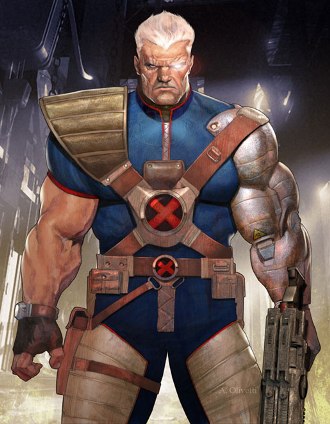
The Cable comic books, published by Marvel Comics, are eponymously named for the main character, Cable. Cable's character page is here.
The character first fully appeared in "The New Mutants" #87 (January 1990), and was created by writer Louise Simonson and artist/co-writer Rob Liefeld.
Cable, or Nathan Christopher Charles Dayspring Askani'son Summers, is a time-traveling soldier from the future who is here to prevent his apocalyptic timeline from coming to pass. He is biologically the son of Madelyne Pryor (a clone of Jean Grey) and Scott Summers, a.k.a. Cyclops, and the stepson and genetic-proxy son of Jean Grey. As an infant, he first appeared in Uncanny X-Men #201 (October, 1985), though it took years for said infant and the time-traveling adult to be revealed as the same individual.
Thanks to the machinations of Mr. Sinister, he was born with a destiny—to kill Apocalypse. Not being an idiot, Apocalypse took steps to prevent this at an early stage by infecting Nathan with a special "techno-organic virus" which severely limited his powers and would have killed him if his loving father and step-mother hadn't sent him 2,000 years into the future to be raised by his alternate-universe sort-of-half-sister's all-female psychic cult. Once he had grown into a grizzled old veteran, Nathan came back in time to the present in order to kill Apocalypse before he could conquer the world.
Now that Cable has accomplished his mission (repeatedly), he has become a man without a purpose; the character has been bounced around through a variety of new concepts. He's been a member of the X-Men more than once, became a messiah figure and developed an Odd Friendship with a certain psychotic katana-wielding mercenary, then adopted and raised Hope, the first mutant born after the mass depowering, while traveling through time. His powers have fluctuated as well, regaining and losing both his techno-organic symbiote and his mutant powers.
In the aftermath of Extermination (2018), a younger version of Cable dubbed "Kid Cable" and who murdered the original, stars in a new X-Force series that reunites the surviving members of the original X-Force team. Kid Cable then joined the Fallen Angels alongside Psylocke (the second one) and X-23 before getting his own series. Old Cable was later resurrected to defeat Stryfe and Kid Cable had to return to the future.
Cable appears in:
Notable Comic Appearances
- New Mutants (first appearance as Cable)
- X-Force Vol. 1 (1991)
- Cable: Blood and Metal #1-2 (1992)
- Cable Vol. 1 #1-108 (1993)
- The Adventures of Cyclops and Phoenix (1994)
- Askani Son #1-4 (1996)
- Soldier X #1-12 (2002)
- Cable & Deadpool #1-50 (2004)
- Cable Vol. 2 (2008)
- Avengers: X-Sanction (2012)
- Cable and X-Force #1-19 (2013)
- X-Force Vol. 6 #1-15 (2014)
- Cable Vol. 3 #1-5, renumbered to #150-158 (2017)
- Extermination (2018) (2018) (murdered and replaced by younger self)
- X-Force Vol. 7 (2018)
- X-Men Vol. 5
- Fallen Angels (2019) #1-6
- Cable Vol. 4 (2020)
- Cable: Reloaded (2021)
- Cable Vol. 5 (2024)
Appearances in Other Media
- X-Men: The Animated Series, voiced by Lawrence Bayne (Japanese voice: Tesshō Genda)
- X-Men '97, voiced by Chris Potter
- Deadpool (2013), voiced by Fred Tatasciore.
- Deadpool 2, played by Josh Brolin.
- Marvel vs. Capcom 2: New Age of Heroes
- Marvel: Avengers Alliance.
- Super Hero Squad Online
- Marvel: Ultimate Alliance 2
For tropes pertaining to the Cable character and those associated with him, see the character page
This page is for tropes applying to the series named Cable; tropes applying to the character go on the characters page.
The various Cable series contain examples of:
- Aborted Arc
- Issue #78 revolves around Blanquesmith developing a cure for the techno organic virus as Cable loses his telekinesis and thus his ability to hold it off. Issue 79 ignores all of these developments.
- When Sensei Shin decides to start training Cable, we cut to a shot far away from Earth 616 of a giant man mocking her for taking on a human apprentice and sending several Black Dawn ninjas out to find Cable, warning them to not return until he is captured. This is never followed up on.
- A.I. Is a Crapshoot: S.H.I.E.L.D.'s Mad Scientist Horatio Belgrade implants Cable's technorganic virus in ten robots from the Nemesis project. Six of them are destroyed. The remaining ones go berserk, believing that: 1) they were Nick Fury and the Howling Commandos; 2) they were on Nazi Germany and 3) everyone else was a Nazi. As a result, their directive is to kill anyone on sight. Their first victim is Doctor Belgrade himself.
- Art Shift: The Walking the Earth phase following the Dark Sisterhood arc is marked by wild art shifts as Cable moves from Singapore to Peru to Macedonia to Brazil, etc.
- Backup Twin: The origins of Stryfe. After Nathan got transported to the future, Clan Askani weren't certain he'd survive after having been infected with the Transmode Virus, so they tried making an uninfected clone. They were surprised when Nathan pulled through, and even more surprised when Apocalypse's forces stormed in and grabbed the baby clone.
- Beard of Evil: Stryfe, normally clean-shaven in his own body, decides the first thing to do on taking over Nathan's is to grow a beard. Second time around, he's annoyed Nathan's shaved, because it'll take ages to grow a new one out.
- Catching Up on History: Issue #1 has Kane, who's been brought into Cable's future, checking historical records, though part of his motivation is learning more about Cable's history. Unfortunately, accessing the records allows others to track him down.
- Clone Angst: Nathan originally thought he was the clone, and Stryfe was Scott and Madelyn's baby, and was pretty angsty about it. Eventually, Mr. Sinister reveals it's the other way around.
- Compelling Voice: Arc villain Randall Shire is an Australian mutant described as a "psychomorph" who could change people's emotions to match what he told them; talking about sad things made them sad and happy things made them happy. This made him an excellent actor and entertainer in his job as a circus clown before possession by an alien entity amplified his powers to totally enslave anyone who heard him directly.
- Cruel Mercy: The courts decide that since Gaunt does not fear death they are going to force him to live out the rest of his days in the most agonizing Ironic Hell comic book super science can construct to torture him personally. Cable at first thinks it's too good for Gaunt, but then has a change of heart, decided it really is better to spare his life, and maybe even apply such "mercy" to more of his enemies down the road. Cable being Cable, doesn't stop killing people entirely, however.
- Cybernetics Eat Your Soul: Hammer refuses Cable's offer of cybernetics fixing his paralysis, saying they've robbed Cable of what little humanity he might have. Kane, who had his missing limbs replaced with cybernetics, is a little put out by this.
- Depending on the Artist:
- Irene Merryweather's hair shifts from auburn to brown depending on the mood of whoever the artist is, with her eyes shifting form green to blue to brown for the same reason
- Rachel Summers has green eyes, when they aren't blue
- Dropped a Bridge on Him: Mother Askani, a future version of Rachel Summers, died when Apocalypse's forces raided Clan Askani. Despite her powers, Ray's instantly dropped by being shot through the chest, with no last words or acknowledgement of her death.
- Foreshadowing: In issue #2, Cable shows an unusually callous attitude to one of his allies sacrificing himself. A few issues later, it turns out Stryfe was in his head.
- Hairstyle Inertia: Flashbacks show Mother Askani still has the very 80s rat-tail she bore in the Excalibur days before she grew her hair out, even in old age.
- Headbutting Heroes: In his 90s series, Cable frequently came into opposition with the X-Men. This was particularly the case with Cyclops, Jean Grey and Wolverine.
- Humiliation Conga: Cable first gets some Humble Pie when he decides to kill Apocalypse in the past and avert Age of Apocalypse entirely. Not only does he utterly fail, with Cyclops being the one to knock off Apocalypse at the cost of his life, but then Cable proceeds to be repeatedly put his place by Maximum Secret, Harmony, the Rashim Empire, the Norns, Sensei Shin and Gaunt, and also suffer some nearly demoralizing mind games at the hands of the Undying, to reinforce to him that he's neither as skilled, intelligent or powerful as he thinks he is. Of course Cable learns and resolves to become as skilled, intelligent and powerful as he needs to be, but the experience makes the Trope Codifier for 90sAntiHero a much more kind and sociable man, to be point he starts to worry about his reputation.
- Ironic Name: "Askani" means outsider, but in this series Cable often acts like it's the only group he ever truly belonged to, even after Askani's goal had been accomplished
- Lawyer-Friendly Cameo: Two Baltimore PD detectives that are clearly meant to be Frank Pembleton and Tim Bayliss (and even share their first names) briefly appear in #33.
- Luke, You Are My Father: It's in this series Scott and Jean learn Cable is an adult Nathan Summers.
- One Bad Mother: The third Arc Villain of the Robert Weinberg's run is the Dark Mother, the leader of a female-only cult of robe-clad warrior nuns.
- Pet the Dog: In a weird, warped way. Mr. Sinister reveals to Nathan he's the biological son of Scott and Madelyn. While it does lead to Stryfe possessing Cable, Sinister also seems to do it because he just wants Nathan to know the truth.
- Plot Hole: At first all clues point to the Dark Sisterhood are Gaunt's mysterious benefactors. But then we get the big reveal on exactly who they and their Dark Mother are, and it becomes clear they lack the knowledge and resources to even reach Gaunt, much less know of him. How the group rebuilt to the point they could dictate terms to Gaunt (who is trapped at the end of time) after being utterly crushed by the Summers, S.H.I.E.L.D., the police on all levels of government and the US armed forces (in present time) was never explained, much less who else it might have been if the increasingly unlikely Dark Sisterhood weren't behind it.
- Red Shirts: Cable has many stationed in several cities across North America, Europe and Asia, such as New York's Clean-Up Crew. In a bit of defiance to this trope, few of them actually die, but they aren't meant for Six Pack level fights either.
- Reed Richards Is Useless: The main theme of the David Tischman run was averting this trope, with Cable using his godlike powers to solve real-world problems like terrorism and ethnic conflicts (albeit with decidedly comic-booky twists like super-plagues and clones).
- Screw the Rules, I'm Doing What's Right!: Bridge's decision during "The Nemesis Contract" is to leak information to Irene Merryweather as to expose SHIELD's shady dealings in trying to capture Cable.
- Skewed Priorities: When Cable and Bridge have a less-than-warm reunion in one of Cable's safehouses, Kane occupies his time making a cup of coffee while waiting for them to calm down.
- Techno Wizard: Cable's no tech wizard in his more familiar time line, but he can easily manipulate most electronics of the 616 era he finds himself in. When Cable does it a snag, he can call on Clarity or Key to get the job done.
- Teeth-Clenched Teamwork: Cable and Hope of Clan Chosen do not get on, what with Hope blaming Cable for the death of her sister, his wife, and Cable's habit of disappearing on everyone.
- Trash the Set: Cable puts most of his mercenary money and investments towards the establishment of ever more safe houses, which means the creative team is free to scrap a few every couple of years
- Unwanted Assistance: Rachel and Nathan both have this reaction, when Nathan arrives to save Rachel from Gaunt and when Rachel arrives to assist him against the Dark Sisterhood. The "half siblings" are happy to reunite, but not under circumstances where the other was expecting help from a different source and is convinced their sibling is just going to get hurt.
- We Used to Be Friends: Cable and the Six Pack. His obsessive pursuit of Stryfe led to him mistreating all of them, and to Kane and Hammer losing their limbs. Needless to say, reunions are fraught.
- Yank the Dog's Chain: Cable repeatedly has chances to cure or even just treat the techno organic virus dangled in front of him only for them all to be ripped away. After the Legacy Virus is cured, it's decided by the creative team that Cable can finally have the the techno organic virus expelled from his system too, though the alternations to his arm and leg can't be undone.
- Cockroaches Will Rule the Earth: There's a storyline in Earth-80521 with a race of humanoid roaches; the Roach Soldiers, and they have their own president.
- Evil Counterpart: The 2008 series positions Bishop as one to Cable, being a time-travelling cyborg mutant from a post-apocalyptic future.
- Harmful to Minors: Poor Hope lives in constant danger of this.
- Plot-Relevant Age-Up: Hope Summers, with the frequent time skips in the 2008 series. In issue 1, she's a baby, by issue 24, she's a teenager.
- Covers Always Lie: The first issue of the "Newer Mutants" arc featured what seemed to be the cast on the cover, including Cable, X-23, Armor, Doop, Shatterstar, Longshot and the Age of Apocalypse's Blink. Most of these characters are in fact the protagonists... except Blink. Not only is she working for the villains, but it's not even the same Blink — the Blink present in the story is the mainstream Blink, while the Age of Apocalypse Blink is nowhere to be seen, and in fact returned later in a new Exiles series.