GcoreGlobal Network
210+ PoPs
worldwide
200+ Tbps
network capacity
14000 +
peering partners

Network Locations
Test your Latency
- Your location
- Active locations
- Planned locations
Network locations list
North America
- Ashburn
- Atlanta
- Chicago
- Dallas
- El Paso
- Los Angeles
- Manassas
- McAllen
- Miami
- Minneapolis
Latin America
- Asunción
- Guadeloupe
- Bogotá
- Buenos Aires
- Caracas
- Ciudad del Este
- Martinique
- Fortaleza
- Guatemala City
- Guayaquil
Europe
- Amsterdam
- Athens
- Barcelona
- Belgrade
- Bratislava
- Brussels
- Bucharest
- Budapest
- Chișinău
- Cluj-Napoca
Middle East
- Amman
- Baghdad
- Doha
- Dubai
- Erbil
- Istanbul
- Kuwait City
- Manama
- Muscat
- Riyadh
Africa
- Abidjan
- Abuja
- Accra
- Addis Ababa
- Bamako
- Bangui
- Cairo
- Cape Town
- Casablanca
- Conakry
Asia & Pacific
- Almaty
- Astana
- Baku
- Bangkok
- Bishkek
- Colombo
- Davao
- Dhaka
- Dushanbe
- Ho Chi Minh City
Robust connectivity around the globe
Gcore’s expansive network and rapid content delivery benefits both ISPs looking for an effective peering partner and customers seeking high-performance connectivity. By peering with Gcore, you gain cost-efficiency, enhanced performance, and excellent control over traffic worldwide. Both public peering (route server) and private peering (Private Interconnect) are available to our partners.
120+
directly connected IXPs
14000+
directly connected ISPs


- + others
Powerful and secure infrastructure

Industry content you may like
More articles → How various audiences viewed the World Cup via Gcore
Gcore's content delivery network (CDN) was the backbone behind many broadcasters and live streams at the recent 2026 World Cup, and we observed some interesting stats on how tournament viewing habits differed across the five regions where we operated.This article explores the differences in how audiences watched the games in the Middle East, Francophone Africa, Germany, Malaysia, and Latin America. It also provides some insight into the technology that powered it all behind the scenes.One tournament, several prime timesA football match begins at the same moment everywhere. However, depending on the time zone (and, of course, which teams are playing), viewing demand can differ greatly.Since this year's matches took place in the US, Mexico, and Canada and aligned with their standard waking hours, viewers across the world often had to watch games at unusual times, with regional traffic peaking at different local times.For example, Latin America's peaks came during the evening after work (typically between 18:00 and 21:00). Francophone Africa peaked around 20:45. Germany's regional traffic peaked around 22:30 CEST, while the Middle East and North Africa reached peak audience later still, in the middle of the night. Matches played in the Americas could reach Malaysian viewers at around 11:30 UTC+8 the next morning.These peaks did not necessarily correspond to the same fixture, with demand shifting between regions depending on which teams were playing and the stage of the tournament, meaning that sufficient capacity and 24/7 operational support were vital from beginning to end.Viewing habits and devicesWhat's more, the method viewers used to watch the game also varied greatly across regions.For example, in the Middle East, television dominated: 69% of viewing devices were TVs, against 28% phones and just 2% computers, big-screen viewing in the most literal sense.Francophone Africa showed almost the reverse pattern, with phones accounting for 71% of viewing, computers 25%, and television only 3%.Germany had the most distributed device mix of any region: although phones were the most popular viewing method at 42%, followed by computers at 30%, other connected devices at 15%, television at 12%, and tablets at 1%. Overall, the tournament was followed across a range of devices that people already use at home and on the move.Malaysia was more evenly distributed: phones represented 30% of viewing devices, computers 28%, televisions 21%, other connected devices 19%, and tablets 2%.What the tournament showedThe world watched the same tournament. The way it was watched was different everywhere: televisions across the Gulf, phones across Francophone Africa, mixed devices in Germany and Malaysia, each creating its own traffic peaks and operational demands. For example, in Germany, Gcore's largest regional market during the tournament, traffic peaked above 3 Tbps during national prime time, with the largest share delivered through direct Deutsche Telekom connectivity.Elsewhere, that meant supporting sports platforms across Latin America, a major streaming platform across the Middle East and North Africa, and national broadcasters in Malaysia and Francophone Africa — each with very different audiences and delivery needs.Supporting those audiences required more than raw bandwidth. It required enough capacity to absorb regional surges whenever they arrived, low-latency delivery to keep viewers close to the action, edge-based access control, and engineering teams operating around the clock.The delivery conditions also varied. A stream watched on a large television over fixed broadband in the Gulf Cooperation Council (GCC) also had to perform reliably on a phone across West and Central Africa, without requiring each platform to build a separate delivery stack for every market. This means that behind the scenes, the network had to be ready for weeks of unpredictable demand.For such an emotional, once-every-four-years occasion, audiences need a seamless and reliable viewing experience.Read on to learn more about the infrastructure that made it possible…The technology behind the scenesDelivering that experience, across five regions with very different viewing habits and peak times, was the same engineering challenge everywhere: keep live video reliable, keep viewers close to the live edge, and absorb traffic peaks that arrived at different hours around the world.Gcore didn't publicize its role during the tournament, but the work happened behind the broadcasters and streaming platforms viewers already used: carrying live streams, absorbing sudden demand, validating access at the edge, and keeping services available throughout.Reach means little if the stream fails when audience demand peaks. Across billions of requests measured for the approved reliability figure, 99.9998% completed without a server error. That corresponds to roughly one server error per 500,000 requests across the participating regions, rather than on a single isolated feed.Live streaming also introduces constraints that on-demand systems never face. Viewers expect to stay close to the live action and for playback to recover cleanly when they pause, arrive late, or miss a goal. Gcore supported low-latency delivery using LL-HLS and LL-DASH, alongside catch-up and restart, keeping viewers close to the live edge while still letting them return to a moment they missed.Delivering a major live broadcast also requires more than network capacity and speed. Streaming platforms have to protect accounts and premium content while remaining resilient against threats such as DDoS attacks, credential abuse, and stream piracy.For services using token-based access control, a Gcore FastEdge application validated a signed token on every request and could revoke access immediately, ensuring that premium streams remained available to authorized viewers only. Because verification ran at the edge on the same infrastructure as the CDN, access decisions could be made close to the viewer. This reduced verification traffic reaching the customer's origin while supporting both security and playback performance.Ready for the next tournament?The 2026 World Cup showed what it takes to keep live sport online at a global scale: enough capacity for peaks that never land at the same time twice, low-latency delivery that keeps pace with the action, and security that holds up under real demand, not just on paper.Delivering live streams at a global scale takes more than bandwidth. If you're planning coverage for a major live event, get in touch with Gcore to talk through CDN capacity, low-latency delivery, and edge security for your platform.
22 Jul 2026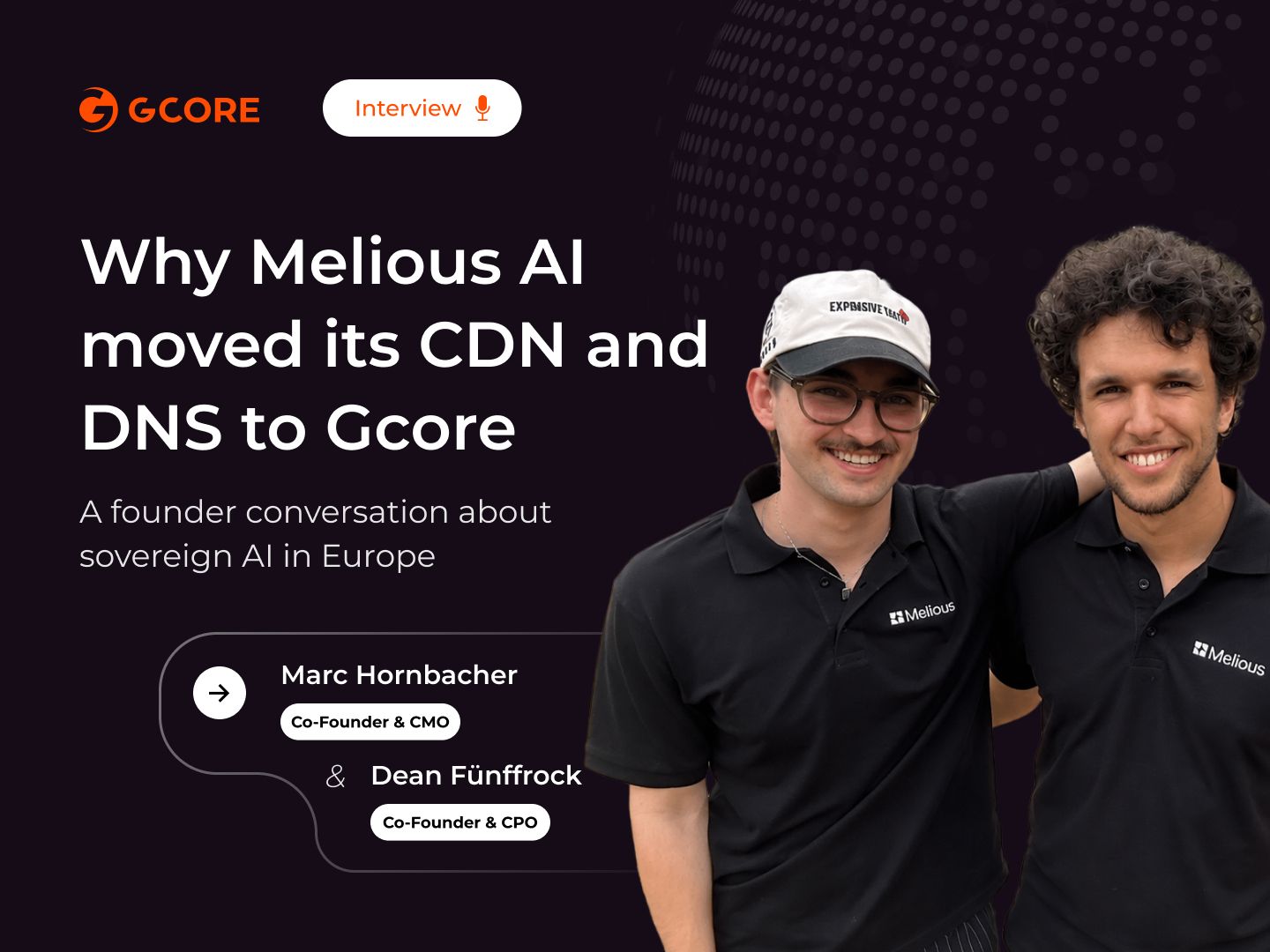 Why Melious AI moved its CDN and DNS to Gcore: a founder conversation about sovereign AI in Europe
For many startups, infrastructure decisions are mostly about performance, pricing, and developer experience. For Melious AI, they are also about trust.Melious AI is a German startup building a European AI platform around privacy, transparency, sustainability, and digital sovereignty. Its core product gives companies an OpenAI- and Anthropic-compatible endpoint, so teams can switch by changing the base URL rather than rebuilding their applications from scratch. Behind that endpoint, Melious connects open-weight models, European infrastructure providers, and additional tools such as web search and code execution in a sovereign environment.We spoke with Dean Fünffrock, Co-Founder & CPO, and Marc Hornbacher, Co-Founder & CMO, about why they started Melious, what sovereignty means beyond a marketing slogan, and why the team decided to move its CDN and DNS layer to Gcore."We make European AI infrastructure actually usable"Dima Maslennikov, Gcore: Dean, Marc, thanks for joining. Let's start with a short introduction. Who are you, and what is Melious AI building?Dean Fünffrock, Melious AI: I'm Dean, Co-Founder and CPO at Melious AI. We are a startup based in Germany, and what we build is a way to connect the software and infrastructure that already exists in Europe and make it usable and accessible for companies.At the core, we provide an inference service. It works through an endpoint that is compatible with what many developers already use with OpenAI or Anthropic. In practice, that means companies can switch quite easily by changing the base URL.But we are not only building around technical compatibility. Our values are privacy first, sustainability, and transparency. We try to work with data centers that mostly use green energy, and where that is not fully possible, we compensate through projects. We also want users to know what they are getting: which model was used, which provider was used, what energy was consumed, and what CO₂ was estimated for a request.On top of the API, we also have a chat interface so that people can use the product without coding. And we are expanding with tools that AI applications often need, such as web search and code execution. The important part is that these tools are also hosted on sovereign infrastructure. We do not want to rely on Google APIs or Brave APIs for that.Dima: And your role specifically?Dean: I'm CPO, but at our stage, that means a lot of things. Right now, I mainly work on front-end development and talk to customers about what they need, what features matter, what does not matter, and where the product has the biggest potential.Marc Hornbacher, Melious AI: I'm Marc, Co-Founder and Chief Marketing Officer. I take care of the marketing side at Melious. I'm also still at university and finishing my bachelor's degree this semester. After the summer, Melious will be my full focus.From a privacy problem to a companyDima: How did the company start?Dean: The project started before the company was officially founded. I worked with our CEO, Simon, at another company in our city. He was building a solution that needed AI integration, but it had to be really private. There was no solution where we could be fully sure that no data was exposed to US authorities, logged, or used for training.That was the beginning. We started with brainstorming sessions, met in the city, talked about the idea, and later brought in Tom, our COO. Simon, Tom, and I went to the same high school, which was also quite technical, so the idea resonated with us. Marc and I knew each other from making music a few years ago. That is how the team came together.We founded the company in September 2025. Since then, we have been building the product and raising money.Dima: Where are you now in terms of traction?Dean: We have a live product with over 300 registered users, and we've seen especially strong growth recently — driven in part by events like the Fable shutdown pushing teams toward sovereign infrastructure.Dima: What has been the main acquisition channel so far?Marc: LinkedIn and events. A lot of it comes from talking to people in person. We are also about to start Google Ads, but until now it has mostly been LinkedIn and direct conversations at events."If you work with sensitive data, you should care where it goes"Dima: Let's step back to the problem. What is the core issue you are solving?Dean: AI is one of the biggest topics right now, and it will be integrated into almost everything. But if you deal with sensitive data, you really need to care about where that data goes, who is involved in processing it, and what happens to what you put in.With many established solutions, companies face uncertainty. Data may be processed in environments where they do not fully control legal exposure. For example, there are questions around whether data can be accessed under the US Cloud Act if US-owned cloud companies are involved.For us, that is the problem: companies want to use AI, but they need to know what happens to their data and who has control over the infrastructure.Dima: Marc, who are the customers with this problem?Marc: Basically, every company has to think about privacy and data. But some industries feel it much more strongly. Medtech, fintech, defense tech, govtech — these are obvious examples. Any company that works with sensitive data and cannot compromise on privacy is relevant.At the same time, we currently focus a lot on startups because they are easier to reach at our stage. We can talk to them faster, learn faster, and understand where the product fits best.Dean: The challenge with industries like medtech is that there are many compliance requirements. As a startup, you cannot just rush into that. It will take time. But in the long run, those areas are exactly where a solution like ours can have the biggest impact.Sovereignty is not one thing. It has layers.Dima: Sovereignty is a hot topic, but it is also becoming a marketing keyword. What does sovereignty actually mean for you?Dean: For us, in AI, sovereignty has three layers.The first layer is the model provider or the lab that trains the model. The second layer is the hardware the model runs on. The third layer is the entity that operates the hardware, provides the service, and controls the data center.The part we are solving is control. We want to know what is happening in the infrastructure we use, and we want to be able to tell our customers what is happening to their data.That is the core of sovereignty for us. It is not just about saying "European." It is about being able to understand and control the chain.Why Melious AI moved CDN and DNS to GcoreDima: And that is also why you decided to move to Gcore?Dean: Yes. We needed to make sure there was no US entity involved in the chain.So we did some research and checked whether there was a provider that could give us what we needed. We found Gcore, and it provided everything we needed.Dima: So for you, it was not only a technical infrastructure decision. It was part of the sovereignty requirement.Dean: Exactly.What comes next for Melious AIDima: What are your plans now? Are you looking for customers, investors, partners?Dean: Our primary goal is to reach as many potential customers as possible who struggle with privacy and work with data where privacy really matters. We are looking for companies that do not want to compromise, that want to know what happens to their data, and that want to be sure it is safe.Fundraising is a topic for us. We are well set for the moment, but we are preparing for a larger seed round toward the end of the year, and we are always open to discussions with the right partners.What we really want is customers, feedback, and connections — especially into government organizations. We already got some insights into healthtech, but govtech would be very interesting for us as well.The main call to action is simple: try our service. See how easy it is to switch. Give us feedback if something is not as expected, if you need a feature, or if there is a use case we should understand better.The infrastructure question behind European AIMelious AI is building in a market where "sovereign AI" can easily become a slogan. But for the team, the concept is concrete: who trains the model, where it runs, who operates the infrastructure, and under which legal framework the data is processed.That is why the choice of Gcore for CDN and DNS was not just a backend decision.It was part of the same product logic that shapes Melious itself: if companies are expected to trust AI with sensitive data, the infrastructure behind that AI has to be explainable, controllable, and aligned with European requirements.For startups, this is a reminder that infrastructure is no longer invisible. In AI, it is part of the product, part of the compliance story, and part of the trust users are being asked to place in the technology.Gcore offers global infrastructure built for exactly this kind of challenge. If you're a startup that can't afford ambiguity in your infrastructure stack, explore what's possible at gcore.com/infrastructure-for-startups.
13 Jul 2026 Four e-commerce takeaways from the Berlin Expo
E-commerce is moving fast — and the conversations at E-commerce Berlin Expo reflected just how much has changed in the last few years.Now that the event is over, here are four things I took away from speaking with key players across the industry, as Gcore's e-commerce GTM lead.1. CDN is no longer simply technical jargonMost decision-makers across various business functions are aware of the benefits CDN can bring to their brands: multimedia optimization, reduced manual workload, faster load times, and much more. Just a couple of years ago, you would only hear about this topic in enterprise boardrooms. Now, it's becoming part of a toolkit among SMBs and agencies — and demand is growing exponentially.2. Infrastructure has maturedTeams have already amassed a colossal amount of data, and know exactly which pages trigger a purchase decision. For example, very few brands observed material performance degradation across critical flows (home, product, checkout) during the most recent Black Friday and Cyber Monday events. High-peak discount events no longer expose weaknesses as easily as they did a few years ago. Preparation cycles have become more mature, with even marketing teams treating infrastructure as a strategic priority rather than an afterthought.3. Cybersecurity is a must-haveThe most striking contrast was the difference I saw in the approach to cybersecurity — a total shift from five years ago. What was a long-tail risk acceptance (if it happens, then it happens) has now become part of a proactive risk-hedging strategy, e.g., how can we become more resilient? Decision-makers across all functions recognize the multitude of L3-L7 attacks. SQL injections, API abuse, credential stuffing, and outright payment fraud were all on the radar across operational and technical teams this year.4. Data sovereignty has a price problemEnterprise teams are all-in, embracing the EU data sovereignty approach. Compliance and DevOps have a robust understanding of the types of data they operate with, where the data travels, and who has access to it. But mid-tier and long-tail still prioritize price and accept the risks due to a lack of 360° full-stack solutions on the EU market. On top of this, the price factor still dominates — even the most regulatory forward-looking teams can become hesitant if the price tag for an EU switch becomes substantial.Powering e-commerce: Gcore at Berlin ExpoFor more insights from the event, take a look at this short video of us in conversation with e-commerce industry professionals about the role of AI and Cloud in e-commerce infrastructure.And check out our in-person Masterclass from the Expo, if you're looking for even more insights into e-commerce success and why infrastructure is the foundation.EU-sovereign infrastructure, built for e-commerceAll of these conversations and insights reinforced something we think about a lot at Gcore — particularly around data sovereignty. The demand is real, but price and fragmentation are still holding teams back. That's exactly why we've built a full-stack, EU-sovereign solution for e-commerce and retail that doesn't ask you to compromise on performance or cost to get there. If that's a challenge your team is facing, get in touch.Chat to us about your e-commerce needs
10 Mar 2026
Technology partners


Join our network for robust connectivity and global reach
Connect to Gcore for free and experience unmatched speed and reliability.