


Connecting your TV to the router with an Ethernet cable seems like the right move. You skip the Wi-Fi connectivity hiccups and other variables between the TV and router. Only after doing that do you realize that the TV's Ethernet port caps out at 100Mbps speeds while your Wi-Fi 6 easily delivers three or four times that.
Almost all modern TVs, especially the expensive ones, ship with a fast Ethernet port rather than a gigabit one. So connecting the TV's Ethernet port directly to the router with a Cat7 or higher cable won't magically deliver better results. Sure, you can plug a gigabit Ethernet adapter into the TV's USB port. In the end, the speed gap between Ethernet and Wi-Fi on your TV matters a lot less than you'd think.
Why does your TV even have a 100 Mbps Ethernet port
All have the same speed port

Most TV manufacturers assume that most people do not think much about the Ethernet port. To cut down on component costs, the TVs bundle a fast Ethernet port that doesn't support gigabit speeds. That's right, since no one expects you to task your TV with sending large files across the network. This is why TV makers see no benefit in upgrading the port.
You'd find an Ethernet port on budget TV units, even on the most premium ones, though all are capped at 100Mbps. It's ironic that those TVs have a Wi-Fi 6 or Wi-Fi 6E chip inside, which can hit over 300Mbps. So the Ethernet port turns out to be the slower one. Meanwhile, your setup can have a gigabit internet connection managed with a gigabit router. Even your computer and game console sport a gigabit port. It's just the TV that sticks out with a 100Mbps connection like a sore thumb.
How much speed do streaming services actually need
Streaming services dictate the truth

Each streaming app requires a specific bandwidth to deliver the highest resolution. Here's a quick look at the speeds popular streaming services need to deliver the highest quality:
- Netflix 4K HDR: about 25Mbps
- Hulu 4K: about 16Mbps
- Disney+ 4K: about 25Mbps
- Apple TV+ 4K Dolby Vision: about 40Mbps
- MAX (HBO Max) 4K: about 50Mbps
- YouTube 4K: about 20Mbps
Even while streaming Apple TV+ or MAX content at the highest quality, you are still well within the port's 100Mbps limit. Even if you manage to run two top-quality streams, you're still unlikely to hit the ceiling limits. Besides, streaming services are moving to use more bandwidth-efficient codecs like HEVC and AV1 instead of increasing bitrates.
So it's unlikely the base bandwidth requirement for 4K streaming will go up. Given the bandwidth required to stream the highest-quality content, your TV's Ethernet port won't experience a bottleneck. In fact, it still offers some headroom.

I didn’t expect this GPU-powered SNES emulator to make 16-bit games look this good
Super ZSNES gives classic Super Nintendo games a more modern look.
Where Ethernet still wins over the Wi-Fi connection
It's about consistency, not speed

The wired connection wins on consistent behavior, not on the numbers. In comparison, Wi-Fi 6 and Wi-Fi 6E are wireless. In a home with several phones, laptops, smart home devices, printers, and consoles, all your devices are fighting for the same bandwidth. That makes the wireless unpredictable, and a speed test won't always show it.
Ethernet isn't affected by your neighbors' routers or by multiple devices active on your network. It delivers consistent latency and throughput. That's what delivers a steady streaming experience, not raw speed. Try plugging your smart TV directly into the router or switch using an Ethernet cable. The random changes in media quality, stuttering, and audio delays might just go away for good. After all, everyone wants an uninterrupted streaming experience.
Ethernet falls short for high-quality local playback
When the limit backfires
Using the Ethernet port on smart TVs does offer consistency and stability, but there's an obvious demerit hard to ignore. That port becomes a real constraint if you're planning to stream high-bitrate files locally.
People running Jellyfin, Plex, or Kodi to stream uncompressed 4K Remuxes with Dolby Vision or HDR require 80-100 Mbps speeds. The large files of such high-quality content can easily hit the 100Mbps ceiling.
Folks who self-host media servers with such large files have already thought things out. You can either use a separate media player for those high-resolution files or tweak the media server's transcoding settings. A gigabit port can give extra headroom to those streams.
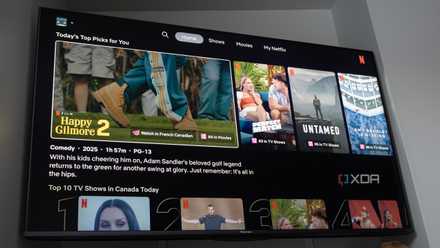
Your smart TV may be holding your entire Wi-Fi hostage
Make your Wi-Fi great again by removing your smart TV from it
The Ethernet port still earns its keep on TVs
The TV's wired Ethernet connection still beats the variable Wi-Fi connection on the grounds of reliability for most home setups. While the 100Mbps port on the TV does seem like a relic, it delivers a more stable, lower-latency, and consistent connection for 4K streaming and gaming.
While Wi-Fi is more convenient, it's not free from interference from walls and other devices. That said, your TV doesn't need a fast data pipe — it needs a reliable one.