Loading...
| Patricius ap Calpurnius is managed by the Ireland Project. Join: Ireland Project Discuss: irish_roots |

Biography

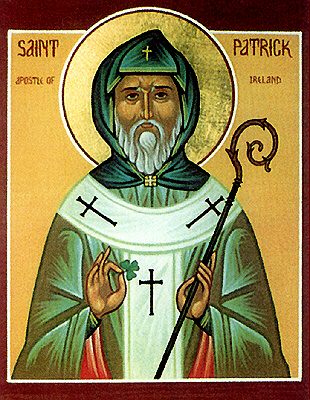
Saint Patrick was a Romano-British Catholic missionary and bishop in Ireland.

|
Patrick is believed to have been born anywhere from 351 to 353. These numbers are based on the supposition that he was at least 16 years of age when abducted "together with many thousands of his Countrymen" as described in his Confessio.[1] This event, the "Great Raid," is assumed to be the "barbarica conspiratio" of 0367-0368.[2][3]
According to his own writings, he was the son of Calpornius, a deacon in the local Christian church, and his paternal grandfather, Potitus, was a Christian priest in "Bannavem Taburniae".[4] According to Muirchú, writing 3-4 centuries after Patrick's death, his mother was Conchessa,[5] who is identified in the (later) Tripartite Life of Saint Patrick as a close relative (possibly sister or niece) of St Martin of Tours, though its veracity is disputed.[6] Patrick was not a practicing Christian in his youth.[4]
While Patricius ("father of the citizens") is the only name he ever used for himself in his surviving writings (rendered Pátraic in Old Irish, Pádraig in Modern Irish and Patrick in English),[4] Muirchú and Tírechán (writing much later) assign him three other names Sochet/Succetus, Contice/Cothirthiacus and Mauonius/Magonus.[5][7] Muirchú attributed his four names to four periods in his life: Sochet when he was born, Contice when he was a slave, Mauonius when he studied, Patricius when he was consecrated.[5]
When he was about 16 years old, Patrick was captured by pirates who often raided the western Scottish lowlands as Roman civilization was collapsing (all Roman troops were ordered back to Rome from Britain c.405). He was taken to north-east Ireland, known as "Dalriada," and sold as a slave whose main duties were herding sheep and pigs for a local Druid (pagan) priest for six years. It was during this time, by his own admission, that Patrick turned to the God of his fathers and developed his faith in Christ as his bulwark against the harsh treatment he underwent at the hands of his pagan captors. Clearly an intelligent lad, he also learned the Irish language (not too different from his own native pre-Welsh dialect) and about Irish customs and history. From this early knowledge, he later devised the Celtic Cross emblem, uniting pagan solar characteristics with the traditional Christian Greek cross.[8]

|
After about six years in captivity, young Patricius, heard a voice in his meditations saying "a ship is waiting" to take him home. He soon escaped and walked several days until he reached the coast where he found a ship and a captain willing to take him on, after some persuasion. After three days at sea they reached Britain where, following several adventures, he was reunited with his family.[8]
In 431 Patrick was ordained a bishop by Pope Celestine I,[9] and shortly after his clerical elevation Patrick felt a renewed call to return to Ireland, this time as a respected leader who could help Irish Christians, struggling with local pagan rulers as well as seaborne invasions. He later wrote that he had a vision of "Saint Victoricus" (possibly St Victricius) appealing to him as "The Voice of the Irish." He decided he needed to answer the call.[8]
The Annals of Ulster record Bishop Patricius's arrival in Ireland in 432.[10] While Patrick is often credited with bringing Christianity to Ireland, Bishop Palladius (Wikipedia) arrived in 431,[11] and even he was noted to have been sent to the Irish believing in Christ, implying that there were already Christians in Ireland.[12] Patrick landed in what is today County Wicklow; possibly in Bray, Glas Gorman (near Arklow) or Wicklow town.[13]
Even though he landed in eastern Ireland, the diocese where Patrick served as bishop was located in the west of Ireland. He was a very successful preacher and organiser, converting thousands to Christianity, including several local chieftains and their families. He also ordained many disciples, among them Beningnus, Auxilius, Iserninus, and Fiaac, (all later canonised saints in the Roman Catholic Church).[14] Tradition also tells of him spreading Christianity to the Isle of Man.[15]
Patrick’s mission in Ireland was not without its controversies and setbacks. His "Confessio" was written to answer critics within the Church who opposed his financial actions (especially accepting gifts from wealthy women converts), and who suggested he had an inflated ego. It worked; he was able to proceed with his mission in his decades on the Isle.

|
Patrick and his followers were excellent teachers, using local lore and flora and fauna to make the Gospel message come alive for Irish listeners. The shamrock, a three-lobed ground cover in Ireland, served as an illustration of the Christian Trinity: Father, Son, and Holy Spirit, three separate identities united in One Being, making a difficult theological stumbling block easier for his flock to understand.
There are conflicting dates for Patrick's death, ranging from 457-496. The wide discrepancy is thought to be because at least two (and possibly three) Patricks have been conflated over the years by historians.[16] The Annals of Ulster record his death as having occurred in 457.[17] Although his remains have never been formally identified, it is generally accepted that he is buried at the Cathedral of County Down's Downpatrick, along with St Brigit and St Columba.[18]

|
| St Patrick cast out the snakes |

|
| Saint Patrick's purported tomb, Downpatrick, County Down |
Sources
- ↑ Koch, John T. Some Problems of the Chronology of Saint Patrick. Irish Historical Society, Dublin (1957), p. 6, fn.7.
- ↑ Blockley, R. C. “The Date of the ‘Barbarian Conspiracy.’” Britannia 11 (1980): 223–25. https://doi.org/10.2307/525681.
- ↑ Tomlin, Roger. “The Date of the ‘Barbarian Conspiracy.’” Britannia 5 (1974): 303–9. https://doi.org/10.2307/525734.
- ↑ 4.0 4.1 4.2 Patrick's Confessio: Patricius, Confessio.
- ↑ 5.0 5.1 5.2 Muirchú's Life of Patrick: Muirchú, Vita sancti Patricii (English translation).
- ↑ Vita tripartita Sancti Patricii (English translation), p. 9.
- ↑ Tírechán's Collectanea: Tírechán, Collectanea (English translation).
- ↑ 8.0 8.1 8.2 Wikipedia contributors, 'Saint Patrick', Wikipedia, The Free Encyclopedia, 10 March 2026, 04:13 UTC, <https://en.wikipedia.org/w/index.php?title=Saint_Patrick&oldid=1342671236> [accessed 10 March 2026]
- ↑ O'Clery, Michael, et al., John O'Donvan (transl.). Annals of the Kingdom of Ireland. Dublin: Hodges, Smith and Co. (1859), p. 129.
- ↑ U432.1: Annals of Ulster. 432.1. English translation).
- ↑ U431.1: Annals of Ulster. 431.1. English translation).
- ↑ Chris Lawlor, The little history of Wicklow (Cheltenham, 2026), pp 23-4.
- ↑ Chris Lawlor, The little history of Wicklow (Cheltenham, 2026), p. 27.
- ↑ Life of Saint Patrick
- ↑ Lebor Gabála Érenn : The Book of the Taking of Ireland part VI pdf available on CELT
- ↑ Koch, John T. Some Problems of the Chronology of Saint Patrick. Irish Historical Society, Dublin (1957), p. 22.
- ↑ U457.2: Annals of Ulster. 457.2. English translation).
- ↑ Wikipedia contributors, "County Down," Wikipedia, The Free Encyclopedia, https://en.wikipedia.org/w/index.php?title=County_Down&oldid=1340178222 (accessed March 16, 2026).
See also:
- Hanson, R.P.C.The Life and Writings of the Historical Saint Patrick. New York: Seabury Press (1983).
- His Irish household and some of the relationships of Saint Patrick are described in a Panegyric poem to be found in the Annals of the Four Masters M448.2 - CELT Corpus of Electronic Texts Edition (Search M448.2).
- On the Life of St. Patrick, Author: unknown - CELT Corpus of Electronic Texts Edition.
- Moran, Patrick Francis Cardinal. "St. Patrick."Catholic Encyclopedia. Vol. 11. New York: Robert Appleton Company, 1911. 16 Mar. 2015 .
- Vita tripartita Sancti Patricii.
- Moran, Patrick Francis Cardinal. "St. Patrick." Catholic Encyclopedia. Vol. 11. New York: Robert Appleton Company, 1911. 16 Mar. 2015 .
- Cotton, Henry. Fasti Ecclesiae Hibernicae (Hodges & Smith, Dublin, 1849) Vol. 3 "The Province of Ulster", Page 3-4.
- Find a Grave, database and images (FindAGrave.com : accessed 15 March 2021), memorial page for Saint Patrick (c.379–c.461), Find A Grave: Memorial #3115, citing Saul Roman Catholic Churchyard, Downpatrick, County Down, Northern Ireland ; Maintained by Find A Grave. States his "generally accepted but not proven" burial site is just outside the Cathedral at Downpatrick.