flowerer
(redirected from flowerers)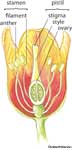

flow·er
(flou′ər)n.
1.
a. The reproductive structure of angiosperms, characteristically having either specialized male or female organs or both male and female organs, such as stamens and a pistil, enclosed in an outer envelope of petals and sepals.
b. Such a structure having showy or colorful parts; a blossom.
c. A flower head.
2. A plant that is cultivated or appreciated for its blossoms.
3. The condition or a time of having developed flowers: The azaleas were in full flower.
4. The period of highest development or greatest vigor. See Synonyms at bloom1.
5. The highest example or best representative: the flower of our generation.
6. A natural development or outgrowth: "His attitude was simply a flower of his general good nature" (Henry James).
7. flowers Chemistry A fine powder produced by condensation or sublimation of a compound.
v. flow·ered, flow·er·ing, flow·ers
v.intr.
1. To produce a flower or flowers; blossom.
2. To develop naturally or fully; mature: His artistic talents flowered early.
v.tr.
To decorate with flowers or with a floral pattern.
[Middle English flour, from Old French flor, from Latin flōs, flōr-; see bhel- in Indo-European roots.]
flow′er·er n.
flow′er·less adj.
American Heritage® Dictionary of the English Language, Fifth Edition. Copyright © 2016 by Houghton Mifflin Harcourt Publishing Company. Published by Houghton Mifflin Harcourt Publishing Company. All rights reserved.
flowerer
(ˈflaʊərə)n
(Horticulture) a plant that flowers at a specified time or in a specified way: a late flowerer.
Collins English Dictionary – Complete and Unabridged, 12th Edition 2014 © HarperCollins Publishers 1991, 1994, 1998, 2000, 2003, 2006, 2007, 2009, 2011, 2014
flow•er•er
(ˈflaʊ ər ər)n.
a plant that flowers at a specific time or in a certain manner.
[1850–55]
Random House Kernerman Webster's College Dictionary, © 2010 K Dictionaries Ltd. Copyright 2005, 1997, 1991 by Random House, Inc. All rights reserved.