androecium
(redirected from androecia)Also found in: Thesaurus, Medical, Encyclopedia.
an·droe·ci·um
(ăn-drē′shē-əm, -shəm)n. pl. an·droe·ci·a (-shē-ə, -shə)
The stamens of a flower considered as a group.
[New Latin : andr(o)- + Greek oikion, diminutive of oikos, house; see weik- in Indo-European roots.]
an·droe′cial (-shəl) adj.
American Heritage® Dictionary of the English Language, Fifth Edition. Copyright © 2016 by Houghton Mifflin Harcourt Publishing Company. Published by Houghton Mifflin Harcourt Publishing Company. All rights reserved.
androecium
(ænˈdriːsɪəm)n, pl -cia (-sɪə)
(Botany) the stamens of a flowering plant collectively
[C19: from New Latin, from andro- + Greek oikion a little house]
anˈdroecial adj
Collins English Dictionary – Complete and Unabridged, 12th Edition 2014 © HarperCollins Publishers 1991, 1994, 1998, 2000, 2003, 2006, 2007, 2009, 2011, 2014
an•droe•ci•um
(ænˈdri ʃi əm)n., pl. -ci•a (-ʃi ə)
the stamens of a flower collectively.
[1830–40; < New Latin < Greek andr- andr- + oikíon, diminutive of oîkos house]
an•droe′cial (-ʃəl) adj.
Random House Kernerman Webster's College Dictionary, © 2010 K Dictionaries Ltd. Copyright 2005, 1997, 1991 by Random House, Inc. All rights reserved.
ThesaurusAntonymsRelated WordsSynonymsLegend:
Switch to new thesaurus
| Noun | 1. | 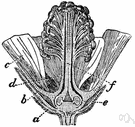 androecium - a male gametoecium androecium - a male gametoecium gametoecium - gametangia and surrounding bracts |
Based on WordNet 3.0, Farlex clipart collection. © 2003-2012 Princeton University, Farlex Inc.
Translations
hetiö
befruktningsdelarna