soviet
(redirected from Sovietisation)Also found in: Thesaurus, Encyclopedia.
so·vi·et
(sō′vē-ĕt′, -ĭt, sŏv′ē-, sō′vē-ĕt′)n.
1. One of the popularly elected legislative assemblies that were created after the Russian Revolution (1917) and existed at local, regional, and national levels in the former Soviet Union.
2. Soviet A native or inhabitant of the former Soviet Union.
adj.
1. Of or relating to a soviet.
2. often Soviet Of or relating to the former Soviet Union.
American Heritage® Dictionary of the English Language, Fifth Edition. Copyright © 2016 by Houghton Mifflin Harcourt Publishing Company. Published by Houghton Mifflin Harcourt Publishing Company. All rights reserved.
soviet
(ˈsəʊvɪət; ˈsɒv-)n
1. (Government, Politics & Diplomacy) (in the former Soviet Union) an elected government council at the local, regional, and national levels, which culminated in the Supreme Soviet
2. (Historical Terms) (in prerevolutionary Russia) a local revolutionary council
adj
(Government, Politics & Diplomacy) of or relating to a soviet
[C20: from Russian sovyet council, from Old Russian sŭvĕtŭ]
Soviet
(ˈsəʊvɪət; ˈsɒv-)adj
1. (Placename) of, characteristic of, or relating to the former Soviet Union, its people, or its government
2. (Peoples) of, characteristic of, or relating to the former Soviet Union, its people, or its government
3. (Government, Politics & Diplomacy) of, characteristic of, or relating to the former Soviet Union, its people, or its government
Collins English Dictionary – Complete and Unabridged, 12th Edition 2014 © HarperCollins Publishers 1991, 1994, 1998, 2000, 2003, 2006, 2007, 2009, 2011, 2014
So•vi•et
(ˈsoʊ viˌɛt, -ɪt, ˌsoʊ viˈɛt)n.
1. Usually, Soviets. a governing official or citizen of the Soviet Union.
2. (l.c.) (in the Soviet Union)
a. a governmental council, being part of a hierarchy of councils at various levels of government, culminating in the Supreme Soviet.
b. a committee of workers, peasants, or soldiers during the revolutionary period.
3. (l.c.) any similar council in a socialist system of government.
adj. 4. of or pertaining to the Soviet Union or the Soviets.
5. (l.c.) of or pertaining to a soviet.
[1917; < Russian sovét council, advice, Old Russian, Old Church Slavonic sŭvětŭ=sŭ- together, with + větŭ counsel; calque of Greek symboúlion]
So′vi•et•dom, n.
Random House Kernerman Webster's College Dictionary, © 2010 K Dictionaries Ltd. Copyright 2005, 1997, 1991 by Random House, Inc. All rights reserved.
Soviet
A Russian term for a local, regional or national elected government council which grew out of the pre-Revolutionary workers’ councils. These initially democratic bodies were dominated by Bolsheviks (later Communists) after 1917.
Dictionary of Unfamiliar Words by Diagram Group Copyright © 2008 by Diagram Visual Information Limited
ThesaurusAntonymsRelated WordsSynonymsLegend:
Switch to new thesaurus
| Noun | 1. | 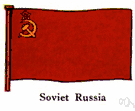 soviet - an elected governmental council in a communist country (especially one that is a member of the Union of Soviet Socialist Republics) soviet - an elected governmental council in a communist country (especially one that is a member of the Union of Soviet Socialist Republics)council - a body serving in an administrative capacity; "student council" |
| Adj. | 1. | Soviet - of or relating to or characteristic of the former Soviet Union or its people; "Soviet leaders" |
Based on WordNet 3.0, Farlex clipart collection. © 2003-2012 Princeton University, Farlex Inc.
Translations
السوفيات
sovětský
sovjet
neuvosto
szovjet
sovét-Sovétmaîur
ソヴェトのソビエトソビエトのソ連の
sovietassovietinissovietų
sovietsovietsky
savet
sovyet
радянський
soviet
[ˈsəʊvɪət]Collins Spanish Dictionary - Complete and Unabridged 8th Edition 2005 © William Collins Sons & Co. Ltd. 1971, 1988 © HarperCollins Publishers 1992, 1993, 1996, 1997, 2000, 2003, 2005
Soviet
[ˈsəʊviət] adj → soviétiqueSoviet Russia n → Russie f soviétiqueSoviet Union nthe Soviet Union → l'Union f soviétique
Collins English/French Electronic Resource. © HarperCollins Publishers 2005
soviet
adj attr → sowjetisch, Sowjet-; soviet power → Sowjetmacht f; soviet citizen → Sowjetbürger(in) m(f)
Soviet
:Soviet Republic
n → Sowjetrepublik f
Soviet Russia
n → Sowjetrussland nt
Soviet Union
n → Sowjetunion f
Collins German Dictionary – Complete and Unabridged 7th Edition 2005. © William Collins Sons & Co. Ltd. 1980 © HarperCollins Publishers 1991, 1997, 1999, 2004, 2005, 2007
Collins Italian Dictionary 1st Edition © HarperCollins Publishers 1995
soviet
(ˈsəuviət) adjective and noun concerning the former Soviet Union.
Kernerman English Multilingual Dictionary © 2006-2013 K Dictionaries Ltd.