parapodium
(redirected from Notopodia)Also found in: Thesaurus, Medical, Encyclopedia.
Related to Notopodia: Notoseta
par·a·po·di·um
(păr′ə-pō′dē-əm)n. pl. par·a·po·di·a (-dē-ə)
1. One of the fleshy paired appendages of polychaete annelids that function in locomotion and breathing.
2. A winglike extension of the foot of certain gastropods, such as the sea butterflies, used for swimming.
[New Latin : para- + Greek pous, pod-, foot; see podium.]
American Heritage® Dictionary of the English Language, Fifth Edition. Copyright © 2016 by Houghton Mifflin Harcourt Publishing Company. Published by Houghton Mifflin Harcourt Publishing Company. All rights reserved.
parapodium
(ˌpærəˈpəʊdɪəm)n, pl -dia (-dɪə)
1. (Zoology) any of the paired unjointed lateral appendages of polychaete worms, used in locomotion, respiration, etc
2. (Zoology) any of various similar appendages of other invertebrates, esp certain molluscs
[New Latin: from para-1 + -podium]
Collins English Dictionary – Complete and Unabridged, 12th Edition 2014 © HarperCollins Publishers 1991, 1994, 1998, 2000, 2003, 2006, 2007, 2009, 2011, 2014
ThesaurusAntonymsRelated WordsSynonymsLegend:
Switch to new thesaurus
| Noun | 1. | 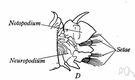 parapodium - one of a pair of fleshy appendages of a polychete annelid that functions in locomotion and breathing parapodium - one of a pair of fleshy appendages of a polychete annelid that functions in locomotion and breathing |
Based on WordNet 3.0, Farlex clipart collection. © 2003-2012 Princeton University, Farlex Inc.