kieselguhr
(redirected from Kieselgur)Also found in: Thesaurus, Medical, Encyclopedia.
Related to Kieselgur: kieselguhr, diatomite
kie·sel·guhr
(kē′zəl-go͝or′)n.
See diatomite.
[German Kieselguhr, obsolete spelling of Kieselgur : Kiesel, pebble (from Middle High German kisel, from Old High German kisil, from Germanic *kisilaz : Germanic *kis-, gravel; probably akin to Lithuanian žiezdra, grain of sand + Germanic *-ilaz, diminutive suffix) + Gur, Guhr, ferment, earthy deposit from water (from gären, to ferment, blend of Middle High German jësan, from Old High German Middle High German *jern, to cause to ferment, from Old High German jerian; see yes- in Indo-European roots).]
American Heritage® Dictionary of the English Language, Fifth Edition. Copyright © 2016 by Houghton Mifflin Harcourt Publishing Company. Published by Houghton Mifflin Harcourt Publishing Company. All rights reserved.
kieselguhr
orkieselgur
n
(Geological Science) an unconsolidated form of diatomite
[C19: from German Kieselgur, from Kiesel flint, pebble + Gur loose earthy deposit]
Collins English Dictionary – Complete and Unabridged, 12th Edition 2014 © HarperCollins Publishers 1991, 1994, 1998, 2000, 2003, 2006, 2007, 2009, 2011, 2014
ThesaurusAntonymsRelated WordsSynonymsLegend:
Switch to new thesaurus
| Noun | 1. | 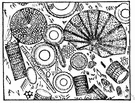 kieselguhr - a light soil consisting of siliceous diatom remains and often used as a filtering material kieselguhr - a light soil consisting of siliceous diatom remains and often used as a filtering materialfilter - device that removes something from whatever passes through it |
Based on WordNet 3.0, Farlex clipart collection. © 2003-2012 Princeton University, Farlex Inc.