cannibal
(redirected from Exocannibalism)Also found in: Thesaurus, Medical, Encyclopedia, Wikipedia.
can·ni·bal
(kăn′ə-bəl)n.
1. A person who eats the flesh of other humans.
2. An animal that feeds on others of its own kind.
[From Spanish Caníbalis, name (as recorded by Christopher Columbus) of the allegedly cannibalistic Caribs of Cuba and Haiti, from earlier Carib karibna, person, Carib.]
can′ni·bal·ism n.
can′ni·bal·is′tic adj.
American Heritage® Dictionary of the English Language, Fifth Edition. Copyright © 2016 by Houghton Mifflin Harcourt Publishing Company. Published by Houghton Mifflin Harcourt Publishing Company. All rights reserved.
cannibal
(ˈkænɪbəl)n
1. (Anthropology & Ethnology)
a. a person who eats the flesh of other human beings
b. (as modifier): cannibal tribes.
2. an animal that feeds on the flesh of others of its kind
[C16: from Spanish Canibales, name used by Columbus to designate the Caribs of Cuba and Haiti, from Arawak caniba, variant of Carib]
Collins English Dictionary – Complete and Unabridged, 12th Edition 2014 © HarperCollins Publishers 1991, 1994, 1998, 2000, 2003, 2006, 2007, 2009, 2011, 2014
can•ni•bal
(ˈkæn ə bəl)n.
1. a person who eats human flesh, esp. for magical or religious purposes.
2. any animal that eats its own kind.
adj. 3. pertaining to or like a cannibal.
4. given to cannibalism.
[1545–55; < Sp caníbal, variant of caríbal <canib-, carib- (< Arawak)]
can′ni•bal•ly, adv.
Random House Kernerman Webster's College Dictionary, © 2010 K Dictionaries Ltd. Copyright 2005, 1997, 1991 by Random House, Inc. All rights reserved.
cannibal
- When Columbus was trying to find the Spice Islands, he was told of a tribe of man-eating natives in Cuba and Haiti called Caribs (from which we get Caribbean) or Caniba (Columbus' rendition of the name); the word canib, meaning "brave and fierce," became cannibal, meaning "anthropophagite," a person who eats human flesh.See also related terms for tribe.
Farlex Trivia Dictionary. © 2012 Farlex, Inc. All rights reserved.
ThesaurusAntonymsRelated WordsSynonymsLegend:
Switch to new thesaurus
| Noun | 1. | 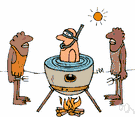 cannibal - a person who eats human flesh cannibal - a person who eats human flesh |
Based on WordNet 3.0, Farlex clipart collection. © 2003-2012 Princeton University, Farlex Inc.
Translations
إنْسانٌ يأكُلُ لَحْم البَشَر
kaniballidožrout
kannibalmenneskeæder
kannibaali
kaniballjudožder
kannibálsaját fajtáját felfaló
dÿr sem étur dÿr af eigin tegundmannæta
kanibalaskanibališkaskanibalizmasžmogėdražmogėdriškas
dzīvnieks, kas ēd savus mazuļuskanibāls
kaniballudożerca
kanibal
ljudožerec
ljudožder
kendi türünü yiyen hayvanyamyam
Collins Spanish Dictionary - Complete and Unabridged 8th Edition 2005 © William Collins Sons & Co. Ltd. 1971, 1988 © HarperCollins Publishers 1992, 1993, 1996, 1997, 2000, 2003, 2005
Collins English/French Electronic Resource. © HarperCollins Publishers 2005
cannibal
n (= person) → Kannibale m, → Kannibalin f, → Menschenfresser(in) m(f); these insects are cannibals → diese Insekten fressen sich gegenseitig
adj → kannibalisch; animals → sich gegenseitig auffressend
Collins German Dictionary – Complete and Unabridged 7th Edition 2005. © William Collins Sons & Co. Ltd. 1980 © HarperCollins Publishers 1991, 1997, 1999, 2004, 2005, 2007
Collins Italian Dictionary 1st Edition © HarperCollins Publishers 1995
cannibal
(ˈkӕnibəl) noun1. a person who eats human flesh.
2. an animal etc which eats others of its own species.
ˈcannibalism nounˌcannibaˈlistic adjective
Kernerman English Multilingual Dictionary © 2006-2013 K Dictionaries Ltd.