electron
(redirected from Electrons)Also found in: Thesaurus, Medical, Encyclopedia.
Related to Electrons: nucleus, Electron shells
e·lec·tron
(ĭ-lĕk′trŏn′)n. Abbr. e
A stable elementary particle in the lepton class having a negative electric charge of 1 elementary unit (about 1.602 × 10⁻¹⁹ coulombs) and a mass of about 9.11 × 10⁻²⁸ grams. Electrons are found in shells orbiting the nuclei of atoms and can also move freely through space as cathode rays in a cathode-ray tube or as beta particles emitted by radioactive nuclei, or flow in a current through a conducting material impelled by an electric potential difference.
[electr(ic) + (i)on.]
American Heritage® Dictionary of the English Language, Fifth Edition. Copyright © 2016 by Houghton Mifflin Harcourt Publishing Company. Published by Houghton Mifflin Harcourt Publishing Company. All rights reserved.
electron
(ɪˈlɛktrɒn)n
(Atomic Physics) a stable elementary particle present in all atoms, orbiting the nucleus in numbers equal to the atomic number of the element in the neutral atom; a lepton with a negative charge of 1.602 176 462 × 10–19 coulomb, a rest mass of 9.109 381 88 × 10–31 kilogram, a radius of 2.817 940 285 × 10–15 metre, and a spin of
[C19: from electro- + -on]
Collins English Dictionary – Complete and Unabridged, 12th Edition 2014 © HarperCollins Publishers 1991, 1994, 1998, 2000, 2003, 2006, 2007, 2009, 2011, 2014
e•lec•tron
(ɪˈlɛk trɒn)n.
1. an elementary particle that is a fundamental constituent of matter, having a negative charge of 1.602 x 10⁻¹⁹ coulombs, and existing independently or as the component outside the nucleus of an atom.
2. a unit of charge equal to the charge on one electron.
Random House Kernerman Webster's College Dictionary, © 2010 K Dictionaries Ltd. Copyright 2005, 1997, 1991 by Random House, Inc. All rights reserved.
e·lec·tron
(ĭ-lĕk′trŏn′) A stable subatomic particle with a negative electric charge. Electrons spin about an atom's nucleus in orbits called shells. Electrons behave both as particles and as waves, and their motion generates electric and magnetic fields. Though the electron is the lightest subatomic particle, its charge is as great as that of a proton. See more at atom.
The American Heritage® Student Science Dictionary, Second Edition. Copyright © 2014 by Houghton Mifflin Harcourt Publishing Company. Published by Houghton Mifflin Harcourt Publishing Company. All rights reserved.
electron
1. One of the three basic subatomic particles. It is very light and orbits round the nucleus of an atom. It has a negative charge.
2. A subatomic particle carrying a negative charge.
Dictionary of Unfamiliar Words by Diagram Group Copyright © 2008 by Diagram Visual Information Limited
ThesaurusAntonymsRelated WordsSynonymsLegend:
Switch to new thesaurus
| Noun | 1. | 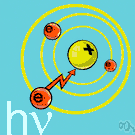 electron - an elementary particle with negative charge electron - an elementary particle with negative chargedelta ray - an electron ejected from matter by ionizing radiation free electron - electron that is not attached to an atom or ion or molecule but is free to move under the influence of an electric field lepton - an elementary particle that participates in weak interactions; has a baryon number of 0 photoelectron - an electron that is emitted from an atom or molecule by an incident photon valence electron - an electron in the outer shell of an atom which can combine with other atoms to form molecules |
Based on WordNet 3.0, Farlex clipart collection. © 2003-2012 Princeton University, Farlex Inc.
Translations
إلكترونإلِكْترون
elektron
elektron
elektrono
elektron
elektroni
elektron
elektron
rafeind
電子
전자
elektronaselektronikaelektroniniselektroninis paštas
elektrons
elektron
electrão
electron
elektrón
elektron
elektron
electron
[ɪˈlektrɒn]A. N → electrón m
B. CPD electron camera N → cámara f electrónica
electron gun N → cañón m de electrones
electron microscope N → microscopio m electrónico
electron gun N → cañón m de electrones
electron microscope N → microscopio m electrónico
Collins Spanish Dictionary - Complete and Unabridged 8th Edition 2005 © William Collins Sons & Co. Ltd. 1971, 1988 © HarperCollins Publishers 1992, 1993, 1996, 1997, 2000, 2003, 2005
Collins English/French Electronic Resource. © HarperCollins Publishers 2005
electron
n → Elektron nt
electron
:electron beam
n → Elektronenstrahl m
electron camera
n → Elektronenkamera f
electron gun
n → Elektronenkanone f
Collins German Dictionary – Complete and Unabridged 7th Edition 2005. © William Collins Sons & Co. Ltd. 1980 © HarperCollins Publishers 1991, 1997, 1999, 2004, 2005, 2007
Collins Italian Dictionary 1st Edition © HarperCollins Publishers 1995
electron
(iˈlektron) noun a very small particle within the atom.
electronic (eləkˈtronik) adjective1. worked or produced by devices built or made according to the principles of electronics. an electronic calculator.
2. concerned or working with such machines. an electronic engineer.
ˌelectronic ˈmail noun (also e-mail, ~email) the system of sending messages by computer; the information sent this way.
electronics (eləkˈtroniks) noun singular the branch of science that deals with the study of the movement and effects of electrons and with their application to machines etc.
Kernerman English Multilingual Dictionary © 2006-2013 K Dictionaries Ltd.
e·lec·tron
n. electrón, partícula diminuta de carga eléctrica negativa.
___ beams → haz de electrones.
English-Spanish Medical Dictionary © Farlex 2012