briar
(redirected from Briers)Also found in: Thesaurus, Encyclopedia.
bri·ar 1
also bri·er (brī′ər)n.
1. A Mediterranean shrub or small tree (Erica arborea) in the heath family, whose woody roots are used to make tobacco pipes. Also called tree heath.
2. A pipe made from the root of this plant or from a similar wood.
[French bruyère, heath, from Old French, from Vulgar Latin *brūcāria, from Late Latin brūcus, heather, of Celtic origin; see wer- in Indo-European roots.]
bri·ar 2
(brī′ər)n.
Variant of brier1.
American Heritage® Dictionary of the English Language, Fifth Edition. Copyright © 2016 by Houghton Mifflin Harcourt Publishing Company. Published by Houghton Mifflin Harcourt Publishing Company. All rights reserved.
briar
(ˈbraɪə) orbrier
n
1. (Plants) Also called: tree heath an ericaceous shrub, Erica arborea, of S Europe, having a hard woody root (briarroot)
2. (Plants) a tobacco pipe made from the root of this plant
[C19: from French bruyère heath, from Late Latin brūcus, of Gaulish origin]
ˈbriary, ˈbriery adj
briar
(ˈbraɪə)n
(Plants) a variant spelling of brier1
Collins English Dictionary – Complete and Unabridged, 12th Edition 2014 © HarperCollins Publishers 1991, 1994, 1998, 2000, 2003, 2006, 2007, 2009, 2011, 2014
bri•er1
or bri•ar
(ˈbraɪ ər)n.
1. a prickly plant or shrub, esp. the sweetbrier or a catbrier.
2. a tangled mass of prickly plants.
3. a thorny stem or twig.
[before 1000; Middle English brer]
bri′er•y, adj.
bri•er2
or bri•ar
(ˈbraɪ ər)n.
1. the white heath, Erica arborea, of France and Corsica, the woody root of which is used for making tobacco pipes.
2. a pipe made of brierroot.
[1865–70; earlier bruyer < French bruyère, Old French < Gallo-Latin *brūcāria, derivative of *brūc- heather]
Random House Kernerman Webster's College Dictionary, © 2010 K Dictionaries Ltd. Copyright 2005, 1997, 1991 by Random House, Inc. All rights reserved.
ThesaurusAntonymsRelated WordsSynonymsLegend:
Switch to new thesaurus
| Noun | 1. | 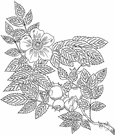 briar - Eurasian rose with prickly stems and fragrant leaves and bright pink flowers followed by scarlet hips briar - Eurasian rose with prickly stems and fragrant leaves and bright pink flowers followed by scarlet hips |
| 2. |  briar - a very prickly woody vine of the eastern United States growing in tangled masses having tough round stems with shiny leathery leaves and small greenish flowers followed by clusters of inedible shiny black berries briar - a very prickly woody vine of the eastern United States growing in tangled masses having tough round stems with shiny leathery leaves and small greenish flowers followed by clusters of inedible shiny black berriesgenus Smilax, Smilax - sometimes placed in Smilacaceae vine - a plant with a weak stem that derives support from climbing, twining, or creeping along a surface | |
| 3. |  briar - evergreen treelike Mediterranean shrub having fragrant white flowers in large terminal panicles and hard woody roots used to make tobacco pipes briar - evergreen treelike Mediterranean shrub having fragrant white flowers in large terminal panicles and hard woody roots used to make tobacco pipeserica, true heath - any plant of the genus Erica briarroot - hard woody root of the briar Erica arborea | |
| 4. | briar - a pipe made from the root (briarroot) of the tree heath pipe, tobacco pipe - a tube with a small bowl at one end; used for smoking tobacco |
Based on WordNet 3.0, Farlex clipart collection. © 2003-2012 Princeton University, Farlex Inc.
Translations
briar
[ˈbraɪəʳ] NCollins Spanish Dictionary - Complete and Unabridged 8th Edition 2005 © William Collins Sons & Co. Ltd. 1971, 1988 © HarperCollins Publishers 1992, 1993, 1996, 1997, 2000, 2003, 2005
Collins English/French Electronic Resource. © HarperCollins Publishers 2005
Collins German Dictionary – Complete and Unabridged 7th Edition 2005. © William Collins Sons & Co. Ltd. 1980 © HarperCollins Publishers 1991, 1997, 1999, 2004, 2005, 2007
Collins Italian Dictionary 1st Edition © HarperCollins Publishers 1995