Aristotle
(redirected from Aristoteles)Also found in: Thesaurus, Medical, Legal, Acronyms, Encyclopedia.
Related to Aristoteles: Aristotle
Ar·is·tot·le
(ăr′ĭ-stŏt′l) 384-322 bc. Greek philosopher. A pupil of Plato, the tutor of Alexander the Great, and the author of works on logic, metaphysics, ethics, natural sciences, politics, and poetics, he profoundly influenced Western thought. In his philosophical system, which led him to criticize what he saw as Plato's metaphysical excesses, theory follows empirical observation and logic, based on the syllogism, is the essential method of rational inquiry.
American Heritage® Dictionary of the English Language, Fifth Edition. Copyright © 2016 by Houghton Mifflin Harcourt Publishing Company. Published by Houghton Mifflin Harcourt Publishing Company. All rights reserved.
aristotle
(ˈærɪˌstɒtəl)n
1. a bottle
2. old-fashioned the buttocks or anus
[rhyming slang; in sense 2, shortened from bottle and glass arse]
Aristotle
(ˈærɪˌstɒtəl)n
(Biography) 384–322 bc, Greek philosopher; pupil of Plato, tutor of Alexander the Great, and founder of the Peripatetic school at Athens; author of works on logic, ethics, politics, poetics, rhetoric, biology, zoology, and metaphysics. His works influenced Muslim philosophy and science and medieval scholastic philosophy
Aristotle
(ˈærɪˌstɒtəl)n
(Celestial Objects) a prominent crater in the NW quadrant of the moon about 83 kilometres in diameter
Collins English Dictionary – Complete and Unabridged, 12th Edition 2014 © HarperCollins Publishers 1991, 1994, 1998, 2000, 2003, 2006, 2007, 2009, 2011, 2014
Ar•is•tot•le
(ˈær əˌstɒt l)n.
384–322 B.C., Greek philosopher: pupil of Plato; tutor of Alexander the Great.
Random House Kernerman Webster's College Dictionary, © 2010 K Dictionaries Ltd. Copyright 2005, 1997, 1991 by Random House, Inc. All rights reserved.
Ar·is·tot·le
(ăr′ĭ-stŏt′l) 384-322 b.c. Greek philosopher and scientist who profoundly influenced Western thought. Aristotle wrote about virtually every area of knowledge, including most of the sciences. Throughout his life he made careful observations, collected specimens, and summarized all the existing knowledge of the natural world. He pioneered the study of zoology, developing a classification system for all animals and making extensive taxonomic studies. His systematic approach later evolved into the basic scientific method in the Western world.
The American Heritage® Student Science Dictionary, Second Edition. Copyright © 2014 by Houghton Mifflin Harcourt Publishing Company. Published by Houghton Mifflin Harcourt Publishing Company. All rights reserved.
ThesaurusAntonymsRelated WordsSynonymsLegend:
Switch to new thesaurus
| Noun | 1. | 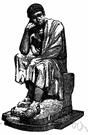 Aristotle - one of the greatest of the ancient Athenian philosophers; pupil of Plato; teacher of Alexander the Great (384-322 BC) Aristotle - one of the greatest of the ancient Athenian philosophers; pupil of Plato; teacher of Alexander the Great (384-322 BC)entelechy - (Aristotle) the state of something that is fully realized; actuality as opposed to potentiality |
Based on WordNet 3.0, Farlex clipart collection. © 2003-2012 Princeton University, Farlex Inc.
Translations
AristotelesAristotelés
Aristoteles
Aristoteles
Arystoteles
Collins Spanish Dictionary - Complete and Unabridged 8th Edition 2005 © William Collins Sons & Co. Ltd. 1971, 1988 © HarperCollins Publishers 1992, 1993, 1996, 1997, 2000, 2003, 2005
Aristotle
n → Aristoteles m
Collins German Dictionary – Complete and Unabridged 7th Edition 2005. © William Collins Sons & Co. Ltd. 1980 © HarperCollins Publishers 1991, 1997, 1999, 2004, 2005, 2007
Collins Italian Dictionary 1st Edition © HarperCollins Publishers 1995