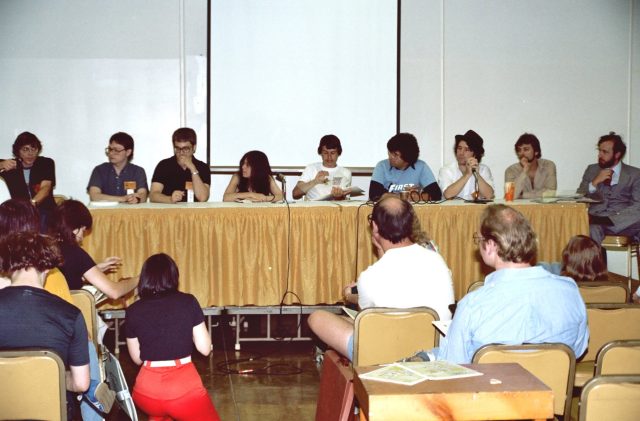
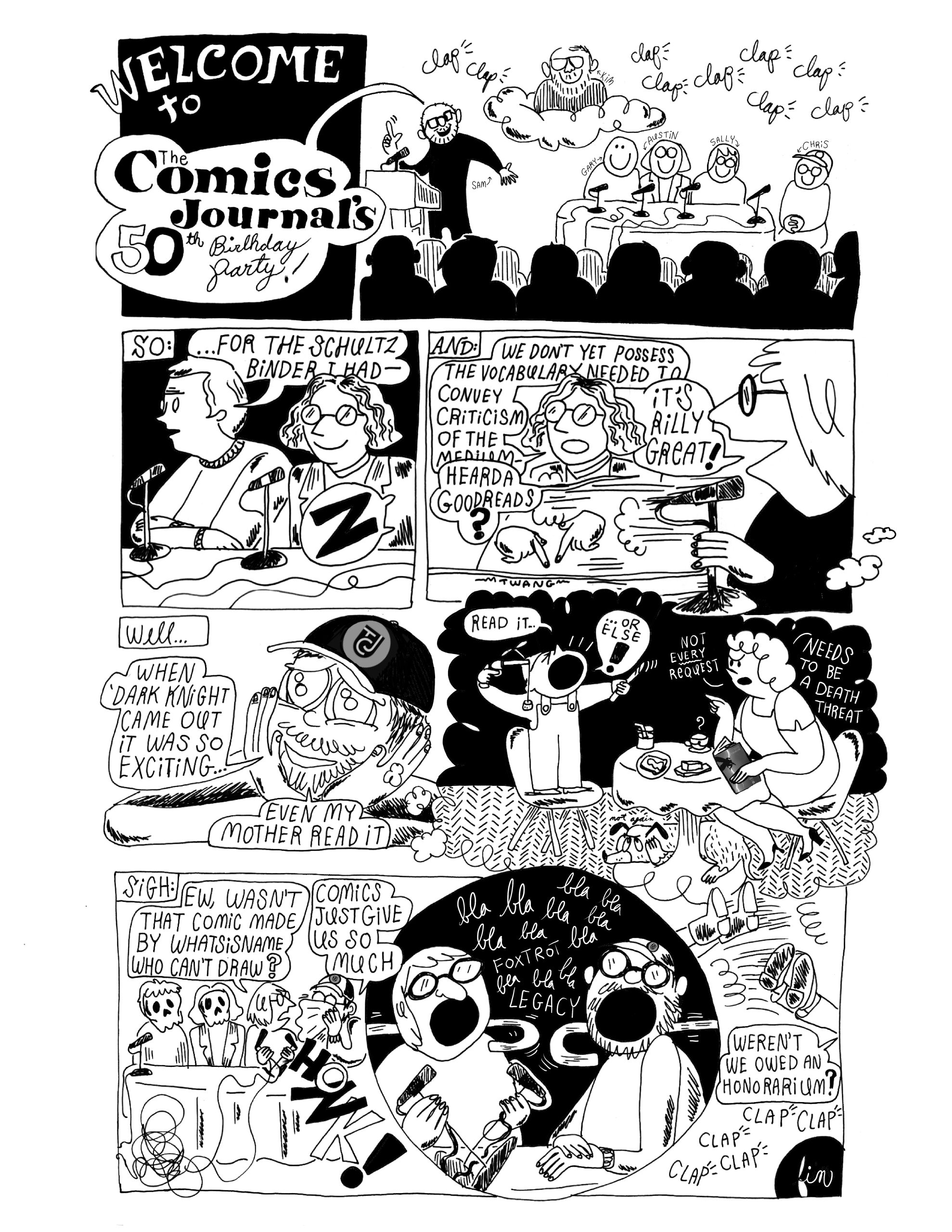
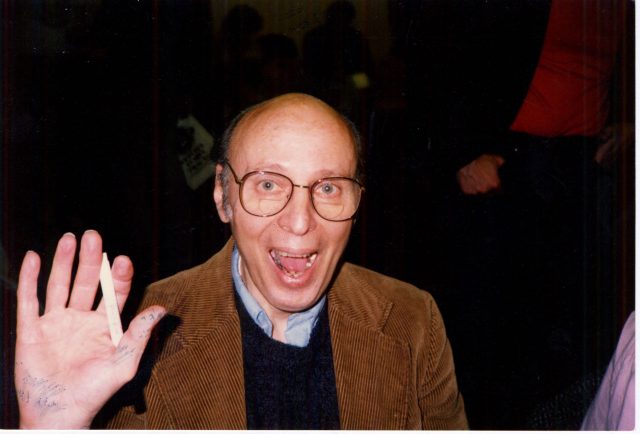
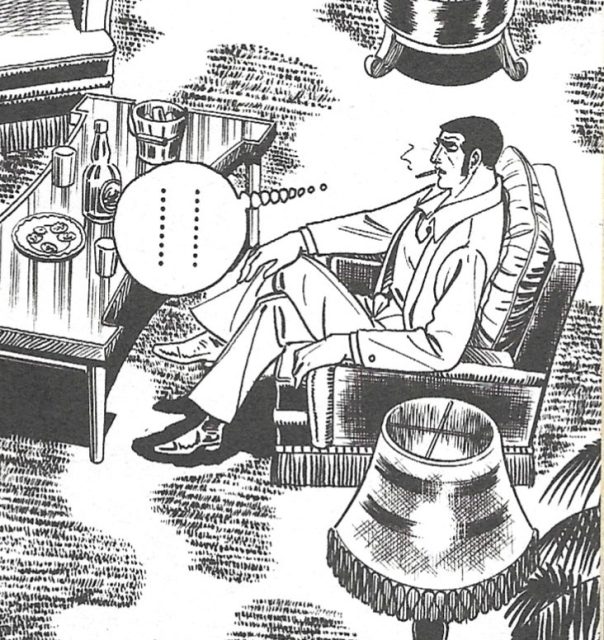
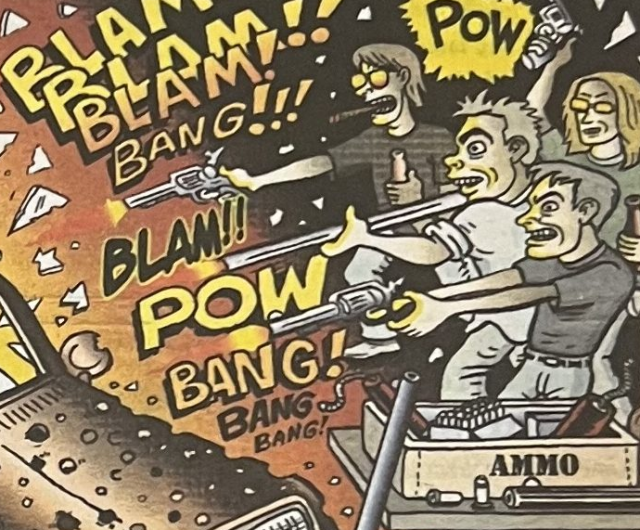
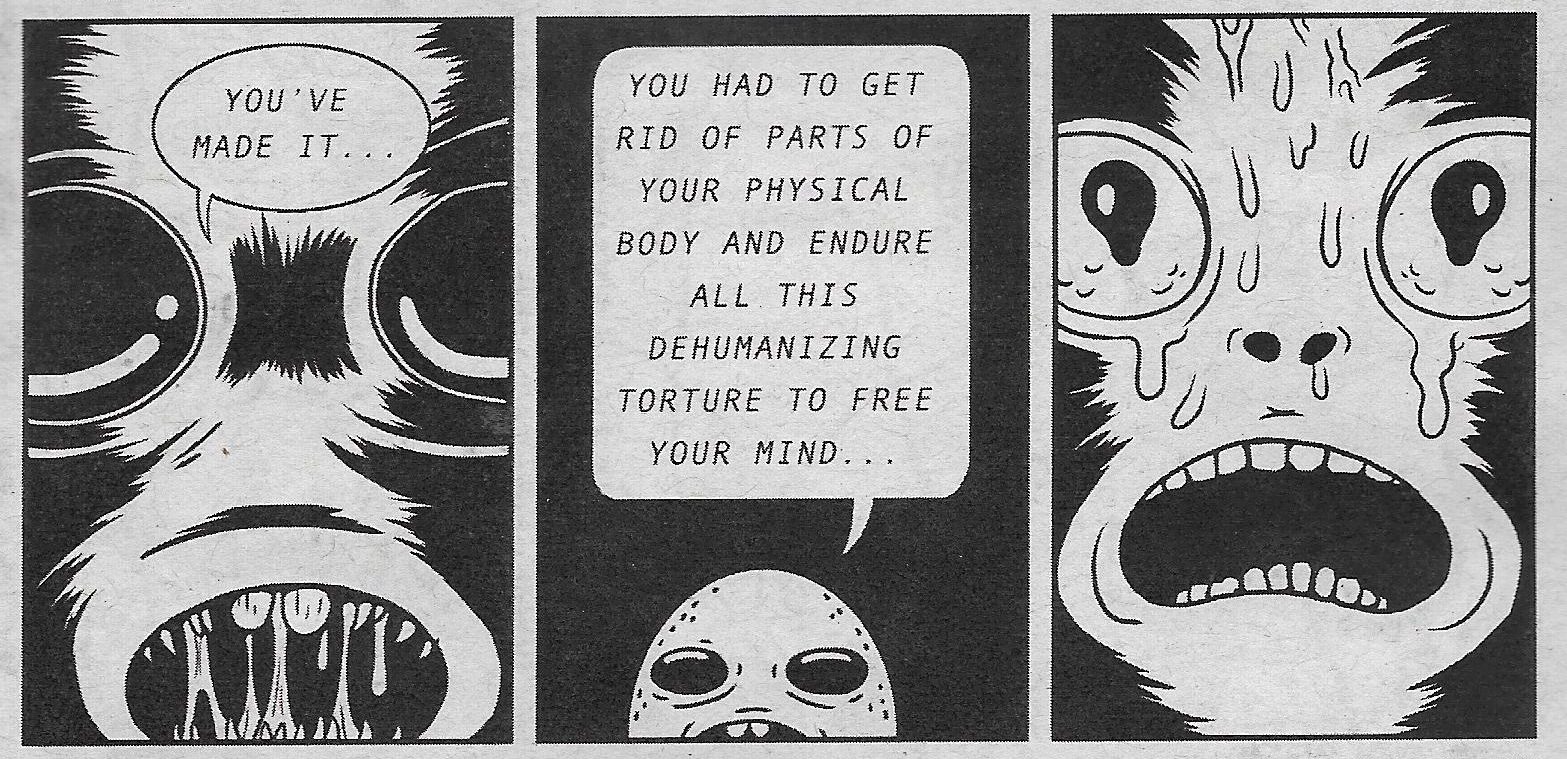
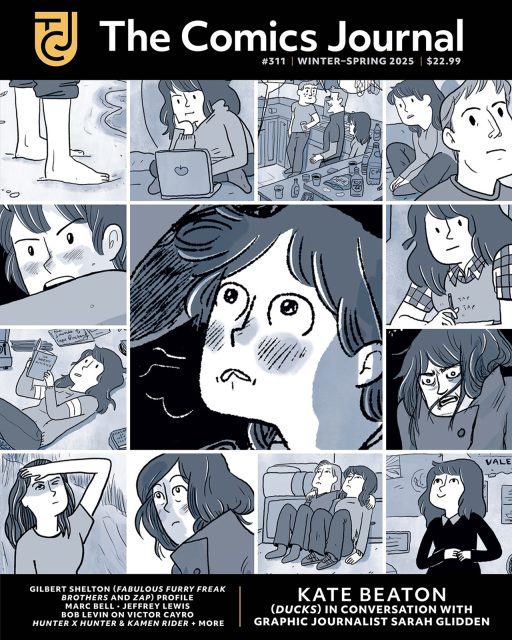
This past Sunday we had the privilege of taking part in a panel for MoCCA 2026: The Comics Journal at 50. We were joined by Gary Groth and Austin English with moderating from Sam Thielman of The New York Times. Thank you to everyone who attended the panel, thank you to Bill Kartalopolous for arranging the programming, and thank you to our contributors, without whom there would be nothing here to read.
Here is an excerpt from the transcript of the event, we wish a happy holiday to all who celebrate.
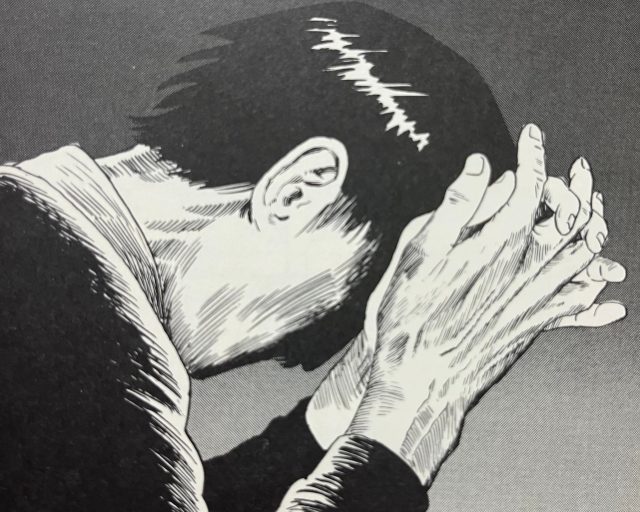
The news broke early this morning that Yoshiharu Tsuge, the enormously influential mangaka, died of aspiration pneumonia on March 3. He was 88.
It's hard to overstate the influence Tsuge had on the manga artists that followed him, not to mention the western cartoonists that became aware of his work through the small dribs and drabs that occasionally saw light in anthologies (or an anniversary issue of TCJ), or more recently through the volumes released by Drawn and Quarterly and NYRC (thanks largely to translator Ryan Holmberg).
We do, of course, plan to have a more official remembrance up on the site in the near future. For now, however, here are some links to our past reviews of and essays on Tsuge's work:
Is there anything better than reading outside? We'll return to our regular programming tomorrow, but for now, let's take a look-see at the beach (lake, poolside, neighbor's driveway, lawn of the art museum) reads that kept me alive during my least favorite season.
clockwise from top left: Wrong by CF, Life is a Treat by Gudim, Simplicity by Mattie Lubchansky, Do Admit! The Mitford Sisters and Me by Mimi Pond
Wrong by Skeleton Bones (CF) is a quickie facsimile from Toybox Coffin Playplace. This is strictly fun in the sun from CF, violent misunderstandings with an abrupt end, you will want for nothing. Sometimes you need a gag to love and leave- amuse yourself while it's reading time and then get on with your life until you pick it back up: Life is a Threat by Gudim from The Mansion Press reminds me of my favorite Perry Bible Fellowship moments, my kid bought this one. The same kid read Do Admit! in one sitting. This story of those complicated century-shaping Mitford sisters took me a couple of weeks of enamored toting around and pontificating to get through, but let me know how quickly your 12-year old finished it. Not everybody read Sassy Magazine growing up, but those who did could not be more primed for this book by beloved Sassy contributor, Mimi Pond. This thick brick from Drawn & Quarterly could be the biggest no-brainer I've ever seen. Do you like to be entertained? Do you like beautiful illustrations rendered in Prussian blue as well as the juiciest gossip humankind has ever created? Thank goodness I had Mattie Lubchansky's Simplicity from Pantheon to get me through the grieving period when Do Admit! was over- the Nib alum's latest has everything in the whole entire world without end: it's funny, scary, horny, dystopian and utopian sci-fi. if I had to crown one title "Beach Read of the Year", this would be it.
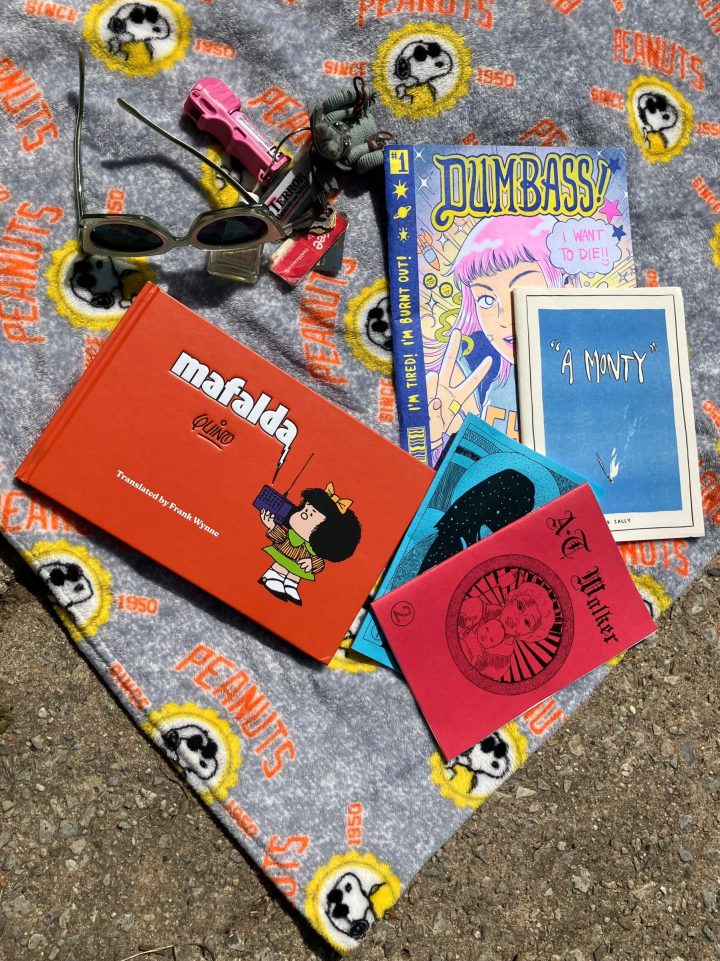
clockwise from left: Mafalda by Quino, Dumbass! by Jenn Woodall, "A Monty" by Zak Sally, A-T Walker 1&2 by Micah Liesenfeld
Do you have a new best friend or did you just meet someone else who also loves Quinto's Mafalda? It's hard to tell! Our precious darling was lovely linework to behold, but now the strip has been translated by Frank Wynne for Elsewhere Editions so we can enjoy the little urchin, Little Dot and Nancy all at a birthday pool party at last. Jenn Woodall's Dumbass! is a self-published collection of fretting autobio and sketches to relate to and (even soothe, wow!) the psychic pain of the artist's mind. I love a gal's gal, and I always find one in Jenn's work. A Monty by Zak Sally has the comfortingly cloudy-day tone you know from Sammy the Mouse, in this childhood autobio zine. Zak tells a story from 45 years ago without a trace of nostalgia. Not a true feel-bad, but you didn't come here to be cheered up, just be satisfied you're getting a little understanding and grace. Micah Liesenfeld's ongoing series A-T Walker, about his family's life with his child's rare neuro-degenerative disease (ataxia telangiectasia) is an incredibly well-paced story of his child receiving this painful diagnosis as well as the guessing game of new parenthood and deciphering illness. These stories are heartbreaking, but when has that stopped you from reading something worthwhile?
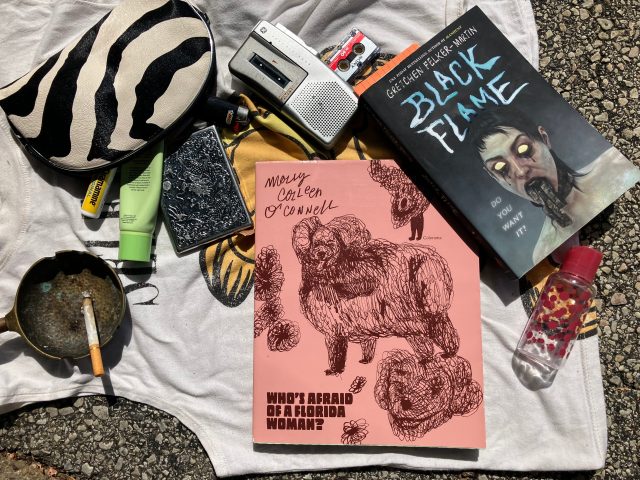
I have a couple of honorable mentions that aren't technically comic books, but get over it. Molly Colleen O'Connell's Who's Afraid of a Florida Woman? is a nice thick pick-it-up-and-put-it-down to live on the bedside table. Molly's comics tell you entertaining secrets while letting you know it's okay to not always be at your best, truly the popcorn eaten as the opening credits roll. Her collection from Colorama features doodle illustrations, photographs that look like whatever charming misty malarky Tyrannosaurus Rex, songs are probably about, ideas for toilets, and interview between Molly and (Thomas) Conor Stechshulte and 100 other scrap-lettes someone made the error of thinking we had earned the right to see.
Who's Afraid of a Florida Woman by Molly Colleen O'Connell, Black Flame by Gretchen Feller-Martin
Summer can be cute, but that body of water will swallow you whole if you don't balance the beach with a visit from your best goth gal: Gretchen Felker-Martin has a new release to remind us all to please shut up, it's now Halloween. Black Flame (Tor Nightfire) is a snappy novel that feels exactly like watching a movie, shutting out the outside world enough to trick me into thinking that being a queer film archivist in 1980s New York would have been so much fun in a way that it definitely was not. This book might not completely ruin your life the way Cuckoo and Manhunt did, but it's no less engrossing, slippery, sexy and scary. Just shy of 200 pages, you can get through it in one day under the black-fringed beach umbrella. An important reminder for reading this book: keep in mind, you can always decant your Swiss Navy into a smaller bottle for easier travel.
As you probably have already heard former Marvel Editor-in Chief Jim Shooter has died at the age of 73 after a long battle with esophageal cancer.
As the head of Marvel Comics during one of its largest and most significant periods of growth, Shooter was a controversial figure to put it mildly, one who was often at odds with The Comics Journal's core values regarding the artistic merits of the medium and the importance of creator's rights, particularly when it came to Marvel's treatment of Jack Kirby.
We hope to have a (nonpartisan) obituary of the man in the coming weeks, but in the meantime, here are links to some of our past essays about and interviews with the late writer and editor:
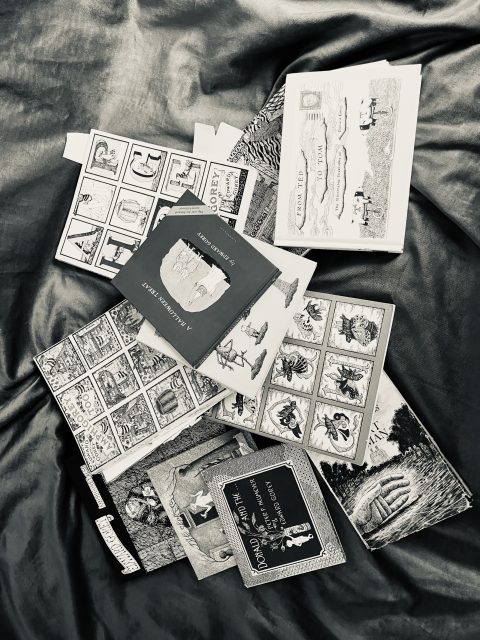
The icy tingle-touch of Edward Gorey’s influence is inescapable. This past Saturday marked the 100th anniversary of Gorey's birth, and the scope of his influence still continues to grow. Despite the shortcomings of not being British alongside the handicap of being alive during all of the 2nd half of the 20th century, Gorey’s bite has throughly sunk into the tone of our culture with the respect and ubiquity of an Oscar Wilde-themed chain of gas stations.
His decades of book covers, illustrations, comics and set design (among plenty else) splash through both bookstores and Broadway, entering our homes through television title sequences and The Gashlycrumb Tinies, ever-present, having remained in print since 1963.
Gorey’s work silences our thought tornadoes with the reassurance that ennui is inevitable, providing company for our misery, dressed in the endless texture of pretty and grimy broken lines. Gorey's stories give our children a place to go when they're battling with the knowledge of death, a cozy nook to explore crisis and creepiness.
Edward Gorey's place is not as a cartoonists' cartoonist- his stories sneak too easily onto library and bookstore shelves, placing his work in that slim genre as work part of the mainstream without suffering from feeling watered-down. Can you even imagine your world without him? What would be in the shelves of Hot Topic? What would Tim Burton be doing for a living? Without Gorey's sensibility, Wes Anderson’s body of work melts into little more than a Fantasia Lights cigarette smoldering in a bakelite ashtray while a Kinks b-side plays on a cardboard turntable. Cute, to be sure- but perhaps not really worth the calories.
All week on TCJ we're celebrating the work of Edward Gorey with reviews, essays and articles from the archives, starting today with an account from contributor Cynthia Rose about his role as her childhood penpal, all dedicated to you, our own RDP.
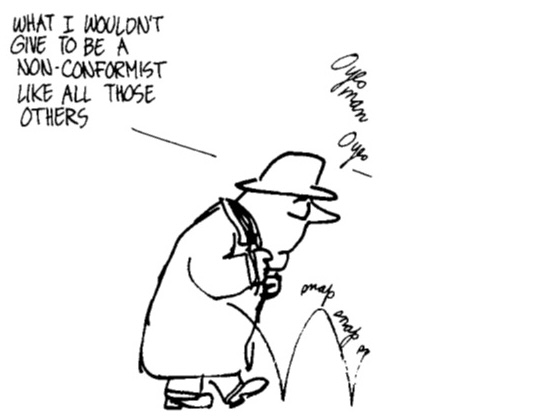
As part of our homage to the mighty Jules Feiffer, who died of congestive heart failure on Jan. 17, 2025 at the age of 95, we thought we'd highlight a few articles and interviews from our back pages, so to speak. Also, if you haven't seen it yet, be sure to read Michael Dean's excellent obituary of the man here.
GROTH: Could you chart your evolution, visually? You started off, the early Sick, Sick, Sick stuff at least, very angular, no fluidity, and sans the spontaneous line you developed later.
FEIFFER: Oh, there wasn’t any [style]. I was struggling for style. Those drawings you found in that pile, some of them date back to those years, and almost all of them are more interesting than you’ll find in Sick, Sick, Sick, because as soon as I got to reproduction, I would stiffen up. I couldn’t handle a brush very well. I couldn’t handle a pen very well. I could handle a pencil well, but you couldn’t reproduce in pencil. Finally I stumbled on a technique of using wooden dowels and that gave me a dry line which I liked very much, which approximated I guess pencil. And I’d draw those in poster and black ink, diluted. And that gave me a line that I liked for a while. But it took forever to do, it was very slow going. In those years I was very influenced by William Steig and Osborn, and the closer I could get my work to look like them, the happier I would be. I must have been doing the weekly strip for, oh, I can’t think of how long, anywhere from three months to six months to maybe a year, before I hit on the drawing style I liked.
Feiffer returned to TCJ in 2014, speaking to Greg Hunter about the publication of his graphic novel, Kill My Mother:
Did drawing Kill My Mother force you to do anything as a cartoonist you hadn’t done before?
It was a complete revolution for me, in my way of thinking, in my way of approaching art and toying with it. I spent over forty years doing Village Voice strips, almost never doing backgrounds, because the characters were the prominent thing and the conversation was the prominent thing. I thought backgrounds would be distracting, and in addition, I didn’t know what anything looked like that wasn’t a human figure. I’ve never had an eye for the inanimate. And so I never drew cars or planes—all the things that boys generally love to do. They were totally foreign to me, alien to me. Buildings, bridges, all of that stuff. And noir, if you take a look at any of the movies—Double Indemnity [1944], Maltese Falcon [1941], any of them—they’re full of atmosphere. And atmosphere is backgrounds, reflected light, shading. All that stuff that I had perfectly no experience in drawing or in thinking about. So I had to completely rethink my entire approach to drawing, at the age of eighty.
In drawing style, both in figure and costume, Superman was a simplified parody of Flash Gordon. But if Alex Raymond was the Dior for Superman, Joe Shuster set the fashion from then on. Everybody else’s super-costumes were copies from his shop. Shuster represented the best of old-style comic book drawing. His work was direct, unprettied — crude and vigorous; as easy to read as a diagram. No creamy lines, no glossy illustrative effects, no touch of that bloodless prefabrication that passes for professionalism these days. Slickness, thank God, was beyond his means. He could not draw well, but he drew single-mindedly — no one could ghost that style. It was the man. When assistants began “improving” the appearance of the strip it promptly went downhill. It looked as though it were being drawn in a bank.
FEIFFER: I am now old enough to know that experience is often meaningless. All it teaches you is what you were determined to know when you were 25 anyhow. You just re-focus it in different ways over the years. I think when you are young the advantage is that you should come in with a passion that may dissipate over the years, and if you don’t have that passion when you’re in your 20s or early 30s, it seems to me you have no business in the business, because it’s not going to get stronger, and if you don’t start out having it strong virtually to the point of obsession in the first place, then you’re not well prepared for the long run. That passion makes up for a lot of what you call a lack of background. One of the things that has always bothered me about this society is the credence we give “experts” and “qualified sources.” If Henry Kissinger is an example of such, I think we don’t know the kind of trouble we’re in. Or for that matter, Charles Krauthammer.
His decades as a cartoonist have obviously made him into a formidable character designer, and each and every character has a unique and strikingly look--if this were a film, its cast would be comprised entirely of character actors--and they all radiate explosive and subtle emotions through the nervous jumble of lines that each is composed of. And they all hold their form,
Kazuo Umezz, the god of horror manga, passed away last week at the age of 88. While not necessarily qualifying as a youngster, I was stunned to hear of his death. The gnashing teeth of Umezz’s work overflows with such bristling exuberance (screaming, laughing, screaming) I figured even if he doesn’t live forever, at least you and I would go first.
As it should be, Umezz is a beloved favorite around here. We're staying up rereading Baptism, The Drifting Classroom, Orochi, My Name is Shingo, among others, gasping into the night. His ghastly penchant for pushing the boundaries of gore balances with a certain tenderness- adults are villains not to be trusted, but children are able to level the illogical and collaborate. The slightest possibility for vengeance as well as anyone operating a motor vehicle near a crosswalk ends in bloody heartbreak, but the family cat gets away unscathed.
Umezz is wonderful for tripping up those who, like some authors of this particular blog post, mistakenly think themselves unflappable. In his world of actual monsters and people behaving monstrously, human entrails emerge through all kinds of ingenious openings, characters save their speaking voices for Hell- choosing to relentlessly scream all conversation. These ring in the ears like a quartet of jackhammers, leaving me clutching both my pearls and the Alka-Seltzer.
But I simply "must keep reading" as that incredible schemer, Katie Skelly, said when she first introduced me to his work, foisting The Drifting Classroom into my life a few years ago. Umezz’s stories unfold with campy gotcha of a Tales From the Crypt and the petty snooping of an Archie digest, it’s impossible not to give yourself over to the pleasure of reading, reading like you did when you were young, as much as you can in one sitting because you have to find out what happens or you’ll just die.
While we assemble a more formal remembrance, here are some items from around the site as well as two from the archives we’re re-running today (Joe McCulloch instructed me that “Umezz” was his preferred diminutive, don’t bother me):
A smiling Harvey Kurtzman bids adieu to you all. Photo from the Comics Journal archives.
Sadly, our centennial celebration of beloved Mad genius Harvey Kurtzman is over. We know, we're crying in our furshlugginer beer, too.
But we're leaving in our archives a week's worth of fantastic material to peruse. Here's a quick rundown of the stories we ran last week, in case you might have missed something:
A big thank you to all our contributors for helping us put this together, especially Paul Karasik for getting the ball rolling. You all made this special.
This Thursday, Oct. 3, marks the 100th birthday of Harvey Kurtzman, the genius behind Two-Fisted Tales, Frontline Combat, Mad, Trump, Humbug, Help! and, yes, even Little Annie Fanny.
Kurtzman’s work changed the shape of American humor with his take on the truth. Advertising is lying to you, Hollywood is lying to you, the government is definitely lying to you- but if you find out what’s not true, therein lies the joke. This style of gag informed the themes of the bulk of our comedy culture, ranging from Saturday Night Live to The Simpsons to Strangers With Candy.
To properly honor his centennial, we at The Comics Journal thought it would be a good idea to dedicate the week to examining his work. Thus, apart from the odd review, we'll be running a number of essays, interviews and articles all about Kurtzman, including:
An in-depth look at his early sci-fi stories for EC
An examination of his influence on comics journalism
An unpublished interview with him on the comics crackdown of the 1950s
Remembrances from those who had Kurtzman for a teacher
And much, much more
We're kicking things off today with a lovely appreciation of Kurtzman's Hey Look! by Paul Karasik, along with a plethora of classic Hey Look! strips.
And, while you're waiting for all those other stories to appear on our home page, consider perusing some Kurtzman-related pieces that have run on TCJ in the past, such as:
I can see now why monarchs wait to die; an orderly transfer of power is a lot of damn work.
In January of this year, preparations began at my suggestion for the arrival of a new editorial team. The fact is, I need to return to my own projects. With the assent of Tucker Stone, who has been on sabbatical, and the support of the editors of the print Journal, it was decided that the present era would conclude entirely, with two new editors selected. In fact, you have already seen some of their work at the site, as these are tasks that cannot rely only on theory; beginning tomorrow, they will formally become site editors.
Sally Madden is a veteran alternative cartoonist and one half of the popular Thick Lines podcast. Chris Mautner has been a contributor to the Journal since the 1990s, and has written for a wide variety of comics-specific and general interest news and culture outlets. I have collaborated with both in the past, Sally on a few podcasts and Chris on a variety of projects over the years. I can say from the trials of the last few months that they have my every confidence in this new endeavor.
On my last day, I must first thank our editorial coordinator, Kristy Valenti, for her invaluable work and unceasing support for the whole of my three years at the desk. Thanks also to Austin English, who is ostensibly exclusive to the print Journal, yet donated so much time and energy. Kit, Barbara, Michael: my affections endure, glowing. All contributors: I love you. And, of course, shoutout to Gary Groth, without whom none of it would be possible.
I would like to dedicate this final post to the memory of Mr. Robert C. Harvey and Mr. Evheny Osievsky, two writers I knew who saw what we all will see, given time.
As for myself, I plan to cultivate an increasingly isolated intellect. Don't let the algorithm get you, folks; it'll make you think you're thinking for yourself.
Today I will write about recent comics by French artists in furtherance of my election campaign for President of the United States of America.
-Robert F. Kennedy Jr.
* * *
Social Fiction by Chantal Montellier, translated by Geoffrey Brock, re-lettered by Dean Sudarsky; published by New York Review Comics
From Wonder City.
When people used to talk about Métal hurlant, they would include something called the "dirty future" among the magazine's innovations: a vision of the future that is crowded, grimy, overgrown. Often, this would be followed by descriptions of how the aesthetic informed movies like Blade Runner, and don't you know Moebius himself worked on Tron, and etc., with the aim of justifying such aesthetics through its adoption by bigger-gamble art forms.
Montellier was present for the birth of this style, though she did not intend to be. A painter and art teacher who turned to political illustration in the early '70s, she made her way into longer, narrative comics in Charlie mensuel in 1974, then Ah! Nana—a sibling magazine to the young Métal, inspired by women-led American undergrounds like Wimmen's Comix—in 1976, at the behest of editorial secretary Anne Delobel, who was a collaborator of Jacques Tardi. But while much of Montellier's energy became focused on Ah! Nana, she also contributed small, linked pieces to Métal: her first such comic, the debut installment of her 1996, appeared in Métal hurlant #7 (May 1976), alongside the first chapter of Moebius' & Dan O'Bannon's "The Long Tomorrow", the comic that popularized the proto-cyberpunk style in its winking blend of detective noir clichés and droll SF devices, its femme fatale a literal monster of devouring feminine desire. But it was the appetites of Ah! Nana that proved concerning to the sweet eyes of France; it was prohibited for sale to minors, which meant it could not be displayed on newsstands, which meant its circulation dropped hard, which meant it became, after nine issues, financially unviable. So Montellier's serial work moved to Métal.
From 1996.
It is always striking to encounter Montellier in Métal hurlant, or the American Heavy Metal magazine, which ran her work throughout its first two and a half years. In a sea of rich color and dense ink, one is suddenly alone on a glacier. Her comics are eerie and still—even when depicting motion, one is aware from the page that everything is still—incidentally resembling Tardi, or Chester Gould sometimes, but Montellier has sealed these men in plastic and beckons you to look, look at them: her comics are discursive, her figures less inhabitants of space than collaged figures. See the heap of bodies above: a civilization of comic strips piled as cultural refuse in the cellar of an art gallery-cum-automobile dealership just 10 years from now. Later, she would become far more overt about clipping isolated images and digitally pasting them into arrangements on the page, less realistic than iconographic, analytic, but here she still observes the traditions of narrative strip art.
Social Fiction, published just now by NYRC, collects three of Montellier's serial albums from Métal hurlant: the aforementioned 1996 (1976-78); Shelter (1978-79); and Wonder City (1982). Specifically, they are revised versions of those albums, sometimes significant re-drawn, and, in the case of Wonder City, also re-colored. That said, the comics appear to be the same as presented in the 2003 Vertige Graphic edition of this material in French, so it's been 20 years since the stuff has been touched. (The NYRC edition also repeats a certain fuzziness to some images from the Vertige Graphic edition, which I fear may be owing to the state of the materials.) For readers of a certain age, 1996 will be immediately memorable as a puzzling feature of those early Heavy Metals, if in part due to a localization strategy by which much of the dialogue is spelled out as phonetic sounds: LEE MEEYULONE! YU GOD NO RIDE! It later emerges that everyone in the comic is being forced into surgery, in part, to correct this indigenous (or, as is suggested at one point, nuclear fallout-related) dialect so that they conform to 'correct' comic book lettering - thus imposing an editorial subplot onto Montellier's comic, which contained no such element in French. Those editors, Sean Kelly & Valerie Marchant, were succeeded by Ted White, whose first issue saw the removal of the subsequent Shelter, mid-serialization. This is its first appearance in full English, and the first English translation of the later Wonder City.
From Shelter.
But what, you are asking, does it mean to look at comics that look like this? For these three albums, all of them SF, the idea is to observe the broken pieces of the state of the future, and to discern, perhaps, some means of aggravating the cracks in it. Montellier's "dirty future" is not just dirty, it is barely functional. Authority figures constantly make mistakes. Automated systems are filled with blind spots. This is to say, the "dirty future" aesthetic is employed by Montellier to a specific political end. The dystopia in Social Fiction droops from the loosening tape that holds it together, yet people still comply. Like most Métal hurlant contributors, Montellier lived through 1968, but unlike nearly all of them, she worked extensively in radical leftist venues prior to her narrative strip work; the sigh behind her pestilent societies is that of faded promise.
This is information for the observer, with little in the way of an explicit call to action, as I think is expected from writers who chide her for depicting women as victimized by these circumstances. Shelter, especially—in which shoppers are trapped in a massive underground mall, inspired by the Belle Épine shopping center in the Paris suburbs, after a purported nuclear exchange—mordantly tracks the decay of government into totalitarianism; as in Chris Marker's L'Ambassade, another fascism conjured from scraps, an overwhelming sense of dispirit pervades. The heroine, her body at the pleasure of authorities, dreams of herself in a concentration camp that becomes a pornographic fashion show, latex-wrapped flesh as consumable goods. Yet she regrets intensely the costs she imagines her resistance has put on her life. Or, in simpler terms: in one of the vignettes of which 1996 is comprised, a person is walking down the street on a windy day, and is unable to light a cigarette. They duck into a building to get away from the wind. This maneuvers them out of range of the security cameras that purportedly (but do not actually) cover everything. A security professional cries out in frustration, and the smoker, equally annoyed, walks back into range: an obedience dictated by the awkwardness of violating the social contract this surveillance apparatus has drafted. A friend had to explain the joke to me.
From 1996.
Wonder City has a more explicit theme of resistance; a bustling metropolis' AI teledoctor is engaging in eugenics via covert sterilization of undesirable demographics, and a young couple makes a break for it. Among other post-serialization revisions to this album, hair was added to the story's previously bald heroine; the original look was quite close to the characters from George Lucas' 1971 film THX 1138 (speaking of works with several distinct versions), which remains a notable reference. Like not a few French artists, Montellier responds to the stuff of popular genre fiction, so much of it American, with a particular studied gaze.
I think it is very useful that Montellier stands at a certain remove; that these scenes are unsettling and often strange, rather than thrilling. Popular dystopian fiction of this type has a tendency to support one's delusions of superiority; everybody involved in the FTX fraud scandal or the renaming of Twitter to "X" fancy themselves the protagonist of stories like these. There is a very curious undercutting of the lovers' triumph in Wonder City. We dip suddenly inside the characters' heads through a shared thought bubble, and we see they are both thinking in the way a computer thinks. If this is the aptitude that allows them to outthink the eugenicist AI, it is also the subtle victory of the machine; the alteration of human behavior, human thought, to meet the demands of technology. A popular YouTuber speaking in a certain cadence, using certain expressions, to maximize views and profits in a world where prospects are limited; the manner of argument, discourse, controlled by the newest developments in communication platforms. To obey the camera because the camera is there. Montellier is of a generation that is very mindful of this. She remade Shelter, completely, in 2017, as a new album titled Shelter Market—it has not been translated to English, and is not included here—which opens by acknowledging the inspiration of her near-contemporary, the philosopher Jacques Rancière, author of The Politics of Aesthetics. This is one of many routes for future study beyond these brief and very introductory remarks of mine.
From Wonder City.
L'Almageste by Frédéric Coché, photogravure by Ilan Weiss; published by Frémok
Of any artist that might be read to articulate comics as poetry, Coché is my favorite. He works through metal engraving, for the most part. For a while, he also experimented with oil painting; his 2018 album with Frémok/FRMK, L'homme-armée, sought to combine painted and etched images in an undulating and violent display. Since then, he seems to be sticking to the classic mode. In 2021 he released Brynhildr in conjunction with the scholar Gwladys Le Cuff; they had both completed residencies at La Pommerie, which published the resultant book with Frémok. It pairs a series of Coché etchings and a long critical essay by Le Cuff (in French, mind) on the subject of Wagner's Der Ring des Nibelungen.
L'Almageste now returns Coché to entirely wordless comics.
In fact, L'Almageste reaches back all the way to Coché's first dedicated book, Hortus sanitatis, published in 2000 by the Belgian house Fréon, which would only later combine with the French publisher Amok to form Frémok (which reissued the early album in 2016). Named for a 15th century natural history encyclopedia, Hortus sanitatis saw a knightly Death figure cavort in a city celebration, slaying all he encounters, until he pierces the pregnant belly of a Virgin Mother figure, prompting a vision of a mushroom cloud that becomes a tree grown from a pail of mussels; skeletal Death appears despondent (this too is a wordless comic), wandering contemplatively through a new agrarian city, observing a woman masturbating, and concluding on an enormous penis housed in a chapel at the center of a gigantic fungal patch. This was put together as part of millennial celebrations for the city of Brussels, and places various allusions to Belgian art and culture in comic sequence, the publisher assures.
L'Almageste is named for Ptolemy's 2nd century astronomical treatise, and is also concerned with Death and life. One day, nearly every human being in the civilized world wakes up as a skeletal, undead figure. They have apparently forgotten everything about human culture, and set about reconstructing it. Early on, they consider an image of the geocentric astronomical model: the antique manner of viewing the universe outward from the Earth at its center. This is in the midst of the film they are watching of living men in trench warfare, enormous bugs crawling atop them. The undead consider ripping the hearts from the chests of the living and building from them a tower to the heavens, other worlds. An illustrated book and a vinyl record—L'Almageste, incidentally, is Coché's largest, at the square size of an LP sleeve—occasion a fantasy about a heroic angel piercing a maiden, again, with his sword, her body a worm snaking deep down into creation. We imagine, here, Coché's masterpiece, The Hero's Life and Death Triumphant (2005), and wonder uncharitably if this is not a terrific step back. Yet:
Click to enlarge.
L'Almageste is surrounded glimpses of other things. The way the page is arranged, spatially, is that the 'main' activity of the story occurs toward the center gutter of the open book. At each side, like religious panels, are images that do not directly reflect the action, but seem to exist in an allusive or extra-narrative context; some are just parts of drawings, or nests of scratches. Some of these panels seem to be abridgements, cut from larger rectangular pieces, while some are whole. Inherent to Coché's engraved comics is a sense of texture, distress—soot and smudge on the page—but the new idea of this book is emphasize the 'world' of the comic as partially glimpsed from the center of things, like by Earth inhabitants of the geocentric model.
The undead are searching, reforming. They visit a factory where angels bottle people's tears. They drop a coffin into a volcano and it shoots up into the sky and raindrops fall with queens and lutes and bare asses inside, and all the while, as the undead learn themselves to weep, their tears form new skin on their bones. This is a very idealistic, romantic book, in which people feel like they are dead and alienated from everything, and they seek to build a new world from irrational aesthetics. So if we are going back, we are going far, far back, to negate modernity through the historical canon of images in sequence, to become innocent and dead.
It was not my intent to post anything on the site today, but I have heard from several sources online some very sad news regarding a TCJ contributor.
On February 21, 2022, the editors received an email from Evheny (sometimes "Evgeny") Osievsky, an anthropology Ph.D. student from Kyiv. He was interested in writing about the idea of nuclear paranoia in the graphic novel Watchmen. There are many essays in this world on Watchmen, but Evheny's particular approach to the topic seemed interesting, so I made a note to get back to him later in the week. It was a Monday.
It felt absurd, truly a bitter farce, when I hastily replied on February 24, the day the war 'officially' began. Evheny would later remark that my acceptance of his idea was "cautiously affirmative" - in truth, I had no idea if such things were important to him anymore, but I had felt moved to respond on that day, I suppose to let him know that this splinter of his interests was still a valuable thing. He would have had every right to tell me to fuck off—the war was suddenly a very 'hot' international news item, and my approaching him, let's say, didn't not look exploitive—but he responded in the affirmative. He cautioned me, of course, that there would be delays.
Soon after, in November of 2022, Evheny told me he had been conscripted. His communications were sparse after that, though we exchanged emails a few times. We talked about the future, a little, what he wanted to write. I last heard from him in late April.
I am told that he was killed on May 22, near the city of Bakhmut.
The photo at the top of this post is one I took from his Facebook page, which has laid still since May 19. This is what happens in war, of course: exquisite passions fade cool against the flush and bloody face of conflict. On one occasion he joked to me that he was going to bring some comics wherever he went, and I laughed because we want to believe we'll be the same people after. But I only knew him in the tiny way an editor knows a writer.
Our consolation is that we may rest, some day, retired from the troubles of this world.
A few days ago, posts began to appear on social media reporting the death of cartoonist Michael Dougan, a longtime presence on the Seattle scene who had moved to Japan in recent years. A much-loved contributor to anthologies such as Weirdo and Real Stuff, in addition to the solo books East Texas: Tales from Behind the Pine Curtain (The Real Comet Press, 1987) and I Can't Tell You Anything and Other Stories (Penguin, 1993), Dougan will be greatly missed.
Below, Fantagraphics VP/Associate Publisher Eric Reynolds offers his memories of Michael Dougan.
-The Editors
* * *
I was (and am) shocked to hear of the passing of my friend, the cartoonist Michael Dougan. He was a great guy, and a fabulous writer and cartoonist. I first met him in the early 1990s - he was the first professional cartoonist I ever knew who rented his own studio space outside of where he lived (in a historic building on Seattle's old Ballard Ave., no less)! He was also smart, charming, funny, and good-looking - a true inkstud! (He was even recognized in Peter Bagge's and Helena Harvilicz's 1990s fanzine, I Like Comics, as one of comics' most eligible bachelors.) Michael was so well-rounded; he was at times a cartoonist, a newspaperman, a barista, a restauranteur, a tv writer, and a great conversationalist, to name a few. His work is not as well-remembered as it should be, although his best book, I Can't Tell You Anything, was released by Penguin in 1993 and still holds up as some of the best autobiographical work of its era. Part of Michael's obscurity is because in 2006 a fire destroyed his house in Seattle, taking all of his art and archives—and in some ways his comics career—with it. He seemed to process what was a cartoonist's Worst Case Scenario better than most could have, but it also seemed to fuel a desire to move forward rather than look backward. He spent a couple of years in LA writing for television. Whenever I brought up doing a collection of his work, he was interested but ultimately dismissed it as being too much of an "epic undertaking" to find the time for. I regret not pushing him harder, but when he and his wife Chizuko moved to Tōno, Japan, circa 2018, and opened a coffee roasting business and café, we agreed to table the conversation until he felt more grounded over there. Unfortunately, the pandemic started, and we lost touch over the ensuing three or four years. Just a few weeks ago, though, my family and I visited Japan for the first time, and Michael had been on my mind as we prepped. I knew we wouldn't be anywhere near where he lived, but I reached out to him on Facebook in late November to let him know I was thinking of him and wished we could meet up. He didn't reply, and I just figured he was busy and that I'd hear back from him eventually. But now I realize that we had always communicated via email before this, and I'm kicking myself for using Facebook despite neither of us being too active on it, because I think it deprived me of hearing from him one last time.
In 2003, I was proud to have been immortalized by Michael, along with Gary Groth and Jim Blanchard, in this autobiographic strip for the Seattle Weekly (later republished in Fantagraphics' own Comics As Art: We Told You So). I'm the longhair in the strip. Yeah, I know, different times, but what a great memory. R.I.P., Michael.
Recently, the filmmaker Brad Bird contacted TCJ with this brief tribute to the animator, character designer, art director and production designer Ralph Eggleston, who died of pancreatic cancer on August 28, 2022. Bird's remarks, with samples of Eggleston's art, are presented below.
* * *
Ralph Eggleston was a major artistic talent, a tornado of nervous creative energy that turbo-charged the engines of many animated films for nearly four decades, most notably for Pixar Animation Studios.
From the whimsical and iconic cloud wallpaper for the ground breaking TOY STORY (as Art Director) to the richly lit superhero cityscapes of INCREDIBLES 2 (as Production Designer), Eggleston supported and deepened the wide-range of storytelling visuals of MONSTERS INC, FINDING NEMO, WALL-E, INSIDE OUT among others. Ralph was a genuine multi-talent, working as an animator, story artist, writer and director before focusing on film design. His short FOR THE BIRDS, which he wrote and directed, won the Academy Award.
He was extremely passionate about the arts, both as practitioner and consumer. Ralph soaked up music, movies, books and art with an unquenchable thirst, and eagerly shared his discoveries with countless friends and collaborators. His creativity, generosity, humor and friendship will be greatly missed.
I am going to write briefly about some things I read recently, as I've been reminded that I'm supposed to be writing about comics in addition to editing articles and shouting at myself in the mirror like Willem Dafoe in Spider-Man (2002).
* * *
Let me start by posting some art I've liked by Jade Mar, a cartoonist who does not appear to have any active social media presence right now, but has been consistently published by Deadcrow, one of the most prolific of the new small-press outfits:
From Tinfoil Comix #1 (2020).From Tinfoil Comix #3 (2020).In collaboration with Simon Koza & Shen, from Tinfoil Comix #4 (2021).From Tinfoil Comix #5 (2021).From Cowlick Comics #1 (2022).
Squashing and stretching bodies fit to pop in smearing color; very lush. I hope you continue.
* * *
DC Narok; published by Le Dernier Cri / Timeless Editions / Hunting Asia
Cover art by Louie Cordero.
This is the catalog for an exhibition that recently closed in Marseille, the stomping grounds of notorious image-making circle Le Dernier Cri, which put on the show. They also published this book in collaboration with the fringe culture outfit Timeless Editions and Hunting Asia, the project of abrasive musician Stephen Bessac, a French expat in Thailand. The theme of the exhibition is artworks inspired by Narokphum sculpture gardens or illustration suites, which depict the torments of Hell in vivid, bloody form on the grounds of Buddhist temples in Thailand and other nations in Southeast Asia for the edification of visitors. In 2019, Timeless published an English-language book of Bessac's photos from 13 such 'hell gardens', Narok: Visions of Hell in the Kingdom of Siam, which fell into the hands of LDC's Pakito Bolino, who assembled a crew of collaborators as familiar now as the circle of artists that used to surround Monte Beauchamp's Blab!
Perhaps some familiarity is presumed. The reader of this book is presented with an alphabetical listing of the participating artists and a map of the exhibition floor, but almost no indication of which artists are responsible for which pieces; there is, arguably, a collectivist impulse behind such lack of attribution, but I also think LDC prefers exhibition catalogs such as these to function like their other books: as a blast of sensation unbothered by the complications of attribution. A French-language translation of some text from Bessac's book appears at the beginning, along with a brief French-language descriptive statement taken from the show's webpage at the end, but otherwise the reader is zoomed in and out of portions of the exhibition, looking sometimes at full reproductions of the submitted illustrations, and sometimes at photography taken on the floor of the show:
In case you've been wondering what Takashi Nemoto of Monster Men Bureiko Lullaby is up to these days, that's your answer on the left of the above image, with a glimpse to the right at a series of digital collages from the French artist Fredox, blending genitals, faces, meat and fonts; around it you can see several of the exhibition's original sculptural pieces. LDC does put together a rightly hellish and occasionally playful atmosphere—the book is an edition of 666, folks—but there is an unusual complication present.
Also in the catalog are some photos from actual Narokphum setups on wat premises, which absolutely shake the surrounding material in terms of témérité du trait iconoclaste - this despite functioning as actual religious iconography. It may be the first time LDC is paying homage to a body of work as vivid and pummeling as its own, which puts les terroristes graphiques on a uniquely defensive footing. I can certainly see why Bolino would respond strongly to the Bessac book, which is entirely an exercise in novel aesthetics, "exotica" in the gawking manner of the old Italian "mondo" films. Bessac also provides a very limited text - the temples themselves are identified, with a general overview of what the gardens are and a partial guide to what some of images represent, but it is not long before Bessac gestures to an earlier, more detailed study, Benedict Anderson's The Fate of Rural Hell: Asceticism and Desire in Buddhist Thailand.
Released in English in 2012 by an Indian publisher, Seagull Books, this slim, essay-length hardcover adopts of the pose of a photographic memoir - a few of the pictures were taken by the filmmaker Apichatpong Weerasethakul, so the book may be known already to admirers of him. Anderson focuses on perhaps the oldest of the sculpture gardens, at Wat Phai Rong Wua in Suphan Buri province; he mentions a yet-older 2010 Japanese-language book, the photographer Kyōichi Tsuzuki's Jigoku no arukkata (which Anderson wonderfully translates as "Hells that I have Walked to"), as precedent for the international fascination surrounding the gardens. Thailand and Southeast Asia was a limitless source of grotesque spectacle for Japanese 'death tapes' in the pre-streaming 1990s; those were VHS compilations of, say, roadside accidents and murder scenes - which, at least per Bessac, enjoyed their own local popularity on Thai VDC (to say nothing of western titles like Traces of Death, which were more explicitly connected to the hardcore music and edgelord zine scenes of France, USA et al.). But Anderson's analysis is a bit broader; he profiles the wat's late abbot, Luang Phor Khom, who parlayed nationalist sentiment across government coups into a decades-long massive program of temple expansion; Wat Phai Rong Wua also features, for example, the world's largest concrete Buddha statue. But the Narokphum garden, erected in the 1970s, proved unconcerned with international emulative competition, and was locally popular - and, with its many depictions of undulating nude figures, Anderson suspects it served as a source of sexual expression for the abbot. Not that these images came from nowhere - one sculptor who worked under the abbot's direction candidly notes that some of the figures were modeled off images from Thai comic books of the time.
Art by Tawee Witsanukorn.
Thus, completing the circle, the DC Narok catalog devotes an ample section to Thai horror cartoonists of that era; they are the only artists in the book identified by name, perhaps in deference. Above we see an image by Tawee Witsanukorn, who purportedly defined the popular image of the mythological Krasue spirit as a woman's head trailed by oozing guts. The next stop in this never-ending chain of books should be Nicolas Verstappen's The Art of Thai Comics: A Century of Strips and Stripes (River Books, 2021), which I hope to get to soon.
* * *
Mek Memoirs Facsimile Edition by Kevin O'Neill & Chris Lowder (as "Jack Adrian"); published by Dark & Golden Books
Elsewhere in comics history, we have this 1976 self-published SF item - a 12-page fanzine notable for aiding the young artist Kevin O'Neill in getting a job as an art assistant on the nascent weekly magazine 2000 AD, which launched the following year. The present Facsimile Edition is the project of two UK art comics veterans—Douglas Noble of Strip For Me and Tom Oldham of Breakdown Press—which presents the entire original comic in simple unstapled folded paper format and wraps it in an equally-simple paper cloak of supplementary materials; it is then sealed in an illustrated envelope with a small art card depicting a nude women with large breasts observing a fight between a robot and a shark, for that authentic 'comic book store' touch.
If you happen to have the 2021 expanded second edition of Cosmic Comics, the Hibernia Comics / Gosh! Comics / Treasury of British Comics collection of early O'Neill miscellany, you'll recall an anecdote in which Jan Shepheard, art editor of the weekly magazine Valiant, advises O'Neill in 1970 that it would be 10 years before he was good enough to be a proper comic book artist. I don't know if I'd go that far, but O'Neill is a bit like Mike Mignola in that it did take a while to reach the form that is characteristic of him - in this way, Mek Memoirs makes for a good companion piece to that larger volume, with the added benefit that the comic here is notably more ambitious and raw than any of the finished strips in Cosmic Comics. I mean:
While officially an unfinished serial, Mek Memoirs is notably self-contained. A distraction-prone and foul-mouthed narrator (no 2000 AD slang in here, fucker) talks along with video footage of the history of robots in combat. The footage skips around in time, relieving the young O'Neill of too much in the way of tightly sequenced images, preferring to linger instead on isolated scenes of mayhem as the Nazi-like dictator von Kruppstein pursues ambitions of conquest. But then! Upon reaching the final page, we discover that the narrator is a very dapper humanoid robot relaxing in a sort of cyber-utopia, suggesting that the meks were not just tools but sentient beings that eventually overthrew their oppressors. In its eight heavily-illustrated pages, the supplements to this edition nonetheless manage to accommodate three separate people talking shit re: the venerable UK strip Robot Archie, in which the title character is the remote slave of human operators; none of that here!
O'Neill, in truth, is still developing here as an artist, but that does allow for stronger hints of his forebears; Harvey Kurtzman registers strongly:
And so does the atmosphere of the EC Kurtzman war comics, though I'm unsure how many (if any) O'Neill had even seen by then. This is not a complicated story; every note is played big and broad, the horror of war rendered as vivid depictions of situational viciousness. The pathos of Kurtzman, though, are replaced with a very bleak irony of the sort that would soon become associated with 2000 AD in its the better strips - and, by his young lack of polish, O'Neill (but 21 when much of this was drawn) finds a vulnerable in soft flesh pressed against a jagged edge.
Panel detail.
* * *
Judge Dredd: The Citadel by John Wagner, Dan Cornwell, Dylan Teague & Annie Parkhouse; ongoing serial in 2000 AD, from Prog 2270, published by Rebellion
Panel detail.
Meanwhile, in contemporary 2000 AD, the current Judge Dredd serial is set in the midst of a Russian ("Sov") invasion of a sovereign nation, in which professionals and civilians alike are made to defend a crumbling city, the moment of warfare providing an immediate justification for a stripping away of civility and morality that will damn everyone involved. This is not unfamiliar territory for writer/co-creator John Wagner—the thus far story-length flashback is yet another take on the much-revisited early '80s Dredd favorite "The Apocalypse War", which Wagner co-wrote with Alan Grant—but the horrible synchronicity with real global events is potent enough that the magazine's cartoon alien host Tharg the Mighty issues a semi-disclaimer in Prog 2273 that this doubtlessly-finished-in-advance serial "is unfortunately more on-point than I anticipated," recommending readers turn to the rest of the magazine's features for escapism. Such are the unexpected consequences of weekly serialization. Would the Vault-Keeper have had to face the public like this if EC had lived?
* * *
"Sisters" by Kazuo Umezz (translated by Jocelyne Allen, adapted to English by Molly Tanzer, lettered by Evan Waldinger); from Orochi: The Perfect Edition Vol. 1, published by VIZ
But there's no need to be glum, chum. The most negative worldview among any of the artists in this post also belongs to its most buoyant and joyful. I can only be referring to the great Kazuo Umezz, aged 85, who recently enjoyed an enormous art exhibition in Tokyo. English translations of his work, however, remain at a trickle - VIZ re-issued his epochal The Drifting Classroom in 2019 and 2020, after many years of silence, and now brings the first of four volumes for Umezz's 1969-70 shōnen manga story sequence Orochi, which they previously tried to release in 2002 to what I can only presume was general befuddlement. These are children's comics from an era where the idea of "children's comics" was rapidly shifting to accommodate bleak and mean subjects - a situation Umezz narrates in a hysterical register, beyond the top of over-the-top, provoking a compulsive glee in the sympathetic reader.
This is inseparable from Umezz's viciousness. If there is a common theme that emerges from all of his works released in English, it is the guaranteed failure of every assurance of order in the adult world. Teachers, when placed in danger, try to kill their students. Sickly relatives curse their young caregivers. Governments facilitate ecological destruction and human exploitation, every time. Sexuality is like putting a gun to one's head, it is so laden with disastrous portent. Umezz is juvenile; his tone that of a screaming child correctly appalled at the failure of the grown-up world they are expected to inherit - so they reject everything. The idea at the center of The Drifting Classroom is that children are fated to live in the future, and its hope is that when the whole damned world is annihilated, totally destroyed, that children can build something different and better.
But us? There is no hope for us.
I am only going to focus on "Sisters", one of the two stories in this new Orochi compendium. The second, longer story, titled "Bones", concerning an abused woman's mutually-destructive distrust of her caring milquetoast husband is also good, like if the Iger Shop managed to drop an early graphic novel before the comics code came in - its disposition is very much reminiscent of Iger's writer/editor Ruth Roche and her nihilistic depiction of love and romance as a prelude to doom.
"Sisters" is more focused; the essence of simplicity. Orochi—the very amusing, supernaturally-enabled protagonist of the episodic series, who cares not for morality but can easily be moved by beauty and pathos, which she appreciates in a catastrophe-prone manner—takes a job as maid for a pair of teenaged sisters. But there is a dark secret in this house: all women of the bloodline are fated at the age of 18, the moment they are adults, to become monstrously ugly. And then, one of the sisters discovers that the other is adopted, erasing the sisterly bond in an instant and replacing it with a sort of kids' manga variant on the Onur Tukel film Catfight, where Sandra Oh and Anne Heche externalize their smothered frustrations by attacking each other to physically disfiguring and life-ruining ends. So it goes for the genetically-damned of Umezz's sisters, who understands, latently, that society will treat an unattractive woman at a disadvantage to other people, causing a complete violent break from the dull normalcy offered by her Marmaduke-like oaf boyfriend, who, when asked if he would still love his girlfriend if she were ugly, replies: "What do you mean? She's beautiful!" These gems of empathy eventually result in his lover firing a crossbow bolt into his gut, at which point Orochi must throw the man over her shoulder and walk him out of the rising action.
There is a twist at the end, which I will now ruin. It is revealed that the woman whom we thought was adopted, is actually the condemned one - she lied to her sister, knowing that she would become so hateful that she would disfigure herself through violent resentment. Such intensely misogynistic ideas; burlesque for an audience of young boys, although boys were not Umezz's only audience. Like his artistic descendant, Junji Itō, Umezz also worked extensively in girls' comics, and the sympathetic reader might take this story as an expression of socially-mandated fear of not growing into the standard of femininity, of being so ugly that nobody will ever love you (for the perspective of two woman cartoonists on this book, I would recommend the 3/28/22 episode of the Thick Lines podcast). And, there is an interesting quirk at the very end.
The idiot boyfriend returns to the heroines' house at the end of the story. The sister who disfigured herself is dead; perhaps by suicide, perhaps by sheer force of irony. Meanwhile, the condemned sister swans around the landing in a robe, glorying in her full monster form. But Umezz denies us the Basil Wolverton goods. The woman's face is completely cloaked in shadow. What she looks like, belongs only to her. Orochi approves!
I don't know if you can tell, but the cum and hairspray are both glitter.
V.A.L.I.S. is an artist I've written about before - six years ago, the Mexican underground outfit ¡Joc-Doc! put out her Lilin, a 44-page comic about a succubus dominatrix spreading sexually transmitted diseases online to horny high school boys, who then mutate into her ravenous leashed slaves. At that time, V.A.L.I.S. was known by another name - one now dead and buried by the title of this new publication from Inés Estrada's Gatosaurio. "Through Mou," Estrada writes in an introduction, "V.A.L.I.S. had already begun to explore a facet of a femininity that is now so evident to her that she embodies it completely: the power of creation." The 48-page R.I.P. Mou can be read as a transition journal, albeit one given meaning through retrospection; we are told that V.A.L.I.S. did not draw for several years while transitioning, so these pieces dated to 2014 and 2015 should be read with the circumstances of the present in mind.
Page detail.
Mostly this is a drawing zine, with many pages of anime-looking characters hanging around doing hot girl shit: taking selfies; eating takeout food; going down on each other; getting tied up; smoking cigs; smashing people in the face with yonic fists. But 10 pages are fully finished comics, either in English or Spanish with English subtitles, and all of them depict the profound force of bodily change. Some of these stories take the form of slapstick - a little boy puts a lost tooth under his pillow, only for the tooth fairy to eat it up and piss on his head while he sleeps. Or, a cartoonist lays on his therapist's couch, concerned about the meaning of his raunchy output - the therapist saws into his head to remove the offending part of his brain, only to find a living entity that she finds far more charming than the sad sack on the sofa. Broadly, these pieces are of a type with Lilin, in that they depict a powerful (if not supernatural) woman exacting some painful toll from male onlookers; whether or not this is pleasurable to the men is left to the reader's own interpretation and/or predilections.
Page detail.
But V.A.L.I.S. modifies this approach in the zine's longest comic, "Manos de alien", which evokes Charles Burns in its rounded biological forms adrift in pools of solid black. A high school boy has a terrible habit of biting his fingernails - so extreme that one day he nibbles his fingers perfectly smooth. In a twist that would please the Gō Nagai of Hanappe Bazooka, this smoothness manifests an extraordinary sexual power in the boy's fingers, making him the sex star of his school. But there is something else happening. Out of the opaque ink that is the sky of his world, a star forms, and out of it emerges an alien that declares a new form emerged from the boy, and his body catches fire as he beholds a new tendrilled self undulating before him. I think this is a universal experience. The solitude and ecstatic terror of understanding yourself as a desirable being; of anticipating the attention of others on your body, feeling that as a physical sensation. These private emotions, made manifest in stock genre transformations, are the erotic engine of this cartoonist's work.
But some bodies remain forever in flux. Bhanu Pratap has been making comics for a little while now—I recall seeing his 24-hour comic Crystalized mentioned on Zainab Akhtar's old Comics&Cola site years ago—but Dear Mother has arrived with the force of an out-of-nowhere debut, so strong are its visual ideas. I think to some extent this work needs to speak for itself, so I hope I will be forgiven a longer-than-usual excerpt, from "Life Sentence", one of five stories collected in these 52 pages. Depicting the fall of Lord Durma to Earth, I think this best encapsulates Pratap's approach:
Emerging from an abstract heavenly swirl, we see a hand, a mouth, an eye - then an allegorical, ideal figure, and then a splatter of meat on the ground. Every human in the world of Dear Mother is created in this image, the contours of their form stretched like musical notes held alarmingly long. If I am not mistaken, Pratap has a background (or at least some practical experience) in animation, and his panels seem to catch his characters perpetually in the midst of a smear frame that a commercial work might use to liven the pace - but all of life is a smear over here, which Pratap exploits for the purpose of sensuality and estrangement.
In "An Interrogation for a Man's Body", my favorite of these stories, a terrible bout of gas causes a man to die of farts, cheeks flapping from the gale force; his lover comes home and cradles his ass, wailing "How did this happen?" Meanwhile, somewhere else—in shadows—a man slips on a banana peel, which sets off a running counterpoint of wordless disasters to the A-plot of the grieving woman binding her lover with ropes, his prick erect under the coil of hemp. "He died." She is being interrogated by the police. "But his body, it stayed." Eventually, the two storylines converge to rescue the woman from police custody, at which point they combine into a sort of fugue, where the gestures of the body and the antics of knockabout comedy become a sense memory of somebody who is gone.
Crucial to Dear Mother is the breakdown of chronology, of panel sequence, whereby scenes (perhaps eras) seem to shift without warning; in this way, the constant stretching and rolling of flesh in Pratap's art speaks not only to the present-sense impressions of the body, but also the body's experience of time. The title story, "Dear Mother", is the most traditionally-styled rendition of this theme. A young mother engages in sex work with an older man who forbids her direct touch; instead, she cracks eggs between her legs and allows him to suckle on her breasts. At home, the woman insists on breastfeeding her son, although he is probably too old. Identifiable frequently by her large, protruding nipples, the woman conflates sexuality with nourishment, in the way the human body has simultaneously pleasurable and reproductive functions. Her john hates women for abandoning him - but then, perhaps he is really her son, unstuck in time, let loose to play alone on roadkill-festooned highways and tall, ominous bridges. Women suffer greatly in Pratap's book, and rarely find any resolution; read as total allegory, the restless gasping of meat that is this artist's technique for drawing people suggests a confusion of the body's purpose, caught in a loop of pleasure and agony by the demands of life.
The lettering in these stories recalls the font you see in translations of prestigious gekiga, teasing out the commonalities between Pratap's art and that of the Garo legends - perhaps most notably Seiichi Hayashi, in his own abrupt deviations from panel chronology and usage of wildly inconsistent character drawings. But in his best panels—I am thinking of the bottom-left, just above—Pratap recalls the great transgressive mangaka Keizo Miyanishi in his voluptuous curling of shadow on skin. And, there is a similar sense of annihilation waiting at the end of all this activity; that the only rest of Eros is in death. I pray this is not the end for Pratap, however - this book suggests a million ways in which he might develop.
Well, here it is: the new look for TCJ! Designed and developed by Michiko Swiggs with a fresh new look and logo by Keeli McCarthy, this iteration of the site has been a long time coming. For those of you who were looking at it on a phone (and according to the backend of the site, there were more of you than any of us believed possible), enjoy what will certainly be a thousand percent less frustrating experience.
The goal with the new TCJ was simple: get out of the way of our contributors, make it easier to search and find and immerse and get pissed off for longer periods of time, come up with a fresher and cleaner and overall bigger reading experience after clicking through to said pieces, and make it possible for articles to have a longer run of the homepage than before. (No 29,000 word interview should disappear from the main page in 2 days, and yet, that was happening every other month.) There's still kinks and bugs to be worked out right now, and the inbox is open if you've found some that we don't seem to be working on. And if you're interested in really extreme sausage machine stuff: the site is no longer hackable via the old comments server (which is why it kept crashing for multiple days last year) and the site's image server has now been....well, I don't actually understand this part, but something pretty major changed that will make it so that we aren't super fucked up every year with extensive costs relating to the way the images are loaded on the server, and we should be able to be a lot more creative with how we use images, and what resolution those images can actually be--it's something that will be a notable difference for about a week and then you'll all get used to it and we'll run an article about how comics really suck that you think is about you personally and we'll all reset to our previous feelings towards one another. Another thing you'll notice is that there's an "s" next to the http now, which means the site doesn't send out "Not Secure" warnings, which is a godsend to me personally, because I'm the guy who got the ever-more-increasingly condescending emails from people who were convinced, 100% sure, that this was problem I didn't care about and it could be easily resolved if I would just go and easily resolve it and stop saying "actually, we can't fix it for these technical reasons". See, seven completely different people who were condescending to me over the last four years? I was right! It wasn't an easy fix at all and required we redo the whole goddamned website! I hope you all get run over by a school bus, and that it's a school bus packed with your loved ones who were coming to surprise you for being the most condescending dickhead in the world, but instead it runs you down and your organs pop out of your asshole so fast that it looks like a clown making balloon animals.
Additionally, if you're an archive subscriber, you'll find the experience to be a good bit easier than before, with even more print issues now available to read, and the entire previous print archive now loaded in an Issuu format that will accommodate longer, drink-it-in style afternoons of Blood & Thunder binging. And we'll be continuing the process that Dan & Tim started, with more major print articles making their way to the site as time and human capacity permits. (For those of you who are wondering if Amazing Heroes articles might soon join their siblings--well, the answer is yes, and so I'd guess your next question is when, and my response is "soon!")
When Tim retired from TCJ, Gary and I both agreed that the site needed a redesign more than it needed another editor, and we started putting that money towards a redesign and began the process of getting to the point we are out right now. (We originally thought that solo process would last about six months, which was as much of me that people tend to tolerate.) Along the way, COVID came along and screwed our budget into oblivion, we went through five different development teams, all of whom were awesome because they were all honest enough to say "we don't want to do this project, and you should take it to somebody else", and then, in March of this year, Michiko Swiggs came along and there wasn't a bump in the road from then to now. From the very beginning, I asked her to help us find a way to show off the people who take the time to write for us. To trust that the images of the work we are speaking about will be strong enough to make a clean site look beautiful. To be able to host a history that goes back decades, and to make it possible that one could actually chase their preferred strands of that history without frustration. To be able to fall in love with one of our contributors and easily find their work. The end result is this. I hope you like it, but if you don't--well, it's not going anywhere. And I'll see you in hell, the place we both belong.
Hi everyone, it's a very busy week behind a scenes of TCJ - and you'll be seeing the results sooner rather than later. I won't keep you or me long; although, you should spare some time to read this post by Domino Books impresario Austin English. It's a tribute to the artist and publisher Dylan Williams, one of the crucial figures of late 20th/early 21st century small-press comics, who died 10 years ago last Saturday - there's a comic by Williams, an interview, and several historical and personal writings, all brought together.
* * *
Today on the site, the artist Marc Tessier presents an obituary for Henriette Valium, a Montreal underground comics mainstay since the early 1980s, and a quintessential artist's artist. Marc has also generously allowed us to post some of his own photographs of Valium, as well as images from Valium's memorial last week; a moving tribute to a true original.
Later this week, we'll be welcoming back Michael O’Connell, who will have a piece on a topic close to my heart: the accumulation of tons of stuff that comes with being a comic book reader and general nerd, and the inevitable shedding of that stuff as one grows older and life circumstances change. Heavy stuff, but not as heavy as carrying all these books around.
* * *
I didn't get to go to the Steve Ditko convention last Saturday, so I recorded a podcast on issues #59-75 (+ Annual 4) of ROM, the Marvel toy license book on which Ditko worked from 1984 to 1986. Owing to the license, these comics have never been reprinted, nor have their various Marvel mutant comic or Secret Wars II tie-in issues. P. Craig Russell worked on 6 of these 18 issues (he is often referred to as an 'inker' though the comics always credit Ditko and whomever as dual artists, presumably owing to the pencil layouts Ditko would contribute to these work-for-hire projects), and is often considered the star contributor, but I love this panel with Jackson Guice (from issue #61, colors by Petra Scotese), who puts a lot of emphasis on invading creatures and moments of disaster - there is a lot of doom in ROM. A lot of moral struggle, particularly later on as the titular Space Knight struggles with a younger generation of cyborg-like characters who abhor his moral code and desire only demonstrations of power. One does wonder if the writer, Bill Mantlo, introduced these familiar struggles specifically to tantalize Ditko; they are not out of line with his own auteur works and later essays, which were very concerned with the threat of anti-heroism.
Anyway, this is all a long way of saying that Helen Chazan is going to have a Ditko piece up this week, that will examine the deeper issues of *sniff* ideology.
* * *
Ok, that's it. See you next week, unless the very fabric of reality collapses into disaster and we are all cast into limbo, or forced to get off the computer.
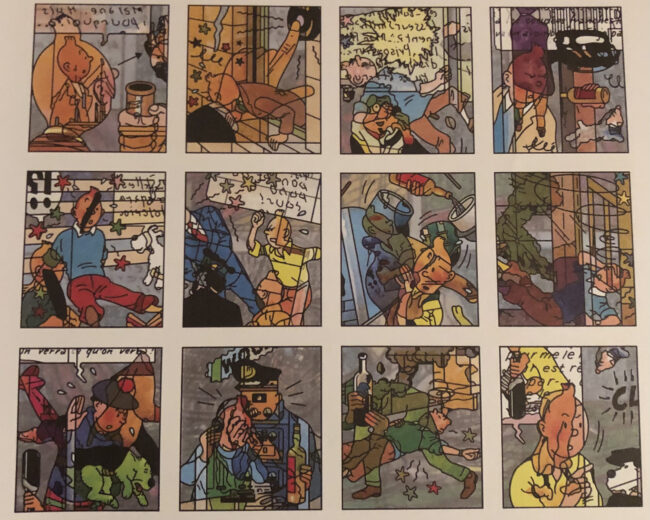
A page detail from Nitnit and the Pink Lambda Mystery, a 2019 book by the late Henriette Valium, published by Crna Hronika in Macedonia, which specializes in aggressive content. Nitnit takes the form of, naturally, a Tintin album, but one where several layers of images have been superimposed atop each other, transforming the clear line into an itchy relief of textures. The dialogue is a stream of invective, serving mainly to squeeze the homoerotic and racist characteristics of the children's comic favorite into a thick surface of sludge atop the visual information. Very deep into the weeds, off-putting to most - Valium is certainly an acquired taste. More on his work soon.
* * *
Today we have veteran contributor Brian Nicholson reviewing The Hand of Black and Other Stories, a collection of comics by Martin Cendreda. There's going to be several familiar names on the site this week; it will be cozy like a roaring firepit. My Labor Day was fine. I ate really poorly, and drank a lot.
* * *
A longtime reader mentioned this week that he hoped I would bring a blogging flavor to the website - careful what you wish for, huh? Here's something I'd have blogged about:
Yes, the new Olivier Schrauwen has arrived: Sunday 3&4, a 100-page double installment of Schrauwen's riso serial with Colorama - and by double, I mean it's two issues of an ostensibly six-issue series put together as one item, complete with the cover art for issue #4 appearing on its own glossy cover stock in the middle of the book at the appropriate place. The final two issues will apparently be published in the same manner next year, so that will be four books in total for the six chapters.
Sunday, taken strictly in terms of story, is shaping up to be Schrauwen's most 'traditional' narrative, in that its account of a single day in the life of Thibault Schrauwen, cousin of O. Schrauwen -- who is both the author of the book and a character in the book, and was also abducted by aliens in the "Greys" chapter of Schrauwen's last book, Parallel Lives -- spends some time poking at the neuroses and hypocrisies of a bourgeoise protagonist; one can easily imagine a movie adaptation appearing at a European film festival. But it is also filled with Schrauwen's fascination with language - that of speaking, of narration, of printing. There are three layers of reality depicted in the image above, denoted by different reproductive styles. The present-time images depict Thibault with crisp outlines and a predominantly blue hue. Then, there is the movie he is watching: a film he made as a typography student, involving the depiction of letters as part of the set. This also literalizes formal elements of comics, rendering them as absurd as the highfaluting motives of Thibault's film, which is really a platform for his pining over a lover of his youth, who has since left. Thus, the images from the film are very blurry and hazy. And then, there is Thibault's own memories, which render all lines and shade in uniform gold, creating images that are difficult to even read without holding the book up to a light source; you must squint as Thibault strains to remember these golden weeks.
The greater focus, however, is on the unreliability of narration. Where Arsène Schrauwen paired descriptive narrative captions with images that summarized or symbolized what was being said, Sunday locks Thibault's narration into the text captions, and then sends the images drifting luxuriously outward, often presenting dialogue between faraway characters underneath the narrator's thoughts. There is sometimes a discreet motive to this, but broadly we get the sense of lives existing beyond the self-obsession of the narrator - a typographer seeking to capture reality within his subjective descriptions, while others pursue pleasures and motivations unknowable to him. The Schrauwen to work to which it is closest is probably "The Scatman" (also in Parallel Lives), in which the protagonist's mental narration is hijacked by a nero-hacker who slathers a miserabilist internal monologue over her life. In Sunday, this SF concept is rendered more philosophical: there is the world as perceived by the self, and the world as it exists apart from the individual; words and pictures, gliding and colliding. Good jokes too, I recommend it!
* * *
Ok, that's enough for now. See you next week, unless I wake up and find myself face to face with the big faceless glowing God on their shimmering throne.
God, this is harder than I thought. Well, my weekend was busy, so the blog is very short.
* * *
Today on the site we have a piece by Brian Puaca, a historian whose work you may have seen at Sequart. He is going to be exploring 'chokepoints' in comics history, comparing the formation of the Comics Code Authority in the 1950s and its economic impact on the U.S. comic book industry with the impact of the COVID-19 pandemic - of course, many different factors, particularly the means of distribution for comic books, allowed or disallowed responses by the industry at large.
And, later, we are going to welcome another new contributor to the site - Sally Bryden, a musician and sports entertainment connoisseur who will be reviewing the new collection of wrestling drawings by Jaime Hernandez. You can hear Sally’s music in the short horror film Sungazer from last year.
* * *
That's it. I'm sorry I tricked you all by putting a Jack Chick image on the front page for Clark's column last Friday. I thought it was dizzying, you know? Like staring down from a high place. What can I say?
See you next week, unless I am cast into the Lake of Fire.
Hi, hope you enjoyed your weekend, which is gone forever. I spent part of mine reading the firsttwo posts on The VanCAF Reader, which is the new writing-on-comics platform of the Vancouver Comic Arts Festival. Both posts are lengthy, chatty reminisces about Canadian art comics history by Robert Dayton, a writer, musician and performer with a longstanding association with comics - he was one of the principals of the Drippy Gazette back around the turn of the century. Some of the comics in these posts date back to the '60s and '70s, which, at least in the U.S. discourse, places them well outside the more recognized 'alternative' era works of Canadian genre-adjacent and memoir-driven cartooning. I recommend it!
* * *
But what do we have on this site, the most important site? Today, Tiffany Babb -- a poet and critic for venues like The AV Club and PanelxPanel -- interviews artist Shing Yin Khor, an Ignatz winner who recently released The Legend of Auntie Po, a middle-grade historical fiction graphic novel, with Penguin Random House. Some good discussion of the outdoors, woodcarving, mapmaking, and other not-leaning-over-a-table activities.
Later this week, we will have the TCJ debut of Sommer Browning, a poet and artist who will present a reflection on the works of Belgian dynamo Olivier Schrauwen, albeit one focused on the stillness, the waiting quality of his 2014 book Arsène Schrauwen. It's a unique piece that I think you're going to enjoy!
And, we're starting a new recurring feature. Retailer and industry commentator Brian Hibbs probably does not require any introduction for many of you, but you may not know that he has been livestreaming video interviews of late with various comics figures. TCJ is going to be sponsoring some of these archived streams and posting them on the site - the first one finds Hibbs in a lengthy and detailed conversation with Wendy & Richard Pini, creators of the Elfquest series, which has seen pretty much the entire history of the comic book direct market... all of which is covered in the talk. Video! Imagine looking at me while I type this.
* * *
Speaking of Hibbs, earlier this week he posted his annual rundown of sales data reported to NPD BookScan - which is to say, book-format comics sold in big box bookstores, through Amazon, and via some (not all, or even most) independent bookstores. It does not, in any way, give an accurate accounting of how well a comic actually sold, but it does create a snapshot of how the year went in the broad 'bookstore market', with all the biases attributable to those areas of bookselling. You sometimes see these results (with less detail than Hibbs gives it) used as a broad pick-me-up for the health of 'comics' as an art, but it is really a specific area.
And what does this area of bookselling prefer? Comics for young readers, above all else. It is interesting to me that the works at the very top of the bestsellers -- your Dog Man, your Raina Telgemeier stuff - are 'pure' comics; they are not franchise fare, or spinoffs, but comics first, which is not something that can be said for all of big sellers. The shōnen manga that rank highly -- and, I’ve noticed the more clickbait-ish recent headlines re: booming bookstore sales reporting numbers for 'adult' graphic novels that include all the shōnen manga in the count, which pumps those numbers up quite a ways -- typically have a huge clattering mechanism of television anime and merchandise built around them, although it is a little telling that the bestselling superhero comics per BookScan are, by an enormous margin, the version presented in Kōhei Horikoshi's My Hero Academia. American superheroes are represented fleetingly by a small number of YA-audience DC projects, a smattering of prestige Batman comics, and the Alan Moore perennials; Marvel, meanwhile, has apparently managed the impressive feat of not logging more than 10,000 sales for any one book in the entire year, which I think speaks to a company totally focused on (or incapable of stepping away from) the 'traditional' superhero market of periodicals to a specialty crowd, and digital editions thereof.
But if you're like me, and you want to look at the more ‘general audience’ original works: what you see is a long horizon of a mainstream. In this market, it appears the bestselling adult-oriented book is a collection of the webcomic Strange Planet by Nathan W. Pyle, which is an Instagram comic that looks like a newspaper strip without a newspaper, though I have not read any of it. Then we have Junji Itō's seinen manga Uzumaki -- which, through ups and downs, remains Itō's signature work -- and the indefatigable March from Nate Powell, Andrew Aydin and the late John Lewis; Uzumaki and March I have read, are they are good comics, but they all have a notably strong appeal to teen or younger readers, which is generally true of everything reporting more than 10,000 sold here. This an elementary observation, but this market has developed enough to grow its own preferences and biases; it is not enough to look at brief summaries and think "wow, comics are doing great," you have to question the information you receive, and understand that all of these things are only giving you a partial idea of what comics is, as a set of particular conditions. So many licensed books in this area! Video games, television, internet personalities: the certitude that comes from something with more money than comics, than books. It does little good to appeal to a miscellaneous Comics in these situations, which is how the picture is often boiled down.
* * *
Hmm, that was basically an exercise in automatic writing. I am continuing to explore different forms for the debutante month of the new weekly blog. Keep your cards and letters coming, and I will see you next week, unless I die.
Hi everyone, I'm moving in two directions today, because our linear perception of time is but a portal in the side of the prison of our bodies.
Last week we welcomed Natsume Fusanosuke (夏目房之介) - a cartoonist, critic, theorist and educator whose work I've seen discussed many times over the years; you may have spotted a link to his blog in Helen Chazan's Tono Monogatarireview not a month ago. I think the writing about manga on this site is generally very strong, but we've lacked the perspective of Japanese writers on Japanese comics, so Tucker and I were very pleased to present a 2018 essay on the topic of Jirō Taniguchi, an artist who's taken on several 'forms' depending on which of global comics' solitudes is translating him - as somebody who discovered Taniguchi through VIZ's 1990 edition of his and Natsuo Sekikawa's crime comics collection Hotel Harbour View, it has been striking to see his reputation in the English-reading terrains of the 21st century become that of a solemn purveyor of peaceable observational works. Natsume addresses this international identity of Taniguchi from the Japanese- and French-language comics perspectives, via the translation of Oregon-based scholars Jon Holt & Teppei Fukuda. We are hoping to see more of Prof. Natsume's work in the coming weeks!
Also last week, we posted a review by another new contributor, Edward Haynes - a writer and editor of comics, prose fiction and criticism whose work has appeared at venues such as SOLRAD, Multiversity Comics, PanelxPanel and others. They offered us their thoughts on the music and horror-themed graphic novel Blue In Green, and we hope to see them again soon.
This week, we are kicking things off with another artist-on-artist conversation, in which Joe Ollmann of the recent Fictional Father chats up Brecht Evens of The City of Belgium - both graphic novels from Drawn and Quarterly. Topics include the limited utility of art in a medical crisis, the finer points of translating one's own work to another language, and exactly how easy is it to become a controversial figure in the polite society of art comics. Read it and live it!
* * *
Cover art by Jeremy McBrian.Lately I've been rearranging my plans, as I'm sure some of you are - I was going to visit some friends in New Orleans in October, but that might not be a great idea anymore; I'm vaccinated, but I don't want to put anyone at risk. I was also looking forward to Ditko-Con 2021, to be held on September 11 in Steve Ditko's hometown of Johnstown, PA; it's still happening (as of today), I just don't know if I'll go. A small con that functions as a sort of meetup for mid-east coast Ditko fans is a really fun idea to me.
I became very sentimental looking at videosfrom another recent small con: the Mission Underground Comic Con, an event from last June in San Francisco, sponsored by deadcrow. You might know deadcrow as the organization behind the Tinfoil anthologies, most recently co-published with Austin English's Domino Books. The Tinfoil books are very regional, and very inclusive, in the manner of lo-fi underground newspapers, but not as frequent. It's an occasional dispatch. The item you see here, however, is not an issue of Tinfoil; it's a collection titled Speshal Comics, which was available at the show, and which I bought off the deadcrow website later on. It's sold out from them, but you can still get one from Domino. The book is a tribute anthology to Evan "Spesh" Larsen, a cartoonist and graffiti tagger who died in 2019. Though not a deluxe print object, it's a complex book, with various tipped-in minicomics; some of the on-page contributions also seem to be minicomics that have been reformatted, like the below excerpt from a piece by Mike Reger:
What we see here is push and pull of the form of art. The ascendant American artist Andrew Schoultz has invited the author and his friends to a tony exhibition; Larsen takes the opportunity to tag the glass front of the gallery, causing some upset. A later show results in work spilling out for two blocks around, and the rich guy sponsoring the event laments that it can't happen again. These are the butting forces of art as an aesthetic, a learned thing, a career path -- and a status symbol for those who patronize it -- and art as a process of living, agnostic to ideas of property rights, 'ownership' and social niceties. Art that does not desire to be captured in a book to realize itself as a true thing, but may nonetheless be memorialized as it is here: a record of a small society of people working directly with one another in the place where they live. But Reger has lived a lot, and demonstrates in his piece how this type of practice removes a great deal of the cushion from living - and nobody wants to see what little there is disappear.
The other day there was a tweet from the artist Chris Kindred that provoked some discussion: "you can't work in comics for a living and be happy at the same time. not without a massive amount of luck, privilege or generational wealth" You struggle to get noticed, to get paid, and if you have a job you struggle with the job and the art. You have a patron, a spouse, something - you struggle with the responsibility of that. The support of authority figures, of which I am one, is a fleeting and fragile thing. People tell you "just work hard," but comics can only reward a few things. I think of another late artist, Jesse Hamm, who loved comics so fervently he kept offering tips to improve the skills of cartoonists, even though comics offered him very little, because he lacked the promotional celebrity fire to sell himself and he did not want to work in those few corners of the market that paid. So he worked in illustration, pouring love into the the thing that gave him so little beyond the affection of people.
* * *
Anyway, diary, that is all I have time to write tonight. I will see you again next week, unless I die.
Hey there, hope all of you had a great week - especially the anonymous person who accused me on Twitter of publishing CIA propaganda and then deleted their tweet, having presumably read past the title of Lane Yates' piece on Tom King. Buddy, the podcast I'm on doesn't make enough money for that.
This week we have a lot of good stuff coming up, and we're kicking it off with Ian Thomas, who's conducted quite a few interviews for us in the past year or so, among other pieces - this time, he's speaking with scholars Brannon Costello and Brian Cremins, who've edited The Other 1980s, a new LSU Press collection of essays on topics from '80s comic books -- some of them very popular at that time -- which aren't generally the stuff of academic study. I was particularly struck by a comment Costello makes about how advantageous it becomes when a particular magazine has a readily searchable database of contents; this is the sort of thing you don't always think of in terms of serving posterity (if indeed that is something you think about at all), but as years pass and the tastes of larger groups drift apart online, it becomes especially useful to have a reliable source of data. When ComicBookDB dot com was bought out by ComicBook dot com and shut down in 2019, a huge amount of issue-by-issue creator data for late 20th century self-published and small-press comics vanished from ready access. A quiet calamity for maniacs such as myself.
Anyway, much more in the interview, and much more to come this week!
* * *
What was the last Tom King-written comic I read? My handler keeps asking.
From Superman Giant #9; pencils by Andy Kubert, inks by Sandra Hope, colors by Brad Anderson, letters by Clayton Cowles, written by Tom King.
I think it was this, from 2019's issue #9 of Superman Giant, which was one of those thick collections of mostly reprints that DC released exclusively to Walmart stores near the checkout aisles. King and penciller Andy Kubert did original 12-page stories in those, which were then collected on their own as two-in-one comic books for the direct market under the title Superman: Up in the Sky. At least in my region of online, the most-discussed of these shorts was an episode in which Superman envisions a series of awful deaths for Lois Lane -- which, though I lack a comprehensive grasp, seems to feed a recurring theme of troubled men and the intensity of their relationships with women in King's writing -- but this one has Superman in a race with the Flash that is extensively narrated by a little girl chained up elsewhere in the serial. There is no great sensation of speed to this contest - Kubert and inker Sandra Hope instead pose the characters in full-page images which, combined with the often dozen-plus captions per page, creates a sort of tableau vivant type of presentation; a Hypothesis of the Stolen Painting that is about how Superman is the mightiest and etc.
Of course, I realize that King is probably writing in this style to introduce Walmart shoppers to Superman and send them away knowledgably into reprints of Jeph Loeb/Michael Turner Supergirl comics in which somebody has retouched all of the panty flashes, but this nonetheless strikes me as part of what I will call the 'explicative tendency' in superhero comics. This is when the writer collapses the distance between their own work and the reader's interpretive role, assessing them as to the writer's 'take' on the character in plain language above the action of the story. We are all familiar with how, for example, Grant Morrison's run on various Batman-related comics served as a summation of Batman history, in which everything was ostensibly real in continuity terms, but I am thinking more of one character explaining to another, or the reader, why a character is cool, or what the societal metaphor active in a certain character might be. Geoff Johns has taken steps in this direction throughout the 21st century, and certainly one can imagine Tom King as a participant in this tradition, recalling all those pages from Heroes in Crisis where superhero characters face the reader and therapeutically detail their struggles; which are really interpretations of what these characters means. But I haven't read that comic, I just know it from social media.
Issue #4 cover art by Giuseppe Camuncoli & Marco Mastrazzo.I have, however, read every issue of the most conceptually advanced recent comic of the explicative tendency: The Other History of the DC Universe, a five-issue miniseries which wrapped not long ago. The writer is John Ridley, who won an Academy Award for his screenplay for 12 Years a Slave, but wrote a number of comics prior to that (among many other pursuits) - I recall some discussion surrounding his 2006 Wildstorm superhero project The American Way (artists Georges Jeanty & Karl Story) back when that was new. But The Other History of the DC Universe is not a traditional comic; it is more a heavily illustrated series of prose stories, where the illustrations are sometimes paneled and sequential, and the text is sometimes in caption boxes. And, each issue is narrated by one or more superhero characters, none of them white, who describe their personal histories and their perspectives on various DC storylines.
This is interesting to me, because it is as much a critical essay series as it is a superhero comic. If contemporary superhero comics are sometimes derided as official fanfiction, this is a particular type of critical fanfiction (and, to be clear, I like fanfiction) that seeks to comment on the work by giving primacy to subtextual or peripheral character traits - or, simply the traits of characters made peripheral by the assumptions of salability and audience taste. The best issue is #2, a seriocomic recounting of the lives of Teen Titans supporting character Mal Duncan -- holder of various and sundry superhero titles like Hornblower and the (new) Guardian -- and his wife, Karen Beecher-Duncan, the Titans and Doom Patrol character Bumblebee. Like Morrison's Batman run, the concept of The Other History of the DC Universe is that most events in DC comics are 'real' (which places the arrival of Superman in the 1970s, to keep things on a plausible timeline), and Ridley uses this idea of continuity to tease out hidden character implications. Because Mal Duncan is an 'important' character to one creative team in 1970, and no longer so important to the creative team behind, say, the wedding of Donna Troy, Ridley can present the character's diminished presence in the wedding scene as an illustration of the callousness of the Titans characters, and the tokenized nature of Black characters in media endeavors such as superhero comic books. Arguments among fans about who is the first Black DC superhero become arguments among the characters in the comic, with charged emotions that serve to analogize the desire for representation in popular entertainment. Plus, it's funny: where Titans continuity doesn't actually make sense, Ridley inserts contradictory and unreliable narrators, and placing all of these confrontations in a row does lead one to the conclusion that the Teen Titans are honestly a bunch of assholes.
And that is part of the narrative: dealing with all these assholes. The ambivalence of a publisher like DC toward committing to Black superheroes becomes an ambivalence on the part of the characters toward being a superhero; a model minority.
Critical narrative in The Other History of the DC Universe #1; layouts by Giuseppe Camuncoli, finishes by Andrea Cucchi, colors by José Villarrubia, letters by Steve Wands, written by John Ridley.
It does seem like the art in this series is incidental, so intense is the focus on narration. The drawing is done by two Italian artists, Giuseppe Camuncoli & Andrea Cucchi -- Camuncoli, an experienced superhero artist, does layouts for Cucchi to finish -- as a series of monumental or metaphorical splashes or collage-type images, sometimes mimicking famous moments in DC superhero comics, and adopting to my eye the very unaffected look of model sheet or merchandising art, but just a little too ink-shadowed and vulnerable, which is fitting for this project: a sort of official criticism. Comics criticism made flesh by its assumption into the comics world. But there are limitations to this.
A few days ago, I read a really excellent critique of issue #3 written by Kelly Kanayama. That issue focuses on the character of Katana, a Japanese woman introduced by Mike W. Barr & Jim Aparo in The Brave and the Bold in the early 1980s. This issue got passed around on social medial a little upon release, because it characterized, in the official capacity of a DC comic, the 'relationship' between Slade Wilson, Deathstroke, and 15-year old Tara Markov, Terra, in the New Teen Titans era as an act of rape by a pedophilic trafficker. This is a broad-view criticism. But Kanayama goes deeper, and asks after the missing particularities of Ridley's story, which does not particularly address the racialized misogyny that follows Asian women, and does not question the details of Katana's character. If these characters exist in a political reality, then why is a twentysomething Japanese woman in the 1980s wearing a costume bearing the imperial rising sun, with no apparent concordant ideology? Why are all the Japanese characters fighting each other with swords in Shōwa 58? This is because, in Kanayama's estimation, the book assents to depictions of Japanese characters as "collections of tropes and stereotypes" rather than people.
I agree with Kanayama's criticisms, and I think it is easy to run into these problems when writing critically in an 'official' capacity such as Ridley does. When working with superhero characters, an element of fiat is presupposed: that you will, to some extent, meet the superheroes on their (i.e. the corporate owner's) terms. So, in a series that asks you consider the superhero continuity to be 'real' as a platform for commentary, there is a degree of distance you must maintain to respect this artificial realism. When Black Lightning muses on the villains of Suicide Slum, we see a character with shuriken decorating his karate gi - because that is the character (whom I don’t think even had an official name in the original comics), and that is how he dresses. When Karen Beecher-Duncan comments in issue #2 that "For an inner city in Metropolis, Hell's Corner had a surprisingly high number of white pride gangs," Ridley is poking at the pieties of how villains are depicted in these comics, but also acknowledging the necessarily reality of such in the comic book world. Kanayama reminds us that what is accepted as 'real' in these parameters, however, is not an unmeaningful choice, as much as the weight of the superhero world urges us to embrace its fake objectivity. Through the explicative tendency, you are always saying something.
* * *
And I will say more to you next week, unless, alas, I die.
Hi, and welcome back to TCJ. I'm going to be using this space to highlight new contributors to the website, in preview of the coming week.
Today we have a nice interview with Bryan Talbot, an artist I think you've all encountered at some point. My first experience with Talbot was via the 1992 Batman storyline "Mask" (from Batman: Legends of the Dark Knight #39-40) - that's the one where a doctor tries to convince Bruce Wayne that he's just imagining himself as a superhero to escape the hell of his shitty life; my Pennsylvania brother, M. Night Shyamalan, used a pretty similar concept in his 2019 film Glass, while Scott Snyder & Greg Capullo did what registered to me as an homage at the top of their miniseries Batman: Last Knight on Earth. It was the first time I can remember reading a superhero comic made by somebody with no evident sympathy or nostalgia for superheroes at all. Of course, Talbot's best work-for-hire project remains 1989's Hellblazer Annual #1, with Jamie Delano & Dean Motter, one of those classic 'fuck the plot' issues that just enunciates occult riffs above the grit bath England of yesterday and today. Such was the promise of DC Comics Suggested for Mature Readers.
This week's interview is about Talbot's extensive recent work in creator-owned graphic novels. It is conducted by Tasha Lowe-Newsome, who works in film and journalism, including writing about comics - for example, she conducted the Journal's interview with Donna Barr in issue #190 of the print edition. She also wrote the 1992-94 Cult Press comic book series Raggedyman, which was drawn by Anthony Jon Hicks, and featured cover art by Mr. Bryan Talbot. We are very happy to welcome her back to TCJ.
Later this week, we will be seeing the TCJ debut of Lane Yates, a writer who has built a striking body of criticism at SOLRAD. Lane is also the creator of the fascinating webcomic Single Camera Sitcom, and the writer of several other small-press works. For TCJ, they will be presenting a reflective essay on Tom King, who is one of the very popular superhero comic book writers of today - the type you see mentioned in media outlets that don't often cover comic books as proof that superhero comics are good. It's about really getting in to a writer's work, and then really kind of getting out of their work, while still buying and reading all of it; along the way, we learn the true allegiances of the superhero industrial complex.
Plus, great stuff by returning contributors! Merriment every day! Please look forward to it!
* * *
Cover art by William Stout.There's a bit in the Talbot interview today where he mentions working with Rick Veitch on the old Tekno Comix series Teknophage. I often find myself linking these two artists together as kindred spirits - born as cartoonists in the late underground period, traveling in those spaces inside or adjacent to the 'mainstream', while working determinedly on the personal projects for which they are best known.
The two of them were actually in a new comic very recently: Last Gasp's Slow Death Zero, edited by Jon B. Cooke & Ronald E. Turner, and published just a few months ago. It's a bookshelf-ready revival of the old Slow Death Funnies (est. 1970), in which underground cartoonists published ecologically-themed short comics; the new one has one of the last new comics drawn by Richard Corben, plus pieces by alt-era cartoonists like Peter Bagge and Rick Altergott. Talbot was part of the original run of Slow Death, I believe in the late-coming final issue (#11, 1992), as was the writer Tom Veitch, Rick's brother, although I think this is Rick Veitch's first appearance on the title. Reading their new pieces, Veitch's and Talbot's, I was struck by how the two shorts illustrate the differences in perspective between these two storytellers. [EDIT: Actually, Talbot's piece is not new; see the comments below.]
This is from Veitch's story, "Tiny Dancer" - the pages are all set up so that there is a large 'low-res' background image set in a destroyed environment with sharper, smaller panels set on top, in the manner of augmented reality experiences. It's the future (just barely), and those with adequate employer-provided insurance coverage have gotten retinal surgery that superimposes a beautiful 'mind-mate' companion onto everything they see. These digital assistants provide companionship, sexual gratification, and great deals on local shopping - it's a little bit Siri/Alexa, a little bit the film Her, but the economics and mass-production evident in Veitch's story reminded me a lot of the lucrative world of gacha games, where the player's addictive tendencies are stokes so that they keep hitting the Spend Real Money button on their phone for chances at winning the rarest (and cutest!) characters to use in the game. Veitch's protagonist eventually marries his mind-mate, which analogizes to the intensity some gamers feel toward characters and rosters into which they've poured much time and cash.
Of course, such valuable entertainment also functions as a platform for nationalist and martial tendencies; that last panel above is *so* funny to me - a new skin signaling the dawn of the waifu proxy war.
Page detail.
This is a subject matter that greatly appeals to the childless editor of a comic book website. The central joke of Veitch's comic -- the structural joke -- is that the advertising-mandated existence of the mind-made endures a ways past everything else, inviting you to treat yourself to a restaurant in the midst of rubble. I recall the strange, paralyzed state of commercials online as COVID really broke loose in the States, and I think Veitch's vision of the end is unusually prescient.
Then, Talbot:
Hell yeah, full-color thrill-power. "Memento" is a wordless story (save for a Crypt-Keeper-like intro by a cartoon Ron Turner, which also kind of messes up the visual conceit of Veitch's piece) about a hired gun blasting through a hellish underground society to deliver a special item to a client in the devastated surface world. Talbot really leans into his talent for grotesquerie, which is another trait he shares with Veitch, although I think the studied subject matter of his more recent books (and the gleaming digital façade of his Grandville anthropomorphic animal comics) gives less need for this tool in the kit.
It does make me think. Probably, I am physically closest to the guy at the bottom left of the above page, who is uncomfortably consuming things in the midst of a terrible orgy, away from the suffering of the world. Talbot's hero, meanwhile, is fit and skilled, and utterly composed. They are strong, which is something that comes up often in Talbot's work. In his Batman story, "Mask", there is a sort of Schrödinger's cat type of ending, where Batman is presented with a door that represents the weak Bruce Wayne and the strong Batman. Naturally, Batman chooses the Batman door, and he is therefore real, and Bruce Wayne is not. But - Bruce Wayne, weak and sick, is still real; we just can't see him anymore, because he did not occur, because his life cannot really exist in a corporate-owned superhero comic. Similarly, Talbot's own characters navigate the contours of power. Luther Arkwright is very powerful; LeBrock, the main character of Grandville, is a strapping and inquisitive badger. The various heroines of Talbot's collaborations with the writer Mary M. Talbot stand astride great historical moments, or encounter extraordinary personalities, or are extraordinary personalities. These are not perfect, or uncomplicated characters, but they move through their worlds with purpose, like the "Memento" hero.
Veitch, I think, presents people as much more fallible, susceptible to temptation, or fundamentally malleable. His many dream comics, lucid as the dreamer may be, force a vulnerability on Roarin' Rick, who cannot entirely control what is coming. The sidekicks of Brat Pack are seduced and exploited; the comics industry figures in The Maximortal subject to rips in history, as the all-powerful hero at the center melts and rips bodies, descending like a glowing terror, Jack Chick's God, archetypical yet not entirely unknowable. I think this is the fundamental and hopefully-illustrative difference between these two artists I associate so much with each other - Veitch floating inside the body and mind of history, and Talbot urging us to be strong and studied.
* * *
Anyway, thank you for continuing to enjoy the blog's gradual transformation into Rorschach's journal. I'll be back in this space next week, unless I die.