



China yesterday expressed its dissatisfaction with President Tsai Ing-wen’s (蔡英文) inaugural address, describing it as an “incomplete test paper.”
China’s Taiwan Affairs Office issued a statement in response to Tsai’s speech, in which many people were looking for clues about the future of Taiwan-China ties.
China said it noticed that the “new leader of the Taiwan authorities” mentioned that in 1992, the two institutions representing the two sides of the Taiwan Strait arrived at various joint acknowledgments and understandings through communication and negotiations.
Tsai also said her new government would continue to promote the stable and peaceful development of cross-strait relations based on existing realities and political foundations, the statement said.
However, Tsai did not clearly recognize the so-called “1992 consensus” nor agree to its core meaning, and she did not propose concrete ways to guarantee the stable and peaceful development of the cross-strait relationship, it said.
“On the fundamental question of the nature of cross-strait relations that people on the two sides of the Strait are most concerned about, [Tsai] adopted a murky attitude,” the statement said.
“This is an incomplete test paper,” it said.
Cross-strait exchanges have slowed since Tsai and the Democratic Progressive Party (DPP) scored resounding victories in presidential and legislative elections on Jan. 16, achieving a complete transformation of power in Taiwan.
Tsai has refused to accept the “1992 consensus,” seen by the government of former president Ma Ying-jeou (馬英九) as a tacit agreement between the two sides of the Strait that there is only “one China,” with the two sides free to interpret what that means.
Official Chinese news outlets largely snubbed Tsai’s inauguration, with searches of her name and “Taiwan” blocked on social media.
China’s state-run media were almost mute about the inauguration, with no coverage at all on national TV or major newspapers, such as the People’s Daily, the Chinese Communist Party’s mouthpiece. Xinhua news agency took nearly three hours from when she was sworn in to report the fact in a 22-word dispatch in English.
For several hours, searches for “Taiwan” or “Tsai Ing-wen” on Chinese microblogging site Sina Weibo both returned the message: “Sorry, no relevant result is found,” although her name was later unblocked.
In an editorial, the Global Times — a newspaper owned by the People’s Daily group that often takes a nationalistic tone — said Tsai’s assumption of power heralded “a new era for a cross-strait region that is characterized by uncertainty.”
DPP rule will make Taiwan “take a larger step away from the mainland politically,” it said. “Certain people are still holding on to the fantasy that ‘soft independence’ might be workable.”
“Perhaps a new round of contention is inevitable to completely drive the topic of Taiwan independence away,” it added.
Beijing has been sending assertive messages across the Taiwan Strait since Tsai was elected. It has warned against any attempt to formally declare independence and the Chinese military has mounted at least three landing exercises in the country’s southeast this month — widely seen as a threat to Tsai not to rock the boat.
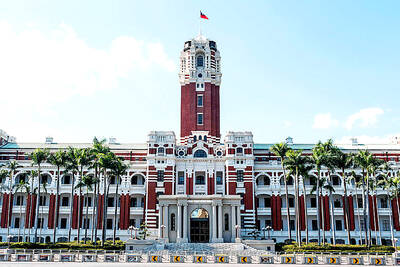
SECURITY: Taipei presses the US for arms supplies, saying the arms sales are not only a reflection of the US security commitment to Taiwan but also serve as a mutual deterrent against regional threats Taiwan is committed to preserving the cross-strait “status quo” and contributing to regional peace and stability, the Presidential Office said yesterday. “It is an undeniable fact that the Republic of China is a sovereign and independent democratic nation,” Presidential Office spokeswoman Karen Kuo (郭雅慧) reiterated, adding that Beijing has no right to claim sovereignty over Taiwan. The statements came after US President Donald Trump warned against Taiwanese independence. Trump wrapped up a state visit to Beijing on Friday, during which Chinese President Xi Jinping (習近平) had pressed him not to support Taiwan. Taiwan depends heavily on US security backing to deter China from carrying
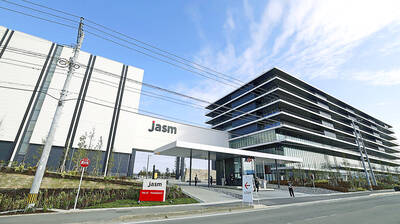
The subsidiary of Taiwan Semiconductor Manufacturing Co (TSMC, 台積電) in Kumamoto, Japan, turned a profit in the first quarter of this year, marking the first time the first fab of the unit has become profitable since mass production started at the end of 2024. According to the contract chipmaker’s financial statement released on Friday, Japan Advanced Semiconductor Manufacturing Inc (JASM), a joint venture running the fab in Kumamoto, posted NT$951 million (US$30.19 million) in profit in the January-to-March period, compared with a loss of NT$1.39 billion in the previous quarter, and a loss of NT$3.25 billion in the first quarter of
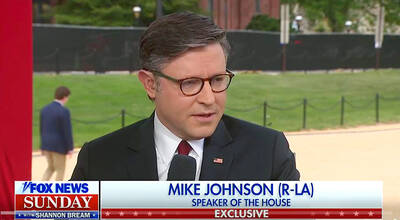
RESOLUTE BACKING: Two Republican senators are planning to introduce legislation that would impose immediate sanctions on China if it attempts to invade Taiwan US House of Representatives Speaker Mike Johnson on Sunday reaffirmed US congressional support for Taiwan, saying the US and “all freedom-loving people” have a stake in preventing China from seizing Taiwan by force. Johnson made the remarks in an interview with Fox News Sunday on US President Donald Trump’s summit with Chinese President Xi Jinping (習近平) last week. In an interview that aired on Friday on Fox News, just as Trump wrapped up a high-stakes visit to China, he said he has yet to green-light a new US$14 billion arms package to Taiwan and that it “depends on China.” “It’s a very good
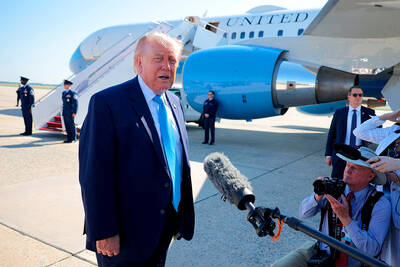
US President Donald Trump yesterday said he would speak to President William Lai (賴清德) as his administration considers whether to move ahead with a US$14 billion weapons sale to Taiwan — a potential arms deal that has drawn criticism from China. “Well, I’ll speak to him. I speak to everybody,” Trump told reporters yesterday when asked if he had any plans to call his counterpart, although he did not offer a time frame for when such a conversation could take place. Trump previously said he would speak to the person “that’s running Taiwan,” without specifying who he meant. “We have that situation very


 RSS
RSS