NEWS LESSONS / Mobile phones have transformed the way we communicate / Advanced
•
P
H
O
T
O
C
O
P
I
A
B
L
E
•
C
A
N
B
E
D
O
W
N
L
O
A
D
E
D
F
R
O
M
W
E
B
S
I
T
E
© Macmillan Publishers Ltd 2010
Mobile phones have transformed the way we communicate
Level 3 Advanced
Answer these questions and then talk about your answers in class.
Do you have a mobile phone?
Did you have a mobile phone five / 10 / 15 years ago?
Do you know anyone between the ages of 18 and 60 who does not have a mobile phone?
How many people in your class do you think have more than one mobile phone?
How many mobile phones are there in your household?
Warmer
1
Key words
2
Write the words from the article into the gaps. The paragraph numbers and the numbers of letters will help
you find the right words.
Something that is _______________ is easy to carry or move, so that you can use it in different places.
1.
(eight letters, para 3)
_______________ are tall metal structures used for broadcasting radio and television, and telephone signals.
2.
(five letters, para 3)
started selling a new product or service to the public _______________ (eight letters, para 3)
3.
the possibility to develop or achieve something in the future _______________ (nine letters, para 3)
4.
calculated how big something would become in the future using information that was available at the time
5.
_______________ (nine letters, para 4)
A _______________ is a sudden increase in the popularity of something. (four letters, para 7)
6.
in a very important or basic way _______________ (13 letters, para 8)
7.
paying some of the cost of goods or services so that they can be sold to other people at a lower price
8.
_______________ (11 letters, para 8)
to get back money that you have invested or lost _______________ (six letters, para 8)
9.
new and unusual things _______________ (nine letters, para 10)
10.
had a legal agreement in which money was paid so they could use a building, land or equipment belonging to
11.
them for a specific period of time _______________ (six letters, para 10)
a situation in which one person or thing has more influence or power than any other _______________
12.
(nine letters, para 11)
very famous and well known, and believed to represent a particular idea _______________
13.
(six letters, para 12)
happening or existing as the final result of a process or situation _______________ (11 letters, para 13)
14.
machines or pieces of equipment that do particular things _______________ (seven letters, para 15)
15.
NEWS LESSONS / Mobile phones have transformed the way we communicate / Advanced
•
P
H
O
T
O
C
O
P
I
A
B
L
E
•
C
A
N
B
E
D
O
W
N
L
O
A
D
E
D
F
R
O
M
W
E
B
S
I
T
E
© Macmillan Publishers Ltd 2010
Mobile phones have transformed the way we communicate
Level 3 Advanced
In just 25 years, the mobile phone has
transformed the way we communicate
Richard Wray
1 January, 2010
In the early hours of New Year’s Day, 1985,
Michael Harrison phoned his father, Sir Ernest,
to wish him a happy new year. There may
appear to be nothing remarkable about this but
Sir Ernest was chairman of Racal Electronics,
the owner of Vodafone, and his son was making
the first-ever mobile phone call in the UK.
Later that morning, comedian Ernie Wise made a
very public mobile phone call from St Katherine’s
Dock, east London, to announce that Vodafone
was now open for business. A few days later, its
sole rival, Cellnet, a joint venture between BT
and Securicor, was also up and running.
At the time, mobile phones were barely portable,
weighing almost a kilogram, costing several
thousand pounds and, in some cases, provided
little more than 20 minutes talktime. The
networks themselves were small; Vodafone had
just a dozen masts covering London and the
area west of London, while Cellnet launched with
a single mast, stuck on the BT Tower. Neither
company had any idea of the huge potential
of wireless communications and the dramatic
impact that mobile phones would have on
society over the next quarter century.
“We projected there would only be about a
million ever sold and we would get about 35%
of the market and BT projected there would be
about half a million and they would get about
80% of the market,” remembers Sir Christopher
Gent, former Vodafone chief executive, who was
at St Katherine’s Dock a quarter of a century
ago. “In the first year, we sold about 15,000 to
20,000 phones. The hand portable Motorola
was about £3,000 but most of the phones we
sold were car phones from companies such as
Panasonic and Nokia.”
Hardly anyone believed there would come a day
when mobile phones were so popular that there
would be more phones in the UK than there are
people. “Within both BT and Securicor, the view
was [mobile communications] were not for
the mass market,” according to Mike Short,
chief technology officer of Cellnet’s successor,
Telefonica O2 Europe, who was with BT when
Cellnet was founded. “That was also the view
in Racal Vodafone. Some of us who were more
active in the day-to-day business, certainly from
1986 to 1987 onwards, could see a much bigger
potential than that but we never expected it
would be as large as it has become.”
For the first decade the predictions that mobile
communications would not be mass market
seemed correct. But in 1999 one mobile phone
was sold in the UK every four seconds, and by
2004, there were more mobile phones in the UK
than people.
The boom was a consequence of increased
competition – which pushed prices lower and
created innovations in the way that mobiles were
sold, which helped put them within the reach
of the mass market – and the move to digital
technology.
In 1986, Vodafone overtook Cellnet, and BT
was so annoyed that they did something which
was to fundamentally change the way that
mobile phones were sold in the UK. “Once we
had got market share advantage over Cellnet
they were desperate to get it back and they
started subsidizing handsets and bringing
down the price of phones,” Sir Christopher
recalls. Ever since then, the mobile phone
networks have subsidized the price of a phone,
hoping to recoup its cost over the lifetime of a
customer’s contract. Cellnet also changed its
prices, reducing its monthly access charge – the
equivalent of line rental – and relying instead on
actual call charges. It also introduced local
call tariffs.
But there was still a fundamental block to mobile
phones going mass market: not enough capacity.
“But when digital came along, that really opened
up the market,” said Sir Christopher.
When the government introduced more
competition, companies started cutting prices
to attract more customers, leading to some of
the cut-throat competition in the market today.
1
2
3
4
9
5
6
7
8
10
NEWS LESSONS / Mobile phones have transformed the way we communicate / Advanced
•
P
H
O
T
O
C
O
P
I
A
B
L
E
•
C
A
N
B
E
D
O
W
N
L
O
A
D
E
D
F
R
O
M
W
E
B
S
I
T
E
© Macmillan Publishers Ltd 2010
Mobile phones have transformed the way we communicate
Level 3 Advanced
Comprehension: Find the information
3
When was the first-ever mobile phone call in the UK made, who made it, and who did he call?
1.
_________________________________________________________________________________
Who were the first two mobile phone providers in the UK? Who did they belong to at that time?
2.
_________________________________________________________________________________
What did BT and Vodafone project the future sales of mobile phones would be 25 years ago?
3.
_________________________________________________________________________________
In 1985, which kind of mobile phone was most often sold and which companies produced these phones?
4.
_________________________________________________________________________________
Which two factors brought about a significant boom in the sales of mobile phones?
5.
_________________________________________________________________________________
What did providers Orange and Virgin introduce to make them stand out from their competitors?
6.
_________________________________________________________________________________
What two features did Nokia introduce to make their handsets become iconic?
7.
_________________________________________________________________________________
According to the chief technology officer at Ericsson, what will be an important future development in 		
8.
mobile telephony?
_________________________________________________________________________________
Write your answers to the questions in note form.
The campaign, “The future’s bright, the future’s
Orange” , created by Wolff Olins, and the
introduction of such novelties as per second and
itemized billing helped give Orange a strong
position in the market. When it launched in 1999,
Virgin Mobile – the world’s first “virtual operator”
that leased network space from rivals – had a
big success with the idea of pre-pay phones.
The way that handsets themselves were
marketed was also changing and it was
Finland’s Nokia, which had been fighting hard
with Motorola and Ericsson for dominance of
the market, who made the leap from phones as
technology to phones as fashion items with the
Nokia 3210 device.
“The Nokia 3210 is iconic because it is the first
phone that deliberately did not display any sort
of external aerial,” explains Linge. “In the late
1990s Nokia realized that the mobile phone was
a fashion item: so it introduced interchangeable
covers allowing you to customize and
personalize your handset.”
Having seen mobile phone penetration soar
above 100% in 2004, the industry has spent the
later part of the past decade trying to persuade
people to do more with their phones than just
call and text, culminating in the fight between the
iPhone and a succession of touch screen rivals –
including Google’s Nexus One.
John Cunliffe, chief technology officer at
Ericsson in north-west Europe, believes the
next wave of growth for mobile telephony will
come not from persuading more people to get
a phone – because many already have one –
but connecting machines to wireless networks.
Everything from vehicle fleets and smart electric
and water meters to people’s fridge freezers will
one day be able to communicate.
“At the moment there are 4.5 billion devices
worldwide; at Ericsson we see this reaching 50
billion devices by 2020,” reckons Cunliffe. “This
is all about machine-to-machine communication,
touching all aspects of our lives.”
© Guardian News & Media 2010
First published in The Guardian, 01/01/10
11
13
14
12
15
NEWS LESSONS / Mobile phones have transformed the way we communicate / Advanced
•
P
H
O
T
O
C
O
P
I
A
B
L
E
•
C
A
N
B
E
D
O
W
N
L
O
A
D
E
D
F
R
O
M
W
E
B
S
I
T
E
© Macmillan Publishers Ltd 2010
Mobile phones have transformed the way we communicate
Level 3 Advanced
Language: Collocations
4
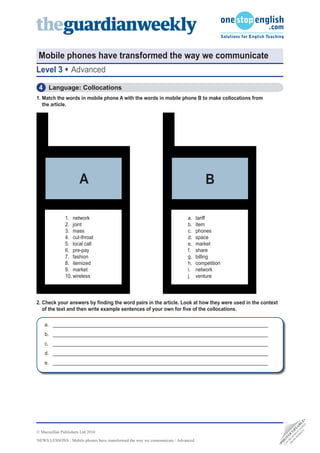
1. Match the words in mobile phone A with the words in mobile phone B to make collocations from
the article.
			
A B
network 		
1.
joint 			
2.
mass 		
3.
cut-throat 		
4.
local call 		
5.
pre-pay 		
6.
fashion 		
7.
itemized 		
8.
market 		
9.
wireless
10.
tariff
a.
item
b.
phones
c.
space
d.
market
e.
share
f.
billing
g.
competition
h.
network
i.
venture
j.
2. Check your answers by finding the word pairs in the article. Look at how they were used in the context
of the text and then write example sentences of your own for five of the collocations.
________________________________________________________________________________
a.
________________________________________________________________________________
b.
________________________________________________________________________________
c.
________________________________________________________________________________
d.
________________________________________________________________________________
e.
NEWS LESSONS / Mobile phones have transformed the way we communicate / Advanced
•
P
H
O
T
O
C
O
P
I
A
B
L
E
•
C
A
N
B
E
D
O
W
N
L
O
A
D
E
D
F
R
O
M
W
E
B
S
I
T
E
© Macmillan Publishers Ltd 2010
Mobile phones have transformed the way we communicate
Level 3 Advanced
Discussion
5
Compare the mobile phone you have now to the very first one you had.
What additional features does your current phone have?
How has the design changed?
What else is different?
What do you think mobile phones will be able to do in the future?
Webquest
6
Search the Internet for information about Google’s Nexus One phone.
• When was it launched?
• What can you do with it?
• What is likely to be its main competitor?
• Is it already available in your country?
• If so, how much does it cost?
• Would you consider buying one?
NEWS LESSONS / Mobile phones have transformed the way we communicate / Advanced
•
P
H
O
T
O
C
O
P
I
A
B
L
E
•
C
A
N
B
E
D
O
W
N
L
O
A
D
E
D
F
R
O
M
W
E
B
S
I
T
E
© Macmillan Publishers Ltd 2010
Mobile phones have transformed the way we communicate
Level 3 Advanced
2 Key words
portable
1.
Masts
2.
launched
3.
potential
4.
projected
5.
boom
6.
fundamentally
7.
subsidizing
8.
recoup
9.
novelties
10.
leased
11.
dominance
12.
iconic
13.
culminating
14.
devices
15.
3 Comprehension: Find the information
On New Year’s Day, 1985, Michael Harrison phoned
1.
his father Sir Ernest. Sir Ernest was chairman of
Racal Electronics, the owner of Vodafone.
Vodafone, which was owned by Racal
2.
Electronics, and Cellnet, a joint venture between
BT and Securicor
Vodafone projected there would only be about a
3.
million ever sold and they would get about 35% of
the market and BT projected there would be about
half a million sold and they would get about 80% of
the market.
Most of the phones sold were car phones from
4.
companies such as Panasonic and Nokia.
Increased competition and the move to
5.
digital technology
Orange introduced novelties such as per second
6.
and itemized billing. Virgin Mobile – the world’s first
“virtual operator” – had a big success with the idea
of pre-pay phones.
Nokia realized that the mobile phone could be a
7.
fashion item and changed the look of the phone
by hiding the aerial and offering interchangeable
covers for the handsets.
“The next wave of growth for mobile telephony will
8.
come ... from ... connecting machines to wireless
networks. Everything from vehicle fleets and
smart electric and water meters to people’s fridge
freezers will one day be able to communicate.”
4 Language: Collocations
d
1.
j
2.
e
3.
h
4.
a
5.
c
6.
b
7.
g
8.
f
9.
i
10.
Teacher’s notes
If your students own smart phones or iPods they
may be interested to know that there are many free
downloads or ‘apps’ available which will help them learn
and revise English via their handsets. These include
podcasts, vocabulary trainers, language games and
dictionaries. One way to find the latest is by going to
www.apple.com and to the iTunes store and typing in
words such as ‘English’ or ‘vocabulary trainer’
or ‘dictionary’.
KEY