
Bees in a hive in San Diego, Calif. Beekeeping has been a practice for thousands of years. Alan Nakkash for NPR hide caption
Bees in a hive in San Diego, Calif. Beekeeping has been a practice for thousands of years. Alan Nakkash for NPR hide caption

Rex, the tortoise, at Brian and Sara Westfall's home, who fostered him while they searched for his owner, in Scottsdale, Arizona. Adriana Zehbrauskas for NPR/57999420m hide caption
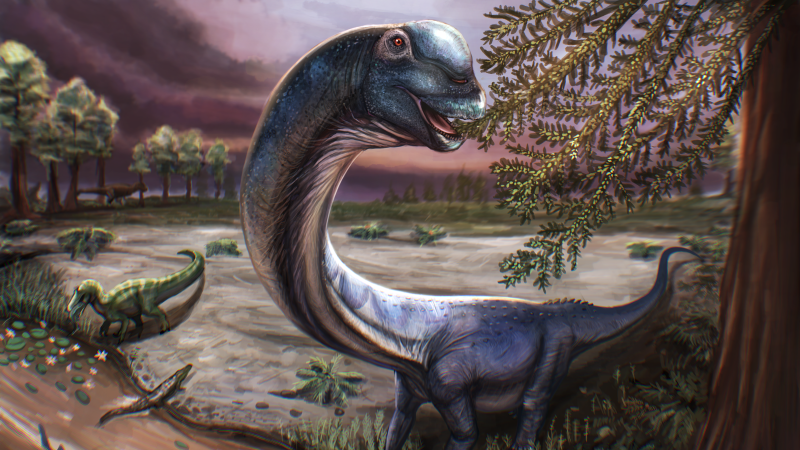
An artistic illustration of the Nagatitan, the largest dinosaur discovered in Southeast Asia. Patchanop Boonsai hide caption

Teammates Otys Train, 16, (left), Zade Pacetti, 16, and Jack Trojan, 17, look through a scope and binoculars as they aim to identify as many bird species as possible during the World Series of Birding at Malibu Beach Wildlife Management Area in New Jersey. Mohamed Sadek for NPR hide caption

Sir David Attenborough at the Beijing Museum of Natural History with fossil of Juramaia, as featured in the Smithsonian Channel series Rise of Animals: Triumph of the Vertebrates. Courtesy Smithsonian Channel hide caption

A Devils Hole pupfish is pictured at the Ash Meadows Fish Conservation Facility in Nevada. Scientists recently took captive-bred pupfish from this facility and introduced them into the species' natural habitat in Death Valley National Park. Olin Feuerbacher/U.S. Fish and Wildlife Service hide caption

An aerial photo taken on May 2, 2026 shows Timmy, the rescued humpback whale, offshore near Skagen after being released from a barge. The whale was first spotted stuck on a sandbank on March 23 near the city of Lübeck before freeing itself and then becoming stuck again several times. Sebastian Peters/Getty Images hide caption

One of the Decorah, Iowa, bald eagles feeds its eaglets. The bald eagle livestreams allow viewers to watch the eagles from anywhere. Raptor Resource Project hide caption

A sketch of the giant octopus. Yohei Utsuki/Department of Earth and Planetary Sciences, Hokkaido University hide caption

Naked mole rats live in colonies underground. Typically just one female reproduces at a time. When it's time for one queen to retire and another to reign, sometimes battles ensue. Evgeniya Moskova/iStockphoto/Getty Images hide caption
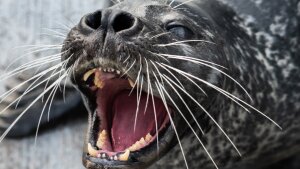
Filou worked with scientists for two years to help them test a theory about how harbor seals use their whiskers to hunt. Robin Heinrich/Marine Science Center hide caption

The Ngogo chimpanzee group in Uganda's Kibale National Park is the largest known community of wild chimpanzees in the world. Over the last decade, it has split into two distinct groups that are hostile to each other. Aaron Sandel hide caption

Shellear fish have certain anatomical traits making it possible for them to climb as well as swim. Pacifique Kiwele Mutambala hide caption
This juvenile warty frogfish was raised in captivity at the Shedd Aquarium. Brenna Hernandez/Shedd Aquarium hide caption
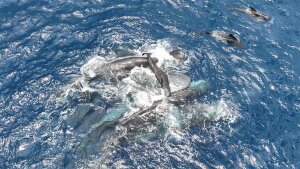
A group of sperm whales, including nonrelatives, work to keep a newborn calf afloat in the hours after its birth. Project CETI hide caption

A new paper in the journal Royal Society Open Science describes evidence that the wood-feeding cockroach Salganea taiwanensis may engage in a behavior known as pair bonding. Haruka Osaki hide caption

An experiment in nature-inspired design is underway in a South Florida residential canal. Two mangrove planters are being installed on a new seawall to provide habitat for marine wildlife. Nathan Rott/NPR hide caption
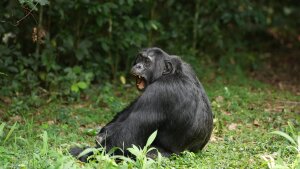
Researchers collected and analyzed urine from chimpanzees in a Ugandan forest after they'd eaten fermented fruit to determine how much alcohol they'd consumed. Sharifah Namaganda hide caption
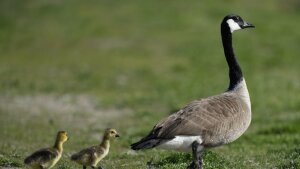
A Canada goose escorts goslings as they walk to a pond at Water Works Park, Thursday, May 4, 2023, in Des Moines, Iowa. Charlie Neibergall/AP hide caption
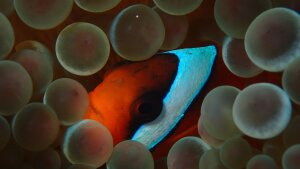
Tomato clownfish, like the one seen here nestled in a sea anemone, lose all but one of their white stripes (the head bar) as they grow up. Camille A. Sautereau hide caption
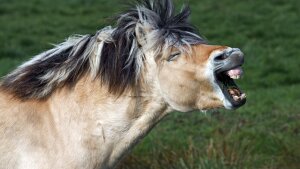
Horses, like the Norwegian fjord breed apparently yawning in this image, generate both a high frequency and a low frequency when they whinny. ullstein bild/Getty Images hide caption

Paleontologists Paul Sereno and Dan Vidal take notes on a massive hind limb of a new long-necked dinosaur, its femur measuring nearly 2m in length, at the Jenguebi dig site in Niger in November 2022. Matthew Irving/Fossil Lab/University of Chicago hide caption
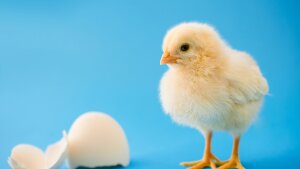
Baby chickens appear to react similarly to humans when tested for something called the "bouba-kiki effect," which links certain sounds to certain shapes. Elena Goncharova/Getty Images hide caption