


Giant iceberg

Giant iceberg behavior influences biogeochemical cycling across the Southern Ocean

  • Laura R. Taylor
  • Helena Pryer
  • Clara Manno
Article

Announcements

  • Town, tree, people to illustrate environmental social sciences

    Understanding the complex relationships between people and the environment is critical to finding solutions to climate and environmental challenges. We welcome articles that address climate adaptation and mitigation, policy, energy and society, environmental economics, psychology and behaviour, socio-economics, and sustainability. Click to browse our latest content.

  • journal logo

    Communications Earth & Environment has a 2-year Journal Impact Factor of 8.9 and a 5-year Journal Impact Factor of 9.5 (2024).

  • Median time from submission to the first editorial decision was 9 days in 2024.
  • Articles published in Communications Earth & Environment in 2024 were downloaded 5,154,659 times. Altmetrics mentions amounted to 39,567.
  • portrait of outstanding reviewers

    We thank Marie Keiding, Geological Survey of Denmark and Greenland (GEUS), and Vidyadhar Atkore, Salim Ali Centre for Ornithology and Natural History at Coimbatore, for their excellent and helpful contributions to peer review at Communications Earth & Environment.

  • wastewater pipe

    We are welcoming submissions to our curated open collections, including:

  • * PFAS and forever chemicals in the environment
  • * Hazards in Mountain Regions
  • * Critical materials supply chain sustainability
  • * Ecosystems under marine heatwaves

Advertisement

  • Generative artificial intelligence has unsettled higher education, raising fears that students will lose the ability to think. Drawing on classroom experience and student feedback, we argue that grounded inquiry sharpens judgement in Earth science teaching by limiting AI to set sources and auditing its claims.

    • Yiming V. Wang
    • Christoph Heubeck
    CommentOpen Access
  • War can have wide-ranging environmental impacts, including on agricultural production. Professors Gong and Lin and colleagues analysed satellite imagery over agricultural areas in five provinces of eastern Ukraine from 2019-2022. They found that production of wheat, sunflower, and rapeseed in these regions has declined by more than thirty percent in the subsequent growing season since the beginning of the Russia-Ukraine war. This work demonstrates the devastating impact that war can have upon agriculture and therefore food security worldwide.

    • Alice Drinkwater
    Research HighlightOpen Access
  • The Earth’s climate is regulated and stabilised by interconnected ecosystem processes. This Comment argues that following on from COP30, nature-based indicators should be integrated into formal climate policy processes—such as the Global Stocktake and Nationally Determined Contributions—to strengthen the coherence between climate governance and Earth System stability.

    • Qinglong Shao
    CommentOpen Access
  • Adoption of the International Maritime Organisation’s Net Zero Framework was postponed by one year, to October 2026. This Comment argues that this time window must be used to address four outstanding challenges, and that success can turn the maritime sector into a model for achieving the Paris climate goals.

    • Hee Jin Kang
    CommentOpen Access
  • Fluctuations in the Earth’s magnetic field across time may have had wide-ranging impacts on ecosystems. Dr Tarduno and colleagues used paleomagnetic data from silicate crystals to examine the Ediacaran period. Crystal data indicated that Earth’s magnetic field had decreased in intensity, becoming 10 to 30 times weaker than the present day. This profound and unprecedented reduction in magnetic field intensity aligned with a diversification in macroscopic animals, suggesting that changes in Earth’s magnetic shielding contributed to Earth’s oxygenation and therefore supported faunal diversification.

    • Alice Drinkwater
    Research HighlightOpen Access
  • Freshwater ecosystems produce methane, a potent greenhouse gas, and ponds on agricultural land are particularly strong emitters. Dr Malerba and colleagues used maps of agricultural ponds and compiled data on their emissions to produce assessments of methane emissions from agricultural ponds for both the USA and Australia. They found emissions twice as high as were initially being accounted for under national inventories, highlighting the need to account for this source in national inventories.

    • Alice Drinkwater
    Research HighlightOpen Access
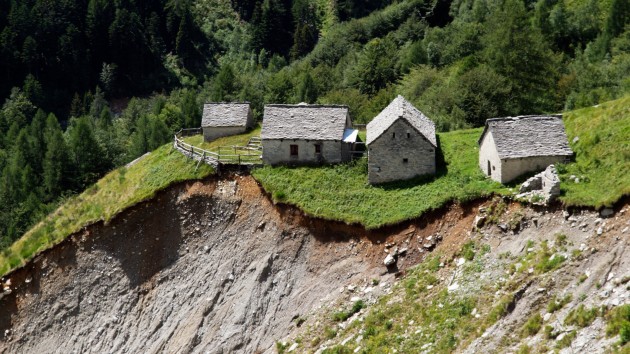
Mountain landslide and erosion

Hazards in Mountain Regions

This cross-journal collection from Communications Earth & Environment brings together research that explores the physical mechanisms and societal impacts of mountain hazards under changing climatic and cryospheric conditions.
Collection
Open for submissions

Advertisement