This weekend, tens of millions will tune in to the Super Bowl, while some will choose the Olympics.
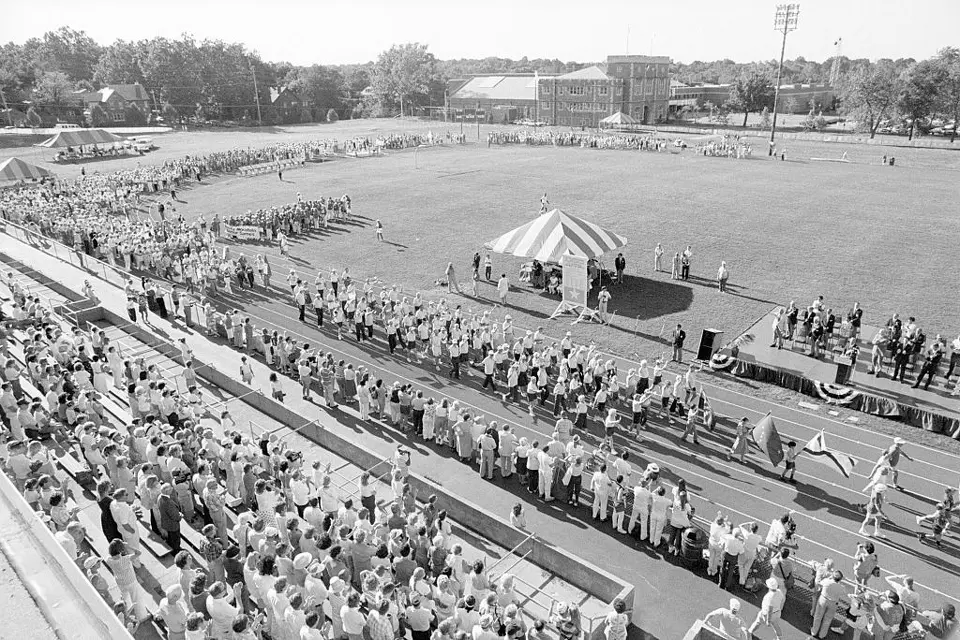
Athletes parade past the podium on the campus of Washington University, the site of the 1904 World Olympics.

Football was actually part of the Olympic program a century ago – for a while.
Advertisement
Article continues below this ad
American football, as it was officially called, was an Olympic demonstration sport in 1904 and 1932, and is long-forgotten today. In both instances, college football players were used — including Charles Moynihan, a White Hall native from the University of Illinois in 1904.
Today, football is a fall and winter sport. But the Winter Olympics were not contested until 1924, and football was relegated – in more ways than one – to the summer, particularly in 1904.
Unlike the glitzy extravaganzas that define today’s Games, the 1904 Olympics in St. Louis was a small affair, with loose planning and scant media coverage. Like many early Olympics, the St. Louis Games were a sideshow to the legendary World’s Fair, held at the same time.
Only 681 athletes from 13 nations came to St. Louis, and some events featured only American entrants. Organizers of the Games banned audience integration, building Jim Crow facilities for racial separation. Modern historians have lambasted St. Louis for its laughably poor organization, though several of the early Games suffered from similarly bad planning.
Advertisement
Article continues below this ad
Still, there was plenty of excitement in St. Louis, where two of the city’s institutions of higher learning, Washington University and Saint Louis University, wanted to play an Olympic football championship that would determine a national title. Their bravado ignored the fact that Eastern schools ruled the college football world in the era, not to mention that Michigan rolled to its fourth straight undefeated season in 1904.
Washington University, commonly known as Wash U., had some strength on the gridiron. Three years later, the school became a charter member of what became the Big Eight, which evolved into today’s Big 12. Wash U. now competes at the Division NCAA III level.
Saint Louis University is credited with throwing the first-ever legal forward pass during a game with Carroll College in 1906, two years after the Olympics. SLU dropped football in 1949.
The Olympic championship, however, never materialized, and Wash U. and SLU just played their regular seasons amid the Games. Since Wash U’s Francis Field was the primary stadium for the Games, only the games played there were considered part of the Olympic demonstration.
Advertisement
Article continues below this ad
A total of 13 games were played at Francis, 11 of them with Wash U., who took on all comers, including Indiana, Missouri and Texas.
Also on the Washington University slate was Illinois with Moynihan, a first-year player at right tackle. Born in White Hall on April 23, 1884, he the son of an Irish immigrant who spent three years with the Illini and later became an attorney.
Moynihan eventually settled in the western Colorado town of Montrose, where he served as mayor from 1914 to 1916.
Described by one source as an “outstanding and colorful criminal lawyer” with an “old school courtroom persona and a silver tongue,” Moynihan was retained in a celebrated 1947 murder trial surrounding a love triangle. A Republican activist who served as public lands commissioner under the Hoover administration, Montrose died in Montrose on Nov. 12, 1956.
Advertisement
Article continues below this ad
Illinois rolled to a 31-0 win over Wash University on Oct. 8, 1904, but even the smaller opponents in the Olympics had some moxie, such as Sewanee, also known as the University of the South. Five years earlier, Sewanee, a current Division III school, had recorded five straight shutout wins, over Texas A&M, Texas, Tulane, LSU, and Ole Miss, all on the road – and all in the span of six days.
Washington University managed a 4-7 on the Olympic season. The two games not involving Wash U. were an 11-0 win by Purdue over Missouri and a much-anticipated matchup in the final football game of the Olympics on November 26. That was a meeting of two Native American schools that were powerhouses of the time, Carlisle Indian, Pennsylvania, and Haskell, Kansas, and Carlisle cruised to a 38-4 win.
American football did not return to the Olympics until the Los Angeles Games of 1932, when a single exhibition game served as a demonstration sport. This time, more people were watching.
The game, played on Aug. 8 at the fabled Los Angeles Memorial Coliseum, featured an East-West matchup of seniors from Cal, Stanford, and USC against senior players of Harvard, Yale, and Princeton. The West prevailed 7-6 in front of 60,000 fans.
Advertisement
Article continues below this ad
Some believe the 1932 Olympic demonstration, coupled with a demonstration game at the 1933 World’s Fair in Chicago, helped create the College All-Star Game, a mainstay of the professional and college schedules for decades.
But football – the American kind – never returned to the Olympics, and it is doubtful that it ever will.