
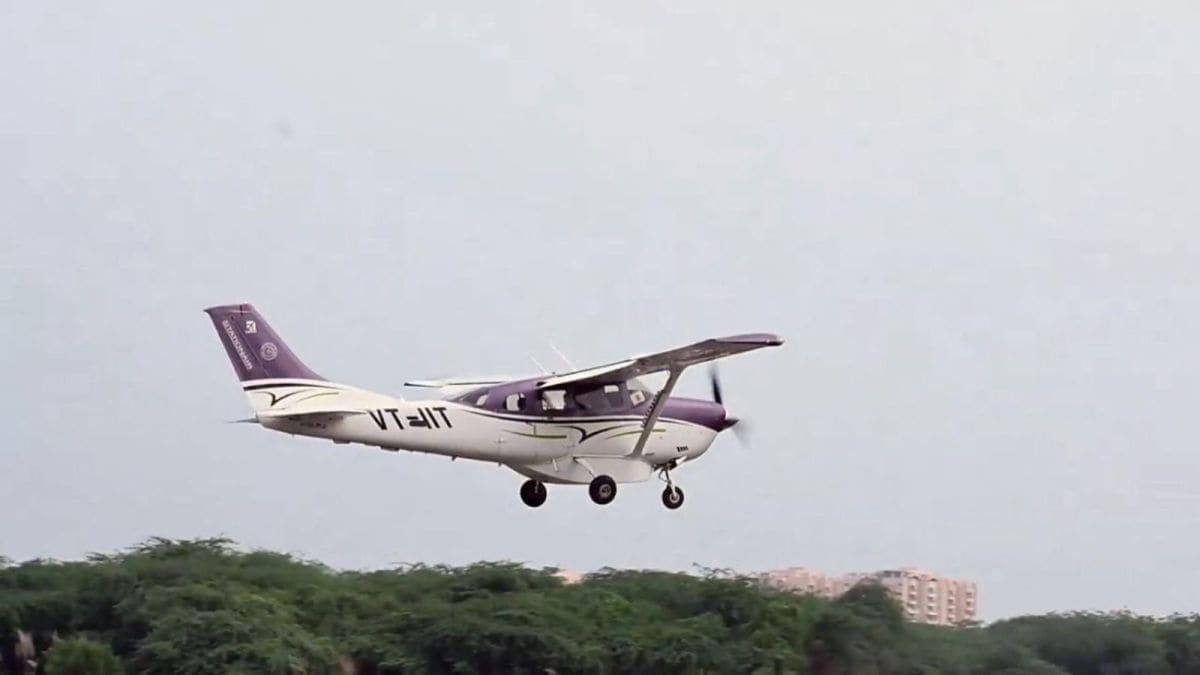


Nearly 50 years after the last such recorded attempt, Delhi witnessed an artificial rain experiment on Tuesday to tackle surging air pollution levels. With the Capital reeling under an Air Quality Index of 294 (poor), two cloud-seeding trials were held at 12.13 pm and 3.45 pm.
No rain was recorded in Delhi after the trials, which were conducted in association with IIT-Kanpur. According to a report shared by Delhi Environment Minister Manjinder Singh Sisra’s office, light rainfall of 0.1 and 0.2 mm each was reported from Noida and Greater Noida in the National Capital Region (NCR) at 4 pm. The report cited data available on the weather website windy.com.

“If these trials succeed, a long-term plan for February will be drawn up,” Sirsa said, adding that 9-10 such sorties are scheduled in the coming days.
On October 23, the Delhi government and IIT-Kanpur — after a nod from the India Meteorological Department (IMD) — had conducted a test run of sorts in a four-hour operation covering Kanpur, Meerut, Khekra, Burari, Sadakpur, Bhojpur and Aligarh.

Launching Tuesday’s trials, a Cessna 206H aircraft took off from the IIT-Kanpur airstrip around noon and entered Delhi’s airspace from the Meerut airfield after its first seeding point at Khekra around 2 pm. It then passed through Mayur Vihar, North Karol Bagh, Burari, Sadakpur (Narela side) and Bhojpur before landing in Meerut at 2.30 pm.
Flares weighing about 0.5 kg, and burning for 2 to 2.5 minutes, released silver iodide and sodium chloride into moisture-bearing clouds. These were fired over a 17-18-minute period, Sirsa said in a video statement.
According to the report shared by the minister’s office, the second seeding sortie took off from the Meerut airstrip carrying 4 kg of seeding material and landed back at 4.45 pm. The main waypoints were the same as the previous sortie.
A senior official at IIT-Kanpur said the arrangement to land was made in Meerut due to the unavailability of a suitable landing facility in Delhi without disrupting flight operations.
The IMD had forecast cloudy skies with mist for Tuesday, providing a narrow window of opportunity for seeding. Sirsa said IIT-Kanpur scientists estimated that any precipitation, if it occurs, could begin within 15 minutes to four hours of seeding but would likely remain limited in scale. According to the scientists, humidity in the target clouds ranged between 15-20%, which was insufficient for natural rain but ideal for testing precipitation potential.
As per the MoU signed between IIT-Kanpur and the environment department, the cost of five trials that have been proposed in all was Rs 3.21 crore.
“Today, IIT-Kanpur successfully executed a cloud-seeding operation over Delhi, a corridor measuring roughly 25 nautical miles in length and 4 nautical miles in width with the largest distance covered between Khekra and a little north of Burari,” sources at the institute said.
“The first round involved six flares released at an altitude of nearly 4,000 feet above ground level, with a burn duration of 18.5 minutes. A second flight took off at 3.55 pm, deploying eight flares at a higher altitude of around 5,000-6,000 feet,” the sources said.
The Directorate General of Civil Aviation (DGCA) had earlier granted permission to IIT-Kanpur to conduct the trials any time between October 1 and November 30.
Dr Thara Prabhakaran, cloud seeding expert at Indian Institute of Tropical Meteorology (IITM), said, “Cloud seeding depends on many factors such as moisture, aerosols, and circulation patterns… There needs to be the right kind of clouds, as well as sufficient moisture.”
She added that weather systems and cyclonic circulations from the Arabian Sea have enabled moisture influx in Delhi, making it a favourable condition to perform cloud-seeding. However, she said, it is a complex process and various aspects including cloud properties, aerosols, and thermodynamics parameters need to be assessed.
Environmentalists, however, described the cloud-seeding trial as a short-term measure, saying it may temporarily reduce pollution but fails to address the root causes of deteriorating air quality.
“Addressing air quality requires tackling sector-specific emissions from transport, power, and construction. Without that, no real impact can be achieved,” said Sunil Dahiya, analyst and founder of Envirocatalysts.


