Justice for Panguna

Rio Tinto’s former Panguna gold and copper mine in Bougainville, Papua New Guinea, has caused an ongoing human rights and environmental disaster for Indigenous communities.
Panguna was previously one of the world’s largest copper and gold mines. From 1972 to 1989, the mine discharged over a billion tonnes of waste into river systems, devastating the environment and the livelihoods and cultural practices of local communities.
In 1989, an uprising by local people against this environmental destruction and economic inequality forced the abandonment of the mine and triggered a brutal decade-long civil war which cost the lives of up to 20,000 people.
It’s time for Rio Tinto to address this legacy.
Generations of Bougainvilleans have been left to deal with the ongoing impacts. Mine infrastructure, levees and chemical storage facilities are collapsing, threatening nearby communities. Copper continues to contaminate local rivers, turning them a bright chemical blue. Forests and agricultural areas are smothered with vast mounds of mine waste, stretching almost 40km to the ocean. What was formerly one of the world’s largest mines is now a gaping wound, and the source of life-threatening risks.
It is time for Rio to remedy these impacts.
Indigenous communities, in partnership with the Human Rights Law Centre, brought a complaint against the company in 2020, leading to a landmark Impact Assessment that identified a wide range of human rights and environmental impacts.
Rio Tinto has now publicly committed to addressing these impacts and to establishing a remedy mechanism, but work on the ground has been slow to start.
In the last week, Tropical Cyclone Maila has ravaged Bougainville, further de-stabilising collapsing mine infrastructure and levees and heightening many of the dangers posed by the mine site.
Community members are calling on Rio Tinto to urgently address this disastrous legacy.
Join the call – add your name to the petition calling on Rio Tinto to provide urgent remedy and justice to affected Indigenous communities.
Theonila Roka-Matbob, Indigenous community leader from one of the mine-affected areas, says:
“This is a struggle for justice that I have taken up so that my children and the next generation of Bougainvilleans can inherit a better world to the one so many of us have grown up with.
The legacy of Panguna continues to impact every part of our lives. We live surrounded by mountains of mine waste that pollutes our lands and rivers, limiting where we can grow food, collect water and our ability to live safely on our own land.
Rio Tinto must deal with this disaster so that our people can move forward. The company’s support for the independent impact assessment, acceptance of the mine’s harms and public commitment to remedying its impacts have all been important steps towards rebuilding trust.
Now Rio Tinto needs to move urgently to implement solutions in partnership with our community leaders and our government.”
Theonila has just been awarded the 2026 Goldman Environmental Prize in recognition of her critical advocacy. The award, often referred to as the ‘Green Nobel’, is considered the world’s most prestigious prize honouring the achievements and leadership of environmental activists from around the world.

Timeline: Rio Tinto’s Panguna Mine
After the Mine Report
Bougainville communities’ human rights complaint against Rio Tinto
Landmark investigation into former Rio Tinto Panguna mine confirms major environmental damage and life-threatening risks to communities
We gratefully acknowledge the support of SAGE Fund for this work.

Representing the Australian Uyghur Tangritagh Women’s Association to take legal action against Kmart
The Australian Uyghur Tangritagh Women’s Association have taken legal action against Kmart, to determine whether the retail giant has misled its customers about the use of Uyghur forced labour in its supply chain.
Read more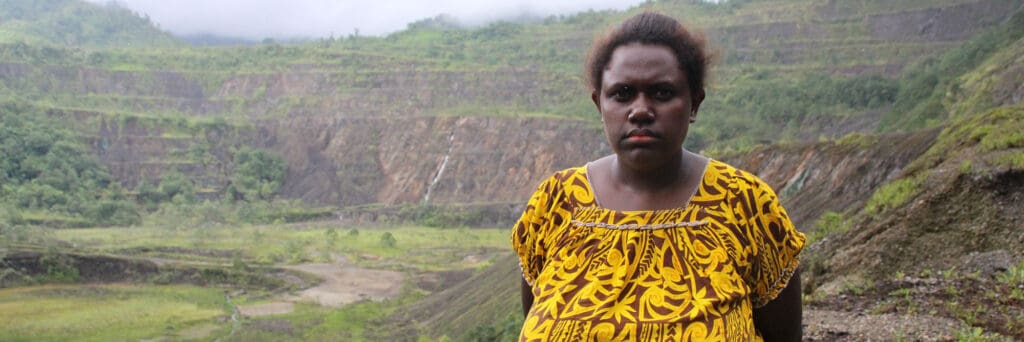
Holding companies to account through the Australian National Contact Point
The Human Rights Law Centre has been working for over five years to strengthen the AusNCP so it can become a truly effective human rights watchdog.
Read more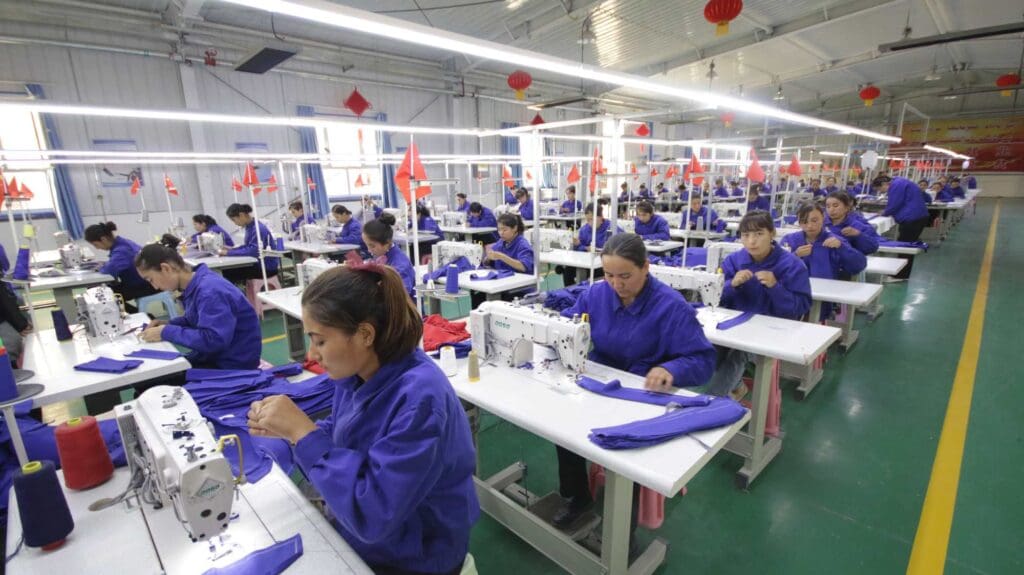
Pushing for stronger laws to end modern slavery
Many Australian companies continue to turn a blind eye to exploitation and abuse in their supply chains. The Human Rights Law Centre advocates for stronger laws to end modern slavery.
Read moreABN: 31 117 719 267 | Connect with the Human Rights Law Centre







Acknowledgement of Country
The Human Rights Law Centre acknowledges the Traditional Owners of the lands across Australia, including the lands of the Wurundjeri, Boon Wurrung, Gadigal, Ngunnawal, Cammeraygal, Darug, Wadawurrung, Turrbal and Jagera people where we work from.
We pay our respect to Elders past and present. This land always was, and always will be Aboriginal and Torres Strait Islander land. Sovereignty has never been ceded.
WARNING: This site contains images and names of people who have passed away.