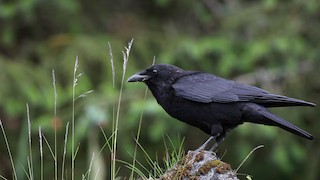

American Crow Corvus brachyrhynchos Scientific name definitions
- Names (28)
- Subspecies (5)
Revision Notes
Sign in to see your badges
Species names in eBird-supported languages
| Language | Common name |
|---|---|
| Azerbaijani | Amerika qarğası |
| Bulgarian | Американска врана |
| Catalan | cornella nord-americana |
| Croatian | američka vrana |
| Czech | vrána americká |
| Danish | Amerikansk Krage |
| Dutch | Amerikaanse kraai |
| English | American Crow |
| English (AVI) | American Crow |
| English (United States) | American Crow |
| Estonian | ameerika vares |
| Finnish | amerikanvaris |
| French | Corneille d'Amérique |
| German | Amerikakrähe |
| Icelandic | Stúfkráka |
| Japanese | アメリカガラス |
| Latvian | Amerikas vārna |
| Norwegian | amerikakråke |
| Polish | wrona amerykańska |
| Russian | Американская ворона |
| Serbian | Američka vrana |
| Slovak | vrana krátkozobá |
| Spanish | Cuervo Americano |
| Spanish (Mexico) | Cuervo Norteamericano |
| Spanish (Spain) | Cuervo americano |
| Swedish | amerikansk kråka |
| Turkish | Amerika Kargası |
| Ukrainian | Ворона американська |
Revision Notes
Carolee Caffrey revised the Habitat page. Anne B. Clark and Kevin J. McGowan reviewed the updates.
Corvus brachyrhynchos Brehm, 1822
Definitions
- CORVUS
- corvus
- brachyrhinchus / brachyrhyncha / brachyrhynchos / brachyrhynchum
The Key to Scientific Names
Legend Overview
Content Partner

Full content is available exclusively to Birds of the World subscribers. Sign in Learn more
Introduction
This clever, curious, social, vocal opportunist is one of the most widespread and recognizable of North American birds. It occurs in a wide variety of habitats, particularly open landscapes with scattered trees and small woodlots, now including suburban backyards and city parks. Despite its familiarity to many and its long history as the subject of written accounts, there remain many unanswered questions regarding to what ecological factors and on what time scales it adapts, and thus the possible reasons underlying its continent-wide variation in social- and breeding-system organization, among other attributes.
Across its range, the American Crow exhibits some degree of territoriality during nesting seasons (February through July across North America) and tends to roost communally, particularly once nesting seasons have ended and through winter. It occurs in fission–fusion societies, wherein breeding groups merge into larger foraging and/or loafing groups, or preroosting and/or roosting groups, and larger groups split back up into smaller groups on a regular basis. But migratory behavior varies (latitudinally at least), as does the relationship between parents and independent young of the current and past years. For example, in monitored populations in Florida, Oklahoma, and New York, U.S., breeding groups maintained territories all year, and pairs were often assisted in nesting attempts by previous offspring (New York) and/or individuals originally from other groups (Oklahoma). In Oklahoma and New York, it was not uncommon for offspring to delay dispersal for two or more years. In a marked population in California, U.S., the American Crow nested semicolonially; pairs and groups maintained small core areas all year, and pairs sometimes had helpers (mostly previous offspring) assisting in nesting attempts, but nonbreeders also occurred in a within-population nonbreeding flock. In most populations at high latitudes and in Great Plains states of the U.S., it breeds as unassisted pairs that hold breeding-season-only territories and migrates out of breeding areas completely in winter. In the northwest, it maintains breeding-season-only territories (or core areas), and pairs may have helpers (previous offspring) assisting with nesting attempts, and while it moves around in winter, it does not really migrate. Differences in migratory behavior make for differences in individual lives: some individuals likely regularly travel 2,500 km twice a year and spend months at a time in two different locations, while others not only do not migrate but may not move more than 25 km from their breeding territories all year. Migratory individuals may fly the same routes to final destinations each year, likely following in the paths of their ancestors.
This omnivorous generalist has adapted to procuring and eating the foods available in the different areas in which it occurs, including shellfish and crabs, walnuts and pecans, small vertebrates and vertebrate eggs, terrestrial and intertidal invertebrates, grain crops, seeds and fruits, carrion, and the many types of refuse left by humans. It caches food for later in ways that depend on the characteristics of what is being cached.
The American Crow varies among populations in size, voice, and behavior, and it varies behaviorally within populations and even within groups: group members (including broodmates) may make very different decisions regarding nightly roost-site choices, dispersal timing and distance, and (at mid-latitudes) whether (or not) to migrate, for example. It is not easy to generalize about this bird.
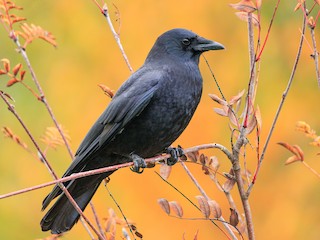
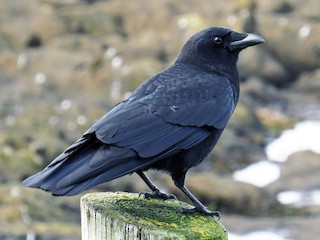
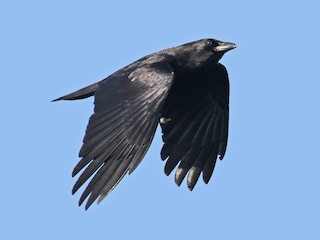
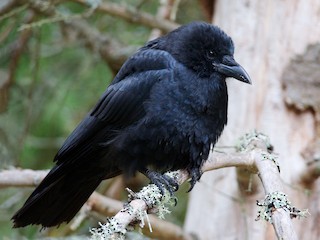
Until recently, the American Crow in the northwest was classified as a separate species ("Northwestern Crow," Corvus caurinus), but because of extensive interbreeding with the Western American Crow (C. brachyrhynchos hesperis) in areas of co-occurrence, those in the northwest are now considered a subspecies of the American Crow (C. b. caurinus). The American Crow is slightly larger but similar in appearance to the Fish Crow (Corvus ossifragus); in areas of range overlap (the southeastern U.S. and north along the Atlantic Seaboard; expanding inland), the two species are more easily distinguished by the more "nasal" voice of the Fish Crow than the slight difference in size. The American Crow also tends to stand a bit taller and is more likely to avoid areas with overhanging vegetation or where humans are close than is the Fish Crow.
The American Crow and humans have been interacting for centuries, and our relationships are of many types. We have expanded its breeding-habitat opportunities by clearing hardwood and coniferous forests, tilling agricultural lands, and planting trees around prairie homesteads and urban areas, yet we consider it a pest when it occurs in large numbers in areas of our creation. Large-scale persecution and slaughter during the 1800s and 1900s made this species wary of people. Its subsequent move into villages and cities was likely related to safety from guns and explosives and the availability of food, both natural and anthropogenic. Communal roosts in winter can be huge (residents plus migrants can number in the millions) and often trigger management responses when located in human-use areas. Our introduction of West Nile virus to North America in 1999 devastated populations across the continent, an impact that is still evident.
In our presence, the American Crow is watchful and hesitant but also inquisitive and bold; if the chance should arise, it will steal a hot dog from your golf cart or a sandwich from your picnic blanket. It is still considered "vermin" by some, but particularly recently, many North Americans have taken to leaving out food to encourage interactions with this mischievous charmer.
The published literature on this species dates back more than 200 years and spans a continent; sources of information range from official government reports and ornithological-organization newsletters to population-level research and studies of marked birds. We have attempted to include here all science-based and reliable sources of information. Although we did not search through newsletter archives for articles on the American Crow, we include some such sources that were relevant among the almost 500 references cited to paint the best current picture of what we know about this common yet uncommon bird.
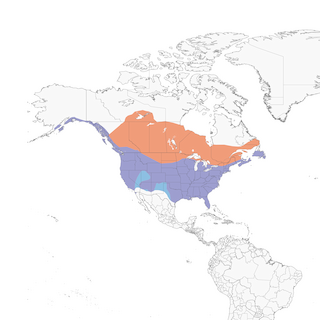
- Year-round
- Migration
- Breeding
- Non-Breeding