


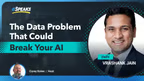
AI thrives on data but feeding it the right data is harder than it seems. As enterprises scale their AI initiatives, they face the challenge of managing diverse data pipelines, ensuring proximity to insights, and supporting a growing range of workloads. In this episode, Corey Knowles speaks with Vrashank Jain, lead product manager for Dell’s AI Data Platform, about how businesses can overcome these hurdles with solutions that simplify data management, enhance performance, and unlock the full potential of their AI investments.

In this episode of eSpeaks, Jennifer Margles, Director of Product Management at BMC Software, discusses the transition from traditional job scheduling to the era of the autonomous enterprise.

eSpeaks’ Corey Noles talks with Rob Israch, President of Tipalti, about what it means to lead with Global-First Finance and how companies can build scalable, compliant operations in an increasingly uncertain world. They explore how automation, AI, and integrated platforms are helping finance teams tackle today’s biggest challenges, from cross-border compliance and FX volatility to […]

-
Latest News - Resources Resource HubsFeatured ResourcesLink to The Real AI Power Play: Who Controls Your Enterprise Data Layer? The Real AI Power Play: Who Controls Your Enterprise Data Layer?IT and data teams were promised that AI would make work easier. Instead, it's created new layers of complexity.Link to Building the Backbone of Agentic AI with Trusted, Context-Rich Data Building the Backbone of Agentic AI with Trusted, Context-Rich DataIn this 10-minute take video, Reltio Principal Solutions Consultant Guy Vorster explains how organizations can overcome fragmented data challenges to power AI agents.Link to IHG scales real-time, trusted data across global brands IHG scales real-time, trusted data across global brandsAccelerating time to value while powering data-driven engagementLink to Dell’s Vrashank Jain on The Data Problem That Could Break Your AIDell’s Vrashank Jain on The Data Problem That Could Break Your AI
AI thrives on data but feeding it the right data is harder than it seems. As enterprises scale their AI initiatives, they face the challenge of managing diverse data pipelines, ensuring proximity to insights, and supporting a growing range of workloads. In this episode, Corey Knowles speaks with Vrashank Jain, lead product manager for Dell’s AI Data Platform, about how businesses can overcome these hurdles with solutions that simplify data management, enhance performance, and unlock the full potential of their AI investments.
Link to BMC’s Jennifer Margules on Intelligent Enterprise OrchestrationBMC’s Jennifer Margules on Intelligent Enterprise OrchestrationIn this episode of eSpeaks, Jennifer Margles, Director of Product Management at BMC Software, discusses the transition from traditional job scheduling to the era of the autonomous enterprise.
Link to Global-First Finance: Building Scalable, Compliant Operations in an Uncertain WorldGlobal-First Finance: Building Scalable, Compliant Operations in an Uncertain WorldeSpeaks’ Corey Noles talks with Rob Israch, President of Tipalti, about what it means to lead with Global-First Finance and how companies can build scalable, compliant operations in an increasingly uncertain world. They explore how automation, AI, and integrated platforms are helping finance teams tackle today’s biggest challenges, from cross-border compliance and FX volatility to […]
-
Artificial Intelligence -
Video -
Big Data & Analytics -
Cloud -
Networking - Cybersecurity Cybersecurity
- Applications Applications
- IT Management IT Management
- Storage Storage
- Mobile Mobile
- Small Business Small Business
- Development Development
- Database Database
- Servers Servers
- Android Android
- Apple Apple
- Innovation Innovation
- PC Hardware PC Hardware
- Reviews Reviews
- Search Engines Search Engines
- Virtualization Virtualization
-
- Blogs Blogs
- Events Events
