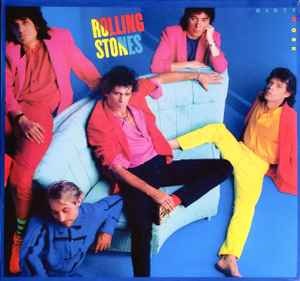
Matte cover which is dark pink inside. For the otherwise identical release with matte cover, which is plain white inside, see: Dirty Work
Cardboard inner sleeve with lyrics and credits on one side and a comic strip, "Dirty Work Out", by Mark Marek on the other side + a generic inner sleeve with rounded corners too. Some copies were issued in dark red cellophane shrink-wrap with a large illustrated promotional sticker on the front.
Track B6 is not listed. It is a short version of the Big Bill Broonzy blues standard. It's played by Ian Stewart who died shortly after this recording.
Inner sleeve: Recorded at Pathe Marconi Studios Paris Mixed at R.P.M. and Right Track Studios N.Y.C.
Special thanks to: Bobby Womack.....Don Covay, Chuck Leavell, Jimmy Page, Patti Scialfa, Jimmy Cliff, Tom Waits, Kirsty MacColl, Ivan Neville, Anton Fig, Steve Jordan, Charley Drayton, Philippe Saisse, Dan Collette, John Regan, Alan Rogan, Ian Stewart, Janis Pendarvis, and Dolette McDonald
Bobby Womack appears courtesy of MCA Records. Don Covay appears courtesy of Rawstock Productions. Jimmy Page appears courtesy of Atlantic Records. Tom Waits appears courtesy of Island Records. Kirsty MacColl appears courtesy of Stiff Records. Ivan Neville appears courtesy of Island Records. Philippe Saisse appears courtesy of Manhattan Records and Doppelganger.
Thanks to Sterling at the Ernie Ball Co. for strings and things. Thanks to Tony King and Jane Rose.
This album is dedicated to Ian Stewart "Thanks, Stu, for 25 years of boogie-woogie."
Gave this one 5 stars for sound quality though the musical content varies, the Keith tune is one of his most beautiful ballads and mastering and pressing are A1!!
Very underrated album, in my humble opinion. No it’s not Sticky Fingers and it does have a couple of clunkers but there’s still plenty of great stuff to be found here. I’d take Dirty Work over pretty much everything the Stones have released since.
Very detailed sound quality on this release. Pressing is lovely too. I made a needledrop of one of the tracks from this vinyl record - You can find it on the right side in the videos - Under the name: The Rolling Stones - One Hit (To The Body) (1986 European Vinyl)
Your comment has made me read about Lillywhite and his connection with KFC fast food chain. Now I don't know whether to laugh or cry. How much 'talent' from the 80's was really genuine art?
In un primo momento trovai il disco sigillato con plastica rossa e l'adesivo in alto. Lo tenni così. Oggi trovai "Dirty Work" già ascoltato. Lo presi poi vidi che era sato fatto per l'Europa nell'86.Guardando altre immagini su discogs veoo alla fine l'immagine del vinile con piastica rossa ..??!!
Between 1980 and 1989, the Stones produced 5 records that leave the critics and the fans of their 60’s and 70’s material quite cold. The Stones are accused of being in shambles, undermined by internal disagreements, increasingly heavy addictions, egocentrism, creative weariness, fashionable drifts ... a narrative that the Stones themselves, on the one hand, feed with nihilistic cynicism and on the other hand, deny, relaunching each record with the ridiculous rhetoric fanfares of the "comeback” and “the best album since… " Yet the Stones in the 80’s shine with a dark light, like a terminal black hole of Rock. A luminous and cathartic explosion / implosion that is halfway between the barker trick and divine illumination (and here is the devil), and which reveals the ultimate meaning and deepest structure of Rock. The records of the 80s, and expecially the post modern tryptic of Undercover, Dirty Work and Steel Wheels, reveal themselves as the ultimate reflection of Rock on Rock, and what are the Stones if not the archetype of rock itself? From this point of view, Dirty Work is, above all, probably their most derailing work. An album unfairly mistreated, when instead it is a central semantic work, both for the Stones and, consequently, for the meaning of Rock itself. Dirty Work highlights, in a martyrdom of ridicule and failure, the primary weirdness that underlies rock culture, and in this way plays the role of a true destabilizing force. Dirty work, and in general all the 80’s Stones material, mockingly show the gears of the Stones machine, revealing its artifice. In Dirty Work they destroy themselves. A supreme rock move. Capturing the semantic flows that underpin Reality, coagulating them and then derailing them, this is the ultimate meaning of rock as a product of post-modern civilization, where creation and destruction find themselves intimately enclosed in a kaleidoscopic groove. And it is here, in the ambivalent shimmer of the products of advanced consumerism, products that on the one hand celebrate themselves and on the other propagate their own end, the vital meaning of rock, not in a sort of mythological romanticized authenticity. And it is still here that Rock reveals itself closer to the plagiarism of hip hop and dub techniques, than to the blues (but of the the blues it captures its signs and symbols)! Looking at this semantic drifts, with the Stones lost between disco, dub, wave, fusion, funk we see how these drifts do nothing but shine a weird light on the previous work of the band, erasing in a chilling way any form of authenticity'. And let's not forget that the early 60's Stones are by no means a blues band, but a bunch of suburban white kids obsessed with the signs of the blues! Punks who grew up in the labyrinth of mass communication, children of the pneumatic vacuum of advanced capitalism, aesthetes of the death principle, sellers of dissolution. And Dirty Work, from this point of view, turns out to be a terminal masterpiece in which the layers of reality, both private (the band in an human, emotional, and chemical disintegration) and public (the post-human individualism of advanced capitalism, the Cold War …) are reflected in a stylistic confusion that threatens and breaks down the borders of their image. It is the Rock that threatens itself, rediscovering its ambiguous identity of death. And here Jagger seems to constantly invoke and play with the end, in a climate of threat, ugliness and terminal dissolution. The Stones are divided between submission to the Totem, the celebration of themselves (later elaborated in the beautiful plastic obsessions of Steel Wheels and in their live shows) and the centrifugal forces of studio work and private life. The critics accuse them of watering down their energy in a tired run-up to follow the last music tendencies, and in this way they fail to understand that this work on signs / inside the signs is the peculiarity of the Stones. There is no real or artifice, but only a disruptive machine of assimilation/ dispersion, which here appears mocking, cynical and above all ridiculous. Here they make fun of the human puppet in a work of ugliness and drift. The beauty of Dirty work lies precisely in the fight of dialectical forces between centrifugal dispersion and that cursed and radioactive circularity, which has always been present in the Stones. Prolonged listening to Dirty Work exposes you to a perverse pleasure, where the death principle offers its seductive dance, even more than in the rest of the Stones' 80’s discography. It is a concept about Rock and modernity. It is an exploration of the limits, on the limits, of Rock. It is no coincidence that the record is constantly haunted by the structural and productive references to dub ... with which the Stones have been flirting since the 70s. (Too Rude as King Tubby’s ghost). And let's not forget the choice of Lillywhite as producer, who covers the Stones machine with fluorescent neon colors. A concept album on dissolution (of signs and relationships), a meditation on the meaning of rock in the pneumatic vacuum of post capitalism, accelerated by the economic dynamics of the 80's. Destruction and dissolution sought and feared at the same time (as in Back to zero, the atomic menace in a seductive funk-wave groove, between Talking Heads’ ghosts and polished disco). And then that ending, that few seconds of a distand boogie piano, like an hallucination from elsewhere, as in a Dickian fiction. As if Ian Stewart had been playing from the 'hereafter' (is he dead or are we dead? They seem to ask themselves) That terminal fragment puts the whole work back into a chilling perspective. And here Dirty Work reveals itself as a work of death, a labyrinth without a center. Their most post-human creation. When this game of mirrors manifests, you are screwed and lost inside forever, the mind infected and free.