
RFID
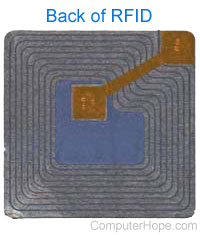
Short for Radio Frequency IDentification, a RFID is a small tag that enable a store or company to keep track of inventory. The picture shows an example of the back of an RFID. You may have seen stickers similar to this on products you have purchased from the store.
Where is RFID used?
RFID has many uses including the following.
- Autos - Help track vehicles and communicate with toll collection.
- Badge - Used with ID badges and key cards to help authorize someone into restricted areas.
- Healthcare - Help track equipment and patients.
- Retail - Help track and manage inventory and prevent theft.
- Tracking - Help with tracking and identifying baggage, people, and pets.
Does RFID use radio waves?
Yes, for the RFID to communicate with an RFID reader it may operate on either LF (Low-Frequency) or HF (High-Frequency) bands. With passive tags, the RFID reader can power the RFID using radio waves. Active RFID tags have batteries that help communicate using radio waves at greater distances.
RFID history
In 1945, Leon Theremin invented the "Thing," which was a listening device for the Soviet Union. This device could be powered by waves from an outside source and is considered to be a predecessor to RFID.
In 1971, Mario Cardullo demonstrated the first predecessor to today's RFID devices. Mario's device was a basic toll device, consisting of a passive radio transmitter with built-in memory, and was powered by an interrogating signal. The device was later patented by Mario Cardullo in January 1973.
Antenna, Barcode, Business terms, Computer acronyms, Frequency, Hardware terms, NFC, Phone terms, Transceiver, VHF, Wireless