-
- Opens the same content in full screenSee more
What’s it about?
This book is about the life of Napoleon Bonaparte, a great soldier-statesman, whose battles are among the greatest in history. - Opens the same content in full screenSee more
Book details
Print length
976 pagesLanguage
EnglishPublisher
Penguin BooksPublication date
October 20, 2015Reading age
18 years and upDimensions
2.3 x 6 x 8.9 inchesISBN-13
978-0143127857
- See moreOpens the same content in full screen
Amazon editors say...
Despite the book's thousand or so pages, I couldn't put it down. This is one of my favorites.
Chris SchluepAmazon Editor - Opens the same content in full screenSee more
Popular highlight
The ideas that underpin our modern world—meritocracy, equality before the law, property rights, religious toleration, modern secular education, sound finances and so on—were championed, consolidated, codified and geographically extended by Napoleon.
2,139 Kindle readers highlighted this
-
What’s it about?
This book is about the life of Napoleon Bonaparte, a great soldier-statesman, whose battles are among the greatest in history. -
Book details
Print length
976 pagesLanguage
EnglishPublisher
Penguin BooksPublication date
October 20, 2015Reading age
18 years and upDimensions
2.3 x 6 x 8.9 inchesISBN-13
978-0143127857
-
Amazon editors say...
Despite the book's thousand or so pages, I couldn't put it down. This is one of my favorites.
Chris SchluepAmazon Editor -
Popular highlight
The ideas that underpin our modern world—meritocracy, equality before the law, property rights, religious toleration, modern secular education, sound finances and so on—were championed, consolidated, codified and geographically extended by Napoleon.
2,139 Kindle readers highlighted this
Buy New
-29%
$20.49$20.49
FREE delivery Wednesday, August 12 on orders shipped by Amazon over $35
Ships from: Amazon.com Sold by: Amazon.com
Learn more
Used - Very Good
$12.09$12.09
FREE delivery August 14 - 18
Ships from: Stellar Book Company Sold by: Stellar Book Company
Book accolades
Los Angeles Times Book PrizeWinner, 2014
Book details
- Print length976 pages
- LanguageEnglish
- PublisherPenguin Books
- Publication dateOctober 20, 2015
- Reading age18 years and up
- Dimensions2.3 x 6 x 8.9 inches
- ISBN-100143127853
- ISBN-13978-0143127857
“A thrilling tale of military and political genius… Roberts is an uncommonly gifted writer.” —The Washington Post
Austerlitz, Borodino, Waterloo: his battles are among the greatest in history, but Napoleon Bonaparte was far more than a military genius and astute leader of men. Like George Washington and his own hero Julius Caesar, he was one of the greatest soldier-statesmen of all times.
Andrew Roberts’s Napoleon is the first one-volume biography to take advantage of the recent publication of Napoleon’s thirty-three thousand letters, which radically transform our understanding of his character and motivation. At last we see him as he was: protean multitasker, decisive, surprisingly willing to forgive his enemies and his errant wife Josephine. Like Churchill, he understood the strategic importance of telling his own story, and his memoirs, dictated from exile on St. Helena, became the single bestselling book of the nineteenth century.
An award-winning historian, Roberts traveled to fifty-three of Napoleon’s sixty battle sites, discovered crucial new documents in archives, and even made the long trip by boat to St. Helena. He is as acute in his understanding of politics as he is of military history. Here at last is a biography worthy of its subject: magisterial, insightful, beautifully written, by one of our foremost historians.
Review
“An epically scaled new biography . . . Roberts brilliantly conveys the sheer energy and presence of Napoleon the organizational and military whirlwind who, through crisp and incessant questioning, sized up people and problems and got things done. . . . His dynamism shines in Roberts’s set-piece chapters on major battles like Austerlitz, Jena, and Marengo, turning visionary military maneuvers into politically potent moments.”
—The New York Times Book Review
“Roberts is a masterly storyteller. . . . I would recommend his book to anyone seeking an accessible chronicle, rich in anecdote, of Napoleon’s fantastic story.”
—Max Hastings, The Wall Street Journal
“With his customary flair and keen historical eye, Andrew Roberts has delivered the goods again. This is the best one volume biography of Napoleon in English for the last four decades. A tour de force that belongs on every history lover’s bookshelf!”
—Jay Winik, bestselling author of The Great Upheaval and April 1865
“Is another long life of Napoleon really necessary? On three counts, the answer given by Andrew Roberts’s impressive book is an emphatic yes. The most important is that this is the first single-volume general biography to make full use of the treasure trove of Napoleon’s 33,000-odd letters, which began being published in Paris only in 2004. Second, Roberts, who has previously written on Napoleon and Wellington, is a masterly analyst of the French emperor’s many battles. Third, his book is beautifully written and a pleasure to read.”
—The Economist
“Napoleon remade France and much of Europe in his fifteen years in power and proved himself one of history’s greatest military commanders. Roberts’s access to Napoleon’s thirty-three thousand letters, only recently available, allowed him to create a fully human portrait of this larger-than-life figure.”
—The Wall Street Journal, Holiday Gift Guide
“A huge, rich, deep, witty, humane and unapologetically admiring biography that is a pleasure to read. The Napoleon painted here is a whirlwind of a man—not only a vigorous and supremely confident commander, but an astonishingly busy governor, correspondent and lover, too. . . . To dive into Roberts’s new book is to understand—indeed, to feel—why this peculiarly brilliant Corsican managed for so long to dazzle the world.”
—Dan Jones, The Telegraph
“Roberts in his Napoleon achieves the near impossible by writing on this extravagantly well-covered subject with a freshness and excitement that makes readers think they have stumbled on something entirely new.”
—Philip Ziegler, The Spectator, Books of the Year
“Truly a Napoleonic triumph of a book, elegantly written, epic in scale, novelistic in detail, irresistibly galloping with the momentum of a cavalry charge, as comfortable on the battlefield as in the bedroom. Here, at last, is the full biography.”
—Simon Sebag Montefiore, Evening Standard, Books of the Year
“Andrew Roberts’s Napoleon is a brilliant example of ‘great man’ history, brimming with personality and the high-octane Bonapartist spirit.”
—John Bew, New Statesman, Books of the Year
“Entertaining, even addictive . . . Roberts writes with great vigor, style, and fluency.”
—Sunday Times (London)
“Magnificent . . . Roberts’s fine book encompasses all the evidence to give a brilliant portrait of the man. The book, as it needs to be, is massive, yet the pace is brisk and it’s never overwhelmed by the scholarly research, which was plainly immense.”
—Mail on Sunday
“Roberts not only brings the Napoleon story up to date but, with new evidence from the archives and an original spin on the present, makes a compelling case for why we should all read anew about the little Corsican in the 21st century.”
—The Observer (London)
“Magisterial and beautifully written . . . A richly detailed and sure-footed reappraisal of the man, his achievements—and failures—and the extraordinary times in which he lived.”
—Standpoint
“A definitive account that dispels many of the myths that surrounded Napoleon from his lifetime to the present day.”
—Publishers Weekly
“A compelling biography of the preeminent French general that stands apart from the rest, owing to the author’s thoroughness, accuracy, and attention to detail. Roberts relies on his military expertise, Napoleon’s surviving correspondence (33,000 items in all), and exhaustive on-site studies of French battlegrounds. . . . This voluminous work is likely to set the standard for subsequent accounts.”
—Library Journal (starred review)
About the Author
Institute, he has won many prizes, including the Wolfson History Prize and the British Army Military Book Award, writes frequently for The Wall Street Journal,
and has written and presented a number of popular documentaries. He lives in New York City.
Excerpt. © Reprinted by permission. All rights reserved.
Introduction
Napoleon Bonaparte was the founder of modern France and one of the great conquerors of history. He came to power through a military coup only six years after entering the country as a penniless political refugee. As First Consul and later Emperor, he almost won hegemony in Europe, but for a series of coalitions specifically designed to bring him down. Although his conquests ended in defeat and ignominious imprisonment, over the course of his short but eventful life he fought sixty battles and lost only seven. For any general, of any age, this was an extraordinary record. Yet his greatest and most lasting victories were those of his institutions, which put an end to the chaos of the French Revolution and cemented its guiding principle of equality before the law. Today the Napoleonic Code forms the basis of law in Europe and aspects of it have been adopted by forty countries spanning every continent except Antarctica. Napoleon’s bridges, reservoirs, canals and sewers remain in use throughout France. The French foreign ministry sits above the stone quays he built along the Seine, and the Cour des Comptes still checks public spending accounts more than two centuries after he founded it. The Légion d’Honneur, an honor he introduced to take the place of feudal privilege, is highly coveted; France’s top secondary schools, many of them founded by Napoleon, provide excellent education and his Conseil d’État still meets every Wednesday to vet laws. Even if Napoleon hadn’t been one of the great military geniuses of history, he would still be a giant of the modern era.
The leadership skills he employed to inspire his men have been adopted by other leaders over the centuries, yet never equaled except perhaps by his great devotee Winston Churchill. Some of his techniques he learned from the ancients—especially his heroes Alexander the Great and Julius Caesar—and others he conceived himself in response to the circumstances of the day. The fact that his army was willing to follow him even after the retreat from Moscow, the battle of Leipzig and the fall of Paris testifies to his capacity to make ordinary people feel that they were capable of doing extraordinary, history-making deeds. A more unexpected aspect of Napoleon’s personality that also came out strongly over the course of researching this book was his fine sense of humour. All too often historians have taken seriously remarks that were clearly intended as humorous. Napoleon was constantly joking to his family and entourage, even in the most dire situations. Scores of examples pit this book.
Napoleon’s love affair with Josephine has been presented all too often in plays, novels and movies as a Romeo and Juliet story: in fact, it was anything but. He had an overwhelming crush on her, but she didn’t love him, at least in the beginning, and was unfaithful from the very start of their marriage. When he learned of her infidelities two years later while on campaign in the middle of the Egyptian desert, he was devastated. He took a mistress in Cairo in part to protect himself from accusations of cuckoldry, which were far more dangerous for a French general of the era than those of adultery. Yet he forgave Josephine when he returned to France, and they started off on a decade of harmonious marital and sexual contentment, despite his taking a series of mistresses. Josephine remained faithful and even fell in love with him. When he decided to divorce for dynastic and geostrategic reasons, Josephine was desolate but they remained friendly. Napoleon’s second wife, Marie Louise, would also be unfaithful to him, with an Austrian general Napoleon had defeated on the battlefield but clearly couldn’t match in bed.
Napoleon was able to compartmentalize his life to quite a remarkable degree, much more so even than most statesmen and great leaders. He could entirely close off one part of his mind to what was going on in the rest of it; he himself likened it to being able to open and close drawers in a cupboard. On the eve of battle, as aides-de-camp were arriving and departing with orders to his marshals and reports from his generals, he could dictate his thoughts on the establishment of a girls’ school for the orphans of members of the Légion d’Honneur, and shortly after having captured Moscow he set down the regulations governing the Comédie-Française. No detail about his empire was too minute for his restless, questing energy. The prefect of a department would be instructed to stop taking his young mistress to the opera; an obscure country priest would be reprimanded for giving a bad sermon on his birthday; a corporal told he was drinking too much; a demi-brigade that it could stitch the words ‘Les Incomparables’ in gold onto its standard. He was one of the most unrelenting micromanagers in history, but this obsession with details did not prevent him from radically transforming the physical, legal, political and cultural landscape of Europe.
More books have been written with Napoleon in the title than there have been days since his death in 1821. Admittedly, many have titles like Napoleon’s Haemorrhoids and Napoleon’s Buttons, but there are several thousand comprehensive, cradle-to-grave biographies too. Every one of them published since 1857 relied upon the correspondence that Napoleon III published as a tribute to his uncle. We now know that this was shamefully bowdlerized and distorted for propaganda purposes: letters that Napoleon never wrote were included while embarrassing or compromising ones that he did write were passed over. In all the compendium included only two-thirds of his total output.
In one of the great publishing endeavours of the twenty-first century, the Fondation Napoléon in Paris has since 2004 been publishing every one of the more than 33,000 letters that Napoleon signed. The culmination of this immense project demands nothing less than a complete re-evaluation of this extraordinary man. Napoleon represented the Enlightenment on horseback. His letters show a charm, humour and capacity for candid self-appraisal. He could lose his temper—volcanically so on occasion—but usually with some cause. Above all he was no totalitarian dictator, as many have been eager to suggest: he may have established an unprecedentedly efficient surveillance system, but he had no interest in controlling every aspect of his subjects’ lives. Nor did he want the lands he conquered to be ruled directly by Frenchmen. He believed that one can control foreign lands only by winning over the population and sought accordingly to present himself in terms that would make him sympathetic to the locals, feigning sympathy for their religion as a means to an end. (It is notable that his strategies varied considerably in Italy, Egypt and Germany.) In the one instance where this was not the case—Haiti—he later acknowledged that the brutality of his policies had compromised his effectiveness and mused with foresight that one could not keep people subject for long at a great distance. Above all he hoped to modernize Europe.
‘They seek to destroy the Revolution by attacking my person,’ he said after the failure of the royalist assassination plot of 1804. ‘I will defend it, for I am the Revolution.’ His characteristic egotism aside, Napoleon was right. He personified the best parts of the French Revolution, the ones that have survived and infused European life ever since. Although the Terror had finished five years before he grabbed power, the Jacobins were a powerful force who could always return. Similarly, a royalist restoration which would have wiped away the benefits of the Revolution was also possible. Instead, the fifteen-year rule of Napoleon saved the best aspects of the Revolution, discarded the worst and ensured that even when the Bourbons were restored they could not return to the Ancien Régime.
The ideas that underpin our modern world—meritocracy, equality before the law, property rights, religious toleration, modern secular education, sound finances and so on—were championed, consolidated, codified and geographically extended by Napoleon. To them he added rational and efficient local administration, an end to rural banditry, the encouragement of science and the arts, the abolition of feudalism and the greatest codification of laws since the fall of the Roman Empire. At the same time he dispensed with the absurd revolutionary calendar of ten-day weeks, the theology of the Cult of the Supreme Being, the corruption and cronyism of the Directory and the hyper-inflation that had characterized the dying days of the Republic. ‘We have done with the romance of the Revolution,’ he told an early meeting of his Conseil d’Etat, ‘we must now commence its history.’
For his reforms to work they needed one commodity that Europe’s monarchs were determined to deny him: time. ‘Chemists have a species of powder out of which they can make marble,’ he said, ‘but it must have time to become solid.’ Because many of the principles of the Revolution threatened the absolute monarchies of Russia (which was to practice serfdom until 1861), Austria and Prussia, and the nascent industrial kingdom of England, they formed seven coalitions over twenty-three years to crush revolutionary France. In the end they succeeded, but, thanks to Napoleon, the Bourbons were too late to destroy the revolutionary principles he had codified into law. Many of those who opposed him were forced to adopt aspects of his reforms in their own countries in order to defeat him.
‘There are two ways of constructing an international order,’ Henry Kissinger wrote in A World Restored, ‘by will or by renunciation; by conquest or by legitimacy.’ Only one of these was open to Napoleon. In Britain, which had already had its revolution 140 years earlier and thus enjoyed many of the legal benefits that the Revolution brought to France, Napoleon faced William Pitt the Younger, who saw in the destruction of French power—be it revolutionary or Napoleonic—an opportunity to translate Britain’s maritime trading success into global great power status. Napoleon’s threat to invade Britain in 1803 ensured that successive British governments would remain determined to overthrow him. Their decrying of French imperialism was pure hypocrisy as Britain was busy building a vast empire at the time. Napoleon boasted that he was ‘of the race that founds empires’—but he had a different kind of empire in mind, more in keeping with those of Caesar, Alexander and Frederick the Great.
Napoleon is often accused of being a quintessential warmonger, yet war was declared on him far more often than he declared it on others. France and Britain were at war for nearly half the period between the Glorious Revolution of 1688 and Waterloo, and Napoleon was only a second lieutenant when the Revolutionary Wars broke out. He launched the Peninsular War and the war against Russia in 1812 in the hope of extending the reach of his ‘Continental System,’ a misguided protectionist answer to Britain’s control of the seas, and thereby force Britain to sue for peace. It was thus Colbertian protectionism that brought him down, far more than the bloodlust and egomania of which he is so often accused.
His decision to invade Russia was not in and of itself his worst mistake. The French had defeated the Russians three times since 1799, so it was understandable that he should believe he could do so again. He had fought in blizzards at Eylau and in the Sierra de Guadarrama, and at the end of long lines of communications at Austerlitz and Friedland. It was the very size of his army in 1812 that forced the Russians to adopt their strategy of constant retreat, and their adroitness in avoiding battle until they had lured him to within 75 miles of Moscow accounted for much of their victory. He could not have known how to block the ravages of the typhus epidemic that killed around 100,000 men in his central striking force as its origins and cure would not be discovered for another century. Despite this, had Napoleon chosen either one of two other possible routes back from Malojaroslavetz, he would have saved enough of the Grande Armée to preserve his crown. He thought he could bring the enemy to a decisive battle and pushed his forces too fast and hard in pursuit of that goal. He failed to appreciate that the Russian army had fundamentally changed and that Alexander I would stop at nothing to annihilate him.
Overall, however, Napoleon’s capacity for battlefield decision-making was astounding. Having walked the ground of fifty-three of his sixty battlefields, I was astonished by his genius for topography, his acuity and sense of timing. A general must ultimately be judged by the outcome of the battles, and of Napoleon’s sixty battles and sieges he lost only Acre, Aspern-Essling, Leipzig, La Rothière, Lâon, Arcis and Waterloo. When asked who was the greatest captain of the age, the Duke of Wellington replied: ‘In this age, in past ages, in any age, Napoleon.’
He convinced his followers they were taking part in an adventure, a pageant, an experiment and a story whose sheer splendour would draw the attention of posterity for centuries. He was able to impart to ordinary people the sense that their lives—and, if necessary, their deaths in battle—mattered in the context of great events. They too could make history. It is untrue that he cared nothing for his men and was careless with their lives. He lost a friend in almost every major battle, and his letters to Josephine and Marie Louise make it clear that these deaths, and those of his soldiers, affected him. Yet he could not allow that to deflect him from his main purpose of pursuing victory, and he would not have been able to function as a general if it had, any more than Ulysses Grant or George Patton could have done.
Napoleon certainly never lacked confidence in his own capacity as a military leader. On St Helena, when asked why he had not taken Frederick the Great’s sword when he had visited Sans Souci, he replied, ‘Because I had my own.’


Explore your book, then jump right back to where you left off with Page Flip.
View high quality images that let you zoom in to take a closer look.
Enjoy features only possible in digital – start reading right away, carry your library with you, adjust the font, create shareable notes and highlights, and more.
Discover additional details about the events, people, and places in your book, with Wikipedia integration.
About the author
Follow authors to get new release updates, plus improved recommendations.Frequently bought together
Frequently bought together

You might also like
-  
-  
-  
-  
-  
Customers who bought this item also bought
You might also like
-  
-  
-  
-  
-  
-  
-  
From the Publisher
Features & details
Features
- Hardcover
Product information
| Publisher | Penguin Books |
| Publication date | October 20, 2015 |
| Edition | Reprint |
| Language | English |
| Print length | 976 pages |
| ISBN-10 | 0143127853 |
| ISBN-13 | 978-0143127857 |
| Item Weight | 2.13 pounds |
| Reading age | 18 years and up |
| Dimensions | 2.3 x 6 x 8.9 inches |
| Best Sellers Rank |
|
|---|---|
| Customer Reviews | 4.6 out of 5 stars 4,500Reviews |
Related books
Customers say
Generated from the text of customer reviewsSelect to learn more
Reviews with images
Submit a report
- Harassment, profanity
- Spam, advertisement, promotions
- Given in exchange for cash, discounts
Sorry, there was an error
Please try again later.Top reviews from the United States
- 5 out of 5 starsVerified Purchase
A well-rounded look at the man, and not just the legend…
Reviewed in the United States on March 6, 2017Format: KindleIn this massive biography, Andrew Roberts has produced an epic review of Napoleon Bonaparte. He focuses on Napoleon the man rather than the myth. He succeeds at presenting a mostly-balanced account of his life, showing us a human being capable of inspiring immense respect and awe even 200 years after his feats. But we also see the failures of mind and body, with evidence aplenty of Napoleon’s more repulsive qualities. Overall, Roberts sees Napoleon’s contribution to history in a positive light, and this is evident throughout the book. But we also clearly see the common cliché regarding the corruptive influence power has on the mind. Even Napoleon's remarkable mind was susceptible to these influences.
Roberts’s work is unique in that his is among the first biographies to leverage recently published primary documents that provide new windows into Napoleon and his character. This allows fresh glimpses of the man both at work and at play. What takes shape is a human being, not a God-like myth or statue with a rigid character. Napoleon, like most of us, changed throughout his life. He adhered to (or was influenced by) competing values that frequently fought one another for dominance within his mind. Who he was at 25 was very different than who he was at 40, and again at 50. The value of Roberts’s work is that it reveals the folly of casting an historical character like Napoleon in one specific light. Was he an idealistic revolutionary who believed in a society free from the prejudice and injustice of the old world? Was he a tyrannical despot who imprisoned his enemies and used war to advance his own personal interests? Casting him into molds like this is what we typically seem to do, but it simplifies what Roberts’s clearly shows is a story of far more complexity and contradiction.
What this means is that Napoleon is too complex of a subject to summarize in a single paragraph. But a few sentences will give you an idea of the view of Napoleon through Roberts’s research. Napoleon was an enlightened agnostic with a love of knowledge and learning and a belief in their power to do good for all humankind. He was an intellectual of the highest order and was just as at home in a library as he was on a battlefield (in fact, he frequently traveled with his personal library). He adhered to enlightenment ideals blossoming during his youth that stressed liberty and merit as opposed to aristocracy and privilege. He was also a militarist, and it imbued him with discipline and courage. His capacity for knowledge, memory, and quick-thinking was truly legendary, and examples abound of his incredible memory even as late as his exile on Elba. He can relatively easily be associated with egomania and megalomania, and yet—for most of his life—he showed a capacity for self-reflection and self-criticism uncharacteristic of such a personality disorder. He displayed genuine concern for people under his charge. His staff members, as well as members of the army, are frequently quoted describing his hard work ethic but also his playful and caring attitude toward them. He was, in many ways, advanced for his time regarding social issues. He favored full equality for Jews and Protestants (indeed, all religions) and leveraged their talents. He was tolerant of homosexuality in an age where it was generally not tolerated: his veritable vice-ruler for much of his reign was Cambacérès, who was gay.
But Napoleon’s faults are also laid bare in Roberts’s narrative. Throughout his life, he generally showed a lack of great integrity and a willingness to break rules to suit his own purposes. He clearly had a view of women that was not progressive, and did much to undermine the freedoms women gained during the Revolution. He naturally was an anxious man, and I believe that “impatience” is probably the character trait that persisted most saliently through every phase of his life. He lacked an understanding of economics, and this, more than any other mistake, was the root of his downfall (the infamous Continental System). He was not a bloodthirsty person in any sense, and his rule was very rarely characterized by repression based on terror. But he was directly responsible for needless executions on at least three occasions throughout his life, and humanity came second to victory when his army was on campaign. As caring as he could be with staff members and soldiers, he often completely lacked emotional intelligence when it came to his own family members (particularly his siblings). Here we see some of Roberts’s most vehement criticisms. Napoleon’s use of his siblings as rulers of client states defies beliefs that he long held (and fought for) regarding meritocracy, and also ignored the sheer lack of talent possessed by some of these family members.
These kinds of ideological clashes, modeled here by Napoleon’s belief in meritocracy but pervasive practice of nepotism, illustrate what I like to call the “Napoleonic Paradox” or “Napoleonic Contradiction.” One cannot read Roberts’s work and not see the ironies presented in Napoleon’s life. There are numerous examples where beliefs and practices of one period of his life simply contradict those of other periods (or even the same period). This is not, I believe, traceable to any kind of inherent character flaw in Napoleon. Rather, it is the natural and (relatively) slow metamorphosis in a belief system over the life of a man—visible in many other famous statesmen reviewed in such a way. Roberts’s work gives us the chance to see these changes take shape. Overall, I believe it is fair to say that Napoleon’s idealistic and modest qualities began to give way to more megalomaniacal qualities after his victory at Austerlitz (1805) and especially after the Treaty of Tilsit (1807). It was here that he reached a level of power unlike any achieved by any other European for centuries. During the years of his zenith (1810-1812) and his subsequent downfall (1812-1814), we see a Napoleon generally unchecked by the modesty and reason more characteristic of his early years in power, and instead see a man corrupted by his awesome authority. But throughout all of his life, we see this war of ideals and practices vying for dominance within him. Napoleon himself does not seem to have been overtly conscious of many of these contradictions, or this war of ideas taking place in his subconscious.
As far as Roberts’s writing style, the narrative is chronological, which makes sense for a biography and is easy to follow. Roberts does not spend much time analyzing the myriad evidence and relaying an argument to the reader. His goal, after all, is to use evidence to show Napoleon the man, providing us a deep-dish look at his successes and failures—the roundness and depth of a man. He does not have an overarching thesis he is using the evidence to prove. Some readers will love this, as it allows for the reader to form their own conclusions. Others may be frustrated that we rarely can catch our breath and read, “what does it all mean?” This isn’t to say that Roberts does not offer opinions from time to time. He defends Napoleon in many of his most controversial moments (for example, the Cadoudal-Pichegru conspiracy and the execution of the Duc d’Enghien). He also specifically identifies Napoleon’s exaggerations or outright lies, and does not shy away from criticizing his decisions (Roberts believes Napoleon only has himself to blame for the disaster in Russia in 1812 and his final defeat at Waterloo in 1815, among others).
If you like to read about battles, oddly enough this “biography” provides a great deal of detail. There is plenty in the narrative regarding most of the battles Napoleon took part in, usually with detail on troop movements and the units involved. Lovers of military history will likely eat this up—others may find it tedious. The first group will likely be as disappointed as I was in the maps available—but this is a criticism I make of just about every military history book I review.
Napoleon was a complex man. He lusted for greatness and was the epicenter of conflict for more than a decade. But we also see a man with good intentions, compassion, and an oft-doting father and husband. It is these stories of tenderness, combined with ones of ruthlessness, that make Roberts’s biography ultimately so effective. We are able to see Napoleon, not as an historical caricature, but as a man possessed of both awesome virtues and crippling faults. Napoleon's greatness and contribution to history is thoroughly revealed. So too are his foibles and failures. It is a story that often leaves you equal parts repulsed, impressed, and sympathetic. I can think of no possible better outcome for a biography.
- 5 out of 5 starsVerified Purchase
Comprehensive & fascinating portrait of a complex but arguably great giant
Reviewed in the United States on April 8, 2015Format: KindleIn this detailed but accessible biography by Andrew Roberts, we get what is arguably the defining biography of Napoleon for our generation. It covers the life of this giant of history, showcasing his monumental achievements and their impact on history, but also his flaws and mistakes.
Although generally a positive portrait, Roberts does not shy away from criticisms of Napoleon's conduct, such as the Jaffa massacre or the murder of the Duke d'Enghien. Nor does it hide Napoleon's flaws as a person, such as his temper and his tendency to meddle in the love lives of his family.
Mostly though, the biography celebrates Napoleon's talents, achievements, & personality. One really gets a good idea of Napoleon's charm and what he might have been like in person. It also showcases his incredible capacity for work and searing intellect. His achievements speak for themselves, but I personally liked the details of his non-military achievements as much as his famous victories, and the book spends considerable pages highlighting his civil achievements. The code Napoleon, which remains one of the most influential law texts today, is a great example of his lasting legacy. (The book also deals with his diplomatic and economic failures such as the continental system).
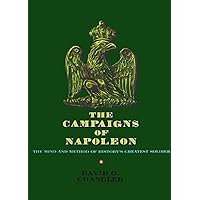
As for Napoleon's campaigns, Roberts does a fine job describing the political situation before the battle, the marches and maneuvers, as well as the flow of the actual battle. I found this part accessible and easily understood, with detailed maps marking the units helping to paint a fine picture of Napoleon's famous victories and defeats. It also gives good reasoning on why Napoleon won and why he lost. Mostly Napoleon's defeats were instances where he doesn't follow his own military maxims. Overall Roberts does a great job illustrating Napoleon's campaigns for the layman and amateur military historian, but for those that want a really detailed analysis of his battles, they should also read "The Campaigns of Napoleon" by David Chandler, the defining classic on the military side of Napoleon's career.
I highly recommend this book for those that want to read the definitive biography on Napoleon. This is the first biography that incorporates many personal letters Napoleon wrote that wasn't published until recently, so it really does give a more detailed look at his personality. Yes it is highly positive portrait, but I wouldn't call it a hagiography either. I found it fairly balanced overall.
If there are any criticisms, it would be that the chapter on the Waterloo campaign was a bit shorter than I expected, but it gets to the core issues. I would have also liked a longer analysis on Napoleon's impact and influence on our politics and institutions after his death, although these are mostly woven into the chapters where his individual policies are written about. Personally though I would have liked a chapter at the end summarizing what this giant of history's lasting historical legacies were. Regardless I give this book 5 stars, I don't think you can go wrong if you want to know about Napoleon's life and times.
Does Napoleon deserved to be called the great? Or was he a blood thirst tyrant? We have to look at him through the lens of the times he was in. Was Napoleon more of a dictator than any other of the reining monarchs in Europe or the world at the 18/19th century? Many of his laws were quite liberal by the standards of the day including his treatment of the Jews, especially compared to other European countries like England.
Was he especially blood thirsty? Well most of the Napoleonic wars were declared against him by successive coalitions so again, is he any worse than the others? In fact one of his greatest mistakes in following the Russians deep into Russia was due to the desire to have a pitch battle as soon as possible so the war can be shortened and a political settlement reached. Yes he was overly ambitious in attempting to spread French influence at the expense of other European powers, resulting in war. However that was par of the course in the age of Empires.
Luckily for us times have changed since. If any lessons can be drawn by the story of Napoleon, it was that political mistakes can not be compensated by battlefield victories. Napoleon was no doubt a genius, however his ambitions and personality got the better of him, and as a result he made a series of unsustainable peace treaties at the expense of other powers which would guarantee animosity. His desperate last campaigns against overwhelming enemy numbers were a direct result of this mistake. Our current political leaders will do well to remember it.
* it's also worth getting the audiobook. Narration was great and it's really convenient to listen to while you are on the train or car.
- 4 out of 5 starsVerified Purchase
HERO NOT KNOWING WHEN TO STOP
Reviewed in the United States on February 1, 2015Avant-Garde Politician: Leaders for a New Epoch
Reading this book as a case study of leadership, historic processes and their intersections, the following lessons emerge:
On leadership, Napoleon was unique, far above accepted classifications, such as "transformative leadership." He is a prime example of what I call in my recent book "prototype avant-garde politician." "He had transformed the art of leadership" (p. 802). However Napoleon, as some other history-swerving political leaders (and other types of "future makers") should be viewed as a "mutant": what made him uniquely "great" cannot be learned, such as outstanding multitasking and a unique combination between radically innovative generalship and revolutionary enlightenment reforms.
Still, many useful lessons on leadership are provided by Napoleon, such as: reading a lot in history and political philosophy, being very inquisitive, hard-working, insisting on meritocracy, being interested in science and a patron of art, and relating personally to subordinates.
Not less so, many lessons on what to avoid are provided by Napoleon's persistent errors, such as nepotism and engaging too much in micromanagement. Striking is the strange combination between interest in science and gross neglect of its military uses.Thus, he disbanded the military balloonist unit (p. 795, note) and did not develop a rockets capacity, despite their proved efficacy when used by the British (p. 682). This may well show that his interest in science was not profound.
More important are two fundamental flaws which led to his ultimate personal failure: (1) Napoleon misread a critical feature of reality, namely Great Britain and its strength; and (2) he did not knowing when to stop, refusing reasonable peace opportunities, such as at the Congress of Prague (after his retreat from Russia) - apparently because of self-conceited imagining himself as a new Caesar (who was his main role model) . As stated in the text "... almost every other statesman of the day would have agreed to [the] terms. But the Emperor of France, the heir to Caesar and Alexander, simply could not bring himself to accept what he saw as a humiliating peace." (p. 661).
On historic processes: Napoleon's career demonstrates the critical role of various forms of "luck," much more so than implied in the view of history as "contingent," or the treatment of Fortuna by Machiavelli. The author provides some examples (p. 269), but much more was at stake: All of his becoming Emperor was a result of counter-probabilistic chains of events, starting with the match between his basic traits and the situation into which he was born (fitting the contingency theory of leadership.
On the intersection between leadership and historic processes: Napoleon was clearly a "Hero" impacting strongly on the future of Europe and beyond, being not only the last but the most important of the Enlightenment absolutist beneficent rulers (pp. 527-528). As put by the author "To large numbers of people across Europe Napoleon seemed to represent the ideas of progress, meritocracy and a rational future" (p. 529). And British historian H. A. L. Fisher was right in judging, as quoted in the book, that "Napoleon`s Empire shattered the obdurate crust of habit and substituted wide ideas...for narrow, slovenly, lethargic provincialism." (pp. 527-518).
Given the many merits of this book, still it does not succeed to "re-enact history," as proposed by the philosopher of history R. G. Collingwood. Despite extensive reliance on letters by Napoleon no real insights into his mind are arrived at. Shorter discussion of the battles (from which no valid lessons for modern military affairs can be drawn), and more concentration on the interiority of Napoleon would have made the book more interesting, at least for me.
As it is, the book makes good reading on a "grand adventure" and an important historic episode. But its lessons on leadership and the processes of history could have been better presented in 400 instead of 810 pages of text.
Professor Yehezkel Dror
The Hebrew University of Jerusalem
- 5 out of 5 starsVerified Purchase
"What A Novel My Life Has Been!"
Reviewed in the United States on January 29, 2015I chose to title my review using a quote from Napoleon Bonaparte himself, who at the end of his life dictated his own recollections of his storied career. In the capable hands of Andrew Roberts Napoleon's story does indeed read like some sort of fantasy written by the most imaginative of novelists. Roberts is the first of Napoleon's biographers to have access to the thousands of letters he wrote throughout his life, and as a result the Great Conqueror, Hero of the Age, or Antichrist (depending on the point of view of the person describing him) becomes more vivid and more personal, a human being rather than the marble statue or giant painting most of us picture when we hear his name.
Throughout his life Napoleon Bonaparte was remarkable for his self-confidence, ambition, and sang-froid. Roberts shows us that these were characteristics already fully apparent when Napoleon was a child on the island of Corsica, part of a large and somewhat impecunious family. An intelligent student, he distinguished himself with his wide ranging reading that concentrated on history and the classics. He continued to display his scholastic abilities at French military schools, entered the French army shortly before the Revolution broke out, and as a result of the Reign of Terror's high death toll became a general in his twenties. He made an advantageous marriage to the somewhat older and extremely well-connected Josephine de Beauharnais. After winning a series of sensational battles he became a national hero, and the weak post-Revolutionary French leadership sent him off to Egypt in the hope that distance and difficulty would dim his luster. Napoleon did indeed have a difficult time fighting in the Middle East, but upon his return to France he displayed an ability to control and twist the news media in his favor. Overthrowing the government in 1799, he became dictator or First Consul and then proclaimed himself Emperor in 1804.
Roberts demonstrates that as leader of France Napoleon governed very much in the spirit of the Enlightenment: appointing officials based on merit rather than birth, reorganizing and making more efficient the national and local governments, encouraging education, but also reinstituting the slave trade and setting up a surveillance and censorship system that seems sadly modern. He was an extreme micro-manager, writing letters that nit-picked insignificant details about low level official duties and regulations But it is as military leader that Napoleon is best known, and Roberts excels in his descriptions of the many battles and campaigns that led him to dominate all of Europe within a few short years. Roberts walked many of the battlefields himself and includes some invaluable descriptions (including, for example, the fact that a hill from which Napoleon directed one German battle is now to be found just beyond a local McDonald's parking lot!) His descriptions of the battles are vivid and colorful, as is his coverage of the maneuverings and agreements that created what might well have become a unitary French empire in Europe, spreading the ideals of the Enlightenment and the Revolution throughout the Continent.
Roberts does just as good a job of detailing Napoleon's decline and fall, describing the disastrous Russian campaign; the retreat back to France in 1814; the first capitulation and exile to Elba; the sensational return and the Hundred Days that culminated at Waterloo in June 1815; and then the final six years of exile marked by increasing illness and depression on St. Helena. Throughout the 800 pages we are treated again and again to Napoleon's own words, demonstrating his sense of mission and his incredible good luck. Not only the Emperor's but also the personalities of those around him are colorfully and often amusingly depicted, again many times in Napoleon's own words. I have never seen so accurate a summing up of the character of Charles-Maurice de Talleyrand, for example, than the Emperor's "Why, you are nothing but a s--t in silk stockings." Napoleon's family, including his indomitable mother, second-rate brothers,and beautiful but scheming sisters are all brought to life; as are his many women: the ambitious and intelligent Josephine, his rather frivolous and empty-headed second wife Marie Louise of Austria, a never ending parade of mistresses, and most endearingly, his friendship with 14 year old Betsy Balcombe on St. Helena.
This is an eminently scholarly and entertaining biography that should become the standard work on the Emperor's life for many years to come. Through it readers will become aware of the enormous impact Napoleon Bonaparte's career had on Europe in his own time as well as on our world two centuries later.
- 5 out of 5 starsVerified Purchase
Epic, amazing, detailed and fascinating
Reviewed in the United States on June 30, 2026Format: KindleA great book to learn about Napoleon, as well as the history of France and Europe. Entertaining writing style but also full of amazing details.
- 5 out of 5 starsVerified Purchase
A must read for military enthusiasts and anyone interested in Napoleon's life and times
Reviewed in the United States on October 30, 2017A marvelous, unparalleled account of one of history's greatest characters.
Andrew Roberts has done what many thought to be impossible - coming up with a new biography on Napoleon that, despite the sheer volume of biographies on him, succeeds in almost every possible way in dethroning the others' and assuming the rightful mantle as the leading book on the subject.
Having showered much deserved praise upon this latest entry into this ever growing genre, I have yet to delve in what makes it stand out from the previous installments. Indeed, having previously read Vincent Cronin's masterful account, I only hesitantly got around to reading this book.
And oh boy, was it worth it...
Let us begin with Roberts' access to a sheer volume of recently published memoranda, memoirs and letters on and of the late emperor which shed some much needed light on Napoleon's character. As stated by the author, all too often is our favourite corsican depicted as an aloof and grave individual, virtually detached from the jovial mundanity typical of the way in which mediterranean people often behave when in private. The same applies for the comradeship, respect and even intimacy he showed to his subordinates, from the higher echelons all the way to the rank-and-file.
Then, Roberts' perfect accounts of Napoleon's battles and accompanying maps go a long way in clarifying the state of affairs on the battlefield. Any and all military enthusiasts can and may very well find these chapters utterly enthralling. This is truly a book that is hard to put down, especially after the Italy chapters begin. However, those who can't stand reading to long and detailed battle reports would do well in considering whether this book is the one they ought to read, as it bears the mark of the military historian from start to finish, feeling sometimes more as an exhaustive analysis of Napoleon's campaigns instead of his private life. It's been a while since I read Cronin's book, but I remember him devoting much more time to explaining/analysing other, non-military events surrounding Napoleon or even at other courts (Cronin explicitly retells the Murat melodrama in 1814-1815, which is barely mentioned by Roberts with no context at all provided. While I knew of the affair beforehand, thanks to Cronin's take on the subject, some readers who may be first delving into the subject might be a tad lost in some paragraphs, which could have used a bit more fleshing out). The Zenith Chapter, for instance, was all that was devoted for Napoleon's time as uncontested ruler of Europe, and even then, not even the whole chapter. His wedding options are barely discussed, and of his & Marie Louise's marriage we get to know little - I recall Cronin devoting far more pages to it. Roberts does make up for this in providing the various bits of recently published information mentioned above.
There's also the author's masterful prose and pace, which is not to be underestimated in a volume which spans such a length as this one does (over 800 pages of content, plus over a hundred more on notes and bibliography!).
Which leads us to the final bit of acclaim: that the author has gone the extra mile to provide us with such a masterful and unrivalled reflects on the bibliography: dozens, if not hundreds of sources - both primary and secondary - have been used by the author to bring about this jewel. His effort deserves every single bit of my praise.
One single bit that did bother me was the "britishness" so overly present in some bits of the biography. There was a particular sentence at the final chapter which derided Archduke Charles while showering praise on Wellington, to the point of depicting him as one of the very best military minds of the late 18th and early 19th century. Able as Wellington's command was during the Peninsular War and after the Napoleonic wars, it is difficult to ascertain if he would have been able to cope with Napoleon's pre-1814 genius, which more often than not allowed him to gain the upper hand on other impressive commanders such as the aforementioned Charles, Schwarzenberg, Blücher and Kutuzov. That the very last paragraph of the epilogue is dedicated to Wellington's thoughts on Napoleon, as he were as important a figure as Josephine or even Murat, speaks for itself. The "arch-enemy" relation is hinted in various bits in the book, while I find no reason at all that could compellingly explain why Wellington ought to be deemed as such, having fought only a battle - even if the most decisive one - against the corsican giant.
That remark aside, I cannot recommend this book enough - it is a gem amid so many unimaginative biographies, and ought to be read by anyone looking to know more of Napoleon and/or the period.
5/5 stars.
- 4 out of 5 starsVerified Purchase
Not for beginners. Written from a British perspective.
Reviewed in the United States on March 1, 2020Format: PaperbackThe book is massive.
It contains over 800 pages of everything you might want to know about Napoléon with pages of references if the 800 pages of everything are not enough already.
The good:
Very detailed.
Lots of references.
Covers his entire life from childhood to death.
Does a good job of describing the supporting cast (Napoleon’s family, marshals, political allies, enemies, Josephine, MarieLouise, Alexander, Wellington, etc...)
Covers his major achievements and losses (and his reactions) in detail.
Detail, detail, detail.
The bad:
Lots of detail means lots of information. (You may not be interested in how he managed his furniture from afar while campaigning in Poland, but details of this and many more like it are in the book)
It meanders: I had a hard time following which year we were in because the author mixes events from one era with references to multiple others in the same chapter, paragraph and sentence without making clear what time you are in.
He does something similar when discussing subjects. He would discuss a battle and then mix in multiple tangential (albeit relevant) comments about something completely different.
Many, many sidebars and footnotes in the midst of passages about that are interesting tidbits, but distract from the main theme of the passage itself.
He takes for granted the reader has more than a passing knowledge of British history.
As an American, I found I was behind the curve on this subject. I am a history buff, n
But Marlborough is not a known person in the US, like in the UK. If he had written that Napoléon was like “honest Abe” I feel like the UK readers might have been lost. I think the average US reader might feel the same when he talks about Wellesley and Wellington in familiar terms.
The author loves to use rare words. Have your dictionary handy. You will find a not-oft used word in every chapter.
Maps were often wanting. I think I could have done a much better job showing movements in battle. The Waterloo maps are probably the best in the book, but others leave a lot of information (dates of battles, for example) to be found on other pages.
In sum:
An excellent study of Napoleon and a great place to find all you want to know.
There might be better options for those wanting a quick description of Napoléon.
Maybe not the best option for US readers without a solid grasp of English history.
Not a quick read, but an extensive study of the man who changed Europe forever.
- 5 out of 5 starsVerified Purchase
a magificent biography of one of the world's great men
Reviewed in the United States on November 23, 2015Format: PaperbackHow many figures in world history have been the subject of as many biographies as Napoleon Bonaparte? Probably Jesus, maybe Caesar and Lincoln, Churchill coming up fast, possibly George Washington. But this one-volume history of Napoleon (always referred to by his given name, not his surname) is an absolutely first-rate work in its scope – running to more than 800 pages – and the magnitude of the drama playing out page after page. Andrew Roberts, one of the most distinguished British historians gives it all. We read about Napoleon’s almost unbelievably rapid surge from a remote village in Corsica to military school in France and, at only age 27, the leadership of the France army in its invasion and conquest of Italy. This was quickly followed by a smashing victory in Egypt where its magnificent prizes were shipped back to France, where many of them continue to be on display today, mainly in Paris.
At only 30 years of age, Napoleon seized power in a revolt against the fragile government created by the French Revolution. He became the First Consul of France, initially joined by two other consuls. The Bourbon reign had been ended, tragically for the reigning monarch, Louis XIV, and the country’s government was in the hands of ardent revolutionaries, who were far better at scheming than governing. Napoleon rapidly shouldered all competitors aside and turned his energies to sorting out the mess of Europe. The Austrian state was in its final throes of decay but it still had enormous assets, both military and financial. Britain was separated from Europe by water, lots of water, and exercised its power only when one or another European state became clearly ascendant. Russia was a distant presence on the borders of Eastern Europe but had a huge population and strong ties to the royal houses of central Europe. This was clearly an unstable situation, with each major state anxious to extend its influence, almost always at the expense of one or another of the major powers.
Napoleon understood that military victories gave him enormous civil power. Austria remained a strong power in northeastern Italy and Napoleon moved to engage the Austrian army, first by drawing the Austrian army further away from its supply lines in Central Europe. At Marengo, he soundly defeated the Austrian army and returned to France in triumph.
Napoleon’s career moved from one brilliant military success after another and in 1804 he was crowned Emperor. This enabled him to lead both the army and the government. He redrew the map of Paris, he reformed the French educational system, he encouraged the arts, he commissioned many of the most remarkable buildings still glittering in Paris, he consolidated the power of France, never more complete than in the early years of his reign.
At the peak of his power, Napoleon moved much further east across the European continent to invade Russia. He had defeated the Russian army earlier, in 1807, but this was in the heart of central Europe. Russia’s power centers, Moscow and Petersburg, were hundreds of miles to east and Napoleon elected to knock out not only the Russian army but its government, headed by Tsar Alexander, with whom Napoleon had established strong bonds of friendship earlier. This effort to subdue Russia, with its huge population, hideous winters, vast expanse, and powerful allies – mainly Britain – was a disaster for Napoleon. It marked the beginning of his decline, not precipitous at first but relentless.
By 1814, France had tired of Napoleon and, without significant emotion, dismissed him, sending him to Elba, a small island in the Mediterranean. His confinement there lasted less than a year and by February 1815 he arrived back on the southern shores of France. Initially with only a fragmentary force, he picked up support steadily as he moved north and arrived about a month later in Paris. The bloated Louis XVIII fled Paris and Napoleon reassumed his role as Emperor, 18 days after arriving on French soil and without any military opposition.
The end was near. In late-March, many of the major European powers joined together to form a Coalition against Napoleon. In mid-June, Napoleon moved his troops north into Belgium where a huge force under the Duke of Wellington waited for the French army. Napoleon’s superb military instincts enabled him to vanquish army after army for more than ten years but these instincts failed him at Waterloo. He was destroyed by the British-Prussian-Dutch-Belgian force. Napoleon resigned and in mid-July 1815 he was sent to a distant island in the mid-Atlantic, St Helena, 4400 miles from the shores of France. Here, he lived until his agonizing death almost six years later.
This is a great story told by Andrew Roberts. It presents a balanced view of a very great man, a man who made a great difference to France and French values. He was the master of Europe for almost a decade, starting as a raw prodigy and ending as one of the greatest military minds of world history. He was, however, far beyond only a military genius. Napoleon reshaped France and Paris into one of the first modern states in Europe and his legend continues to glow. One can only, in the end, admire Napoleon for all his gifts and we have Mr. Roberts to thank for shining his light on this great story.
Top reviews from other countries
Amazon Customer5 out of 5 starsVerified PurchaseExcellent history
Reviewed in France on August 5, 2018Format: PaperbackI was loaned this book in Abidjan and mentioned it to a relative in France which is why I bought it. It contains many facts about Napoleon that I was not aware of, all the more interesting that some of his life was spent around where we have a home. Napoleon is a bit of anachronism. Amazing that he made it as far as he did without getting fired. And yet, a genius whose influence is still felt in many countries around the world today.
Sending feedback...Thanks, we'll investigate in the next few days.Sorry, We failed to report this review. Please try again
Alberto5 out of 5 starsVerified PurchaseMuy bien detallado, muy interesante
Reviewed in Mexico on November 4, 2023Format: PaperbackMuy bien escrito, te atrapa en la lectura desde el inicio. Muy interesante para los que saben disfrutar de la historia y de personajes que han marcado historia! Muy recomendable
Sending feedback...Thanks, we'll investigate in the next few days.Sorry, We failed to report this review. Please try again
Manhar5 out of 5 starsVerified PurchaseExcellent
Reviewed in India on April 30, 2018My interest in reading this book was primarily concerned with gaining an insight into Napoleon’s military campaigns and with Napoleon as a military leader. However, I soon realized that in addition to being a highly talented battlefield commander - he remained undefeated in 53 of the 60 battles he fought- he was also a capable statesman, reformer, administrator and a patron of the arts. In an age where Feudalism and Serfdom were still prevalent in many European states, Napoleon was an ‘enlightened’ absolutist - creator of the Code Napoléon - who fostered meritocracy, secularism, religious tolerance, and equality before the law.
Napoleon’s ambition aptly complemented by his leadership style, ability to inspire men and brilliance on the battlefield made him master of Europe. However, he was not without his vices and could be regarded as the quintessential warmonger, responsible of bringing war and destruction upon Europe for many years. His decline began with his failed invasion of Russia. Also, his enemies learnt from him and applied his methods against him, while he himself began to ignore his own highly successful military maxims. He was finally defeated when much of Europe allied against him and brought an end to his regime in 1815.
As the narrative begins with the French revolution in the backdrop, a little prior reading on the French revolution would be helpful in better understanding the initial chapters. Sizable space has been devoted to Napoleon’s campaigns – Marengo, Austerlitz, Jena, Waterloo - and these have been well described by the author at the ‘Operational level’; a level of warfare, the creation of which is credited to Napoleon. However, in the present century it is difficult to visualize how Divisions, Demi Brigades and Line regiments under Napoleon’s famous Marshals - Murat, Davout, Soult, Ney, Lannes, Masséna, Oudinot etc. - were exactly fighting at the tactical level. Thus, the possession of a companion book on Infantry & Cavalry tactics of the Napoleonic wars would greatly aid in better visualizing the various battlefields. I intend to procure such a companion and re-read this book, also as I recently realized that I was in possession of ‘Dictionary of the Napoleonic War’ by David G. Chandler – currently sitting idle in my library- a book if noticed earlier would have made the reading of this volume more enjoyable and educative.
Overall, Andrew Roberts’s cradle to grave biography of Napoleon- with Napoleon’s recently published thirty three thousand surviving letters as a source material - is exhaustive in its contents and provides a good account of Napoleon’s professional and personal life, his work, his achievements and his failings. Whether he was an enlightened despot or a quintessential warmongers is to be decided by the readers. Nevertheless, the book is highly recommended for anyone interested in Napoleon.
Sending feedback...Thanks, we'll investigate in the next few days.Sorry, We failed to report this review. Please try again
Kindler5 out of 5 starsVerified Purchase英雄か、はたまた独裁者か
Reviewed in Japan on February 17, 2023Format: Kindle元はイタリア領のコルシカ(後にフランス領)に生まれ、砲兵士官を経てフランス皇帝にまで上りつめ数奇の運命を辿った稀代の英傑の生涯をナポレオン研究の第一人者Andrew Robertsがまとめた一巻完結の伝記。
著者はナポレオンに関する同時代の側近や後世の歴史家が書いた毀誉褒貶を含む数々の文献やナポレオンの著作や33,000通余りにも及ぶ手紙などを精読し、なおかつ、流刑地のエルバ島やセントヘレナ島などの史跡や激戦地だったロシアやオーストリアの古戦場、それらの地の公文書館を訪れて見聞を広めるなどして収集した膨大な知識をもとに生い立ちからセントヘレナで病没するまでを描き切っています。
この本によって、虚飾を剝ぎ取った等身大のナポレオンの実像を知ることができ、さらにはフランス革命やその後の統治体制の変遷、当時のヨーロッパの文化や階級制度、地政学などについて博物学的知識を習得できるのも大きな魅力です。
多くの場合、偉人や英雄は本人の資質だけで勝ち得たものではなく、背景に歴史上の大変革や大事件などの舞台装置が大きく作用している。不出世の英雄と崇められるナポレオンだが、一介の下士官で権力の中枢に結び付く有力なコネも財力もない野心家のナポレオンにとってフランス革命は、立身上のまたとないチャンスだったという意味で「フランス革命の申し子」と言っても過言ではないと思う。
ロベスピエール率いるジャコバン派の恐怖政治によりルイ16世とマリーアントワネット妃が断頭台で処刑されると恐怖に駆られた貴族達は挙って国外に亡命する。同時に貴族の子弟たちが多数を占めるフランス軍の高級将校も身の危険を感じて国外に亡命し、結果として将官級ポストががら空きとなり、ジャコバン派寄りのナポレオンは棚ぼた式の僥倖で若干24歳の若さで旅団将軍(general)に任命される。
その後砲兵司令官となり、王政復古を狙う反乱軍の鎮圧を経てとんとん拍子に地位を高めイタリア遠征軍司令官、さらにエジプト遠征軍司令官としての武勲によりフランス国民の熱狂的支持を得ます。
フランス革命という歴史上の大事件がなければ、貴族士官が主要ポストを占めナポレオンは無名の下級将校でキャリアを終えていたかもしれない。
ナポレオンは弁舌が巧みで兵士の士気を鼓舞することに長けており、戦場でしばしば檄を飛ばして激戦をものにした。曰く「勝敗を左右するのは、兵士の士気が4分の3で残りの4分の1が兵器などの物理的装備」。当時の戦闘形態は白兵戦だったので、多少の誇張はあるものの肯ける。
波乱万丈の風雲児の生涯ですが、史実に基づいた等身大の実像に迫る本なので淡々とした文章でまとめ上げられています。戦争に明け暮れる生涯だったことからこの本の大部分が戦争(軍略、同盟、外交交渉等を含む)や戦場や戦闘シーンで占められており、大作であることに加え戦闘や疫病や餓死などで夥しい数の将兵や戦禍に曝された町や村の住民が命を落とし死屍累々の野ざらしとなる様に心が痛み読み疲れします。
英雄かはたまた独裁者かの線引きは難しいけれど、領土をめぐる争いが絶えなかった時代には、有無を言わさず国民を徴兵で狩り集め戦場に送り込む絶対的権力が必要だった。今日でもカリスマ経営者は合議制を嫌う。
我々は歴史上の偉人や英雄を今日的な社会規範や倫理観を尺度にして評価しがちですが、それらの人物が生きた歴史的背景の下で成し遂げた偉業を評価すべきものなのです。
革命に限らず体制の崩壊や大転換の際には内乱や周辺諸国の武力干渉を招き戦争となるのは歴史の必然。
エンタメではなく歴史の教訓を得るための本だと思うのですが、良書なので一人でも読者を増やしたいという思いが募り長々と書きました。
随所にフランス語が出没するので第二外国語履修程度のフランス語の素養があれば理解が深まります。
Sending feedback...Thanks, we'll investigate in the next few days.Sorry, We failed to report this review. Please try again
abdulmalk5 out of 5 starsVerified Purchasephenomenal book
Reviewed in Saudi Arabia on February 10, 2024Format: Paperbackit's a well rounded biography, I'm halfway through the book, and i must say, the book is not very comfortable to read, having one volume for 900 pages is a blunder.
I'm very interested in the time period of the french revolution, especially the reign of terror, and i guess it goes without saying but a biography of napoleon wouldn't focus too much on the revolution rather than napoleon himself, but if you're interested in napoleon himself this book is a must buy
Sending feedback...Thanks, we'll investigate in the next few days.Sorry, We failed to report this review. Please try again
How customer reviews and ratings work
Customer Reviews, including Product Star Ratings help customers to learn more about the product and decide whether it is the right product for them.Learn more how customers reviews work on Amazon