
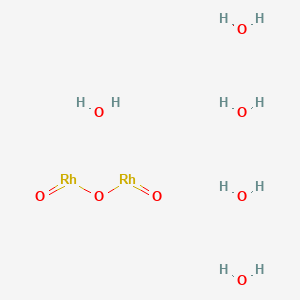


Rhodium(III) Oxide Pentahydrate
Request Quote
| Product | Product Code | SAFETY DATA | Technical data | |
|---|---|---|---|---|
(2N) 99% Rhodium(III) Oxide Pentahydrate |
RH3-OX-02-C.5HYD | SDS > | Data Sheet > | |
(3N) 99.9% Rhodium(III) Oxide Pentahydrate |
RH3-OX-03-C.5HYD | SDS > | Data Sheet > | |
(4N) 99.99% Rhodium(III) Oxide Pentahydrate |
RH3-OX-04-C.5HYD | SDS > | Data Sheet > | |
(5N) 99.999% Rhodium(III) Oxide Pentahydrate |
RH3-OX-05-C.5HYD | SDS > | Data Sheet > |
 Rhodium Oxide Pentahydrate is a highly insoluble thermally stable Rhodium source suitable for glass, optic and ceramic applications. Oxide compounds are not conductive to electricity. However, certain perovskite structured oxides are electronically conductive finding application in the cathode of solid oxide fuel cells and oxygen generation systems. They are compounds containing at least one oxygen anion and one metallic cation. They are typically insoluble in aqueous solutions (water) and extremely stable making them useful in ceramic structures as simple as producing clay bowls to advanced electronics and in light weight structural components in aerospace and electrochemical applications such as fuel cells in which they exhibit ionic conductivity. Metal oxide compounds are basic anhydrides and can therefore react with acids and with strong reducing agents in redox reactions. Rhodium Oxide Pentahydrate is generally immediately available in most volumes. Ultra high purity and high purity compositions improve both optical quality and usefulness as scientific standards. Nanoscale elemental powders and suspensions, as alternative high surface area forms, may be considered. Additional technical, research and safety (MSDS) information is available.
 | Compound Formula | H10O8Rh2 |
|---|---|
| Molecular Weight | 343.886 |
| Appearance | Gray Powder |
| Melting Point | Decomposes |
| Boiling Point | N/A |
| Density | N/A |
| Solubility in H2O | Insoluble |
| Exact Mass | 343.848575 g/mol |
| Monoisotopic Mass | 343.848575 g/mol |
| Signal Word | N/A |
|---|---|
| Hazard Statements | N/A |
| Hazard Codes | N/A |
| Risk Codes | N/A |
| Safety Statements | N/A |
| RTECS Number | N/A |
| Transport Information | N/A |
| WGK Germany | 3 |
| Linear Formula | Rh2O3 • 5H2O |
|---|---|
| Pubchem CID | 45073257 |
| MDL Number | MFCD00149843 |
| EC No. | 234-846-9 |
| IUPAC Name | oxo(oxorhodiooxy)rhodium; pentahydrate |
| Beilstein/Reaxys No. | N/A |
| SMILES | O.O.O.O.O.O=[Rh]O[Rh]=O |
| InchI Identifier | InChI=1S/5H2O.3O.2Rh/h5*1H2;;;;; |
| InchI Key | XZIIPNYQAMUKBU-UHFFFAOYSA-N |
| Chemical Formula | |
| Molecular Weight | |
| Standard InchI | |
| Appearance | |
| Melting Point | |
| Boiling Point | |
| Density |
Customer Reviews
Customers For Rhodium(III) Oxide Pentahydrate Have Also Viewed
Related Applications, Forms & Industries for Rhodium(III) Oxide Pentahydrate

Each business day American Elements' scientists & engineers post their choice for the most exciting materials science news of the day
See more Rhodium products. Rhodium (atomic symbol: Rh, atomic number: 45) is a Block D, Group 9, Period 5 element with an atomic weight of 102.90550.  The number of electrons in each of Rhodium's shells is [2, 8, 18, 16, 1] and its electron configuration is [Kr] 4d8 5s1. The rhodium atom has a radius of 134 pm and a Van der Waals radius of 195 pm. Rhodium was discovered and first isolated by William Wollaston in 1804. In its elemental form, rhodium has a silvery white metallic appearance.
  Rhodium is a member of the platinum group of metals. It has a higher melting point than platinum, but a lower density. Rhodium is found in ores mixed with other metals such as palladium, silver, platinum, and gold. Rhodium is primarily used as the catalyst in the three-way catalytic converters of automobiles it is also highly valued in jewelry. The name Rhodium originates from the Greek word 'Rhodon,' which means rose.