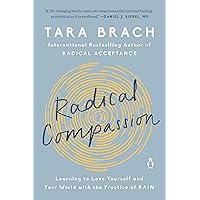
Review
“An important, fresh voice from the ranks of modern dharma teacher-writers.”—Yoga Journal
“A consoling and practical guide that can help people find a light within themselves.”—Publishers Weekly
“A clear, practical and caring guide.”—Sharon Salzberg, New York Times bestselling author of Faith: Trusting Your Own Deepest Experience and Lovingkindness
“Tara Brach, perhaps more than any other spiritual teacher of our time, deeply understands self-compassion: both why we need it and how to cultivate it. This classic is a must-read for anyone wanting to develop a healthier and more loving relationship with themselves.”—Kristin Neff, Ph.D., author of Fierce Self-Compassion
“Radical Acceptance continues to be the wisdom for so many of us to tend to our fear of a rapidly changing world as well as offering us real tools to help build a new world grounded in fierce love and care for our communities.”—Lama Rod Owens, author of The New Saints: From Broken Hearts to Spiritual Warriors
“An invitation to heal our pain by accepting our heart.”—Rachel Naomi Remen, M.D., author of Kitchen Table Wisdom and My Grandfather’s Blessing
“Through her deep experience as a therapist, buddhist meditation teacher, yogi, and mother, Tara Brach shines light upon the vital subject of learning to realise inner completeness, wholeness, and healing.”—Lama Surya Das, author of Awakening the Buddha Within
“An insightful, warmhearted, and important contribution.”—Tara Bennett-Goleman, author of Emotional Alchemy
“Overflows with wonderful characters whose struggles we recognize as our own. . . Tara Brach skillfully weaves together some of the most important new insights in contemporary psychotherapy with one of the central psychological insights of the Buddha: There is no part of ourselves we need to exile from our awareness and our love. Radical Acceptance is a book, and a practice, that we all need.”—Stephen Cope, author of The Great Work of Your Life
“Radical Acceptance offers gentle wisdom and tender healing, a most excellent medicine for our unworthiness and longing. Breathe, soften, and let these compassionate teachings bless your heart.”—Jack Kornfield, author of A Path with Heart and After the Ecstasy, the Laundry
From the Back Cover
"For many of us, feelings of deficiency are right around the corner. It doesn't take much--just hearing of someone else's accomplishments, being criticized, getting into an argument, making a mistake at work--to make us feel that we are not okay. Beginning to understand how our lives have become ensnared in this trance of unworthiness is our first step toward reconnecting with who we really are and what it means to live fully.
--"from Radical Acceptance
Radical Acceptance
"Believing that something is wrong with us is a deep and tenacious suffering," says Tara Brach at the start of this illuminating book. This suffering emerges in crippling self-judgments and conflicts in our relationships, in addictions and perfectionism, in loneliness and overwork--all the forces that keep our lives constricted and unfulfilled. Radical Acceptance offers a path to freedom, including the day-to-day practical guidance developed over Dr. Brach's twenty years of work with therapy clients and Buddhist students.
Writing with great warmth and clarity, Tara Brach brings her teachings alive through personal stories and case histories, fresh interpretations of Buddhist tales, and guided meditations. Step by step, she leads us to trust our innate goodness, showing how we can develop the balance of clear-sightedness and compassion that is the essence of Radical Acceptance. Radical Acceptance does not mean self-indulgence or passivity. Instead it empowers genuine change: healing fear and shame and helping to build loving, authentic relationships. When we stop being at war with ourselves, we are free to live fully every precious moment of our lives. "From the Hardcover edition.
About the Author
Tara Brach, Ph.D., is a clinical psychologist as well as a Buddhist lay priest and popular teacher of mindfulness (vipassana) meditation. She is the founder of the Insight Meditation Community in Washington, D.C., and has conducted workshops at Spirit Rock Center, Omega Institute, the New York Open Center, and other retreat centers nationwide. She lives in Bethesda, Maryland, with her husband, Jonathan Foust.
From the Hardcover edition.
Excerpt. © Reprinted by permission. All rights reserved.
The Trance of Unworthiness
You will be walking some night . . .
It will be clear to you suddenly
that you were about to escape,
and that you are guilty: you misread
the complex instructions, you are not
a member, you lost your card
or never had one . . .
Wendell Berry
For years I've had a recurring dream in which I am caught in a futile struggle to get somewhere. Sometimes I'm running up a hill; sometimes I am climbing over boulders or swimming against a current. Often a loved one is in trouble or something bad is about to happen. My mind is speeding frantically, but my body feels heavy and exhausted; I move as if through molasses. I know I should be able to handle the problem, but no matter how hard I try, I can't get where I need to go. Completely alone and shadowed by the fear of failure, I am trapped in my dilemma. Nothing else in the world exists but that.
This dream captures the essence of the trance of unworthiness. In our dreams we often seem to be the protagonist in a pre-scripted drama, fated to react to our circumstances in a given way. We seem unaware that choices and options might exist. When we are in the trance and caught up in our stories and fears about how we might fail, we are in much the same state. We are living in a waking dream that completely defines and delimits our experience of life. The rest of the world is merely a backdrop as we struggle to get somewhere, to be a better person, to accomplish, to avoid making mistakes. As in a dream, we take our stories to be the truth--a compelling reality--and they consume most of our attention. While we eat lunch or drive home from work, while we talk to our partners or read to our children at night, we continue to replay our worries and plans. Inherent in the trance is the belief that no matter how hard we try, we are always, in some way, falling short.
Feeling unworthy goes hand in hand with feeling separate from others, separate from life. If we are defective, how can we possibly belong? It's a vicious cycle: The more deficient we feel, the more separate and vulnerable we feel. Underneath our fear of being flawed is a more primal fear that something is wrong with life, that something bad is going to happen. Our reaction to this fear is to feel blame, even hatred, toward whatever we consider the source of the problem: ourselves, others, life itself. But even when we have directed our aversion outward, deep down we still feel vulnerable.
Our feelings of unworthiness and alienation from others give rise to various forms of suffering. For some, the most glaring expression is addiction. It may be to alcohol, food or drugs. Others feel addicted to a relationship, dependent on a particular person or people in order to feel they are complete and that life is worth living. Some try to feel important through long hours of grueling work--an addiction that our culture often applauds. Some create outer enemies and are always at war with the world.
The belief that we are deficient and unworthy makes it difficult to trust that we are truly loved. Many of us live with an undercurrent of depression or hopelessness about ever feeling close to other people. We fear that if they realize we are boring or stupid, selfish or insecure, they'll reject us. If we're not attractive enough, we may never be loved in an intimate, romantic way. We yearn for an unquestioned experience of belonging, to feel at home with ourselves and others, at ease and fully accepted. But the trance of unworthiness keeps the sweetness of belonging out of reach.
The trance of unworthiness intensifies when our lives feel painful and out of control. We may assume that our physical sickness or emotional depression is our own fault--the result of our bad genes or our lack of discipline and willpower. We may feel that the loss of a job or a painful divorce is a reflection of our personal flaws. If we had only done better, if we were somehow different, things would have gone right. While we might place the blame on someone else, we still tacitly blame ourselves for getting into the situation in the first place.
Even if we ourselves are not suffering or in pain, if someone close to us--a partner or a child--is, we can take this as further proof of our inadequacy. One of my psychotherapy clients has a thirteen-year-old son who was diagnosed with attention deficit disorder. She has tried everything she can to help--doctors, diet, acupuncture, drugs, love. Yet still he suffers from academic setbacks and feels socially isolated. He is convinced that he is a "loser" and, out of pain and frustration, frequently lashes out in rage. Regardless of her loving efforts, she lives in anguish, feeling that she is failing her son and should be doing more.
The trance of unworthiness doesn't always show up as overt feelings of shame and deficiency. When I told a good friend that I was writing about unworthiness and how pervasive it is, she took issue. "My main challenge isn't shame, it's pride," she insisted. This woman, a successful writer and teacher, told me how easily she gets caught up in feeling superior to others. She finds many people mentally slow and boring. Because so many people admire her, she often rides surges of feeling special and important. "I'm embarrassed to admit it," she said, "and maybe this is where shame fits in. But I like having people look up to me . . . that's when I feel good about myself." My friend is playing out the flip side of the trance. She went on to acknowledge that during dry periods, times when she isn't feeling productive or useful or admired, she does slip into feeling unworthy. Rather than simply recognizing her talents and enjoying her strengths, she needs the reassurance of feeling special or superior.
Convinced that we are not good enough, we can never relax. We stay on guard, monitoring ourselves for shortcomings. When we inevitably find them, we feel even more insecure and undeserving. We have to try even harder. The irony of all of this is . . . where do we think we are going anyway? One meditation student told me that he felt as if he were steamrolling through his days, driven by the feeling that he needed to do more. In a wistful tone he added, "I'm skimming over life and racing to the finish line--death."
When I talk about the suffering of unworthiness in my meditation classes, I frequently notice students nodding their heads, some of them in tears. They may be realizing for the first time that the shame they feel is not their own personal burden, that it is felt by many. Afterward some of them stay to talk. They confide that feeling undeserving has made it impossible for them to ask for help or to let themselves feel held by another's love. Some recognize that their sense of unworthiness and insecurity has kept them from realizing their dreams. Often students tell me that their habit of feeling chronically deficient has made them continually doubt that they are meditating correctly and mistrust that they are growing spiritually.
A number of them have told me that, in their early days on the spiritual path, they assumed their feelings of inadequacy would be transcended through a dedicated practice of meditation. Yet even though meditation has helped them in important ways, they find that deep pockets of shame and insecurity have a stubborn way of persisting--sometimes despite decades of practice. Perhaps they have pursued a style of meditation that wasn't well suited for their emotional temperament, or perhaps they needed the additional support of psychotherapy to uncover and heal deep wounds. Whatever the reasons, the failure to relieve this suffering through spiritual practice can bring up a basic doubt about whether we can ever be truly happy and free.
Bringing an Unworthy Self into Spiritual Life
In their comments, I hear echoes of my own story. After graduating from college, I moved into an ashram, a spiritual community, and enthusiastically devoted myself to the lifestyle for almost twelve years. I felt I had found a path through which I could purify myself and transcend the imperfections of my ego--the self and its strategies. We were required to awaken every day at 3:30 a.m., take a cold shower, and then from four until six-thirty do a sadhana (spiritual discipline) of yoga, meditation, chanting and prayer. By breakfast time I often felt as if I were floating in a glowing, loving, blissful state. I was at one with the loving awareness I call the Beloved and experienced this to be my own deepest essence. I didn't feel bad or good about myself, I just felt good.
By the end of breakfast, or a bit later in the morning, my habitual thoughts and behaviors would start creeping in again. Just as they had in college, those ever-recurring feelings of insecurity and selfishness would let me know I was falling short. Unless I found the time for more yoga and meditation, I would often find myself feeling once again like my familiar small-minded, not-okay self. Then I'd go to bed, wake up and start over again.
While I touched genuine peace and openheartedness, my inner critic continued to assess my level of purity. I mistrusted myself for the ways I would pretend to be positive when underneath I felt lonely or afraid. While I loved the yoga and meditation practices, I was embarrassed by my need to impress others with the strength of my practice. I wanted others to see me as a deep meditator and devoted yogi, a person who served her world with care and generosity. Meanwhile, I judged other people for being slack in their discipline, and judged myself for being so judgmental. Even in the midst of community, I often felt lonely and alone.
I had the idea that if I really applied myself, it would take eight to ten years to release all my self-absorption and be wise and free. Periodically I would consult teachers I admired from various other spiritual traditions: "So, how am I doing? What else can I do?" Invariably, they would respond, "Just relax." I wasn't exactly sure what they meant, but I certainly didn't think it could be "just relax." How could they mean that? I wasn't "there" yet.
Chögyam Trungpa, a contemporary Tibetan Buddhist teacher, writes, "The problem is that ego can convert anything to its own use, even spirituality." What I brought to my spiritual path included all my needs to be admired, all my insecurities about not being good enough, all my tendencies to judge my inner and outer world. The playing field was larger than my earlier pursuits, but the game was still the same: striving to be a different and better person.
In retrospect, it is no surprise that my self-doubts were transferred intact into my spiritual life. Those who feel plagued by not being good enough are often drawn to idealistic worldviews that offer the possibility of purifying and transcending a flawed nature. This quest for perfection is based in the assumption that we must change ourselves to belong. We may listen longingly to the message that wholeness and goodness have always been our essence, yet still feel like outsiders, uninvited guests at the feast of life.
A Culture That Breeds Separation and Shame
Several years ago a small group of Buddhist teachers and psychologists from the United States and Europe invited the Dalai Lama to join them in a dialogue about emotions and health. During one of their sessions, an American vipassana teacher asked him to talk about the suffering of self-hatred. A look of confusion came over the Dalai Lama's face. "What is self-hatred?" he asked. As the therapists and teachers in the room tried to explain, he looked increasingly bewildered. Was this mental state a nervous disorder? he asked them. When those gathered confirmed that self-hatred was not unusual but rather a common experience for their students and clients, the Dalai Lama was astonished. How could they feel that way about themselves, he wondered, when "everybody has Buddha nature."
While all humans feel ashamed of weakness and afraid of rejection, our Western culture is a breeding ground for the kind of shame and self-hatred the Dalai Lama couldn't comprehend. Because so many of us grew up without a cohesive and nourishing sense of family, neighborhood, community or "tribe," it is not surprising that we feel like outsiders, on our own and disconnected. We learn early in life that any affiliation--with family and friends, at school or in the workplace--requires proving that we are worthy. We are under pressure to compete with each other, to get ahead, to stand out as intelligent, attractive, capable, powerful, wealthy. Someone is always keeping score.
After a lifetime of working with the poor and the sick, Mother Teresa's surprising insight was: "The biggest disease today is not leprosy or tuberculosis but rather the feeling of not belonging." In our own society, this disease has reached epidemic proportions. We long to belong and feel as if we don't deserve to.
Buddhism offers a basic challenge to this cultural worldview. The Buddha taught that this human birth is a precious gift because it gives us the opportunity to realize the love and awareness that are our true nature. As the Dalai Lama pointed out so poignantly, we all have Buddha nature. Spiritual awakening is the process of recognizing our essential goodness, our natural wisdom and compassion.
In stark contrast to this trust in our inherent worth, our culture's guiding myth is the story of Adam and Eve's exile from the Garden of Eden. We may forget its power because it seems so worn and familiar, but this story shapes and reflects the deep psyche of the West. The message of "original sin" is unequivocal: Because of our basically flawed nature, we do not deserve to be happy, loved by others, at ease with life. We are outcasts, and if we are to reenter the garden, we must redeem our sinful selves. We must overcome our flaws by controlling our bodies, controlling our emotions, controlling our natural surroundings, controlling other people. And we must strive tirelessly--working, acquiring, consuming, achieving, e-mailing, overcommitting and rushing--in a never-ending quest to prove ourselves once and for all.
Growing up Unworthy
In their book Stories of the Spirit, Jack Kornfield and Christina Feldman tell this story: A family went out to a restaurant for dinner. When the waitress arrived, the parents gave their orders. Immediately, their five-year-old daughter piped up with her own: "I'll have a hot dog, french fries and a Coke." "Oh no you won't," interjected the dad, and turning to the waitress he said, "She'll have meat loaf, mashed potatoes, milk." Looking at the child with a smile, the waitress said, "So, hon, what do you want on that hot dog?" When she left, the family sat stunned and silent. A few moments later the little girl, eyes shining, said, "She thinks I'm real."




 Print length
 Language
 Publisher
 Publication date
 Dimensions
 ISBN-13




 Report an issue with this product or seller