Summer Essentials for your business

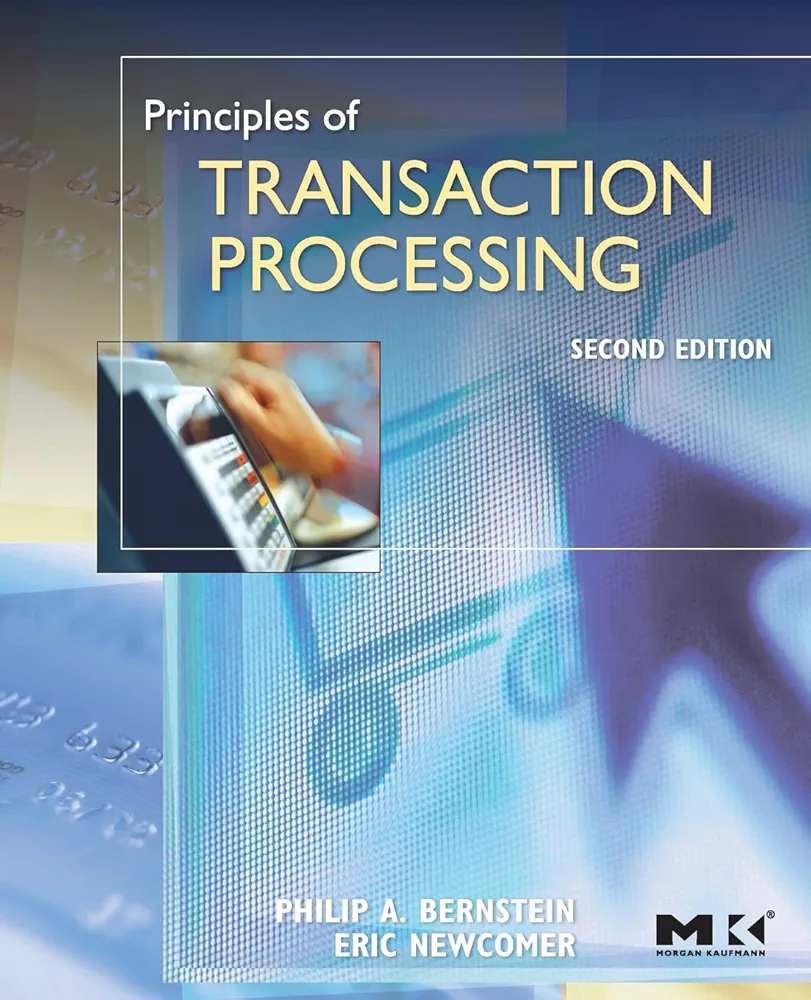
Principles of Transaction Processing (The Morgan Kaufmann Series in Data Management Systems)

2nd Edition
ISBN-13: 978-1558606234, ISBN-10: 1558606238
3.9 on Goodreads
(23)
Loading Images...
Double-tap to zoom
Brief content visible, double tap to read full content.
Full content visible, double tap to read brief content.
Used - Good
$51.31
FREE Returns
FREE delivery Friday, May 22
Or fastest delivery Thursday, May 21. Order within 1 hr 56 mins
Only 1 left in stock - order soon.
Book is in standard used condition. The binding is tight, but the cover and edges may have significant wear. Supplemental materials may not be valid. 100% Money Back Guarantee. Ships fast from Amazon! UNMARKED copy.
Sold by Arigato Books and fulfilled by Amazon.
Access codes and supplements are not guaranteed with used items.
$$51.31 () Includes selected options. Includes initial monthly payment and selected options. Details
Price
Subtotal
$$51.31
Subtotal
Initial payment breakdown
Shipping cost, delivery date, and order total (including tax) shown at checkout.
Brief content visible, double tap to read full content.
Full content visible, double tap to read brief content.

Book details

Brief content visible, double tap to read full content.
Full content visible, double tap to read brief content.
Principles of Transaction Processing is a comprehensive guide to developing applications, designing systems, and evaluating engineering products. The book provides detailed discussions of the internal workings of transaction processing systems, and it discusses how these systems work and how best to utilize them. It covers the architecture of Web Application Servers and transactional communication paradigms.The book is divided into 11 chapters, which cover the following: Overview of transaction processing application and system structureSoftware abstractions found in transaction processing systemsArchitecture of multitier applications and the functions of transactional middleware and database serversQueued transaction processing and its internals, with IBM's Websphere MQ and Oracle's Stream AQ as examplesBusiness process management and its mechanismsDescription of the two-phase locking function, B-tree locking and multigranularity locking used in SQL database systems and nested transaction lockingSystem recovery and its failuresTwo-phase commit protocolComparison between the tradeoffs of replicating servers versus replication resourcesTransactional middleware products and standardsFuture trends, such as cloud computing platforms, composing scalable systems using distributed computing components, the use of flash storage to replace disks and data streams from sensor devices as a source of transaction requests. The text meets the needs of systems professionals, such as IT application programmers who construct TP applications, application analysts, and product developers. The book will also be invaluable to students and novices in application programming.
  • Complete revision of the classic "non mathematical" transaction processing reference for systems professionals
  • Updated to focus on the needs of transaction processing via the Internet-- the main focus of business data processing investments, via web application servers, SOA, and important new TP standards
  • Retains the practical, non-mathematical, but thorough conceptual basis of the first edition

From the Back Cover

This book offers a clear, concise guide for anyone involved in developing applications, evaluating products, designing systems, managing databases, or engineering products. It provides an understanding of the internals of transaction processing systems, describing how they work and how best to use them. It includes the architecture of application servers, transactional communications paradigms, and mechanisms for recovering from transaction and system failures. The use of transaction processing systems has changed in the years since publication of the first edition. Electronic commerce has become a major focus for business data processing investments, from banking and stock purchase on the web, to eBay® auctions, to corporate database management. New standards, new technology and products, and new languages allow web services, REST/HTTP, and SOA to become leading styles of design for enterprise applications. With the help of this book and its rich examples, you will be able to develop, integrate, deploy and manage state-of-the-art transaction processing applications.Complete revision of the classic non-mathematical transaction processing reference for systems professionals. Updated to focus on the needs of transaction processing via the Internet¾ the main focus of business data processing investments, via web servers, SOA, and important TP technologies and standards. Retains the practical, deep, and thorough technical basis of the first edition, with expanded coverage of all topics, including transactional middleware, business process management, transaction synchronization, and database replication.

About the Author

is a Principal Researcher at Microsoft Corporation and author of over 150 technical articles on database and transaction systems. He was previously lead architect for Digital Equipment Corporation’s transaction processing products group and was a professor at Harvard University. He is an ACM Fellow and member of the National Academy of Engineering.

is an independent consultant working in the CTO Office at Progress Software. He was previously CTO of IONA Technologies and a TP Architect at Digital Equipment Corporation. He has contributed to multiple enterprise software products and standards.

About the authors

Follow authors to get new release updates, plus improved recommendations.
Brief content visible, double tap to read full content.
Full content visible, double tap to read brief content.

I’m currently a Principal Researcher at Microsoft Corporation, where I've worked since 1994. I'm also an Affiliate Professor of computer science at University of Washington. Over the past 35 years, I’ve been a product architect at Microsoft and at Digital Equipment Corp. (gone but not forgotten), a professor at Harvard University and Wang Institute of Graduate Studies, and a VP Software at Sequoia Systems. In all of these jobs, I’ve focused on research and development of database management and transaction processing software. Lately, I’ve been working on new transaction processing technology for cloud computing. In particular, I was one of the designers of the Microsoft’s SQL Azure service.

Over the years, I’ve published over 150 papers and two books on the theory and implementation of database systems, especially on transaction processing. The second edition of my latest book Transaction Processing, with Eric Newcomer, was published in June 2009. This is a major rewrite of the first edition, to reflect the many changes in transaction processing middleware technology since the first edition was published in 1996 and to add depth to the database topics, notably locking, logging, and replication.

In addition to my work on transaction processing, I’ve spent many years developing new mechanisms for the management of database schemas and mappings between them. This includes software repositories, schema mapping generation, schema evolution, lineage tracing, data translation, and data integration, all primarily for commercial applications. I was one of the contributors to Microsoft’s ADO.NET Entity Framework, an object-to-relational mapping system, and to the automated mapping functionality in Microsoft’s BizTalk Mapper.

I spend some of my time on professional service activities. Currently, I’m an Editor-in-Chief of the Very Large Databases Journal, a member of the National Academy Board on Mathematical Sciences and Applications, and Treasurer of the Computing Research Association. I’m an ACM Fellow, a winner of the SIGMOD Innovations Award, and a member of the Washington State Academy of Sciences and the National Academy of Engineering.

Brief content visible, double tap to read full content.
Full content visible, double tap to read brief content.
Brief content visible, double tap to read full content.
Full content visible, double tap to read brief content.

Features & details

Features

  • Used Book in Good Condition

Product information

Publisher Morgan Kaufmann
Publication date June 23, 2009
Edition 2nd
Language ‎English
Print length 400 pages
ISBN-10 1558606238
ISBN-13 978-1558606234
Item Weight ‎1.8 pounds
Dimensions 7.5 x 0.9 x 9.25 inches
Best Sellers Rank
Customer Reviews 5.0 out of 5 stars 11Reviews

Top reviews from the United States

  • 5 out of 5 stars
    Verified Purchase

    Awesome book. Poor index.

    Reviewed in the United States on June 11, 2013
    Format: Paperback

    This is an incredibly important book. No other book describes transaction processing as well as this classic, now updated via a second edition that discusses principles of transaction processing in the context of modern technologies (application servers, web services, messaging queues) and products (Java Enterprise Edition, .Net). Chapters 10 and 11 on current and future trends respectively make this book worth an extra star above the five I've awarded.

    My one complaint about this book is the poor size of the index. The book is about 400 pages and the index is 8 pages. That's a ratio of 8/400 or 2%. Indexes are a critical part of non-fiction books. For example, on page 11 the book says it discusses "persistent queues" in chapter 4. But I could not readily find a reference to persistent queues in the index (or even by skimming through chapter 4). It turns out that persistent queues are the only queues discussed in chapter 4. Another example: Most readers will agree that "pessimistic locking" is an important concept. Although the term is used and explained on page 162, it does not make an appearance in the index. A poor index makes this book harder to use than it would be otherwise. If I could, I would deduct half a star for this infraction!

    My litmus test for indexes is around 5%. An exceptional book in this regard is on a related subject: "Java Concurrency in Practice" by Brian Goetz, which has a 40 page index to support a 400 page book, i.e. a juicy index ratio of 10%!

    By the way, both books (Bernstein and Goetz) were recommended to me via the chapter on "Concurrency" in Martin Fowler's incredible tome "Patterns of Enterprise Application Architecture".

    On the other hand, the quality of the summary sections at the end of each chapter is superb, such that it does the job perfectly in case you either don't have the time to read the entire chapter or wish to have some idea about the important topics and conclusions before you start going through the chapter.

    Readers should beware that although I have not found a better treatment on this topic, not everything in the book is neatly gift-wrapped with a bow-tie. You will run into some contentious items and have to figure your own way around them. For example, the book takes a hard line on "phantom reads" by claiming that this ought not to be a problem because inserts ought to be treated as updates. However, the fact is that the ANSI SQL-92 standard does view "Phantoms" as an isolation level (see Berenson, 1995) as do most major database vendors. So, the book's position can be confusing for newbies.

    Although I appreciate all of the rigor and background context in the book (with barely any errors to speak of, see the last paragraph on page 171 for a possible exception), I occasionally found it somewhat frustrating that the book does not provide any clear indication on topics (e.g. how to implement commit/abort on pages 201-203 or the proof for the two-phase locking theorem on pages 183-184) that are relevant only for vendors of transactional middleware or resource managers (e.g. databases) or those interested in going deeper. These sections should have been clearly marked for authors of TP applications and systems to safely ignore because they concern aspects of transaction processing that cannot be influenced via programming or configuration.

    Finally, I observed that whereas the authors spend a lot of time discussing the TPC benchmarking standards, they neglect to mention that Microsoft is the only database vendor posting their results of benchmark testing (perhaps because the benchmark is skewed in favor of SQL Server). As an article I read somewhere noted quite astutely, it's as if Michael Phelps had won all of his Olympic gold medals swimming in an empty pool!

    Regardless, my nits should be viewed as minor and should not detract from the fact that this is the world's most useful book on this highly important subject.

    Remember: Transaction processing is how Amazon gets your orders processed and delivered.

    4 people found this helpful
    Sending feedback...
    Thank you for your feedback.
    Sending feedback...
    Thanks, we'll investigate in the next few days.
  • 5 out of 5 stars
    Verified Purchase

    Recommend

    Reviewed in the United States on February 21, 2012
    Format: Paperback

    I recommend this book to all interested in database transaction management. Better organized and more complete than the previous edition, excellent to prepare database transaction classes, I think my students will profit!

    Sending feedback...
    Thank you for your feedback.
    Sending feedback...
    Thanks, we'll investigate in the next few days.
  • 5 out of 5 stars

    Excellent and gentle intro to transaction processing aspect of relational databases

    Reviewed in the United States on March 4, 2013
    Format: Kindle

    I would highly recommend this book to anyone who fascinates about how relational databases work. This book provides a great intro to the transactional processing aspects of traditional databases. The reader would get a lot of the book in terms of how the databases use locking and recovery mechanisms for highly concurrent fault tolerant transactions. Additionally, the book also provides a flavour of distributed transactions by introducing 2 phase commit. The highlights of the books for me were

    -Locking Mechanisms (The book gives a very gentle and detailed intro to 2PL, MultiGranularity Locking, B-Tree locking). Also talks about Optimistic Concurrency Control and locking strategies for hotspots.

    -Recovery Mechanisms(Write Ahead Logging, Checkpointing, fuzzy checkpointing, shadow paging, logging and recovery strategies for record level locking).

    -Replication Mechanisms

    -An intro to app servers, queueing and rpc.

    I am highly interested in learning about distributed systems and I am glad I looked at this book because it gives a taste of the challenges in building highly concurrent highly available, fault tolerant systems. Thanks Phil and Eric for writing this book.

    This book also has video lectures and slides in the form of a course that Phil Berstein(the author of the book) and Sameh Elnikety have over here

    [...]

    I read over this book twice, the first time I read it over back to back without the lectures and presentations, the second time I used it to complement the video lectures.

    All in all this is a great book if you are interested in database internals and interested in concurrent and fault tolerant computing.

    One person found this helpful
    Sending feedback...
    Thank you for your feedback.
    Sending feedback...
    Thanks, we'll investigate in the next few days.
  • 5 out of 5 stars

    What do you really know about Transaction Processing?

    Reviewed in the United States on July 13, 2009
    Format: Paperback

    The above question is of significance [again] as the Web has caused change and movement in the TP space as much as anywhere else.

    Those of us over, say, 60, will remember some of what is written in the book; many of us, including those over 60, will have forgotten a lot more.

    So, given the changes and increasing speed with which technology is moving, it is more than worthwhile to consider one of the very fundamental things in business and IT: that of transactions.

    We conduct them every day without giving them much thought, be it through an ATM, on the Web or simply by buying something with a credit card.

    This book does a great job answering a lot of questions and of covering a lot of very complicated and intricate ground in a readable and understandable manner: from way back when to the current day!

    Its authors are to be heartily congratulated, not only on the content, but on finishing a daunting task of making a very good book even better.

    Thank you, Phil and Eric!

    3 people found this helpful
    Sending feedback...
    Thank you for your feedback.
    Sending feedback...
    Thanks, we'll investigate in the next few days.
  • 5 out of 5 stars

    Excellent book

    Reviewed in the United States on February 20, 2013
    Format: Paperback

    The discussions on two-phase commit and B+ tree locking alone are worth the money, even if many of the materials can be found from other resources, such as from historical academic papers, this book explained them clearly and concisely. Highly recommended.

    One person found this helpful
    Sending feedback...
    Thank you for your feedback.
    Sending feedback...
    Thanks, we'll investigate in the next few days.

Top reviews from other countries

    Translated by Amazon
    See original
  • 5 out of 5 stars
    Verified Purchase

    Melhor livro de Integração de Sistemas que conheço

    Reviewed in Brazil on March 28, 2015
    Format: Kindle

    Ótimo livro sobre TP e integração de sistemas. Se você é novo na área ou um experiente profissional de TI, não deixe de ler este livro. Há muito conceito errôneo sendo repassado no mercado como verdade absoluta, especialmente por fornecedores de solução.

    Sending feedback...
    Thanks, we'll investigate in the next few days.
    Translated from Portuguese by Amazon
    See original

How customer reviews and ratings work

Customer Reviews, including Product Star Ratings help customers to learn more about the product and decide whether it is the right product for them.Learn more how customers reviews work on Amazon