Al Asmakh historic district in Doha, Qatar: from an urban slum to living heritage PLEASE SCROLL DOWN FOR ARTICLE Al Asmakh historic district in Doha, Qatar: from an urban slum to living heritage
https://doi.org/10.1080/13556207.2014.888815Abstract
In the face of rapid economic development, population growth, people's increasing needs and their changing lifestyles, most historic centres in the Arab world have experienced problems. Located in a central position in the growing urban areas, these historic districts have to function as city centres. Previously, they kept the medina alive and they participated in the economic growth of the city; however, today this is not generally the case, as many of these centres have been erased, replaced by modern shopping malls and hypermarkets. Despite the fact that the trend for building modern skyscrapers is still popular, it is possible to counterbalance this drift by preserving the few remaining historic areas. We believe that one way of rediscovering the cultural identity of Doha is to go back to its initial roots and try to sustain them in harmony with the present and future trends of the city. Fareej (district) Al Asmakh, a model of Qatari heritage in the heart of Doha, presents an urgent case for urban conservation. Fareej Al Asmakh should be recognized as a valuable resource for future development. It is a reflection of Qatar's cultural identity in the heart of Doha, and thus should be sustained in the face of the proliferation of alien high-rise developments around and adjacent to it. This research focuses on the role of Fareej Al Asmakh and other districts in reviving and injecting new life into the heart of Doha. In other words, the question is: can urban conservation be an adequate strategy to revive and sustain Fareej Al Asmakh, thus strengthening the city's cultural identity while participating in its growth and development?
Key takeaways
AI
AI
- Fareej Al Asmakh's conservation is essential for preserving Qatar's cultural identity amid rapid urbanization.
- Doha's population reached 2,068,050 by November 2013, predominantly composed of expatriates.
- Historic districts have faced severe threats due to modernization and neglect since the 1960s oil boom.
- The proposed conservation strategy includes mixed-use development and pedestrian-friendly initiatives.
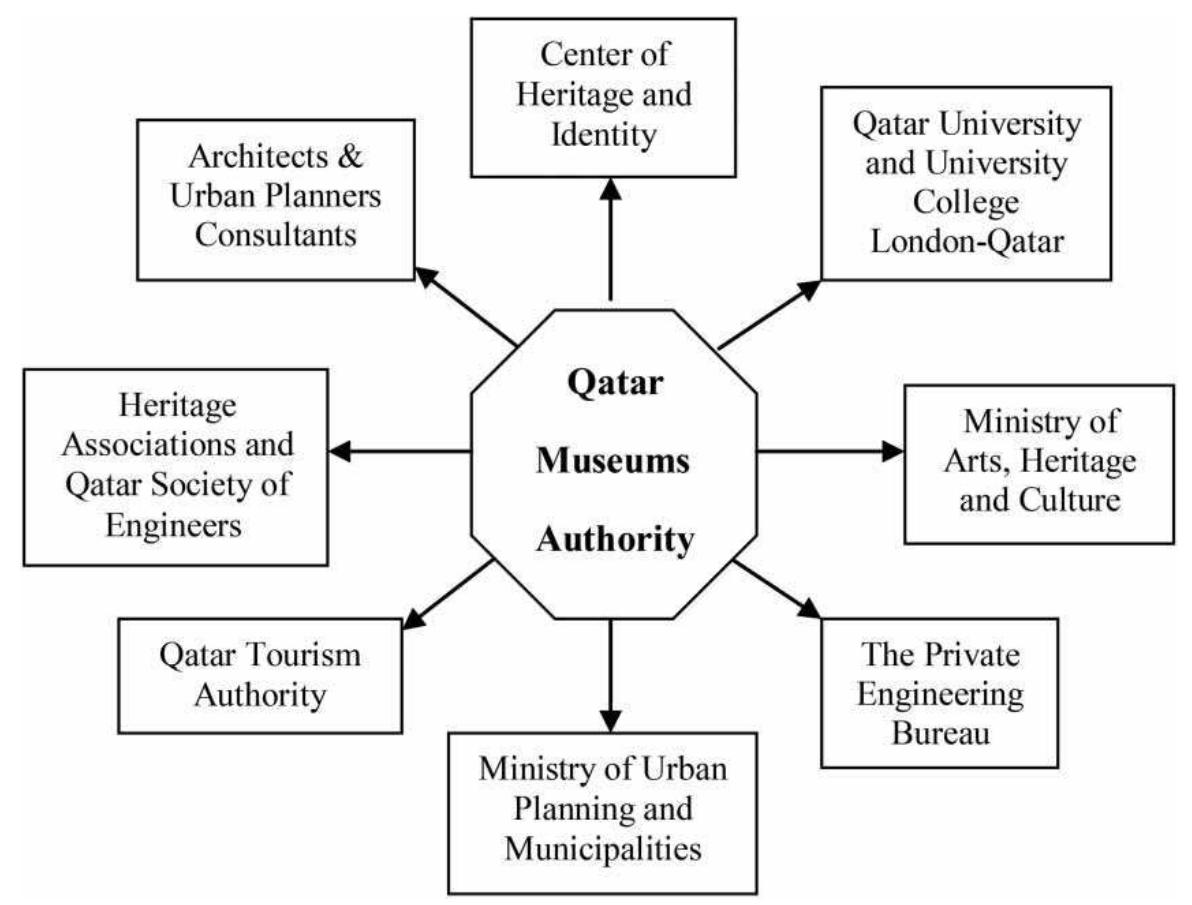
- An integrated management network is crucial for successful heritage preservation and urban development in Qatar.
References (12)
- Habibur Rahman, The Emergence of Qatar: The Turbulent Years 1627-1916 (UK: Kegan Paul, 2005).
- O'Connor, Kadri, The Changing Face of Qatar; Ronin Tanitim (Istanbul, 2011).
- O'Connor, The Changing Face of Qatar; Ronin Tanitim, 68.
- Qatar Museum Authority, Draft Report, Old Doha Preservation Restoration and Urban Rehabilitation of the Traditional Architecture in Asmakh and Najada (Doha: QMA, April 2012), 7-11.
- ICOMOS (1987) International Charter on the Conservation of Historic Towns and Urban Areas (Paris, ICOMOS). Notes on contributor With a Bachelor of Architecture from the University of Algiers in 1984, Djamel Boussaa obtained his Master of Philosophy in Architecture from the University of York, UK in September 1987. He taught as an Assistant Professor at the Institute of Architecture, University of Blida, Algeria for eight years. He joined UAE Uni- versity in September 1996 and worked for ten years before moving to the University of Bahrain for three years. He finished his PhD from the University of Liverpool, UK in December 2007, and the title of the thesis is 'Urban Conservation in the Gulf and North Africa; Problems, Challenges and Opportunities'.
- Since September 2009, he has been an Assistant Professor at Qatar University, Department of Architecture and Urban Planning. Additional Reading Al-Kholaifi, M. J., (2006). The Traditional Architecture in Qatar, Doha, Qatar: National Council for Culture, Arts and Heritage, Museums and antiquities Department.
- D. Boussaa, Urban Conservation in the Gulf and North Africa; Problems, Challenges and Opportunities (Germany, VDM Verlag: Dr. Müller, 2010).
- D. Boussaa, (1 July 2012), American Transactions on Engineering & Applied Sciences, The Casbah of Algiers, in Algeria; From an Urban Slum to a Sustainable Living Heritage, 335-350.
- D. Boussaa, Towards an Inter-Emirate Urban Conservation Strategy in the United Arab Emirates, RICS Foundation, Our Common Sense Journal (April 2001), London, April 2002.
- K. Hadjri and D. Boussaa, Architectural and Urban Conservation in the United Arab Emirates, Open House International 32, no. 3 (2007): 16-26.
- D. Boussaa, Dubai: The Search for Identity', in People Places and Sustainability, ed. G. Moser, E. Pol, Y. Bernard, M. Bonnes, J. Corraliza and V. Giuliani (Germany: Hogrefe & Huber Publishers, 2003), 51-60.
- Jaidah, I.M, & Bourennane, M., (2009). The History of Qatari Architecture (1800-1950), Italy, Skira.
FAQs
AI
What key changes occurred in Al Asmakh's urban fabric since the 1930s?
Al Asmakh has experienced significant transformations, losing many historic structures due to neglect and urban pressure, while also retaining a coherent fabric of old Qatari houses within its 326,333 m² area.
How does Qatar's oil wealth impact heritage conservation efforts?
The influx of oil revenues post-1949 led to rapid urbanization and neglect of historic areas, equating modernization with new construction, which culminated in a 600% population increase by 1970.
What is the current demographic composition of Al Asmakh district?
Today, Al Asmakh is primarily inhabited by low-income workers under overcrowded living conditions, with essential services poorly integrated into traditional houses.
What conservation strategies are proposed for Fareej Al Asmakh?
Recommended strategies include stopping demolitions, documenting remaining structures, restoring buildings progressively, and enhancing pedestrian accessibility to ensure vibrant mixed-use activities.
What role does local governance play in Al Asmakh's revitalization?
Urgent intervening actions are advised to coordinate efforts among heritage institutions, ensuring a comprehensive management network that integrates conservation with urban development.