Academia.eduAcademia.edu

Correlates between Berber and Flamenco Rhythms

Abstract
sparkles

AI

The paper explores the complex historical and cultural interactions between various communities in Andalusia, particularly focusing on the influences of Berber rhythms on flamenco music. It critiques the notion of a singular Gitano identity, suggesting that flamenco is a product of diverse musical traditions, including Roma, Arab, Jewish, and Berber influences. The analysis contextualizes the ethnogenesis of both the Gitano community and flamenco within the socio-political dynamics of multi-ethnic Iberia, emphasizing the contributions of the Berber culture in shaping flamenco's rhythmic elements.

Key takeaways
sparkles

AI

  1. Flamenco's musical culture embodies influences from Roma, Arab, Berber, Jewish, and Christian traditions.
  2. The Gitano community flourished in 15th-century Andalusia, contributing significantly to flamenco's ethnogenesis.
  3. Flamenco rhythms show strong parallels with Berber and Arab folk music, particularly in Morocco.
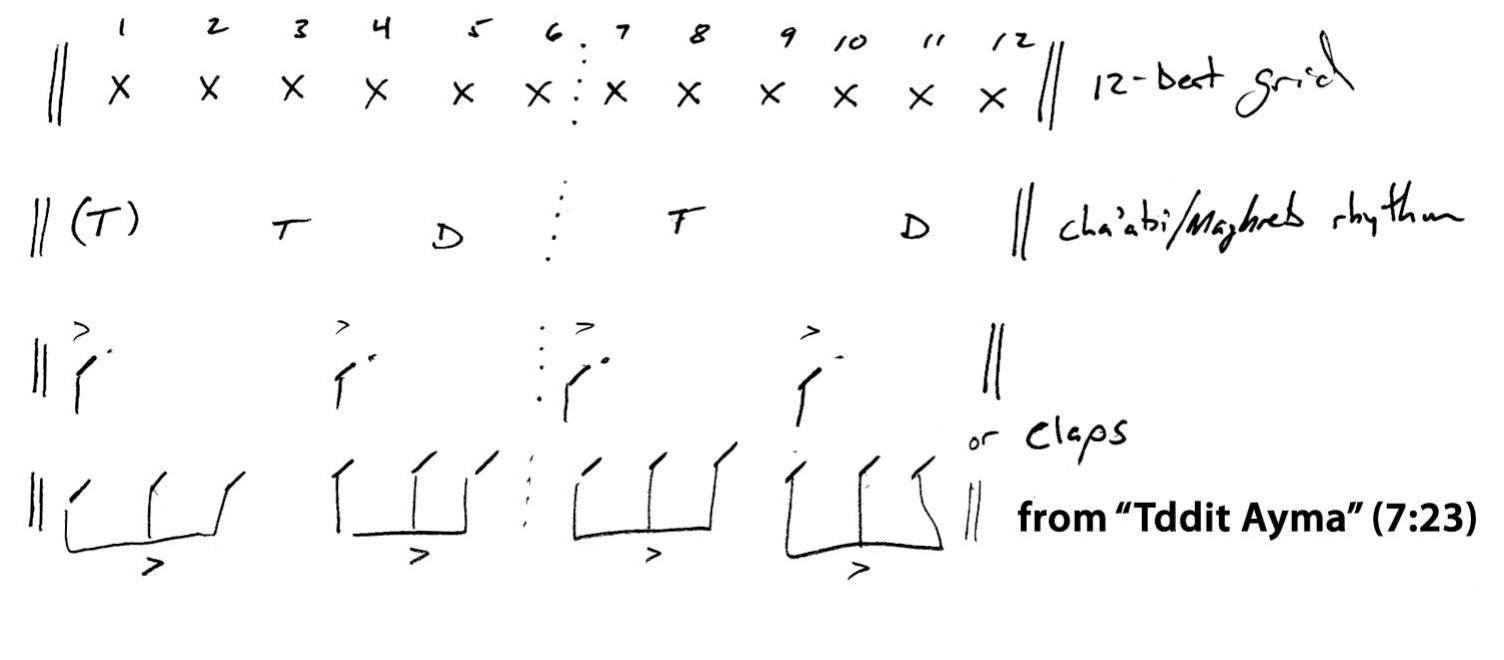
  4. A twelve-beat cycle predominates in both flamenco compàses and Berber cha'abi rhythms, highlighting cultural hybridization.
  5. The text analyzes how Berber musical culture has shaped flamenco, despite a historical neglect of its contributions.

References (19)

  1. Bohlman, Philip: 'Middle East IV', Grove Music Online ed. L. Macy (Accessed 19 December 2007), <http://www.grovemusic.com> 'Bulerias de Estrecho,' 1990. From La Perla De Cadiz: Grande Cantaores del Flamenco, Volume 13. Le Chante du Monde: Paris.
  2. Chase, G. 1959. The Music of Spain. Dover Publications: New York.
  3. Farmer, H.G. 1925. "Clues for the Arabian Influence on European Musical Theory." Journal of the Royal Asiatic Society. Pp. 61-88.
  4. Gerber, Jane. 1992. The Jews of Spain: A History of the Sephardic Experience. Free Press: New York.
  5. Guettat, M. 2000. La musique arabo-andalouse: l'empreinte du Maghreb, Tome
  6. Lapidus, I. 2002. A History of Islamic Societies, 2 nd Edition. Cambridge University Press: Cambridge.
  7. LeFranc, P. 2000. El cante jondo: Del territorio a los repertorios: tnáas, siguiriyas, soleares. University of Seville. Lerdahl and Jackendoff. 1983. Generative Theory of Tonal Music.
  8. Lewis, Bernard. 1995. The Middle East. Simon and Schuster: New York.
  9. Manuel, P. 2002. "From Scarlatti to 'Guantanamera': Dual Tonicity in Spanish and Latin American Musics," Journal of the American Musicological Society 55/2: 313-338.
  10. Manuel, P. 2006. "Flamenco in Focus: An Analysis of a Performance of Soleares." In Analytical Studies in World Music, edited by Michael Tenzer. Oxford University Press: New York. Pp. 92-119.
  11. Mercado, José. 1982. La seguidilla gitana: un ensayo sociológico y literario. Taurus: Madrid.
  12. Mitchell, T. 1994. Flamenco Deep Song. Yale University Press: New Haven.
  13. Papenbrok, M. 1990. "History of Flamenco." In Flamenco: Gypsy Dance and Music from Andalusia, edited by Clause Schreiner. Amadeus Press: Portland. Pp. 35-48.
  14. 'Tddit Ayma,' Rouicha, Mohammed. (Accessed 10 December 2007, <http://www.youtube.com/watch?v=aH-8Tz3kKGo&feature=related>
  15. Schuyler, P. 1985. "The Rwais and the Zawia: Professional Musicians and the Rural Religious Elite in Southwestern Morocco." Asian Music 17/1: 114-131.
  16. Steingress, G. 2005. Sociologia del cante flamenco, 2 nd Edition. Signatura Ediciones: Seville.
  17. Shiloah, A. 1995. Music in the World of Islam: A Socio-Cultural Study. Wayne State University Press: Detroit.
  18. Touma, H.H.1996. The Music of the Arabs. Amadeus Press: Portland.
  19. Wright, Owen: 'Arab Music I:4ii(c)', Grove Music Online ed. L. Macy (Accessed 19 December 2007), <http://www.grovemusic.com>

FAQs

sparkles

AI

What rhythmic elements in flamenco trace back to Berber and Arab influences?add

The study identifies that flamenco shares rhythmic features, specifically in its twelve-beat compàs, with Berber/Arab folk styles from Morocco, particularly emphasizing primary and secondary accents within both traditions.

How did historical migrations affect the formation of the Gitano community?add

The Gitano community in Andalusia emerged largely in the latter half of the 15th century amidst population relocations due to religious upheaval, notably absorbing moriscos seeking refuge from expulsion, as evidenced by records from 1447.

What role did the Almoravid and Almohad dynasties play in Andalusian music?add

The Almoravid and Almohad dynasties, ruling from 1086 to 1147, facilitated significant cultural production in Andalusia, including the hybridization of music that integrated Berber influences with local traditions.

Which specific musical modes are linked to flamenco's tonal structure?add

Flamenco's tonal structure prominently incorporates melodic modes from Arab maqams, particularly Bayati and Hijaz, while also adapting elements from the Gregorian Phrygian mode used in European Renaissance music.

How did non-Gitano performers contribute to flamenco's evolution?add

The study highlights that non-Gitano performers like Antonio standardized and innovated flamenco forms, significantly broadening its appeal outside the Gitano community by the early 20th century.