Concubinage in the Sokoto caliphate (1804–1903
1990, Slavery & Abolition
https://doi.org/10.1080/01440399008575005Abstract
AI
AI
Concubinage in the Sokoto Caliphate (1804-1903) was a pivotal institution that highlighted the sexual exploitation of women within the context of slavery. This article examines the sociocultural implications of concubinage, arguing that it was not only a form of sexual subordination but also a significant mechanism for recruiting women into the Caliphate, thereby influencing the development of modern Hausa society. Despite its critical role, concubinage has often been overlooked in academic discussions of slavery, underscoring the need for a deeper investigation into its historical impact.
Key takeaways
AI
AI
- Concubinage was a central institution for the sexual exploitation of women in the Sokoto Caliphate.
- Between 60-80% of the slave population in the Caliphate were females, reflecting a gender imbalance.
- Concubines often bore children, leading to enhanced social status and legal rights upon childbirth.
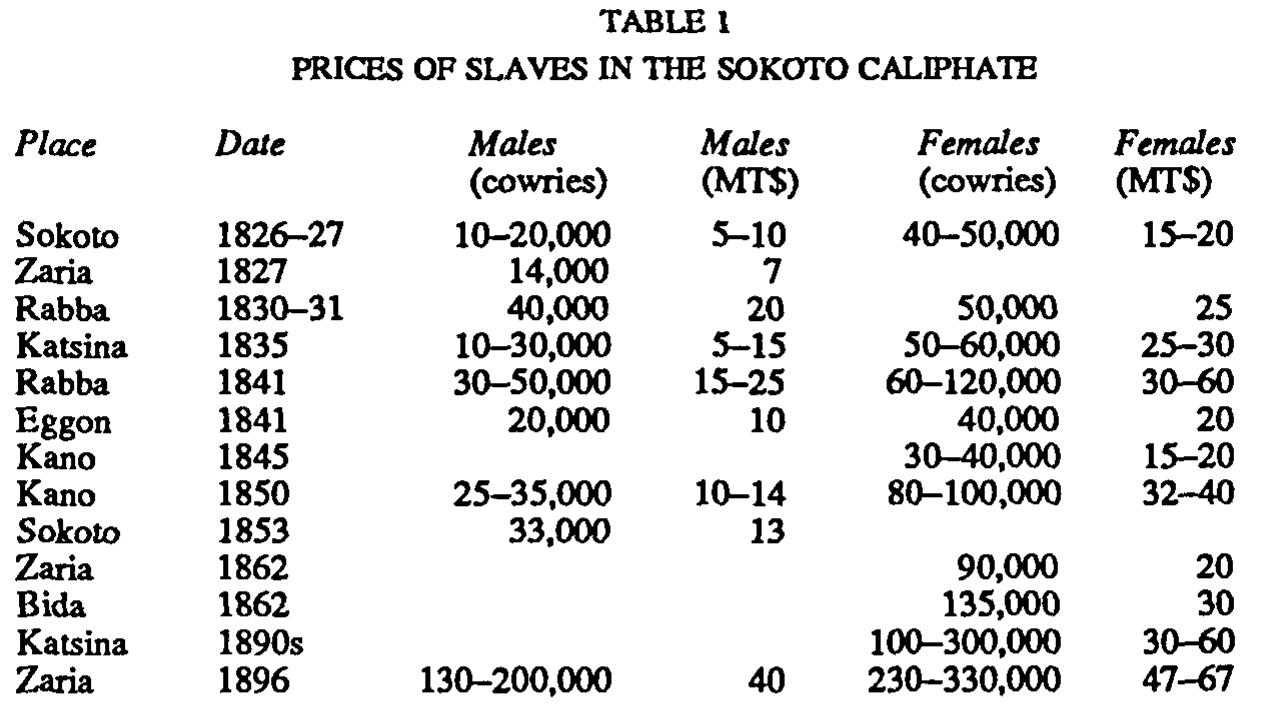
- Slave women cost significantly more than men, often 2-4 times more, due to their reproductive and sexual value.
- The study emphasizes the need to consider sexual subjugation in understanding slavery in Islamic societies.
References (94)
- Children born after 30 March 1901 were legally free, although slavery itself was never abolished. Slave holding was outlawed in 1936; see J. S. Hogendorn and Paul E. Lovejoy, 'The Development and Execution of Frederick Lugard's Policies toward Slavery in Northern Nigeria', Slavery and Abolition, 10, 1 (1989), 1-43. The Advisory Council of the Lieutenant-Governor of Northern Nigeria con- sidered the matter of concubinage in late 1931, but concubinage was never declared illegal; see P. G. Butcher, Concubinage and Dowry, Kaduna, 17 October 1931, Sokprof s.1646, Nigerian National Archives, Kaduna (NNAK).
- To the best of my knowledge, concubinage is discussed at length only in Patricia Romero Curtin, 'Laboratory for the Oral History of Slavery: The Island of Lamu', American Historical Review, 88,1 (1983), 858-82; Paul E. Lovejoy, 'Concubinage and the Status of Women Slaves in Early Colonial Northern Nigeria', Journal of African History, 26, 2 (1988), 245-66; and Ibrahim Muhammad Jumare, 'Slavery in Sokoto City, c. 1804-1936' (MA. thesis, unpublished, Ahmadu Bello Uni- versity, 1988).
- These points are examined more fully in J. S. Hogendorn and Paul E. Lovejoy, Legal Status Abolition: The Ending of Slavery in Northern Nigeria (Cambridge, forthcoming), where it is pointed out that only the United States, of all modern slave societies, may have had more slaves than the Sokoto Caliphate in c. 1900. At the outbreak of the Civil War, the United States had almost four million slaves. We estimate, conservatively, that the Caliphate's slave population was approximately one-quarter of the total population, or approximately 2.5 million in a population of ten million. If the size of the population was greater or the proportion of slaves was greater -and both are probable -then the number of slaves in the Caliphate would be larger correspondingly. No other country or colony in the Americas had as many slaves as our conservative estimate, including Brazil. Indeed the Caliphate probably had more slaves than the whole of the West Indies combined, in either the eighteenth or nineteenth centuries.
- Paul E. Lovejoy, Transformations in Slavery. A History of Slavery in Africa (Cambridge, 1983), 6. Frederick Cooper has reached a similar conclusion, see Plantation Slavery on the East Coast of Africa (New Haven, 1977), 195. Claire C. Robertson and Martin A. Klein ('Women's Importance in African Slave Systems', in Robertson and Klein (eds.). Women and Slavery in Africa [Madison, 1983], 9) suggest that sexual relations did not ameliorate slavery for women, although they wrongly state that Claude Meillassoux ('Female Slavery', in Robertson and Klein, Women and Slavery) claims otherwise.
- Martin Klein ('Women in Slavery in the Western Sudan', in Robertson and Klein, Women and Slavery, 87-8) discusses the free access to slave women being traded and otherwise presents useful information on sexual exploitation, but he does not analyse the significance of his data. Instead, he admits that he is 'wary about generalizations made by an observer about another society's sexual mores'.
- Jean-Pierre Olivier de Sardan, 'The Songhay-Zarma Female Slave: Relations of Production and Ideological Status', in Robertson and Klein, Women and Slavery, 139.
- Cooper, Plantation Slavery, 195.
- Margaret Strobel, Muslim Women in Mombasa. 1890-1975 (New Haven, 1979), 48.
- This observation applies to the various studies in Suzanne Miers and Igor Kopytoff (eds.). Slavery in Africa: Historical and Anthropological Perspectives (Madison, 1977);
- Claude Meillassoux (ed.), L'esclavage en Afrique précoloniale (Paris, 1975);
- Paul E. Lovejoy (ed.), The Ideology of Slavery in Africa (Beverly Hills, 1981);
- John Ralph Willis (ed.), Slaves and Slavery in Muslim Africa (London, 1985, 2 vols.); and the journal, Slavery and Abolition. The one important excep- tion is the excellent but brief discussion in Cooper, Plantation Slavery, 194-9.
- Romero Curtin, 'Oral History of Slavery', 858-82.
- Meillassoux, 'Female Slavery', 59 ff.
- Klein, 'Women in Slavery', 87. Also see Robertson and Klein, 'Women's Impor- tance', 9.
- Klein, 'Women in Slavery', 84 ff.
- Meillassoux, 'Female Slavery', 49.
- Other scholars have accepted Meillassoux's emphasis on the importance of women slaves in production, although not always agreeing with their relative importance; see Klein, 'Women in Slavery', 73; Richard Robots, 'Ideology, Slavery and Social Formation: The Evolution of Maraka Slavery in the Middle Niger Valley', in Lovejoy, Ideology of Slavery, 186. In an earlier work. Transformations in Slavery, I did, too. While I still accept the fact that female slaves were wanted for their labour, I now have reconsidered the importance of sex.
- Meillassoux ('Female Slavery', 49-56) undertakes a selective review of the litera- ture on this point His argument that biological reproduction has been exaggerated is convincing. I base my assessment on my own knowledge of the literature, as revealed in Transformations in Slavery. Robertson and Klein ('Women's Impor- tance', 8-9) concur 'the analysis of the status of slave women suffers from an overweening emphasis on the so-called biological functions of reproduction.'
- Margaret Strobel, 'Slavery and Reproductive Labor in Mombasa', in Robertson and Klein, Women and Slavery in Africa, 111-29. Also see Strobel, Muslim Women in Mombasa.
- Robertson and Klein, 'Women's Importance', 3.
- The reproductive functions of slave women are discussed most fully in Igor Kopytoff and Suzanne Miers, 'Introduction', in Miers and Kopytoff, Slavery in Africa, 29-34, although the discussion of concubines is subsumed under the discussion of polygyny.
- Meillassoux, 'Female Slavery', 58 (italics in the original).
- Meillassoux, 'Female Slavery', 64.
- Robertson and Klein, 'Women's Importance', 3, 4-5; Meillassoux, 'Female Slavery', 51; Klein, 'Women in Slavery', 67-72. Also see Meillassoux, Anthro- pologie de l'esclavage. Le ventre de fer et dargent (Paris, 1986), 80-82.
- Klein, 'Women in Slavery', 68-70.
- Don had a slave population of 15,300 males and 24,565 females, or about 26.62 per cent female; see Klein, 'Women in Slavery', 69.
- Estimates of the size of the slave population of the Sokoto Caliphate are examined in Hogendorn and Lovejoy, Legal Status Abolition; also see Polly Hill, 'From Slavery to Freedom: The Case of Farm-Slavery in Nigerian Hausaland', Com- parative Studies in Society and History, 18, 3 (1976), 395.
- Klein, 'Women in Slavery', 72-5; and David Carl Tambo, 'The Sokoto Cali- phate Slave Trade in the Nineteenth Century', International Journal of African Historical Studies, 9, 2 (1976), 187-217; Emmanual Terray, 'Réflexions sur la formation du prix des esclaves à l'intérieur de l'Afrique de l'ouest précoloniale'. Journal des africanistes, 52, 1-2 (1982), 119-44; and Cooper, Plantation Slavery, 195-6. 'Young women' refers to teenagers and women in their early twenties.
- Klein, 'Women in Slavery', 89.
- Tambo, 'Sokoto Caliphate Slave Trade', 196.
- There is a decided bias in the sources for this article. Except for Baba of Karo (Mary Smith (ed.). Bobo of Karo. A Woman of the Moslem Hausa, London, 1954) and the interviews with women conducted by Ibrahim Jumare, 'Slavery in Sokoto City', all data are derived from males, whether they were colonial officials or informants. Even the court testimonies of women were filtered through male intermediaries, although in some courts women were allowed to speak directly to the judge through a hole in the wall. Hence there is virtually no direct testimony from women, and none from slave women. And the bits and pieces that reveal the attitudes of women are filtered through male ears.
- Jakadiya were not necessarily slaves, but many were; see Mahmood Yakubu, 'A Century of Warfare and Slavery in Bauchi, c. 1805-1900' (B.A. dissertation, unpublished, University of Sokoto, 1985), 64; and Jumare, 'Kwarkwara'. It should be noted that eunuchs were also used for this purpose.
- Jumare, 'Kwarkwara'.
- Testimonies of Muhammadu Rabi'u (interviewed by Yusufu Yunusa, Fanisau, Kano Emirate, 13 July 1975), Garba Sarkin Gida (interviewed by Ahmadu Maccido, Gandun Nassarawa, Kano Emirate, 14 Sept 1975), Abdulwahbu Dawaki (interviewed by Aliyu Musa in Rano, Kano Emirate, 12 Sept 1975), Bakoshi (interviewed by Ahmadu Maccido and Paul E. Lovejoy, Hunkuyi, Zaria Emirate, 10 Dec. 1975). All interviews are on tape, have been transcribed, and are on deposit at Northern History Research Scheme, Ahmadu Bello University. Also see Abdullahi Mahadi, 'The State and the Economy: The Sarauta System and its Roles in Shaping the Society and Economy of Kano with Particular Reference to the Eighteenth and Nineteenth Centuries' (Ph.D. thesis, unpublished, Ahmadu Bello University, 1982), 277.
- All data are taken from Tambo, 'Sokoto Caliphate Slave Trade', 187-217. Tambo provides full citations for the sources of the various prices.
- Tambo, 'Sokoto Caliphate Slave Trade', 193-4. For a discussion of the relation- ship between thalers and cowries, see Paul E. Lovejoy, 'Interregional Monetary Flows in the Precolonial Trade of Nigeria', Journal of African History, 15, 4 (1974), 563-85.
- James Richardson, Narrative of a Mission to Central Africa, Performed in the Years 1850-51 (London, 1853), II, 202-3. Also see Tambo, 'Sokoto Caliphate Slave Trade', 192.
- See, for example, Mahmoud Hamman, 'The Rise and Fall of the Emirate of Mini (Hamaruwa), c. 1812-1903' (Ph.D. thesis, unpublished, Ahmadu Bello Uni- versity, 1983), 299, 302, 304.
- J.S. Hogendorn, 'Slave Acquisition and Delivery in Precolonial Hausaland', in R. Dumett and Ben K. Schwartz (eds.), West African Culture Dynamics: Archaeo- logical and Historical Perspectives (The Hague, 1980), 477-93.
- Michael Mason, 'Population and "Slave Raiding" -the Case of the Middle Belt of Nigeria', Journal of African History, 10, 4 (1969), 551-64.
- Philip Bumham, 'Raiders and Traders in Adamawa: Slavery as a Regional System', in James L. Watson (ed.), Asian and African Systems of Slavery (Oxford, 1980), 43-72.
- In the sample, 80 per cent were of non-Muslim origins, but the sample includes some Muslim women who were enslaved by enemies of the Caliphate. It was possible for relatives to locate such women after the British conquest, and their inclusion in the court records thereby distorts the sample. By excluding such cases, the percentage of slave women of non-Muslim backgrounds was at least ten per cent greater, see Lovejoy, 'Status of Women Slaves', 261.
- Lovejoy, 'Concubines and the Status of Women Slaves'. For a fuller discussion, see Hogendorn and Lovejoy, Legal Status Abolition. Also see Michael Mason, 'Captive and Client Labour and the Economy of Bida Emirate, 1857-1901', Journal of African History, 14, 3 (1973), 460.
- Lovejoy, 'Status of Women Slaves', 255-6.
- It may be that there is a bias in the court sample in favour of younger children, since the slave trade was gradually outlawed between 1900 and 1903 in different parts of the Caliphate and, as a result, slave traders began to invest in children, who were easier than adults to smuggle. None the less, it is unlikely that this factor would alter the general conclusion, since many women over twenty had been enslaved at young ages as well.
- Allan G. B. Fisher and Humphrey J. Fisher, Slavery and Muslim Society in Africa. The Institution in Saharan and Sudanic Africa and the Trans-Saharan Trade (London, 1970), 97-109; Reuben Levy, The Social Structure of Islam (London, 1957), 77-81; Joseph Schacht, An Introduction to Islamic Law (Oxford, 1964);
- Schacht, 'Umm al-Walad', Encyclopedia of Islam (London, 1934), 1012-15;
- Cooper, Plantation Slavery, 195-6; Beverly B. Mack, 'Royal Slaves in Kano', in Catherine Coles and Beverly B. Mack (eds.), Hausa Women (Madison, forth- coming);
- Allan Christelow, 'Women and the Law in Early Twentieth Century Shehu, The City of Sokoto: A Social and Economic History' (Ph.D. thesis, unpublished, Ahmadu Bello University, 1982), 216, as cited in Jumare, 'Kwarkwara'. Also see Jumare, 'Slavery in Sokoto City', 101. Also see the fictional description, attributed to Bauchi, in Tahir, Last [mam.
- Hammon, 'Emirate of Muri', 372.
- Jumare, 'Kwarkwara', citing Abdullahi Aliyu Maradun, Tarihin Isa, Sokoto State History Bureau, Sokoto, 2 June 1979. Another of Muhammad Bello's Gobir concubines, Katambale, was reputedly the daughter of Sarkin Gobir Yunfa, who was defeated in the jihad. Bello is said to have freed Katambale and married her. Such aristocratic origins need to be analysed in determining the reasons why some concubines were able to achieve such high status. Miryam, Uthman dan Fodio's concubine, may also have had similar origins.
- Abdulkadiri, the second son of the former emir, was selected. Momodu Laofe, his older brother, had never been a favorite of his father. Philip Lonsdale, Ilorin Province Annual Report, 1919, SNP 10/8 3p/1920, NNAK. I wish to thank Ann O'Hear for this reference.
- Jumare, 'Kwarkwara'.
- Jean Boyd and Murray Last, 'The Role of Women as "Agents Religieux" in Sokoto', Canadian Journal of African Studies, 19, 2 (1985), 294.
- A. H. M. El-Zein reports that the children of concubines at Lamu, on the east African coast, were not treated the same as the children of free women and that the daughters of concubines were slaves (The Sacred Meadows: A Structural Analysis of Religious Symbolism in an East African Town, Evanston, 1974, 31-3), but his interpretation has been disputed by Patricia Romero Curtin; see 'The Sacred Meadows: A Case Study of "Anthropologyland" vs. "Historyland"', History in Africa, 9 (1982), 342-3. Also see Cooper, Plantation Slavery, 197-8.
- Jumare, 'Kwarkwara'. Also see the fictional account in Tahir, Last Imam, 5. Tahir has the senior wife of the Imam of Bauchi cast disparaging remarks about the son of the concubine of her husband: 'Why should we play second fiddle to the son of a slave, the spoilt son of a concubine?' The co-wives agreed.
- Schacht, 'Umm al-Walad', 1014-15.
- Olivier de Sardan ('Songhay-Zarma Female Slave', 141) is probably wrong in stating that 'the female domestic slave could sometimes be married to the freeborn male. She then became a wahay, a concubine in the Muslim sense. Her status changed. She was purchased and given a place in the household of her 'free' spouse. Theoretically, she was free and her children were also free'.
- 'Notes on Muslim Law', in Abraham, Introduction to Spoken Hausa, 209.
- Schacht, 'Umm al-Walad', 1015.
- Smith (ed.), Baba of Karo, 41.
- Ibrahim Tahir, 'Sufis, Saints and Capitalists in Kano, 1904-1976: Pattern of a Bourgeois Revolution in an Islamic Society' (Ph.D. thesis, unpublished, Cambridge, 1975).
- Boyd and Last, 'Role of Women', 294.
- Levy, Social Structure of Islam, 95, 111.
- For a description from 1905, shortly after the colonial conquest, see A. J. N. Tremeame, Hausa Superstitions and Customs. An Introduction to the Folk-lore and the Folk (London, 1913), 85-8; Also see Baba's account in Mary Smith (ed.). Baba of Karo, 127-66; and Catherine Mary Coles, 'Muslim Women in Town: Social Change among the Hausa of Northern Nigeria' (Ph.D. thesis, unpublished, University of Wisconsin, 1983), 187-226.
- Boyd and Last, 'Role of Women', 287.
- Smith, 'Slavery and Emancipation', 134.
- Smith, 'Introduction', 22.
- Stanley, Report on Sokoto Province, half year ending 30 June 1908, Sokprof 2/9 985/1908 NNAK, and Bargery, Dictionary.
- G. Merrick, Hausa Proverbs (London, 1905), 27.
- Jumare, 'Kwarkwara'.
- Ferguson, 'Description of Imam Imoru', 232-3;
- M. G. Smith, 'Introduction', in Mary Smith (ed.). Baba of Karo, 22; Yakubu, 'Slavery in Bauchi', 63-4.
- Yakubu, 'Slavery in Bauchi', 64; Jumare, 'Slavery in Sokoto City', 98-9.
- Testimony of Abdulkarimu, Magajin Garin Hunkuyi (interviewed by Ahmadu Maccido and Paul Lovejoy, Hunkuyi, Zaria Emirate, 7 Dec. 1975).
- Jumare, 'Kwarkwara'.
- Hiskett, 'Slaves in Hausa Literature', 122. 107. Testimony of Wada.
- C. H. Robinson, Specimens of Hausa Literature (Cambridge, 1896), 6. The poem by the Imam of Chediya, a town between Kano and Bauchi, dates to the period before 1865.
- Hiskett, 'Slaves in Hausa Literature', 123.
- Yunusa, 'Slavery in Kano', 26. Also see Levy, Social Structure of Islam, 79, 111- 12; and group interview, Runjin Biyo.
- 'Notes on Muslim Law', in Abraham, Introduction to Spoken Hausa, 209. 112. Registry of Freed Slaves, SNP 15/1 Ace 121, NNAK.
- Jumare, 'Kwarkwara'; and group interview, Runjin Biyo.
- Duffill, 'Hausa Poems, I', 61-2.
- For the predominance of women in bori, see Tremeame, Hausa Superstitions and Customs; Guy Nicolas, 'Fondements magico-religieux du pouvoir politique au sein de la principauté hausa du Gobir', Journal de la société des Africanistes, 39, 2 (1969), 214-15; Jacqueline Nicolas, 'Ambivalence et culte de possession. Contri- bution a l'étude du Bori hausa (vallée de Maradi, Niger)' (Thèse 3e cycle, Bordeaux, 1969);
- Terence Thomas Booth, 'Spirit Possession in Hausa Society' (M.Soc.Sc. dissertation, University of Birmingham, 1978);
- Nicole Echard, 'Gender Relationships and Religion: Women in the Hausa Bori of Ader (Niger)', unpublished paper presented at the African Studies Association, Los Angeles, 1984; and Mary Smith (ed.). Baba of Karo, 23, 43, 63, 116, 222. As Baba recounted, 'In the old days fcori-dancing was prostitutes' work, but there were some men too', (64) but some of the men dancers 'became like women, some of them even put on women's clothes', (64).
- Early colonial officials noticed the association between unattached slave women and prostitution. The subject is examined in greater detail in Hogendorn and Lovejoy, Legal Status Abolition.
- Tremeame, Hausa Superstitions and Customs. Also see Booth, 'Spirit Possession', 25, 52.
- Smith (ed.). Baba of Karo, 116.
- Ibid., 63.
- Ibid., 222.
- Nicolas, 'Ambivalence et culte de possession'; Jerome H. Barkow, 'The Institu- tion of Courtesanship in the Northern States of Nigeria', Geneve-Afrique, 10, 1 (1971), 1-16; and Michael Onuejeogwu, 'The Cult of the Bori Spirits among the Hausa', in Mary Douglas and Phyllis M. Kaberry (eds.), Man in Africa (London, 1969), 279-305.
- Under the Caliphate, social and religious pressure resulted in the gradual with- drawal of most free women from agriculture. Wealthy males refused to let their wives farm, and of course the same restrictions applied to concubines. But a similar change affected rural areas, even where men could not afford the luxury of a smaller work force. Such restrictions encouraged the use of slave labour, both male and female, as field hands. For an excellent study of this process, see Joseph H. Greenberg, 'Islam and Clan Organization among the Hausa', Southwestern Journal of Anthropology, 3 (1947), 194-5, 206-11.
FAQs
AI
What explains the high cost of female concubines in the Sokoto Caliphate?
Concubines cost significantly more than male slaves, with prices ranging from 40,000-120,000 cowries based on beauty and age. This sexual objectification served political and economic interests in the rising demand for female slaves.
How did concubinage impact the social structure in the Sokoto Caliphate?
Concubinage facilitated the assimilation of non-Hausa women, reinforcing male power structures. The practice contributed significantly to the demographic and cultural evolution of Hausa society in the 19th century.
What were the sexual and social rights of concubines in the Sokoto Caliphate?
Concubines gained legal protections and improved status after bearing children, such as freedom upon their master’s death. However, they remained largely powerless under their masters' control, emphasizing their subordinate position.
How did the ethnic diversity among concubines affect their treatment and roles?
Concubines came from over 88 ethnic backgrounds, with their treatment reflecting the status of their non-Hausa origins. This diversity resulted in varying levels of integration and acceptance within Hausa culture.
When was concubinage recognized as a legal institution under Islamic law in the Caliphate?
Concubinage was formalized under Maliki law, establishing a distinct legal status for concubines compared to wives. The regulation evolved post-Muhammad's era, emphasizing the rights accorded to concubines who bore children.
Paul Lovejoy