Bird-Head Devices on Mediterranean Ships
In Tropis IV: 539-572.
Abstract
Wachsmann, S., 1996. Bird-Head Devices on Mediterranean Ships. In Tropis IV. Fourth International Symposium on Ship Construction in Antiquity (Athens, 28-31 August 1991). H. E. Tzalas, ed. Athens, Hellenic Institute for the Preservation of Nautical Tradition: 539-572.
Key takeaways
AI
AI
- Bird-head devices symbolize protection and power on Mediterranean ships, with origins tracing back to the second millennium.
- The Sea Peoples' ships display bird-head devices, indicating possible connections to Central European Urnfield cultures.
- A cyclic development exists for bird-head devices, transitioning from naturalistic to abstract forms throughout antiquity.
- The aphlaston, emerging in the 5th century BC, evolved from abstract bird-head devices and marked warship design.
- Modern boats in Greece and India still feature bird-head motifs, suggesting a lasting cultural legacy.
References (71)
- Artzy, M. Basch, L. Benson, J.L. Bishop, C.W. Bouzek, J. Bouzek, J. Broodbank, C. 1987. On Boats and Sea Peoples. Bulletin of the American Schools of Oriental Research 266: 75-84.
- A Problem in Orientalizing Cretan Birds: Mycenaean or Philistine Prototypes. Journal of Near Eastern Studies 20: 73-84, pls. Ill-VI. 1938. Long Houses and Dragon Boats Antiquity 13: 41 1-424, pls. I-IV. 1985. The Aegean, Anatolia and Europe: Cultural Interrelations in the Second Millennium 5.C. Prague. 1994. Late Bronze Age Greece and the Balkans: A Review of the Present Picture. Annual of the British School at Athens 89: 2 17- 234. 1989. The Longboat and Society in the Cyclades in the Keros-Syros Culture. American Journal of Archeology93: 31 9-337.
- Buchholz, H.-G. and V. Karageorghis, 1973, Prehistoric Greece and Cyprus. London.
- Casson, L. Clarke. S Culican, W.
- Dakoronia, F.
- Dakoronia, F. 197 1. Ships and Seamanship in the Ancient World. Princeton. 1920. Nile Boats and Other Matters. Ancient Egypt: 2-9,40-51. 1970. Problems of Phoenicio-Punic Iconography -A Contribution. Australian Journal of Biblical Archaeology 113: 28-57. 1990. War-Ships on Sherds of LH Ill C Kraters from Kynos. In: Tropis I 1 (Proceedings of the Second lnternational Symposium on Ship Construction in Antiquity Delphi 27t h-29t h August 1987). Ed. H. Tzalas: 1 17-122. 1995. War-ships on Sherds of LHlll Kraters from Kynos? Editor's Note. In: Tropis 111 (Proceedings of the Third lnternational Symposium on Ship Construction in Antiquity, Athens, 24th -27th August 1989). Ed. H. Tzalas. Athens: 147-1 48.
- Davies, N. de G. De Boer, J. 1927. Two Ramesside Tombs at Thebes. New York. 1991. A Double Figure-Headed Boat-Type in the Eastern Mediterranean and Central Europe During the Late Bronze Ages. In: Thracia Pontica IV (Sozopol6-12 October 1988). Sofia: 43-50.
- De Vries, K. and M.L. Katzev 1972. Greek, Etruscan and Phoenician Ships and Shipping. In: A History of Seafaring Based on Underwater Archaeology. Ed. G. F. Bass. New York: 38-64.
- Dothan, T. 1982. The Philistines and Their Material Culture. Jerusalem.
- Frost, H. 1963. Under the Mediterranean. London.
- Furumark, A. 1 94 1 . The Mycenaean Pottery: Analysis and Classification. Stockholm.
- Gimbutas, M. 1989. The Language of the Goddess. New York. Gottlicher. A. Haddon, A.C. Hencken, H. Hopkins, C. Hornell, J. Ingholt, H. Johnson, J. 1 978. Materialien fiir ein Corpus der Schiffsmodele im Altertum. Mainz am R hein. 1937. The Canoes of Melanesia, Queensland and New Guinea. (B. P. Bishop Museum Special Publication XXVIII). In: A.C. Haddon and J. Hornell, Canoes of Oceania. Honolulu, 1975. 1968. Tarquinia, Villanovans and Early Etruscans 1-11. (Bulletin of the American School of Prehistoric Research XXIII). Cambridge. 1955. Oriental Evidence for Early Etruscan Chronology. Berytus 1 1 : 75-84. 1970. Water Transport. Newton Abbot. 1940. Rapport preliminaire sur sept campagnes de fouilles a Hama en Syrie (1 932-1938). Copenhagen. 1980. Maroni de Chypre. (Studies in Mediterranean Archaeology LIX). Goteborg.
- Karageorghis, V., and J. des Gagniers 1974. La ceramique chypriote de style figure, ~g e d u fer(1050-500 Av. J.-C.) 1-11.
- Rome. Kilian, K. Kirk. G.S. 1988. Ausgrabungen in Tiryns 198211 983: Bericht zu den Grabungen. Archaologischer Anzeiger 1 05-1 5 1 . 1949. Ships on Geometric Vases. Annual of the British School at Athens 44: 93-1 53, pls. 38-40.
- Korres, G.S Lenz, J. 1989. Representation of a Late Mycenaean Ship on the Pyxis from Tragana, Pylos. In: Tropis I: Proceedings of the First lnternatimal Symposium on Ship Construction in Antiquity (Piraeus 30th August -1 st September 1985). Ed. H. Tzalas, Athens: 177-202. in press. Homer's "vrluoi ~o p w v i o ~" .
- In: S. Wachsmann, Seagoing Ships and Seamanship in the Bronze Age Levant. College Station.
- Liddell, H.G. and R. Scott 1953. A Greek-English Lexicon. (Reprint: 1953). Oxford.
- Marinatos, Sp. 1933. La marine creto-mycenienne. Bulletin de correspondance hellenique 57: 170-235.
- Morrison. J.S. and R.T. Williams 1968. Greek Oared Ships: 900-322 B.C. Cambridge.
- Nelson, H.H. et al. 1930. Medinet Habu I: Earlier Historical Records of Ramses 111. Chicago.
- Sandars. N.K. Sjoqvist, E. Svoronos, J.N. 1985. The Sea Peoples: Warriors of the Ancient Mediterranean. (Revised edition). London. 1940. Problems of the Late Cypriote Bronze Age. Stockholm. 1914. Stylides, ancres hierae, stoloi, akrostolia, embola, proembola et totems marines. Journal international d'arch6ologie numismatique 16181-152.
- Tushingham, A.D. 1971. God in a Boat. Australian Journal of Biblical Archaeology 1 /4:23-28.
- Van Doorninck, F.H., Jr. 1982. Protogeometric Longships and the Introduction of the Ram. International Journal of Nautical Archaeology 1 1 :277-286.
- Wachsmann, S. 1981. The Ships of the Sea Peoples. lnternational Journal of Nautical Archaeology 10:187-220.
- Wachsmann, S. . t Wachsmann, S. Wachsmann, S. Wachsmann, S. Westerberg, K. 1982. The Ships of the Sea Peoples. (IJNA 10.3:187-220): Additional Notes. International Journal of Nautical Archaeology 1 1 :297-304. 1995. Earliest Mediterranean Paddled and Oared Ships to the Beginning of the Iron Age. In : Conway's History of the Ship: The Age of the Galley. London: 10-35. in press A. Seagoing Ships and Seamanship in the Bronze Age Levant. College Station. in press 0. Were the Sea Peoples Mycecaeans? The Evidence of Ship Iconography. In: Res Maritimae 1994: Cyprus and the Eastern Mediterranean: Prehistory Through the Roman Period (18-22 October 1994, Nicosia, Cyprus). 1983. Cypriote Ships from the Bronze Age to c. 500 BC. (Studies in Mediterranean Archaeology, Pocket-books, XXII). Goteborg. ILLUSTRATIONS
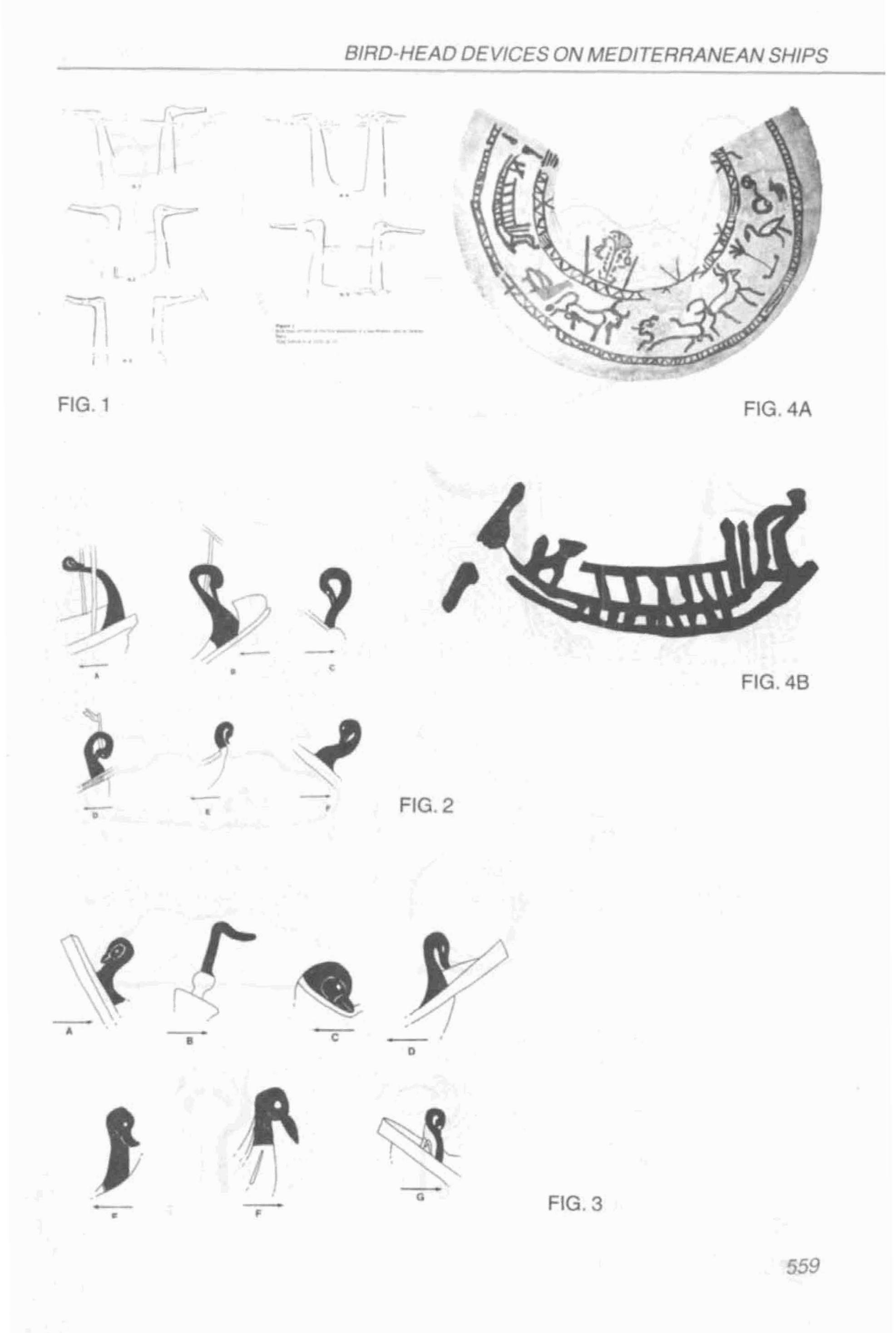
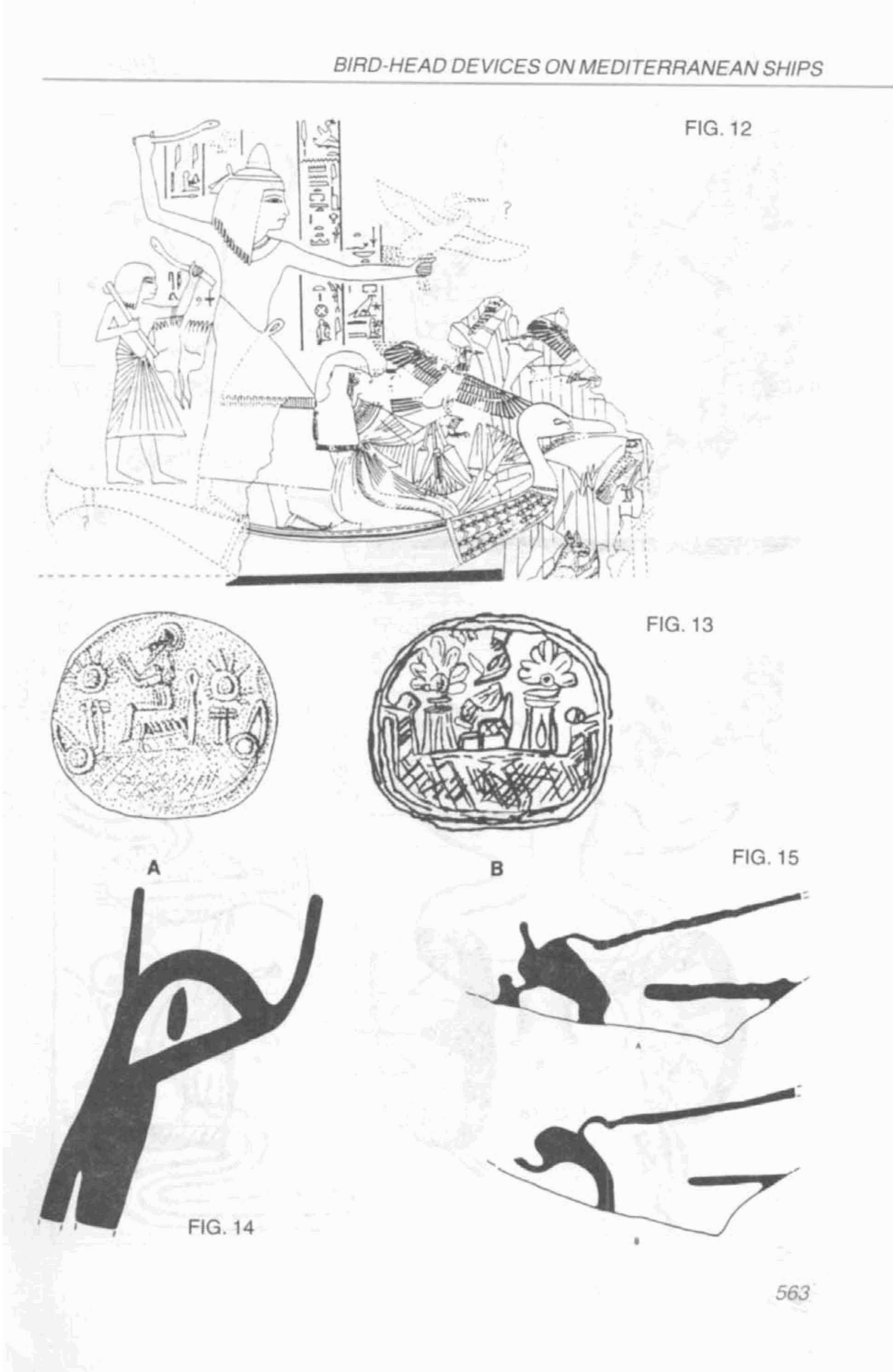
- Bird-head devices on the five depictions of a Sea Peaples' ship at Medinet Habu. After Nelson et al. 1930: pl. 39.
- Bird-head stern ornaments on merchant craft. Ca. 1 st-2nd centuries AD. Arrows indicate the direction of travel. After Casson 1971: figs. 139,151,150,156,181 and 146.
- Bird-head ornaments on merchant craft. Ca. 3rd century AD. Arrows indicate the direction of travel. After Casson 1971:figs. 147,179,147,147,149,148and 191.
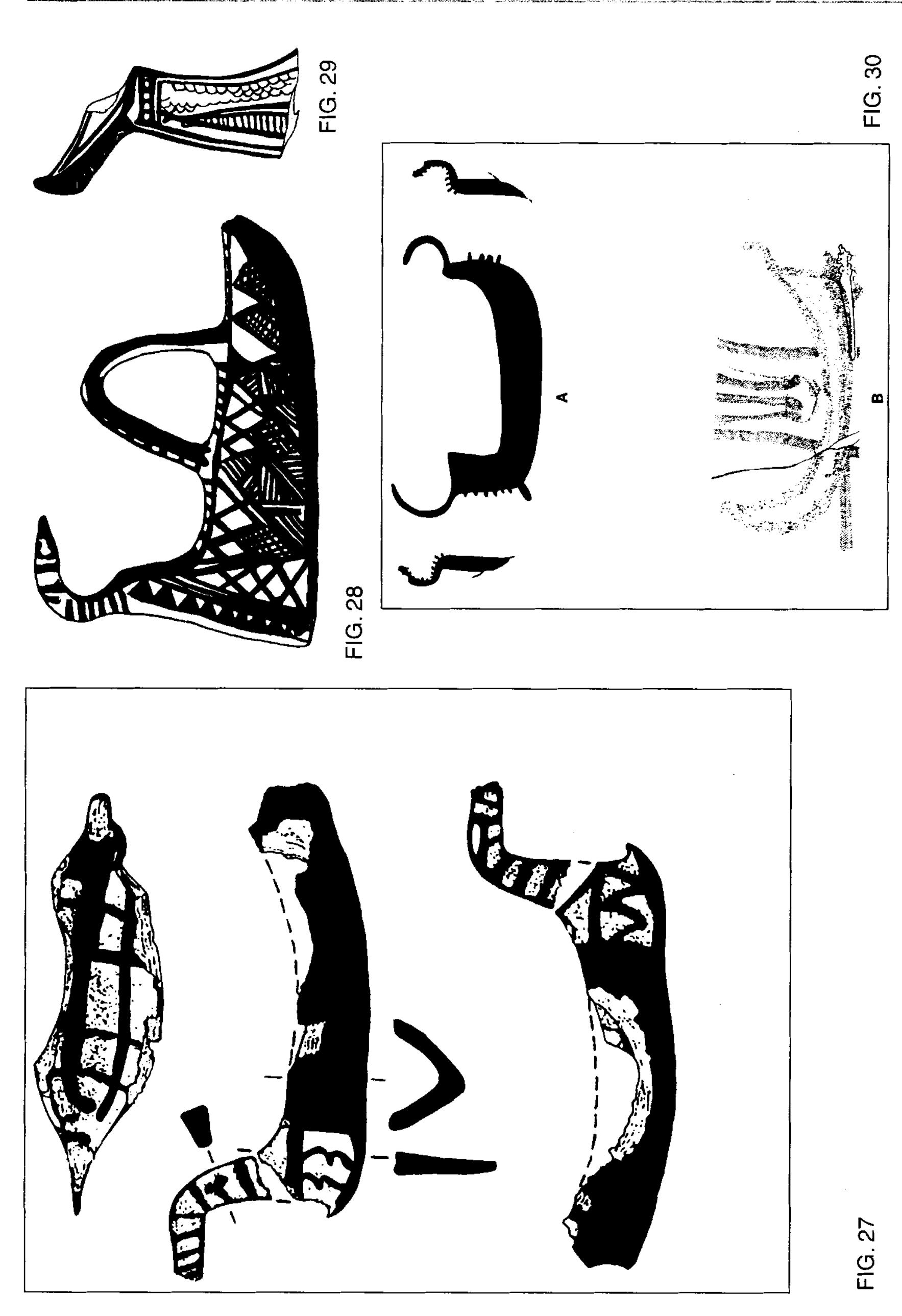
- A. Painted decoration, including a ship, depicted on a funerary urn found at Hama. Ca. 1200-1075 BC.
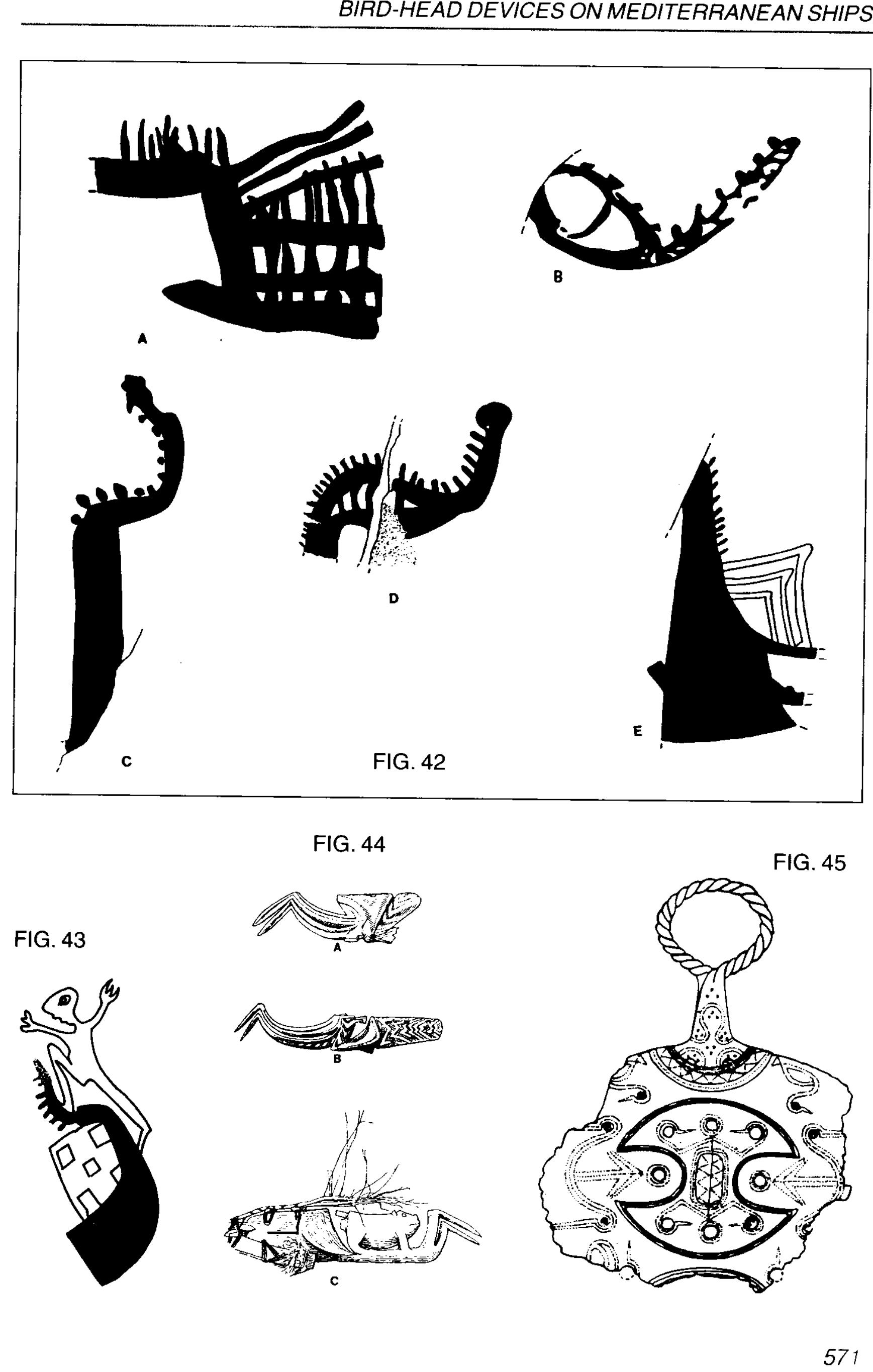
- Detail of the ship. Note the bird-head device capping the stem. After lngholt 1940: pl. XXll:2;
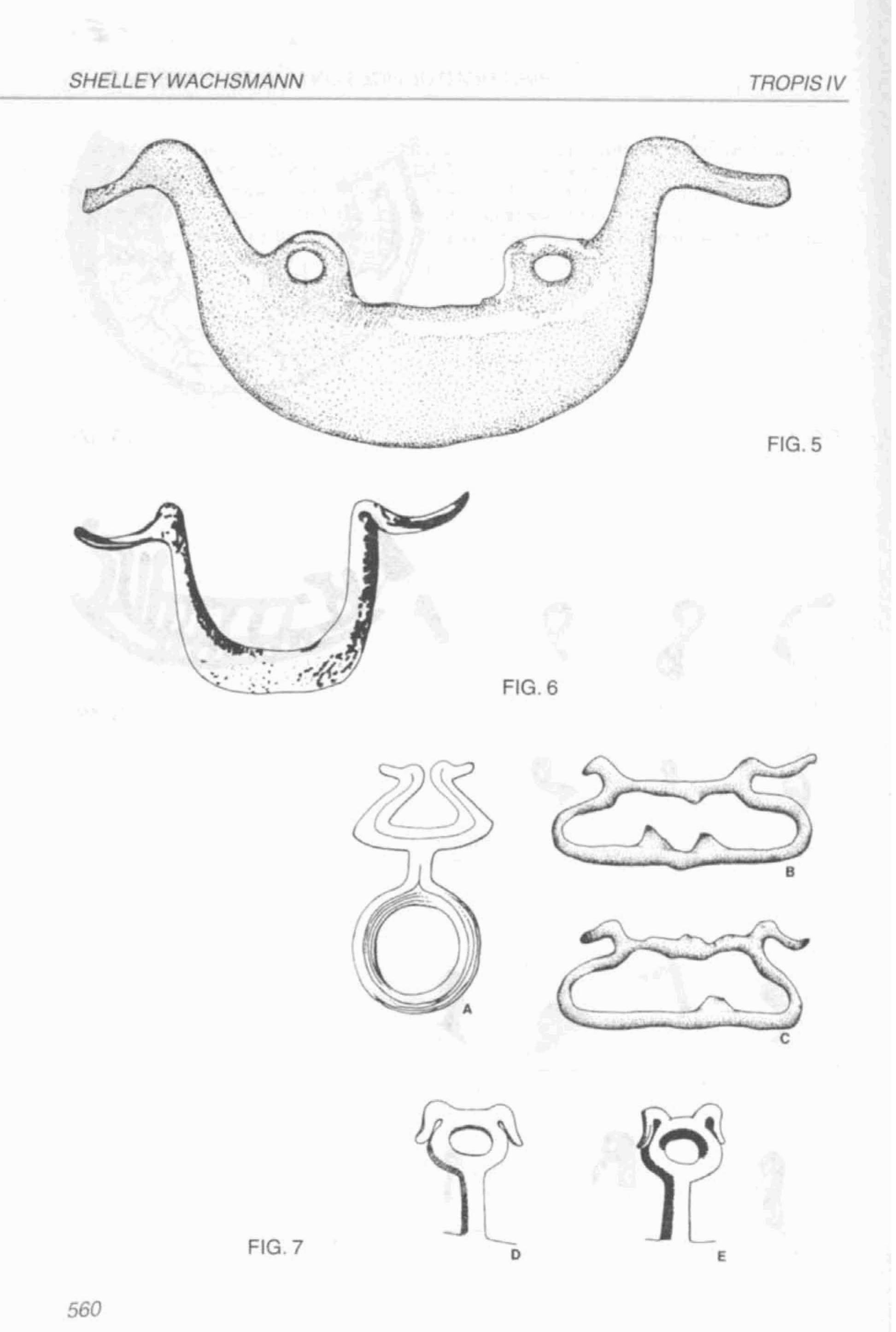
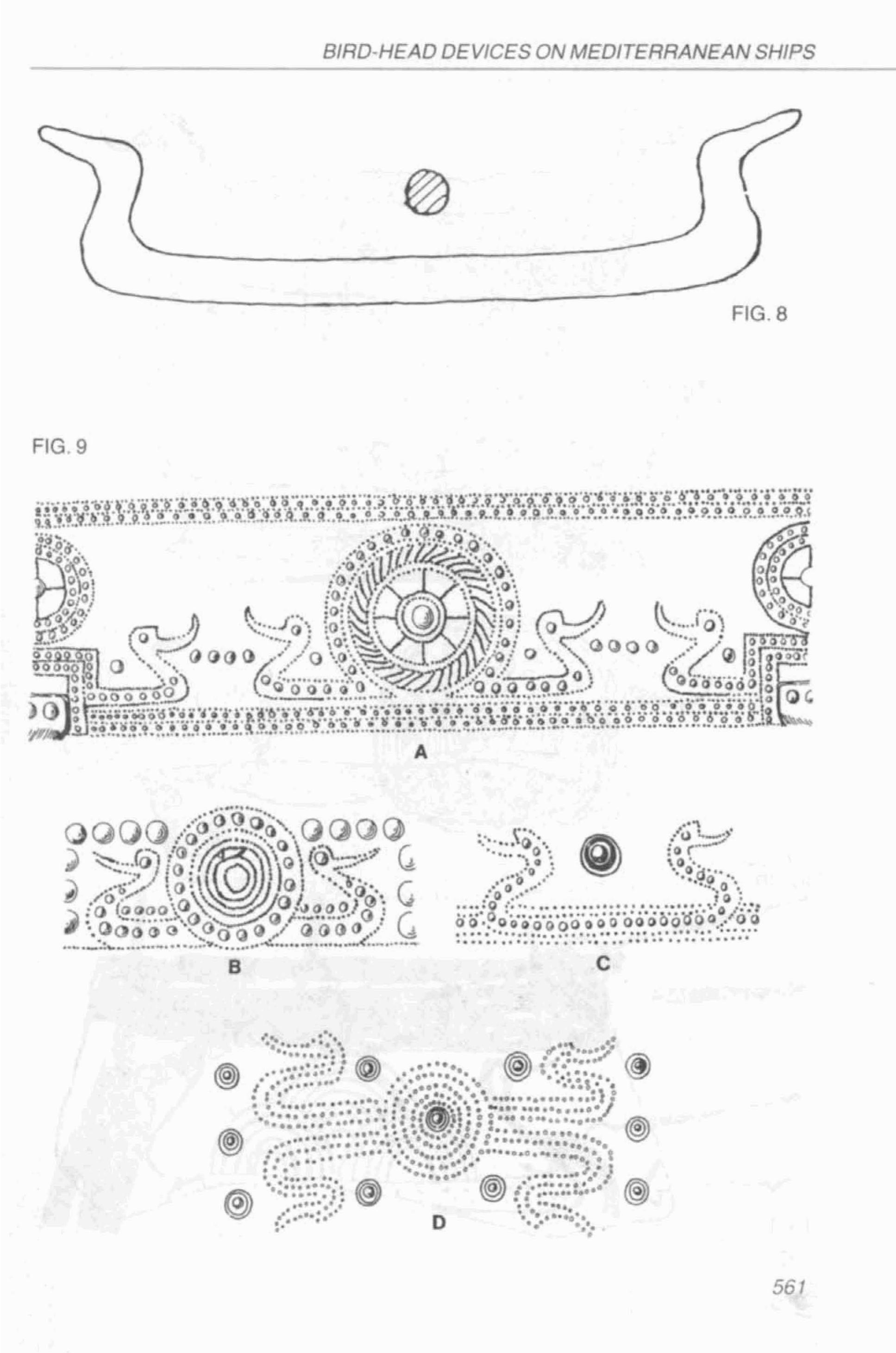
- Bronze "bird-boat" ornament from Somes River at Satu Mare in Northern Rumania. European Bronze D (?). After Gottlicher 1978: Taf. 33: 439.
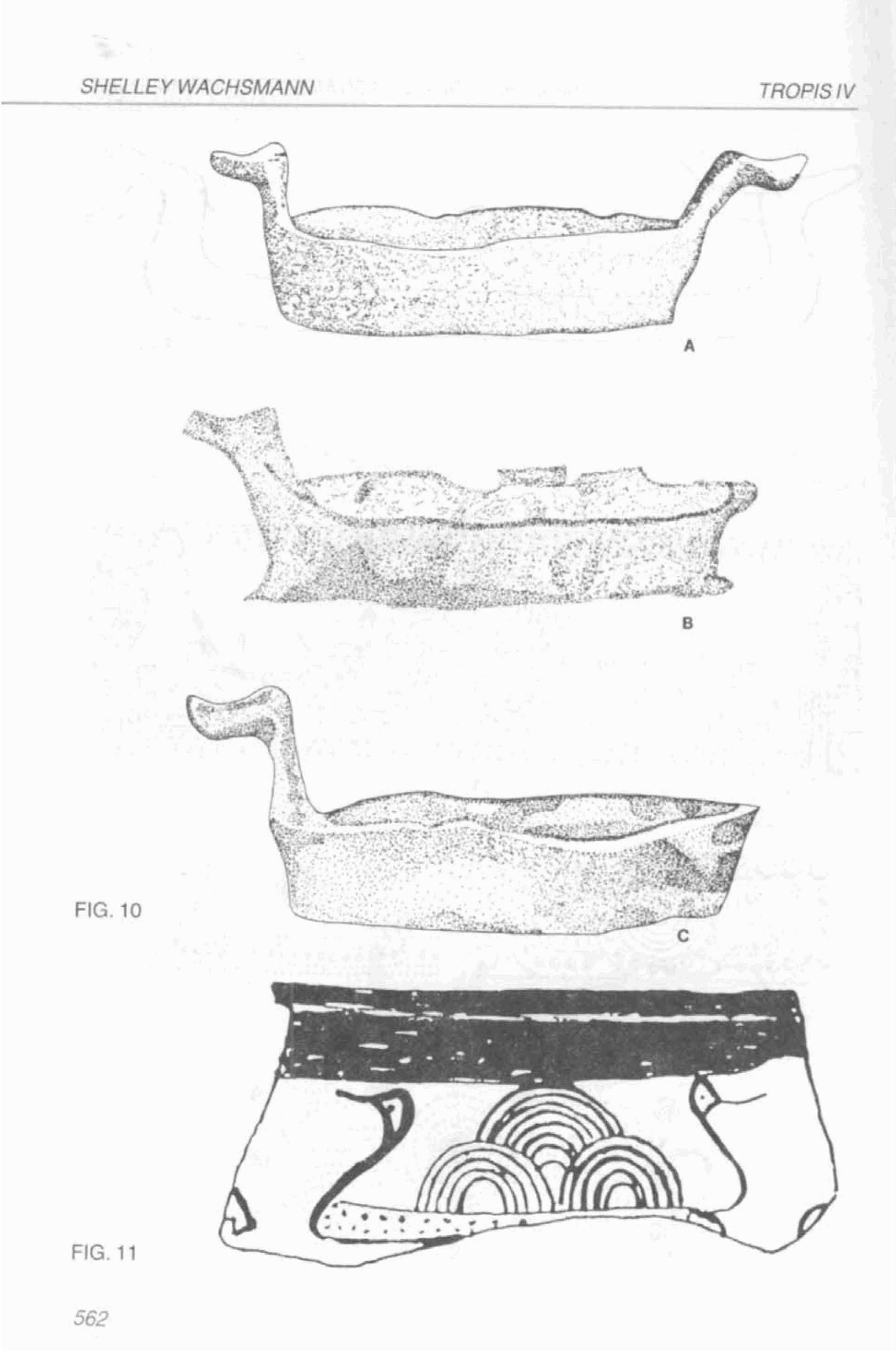
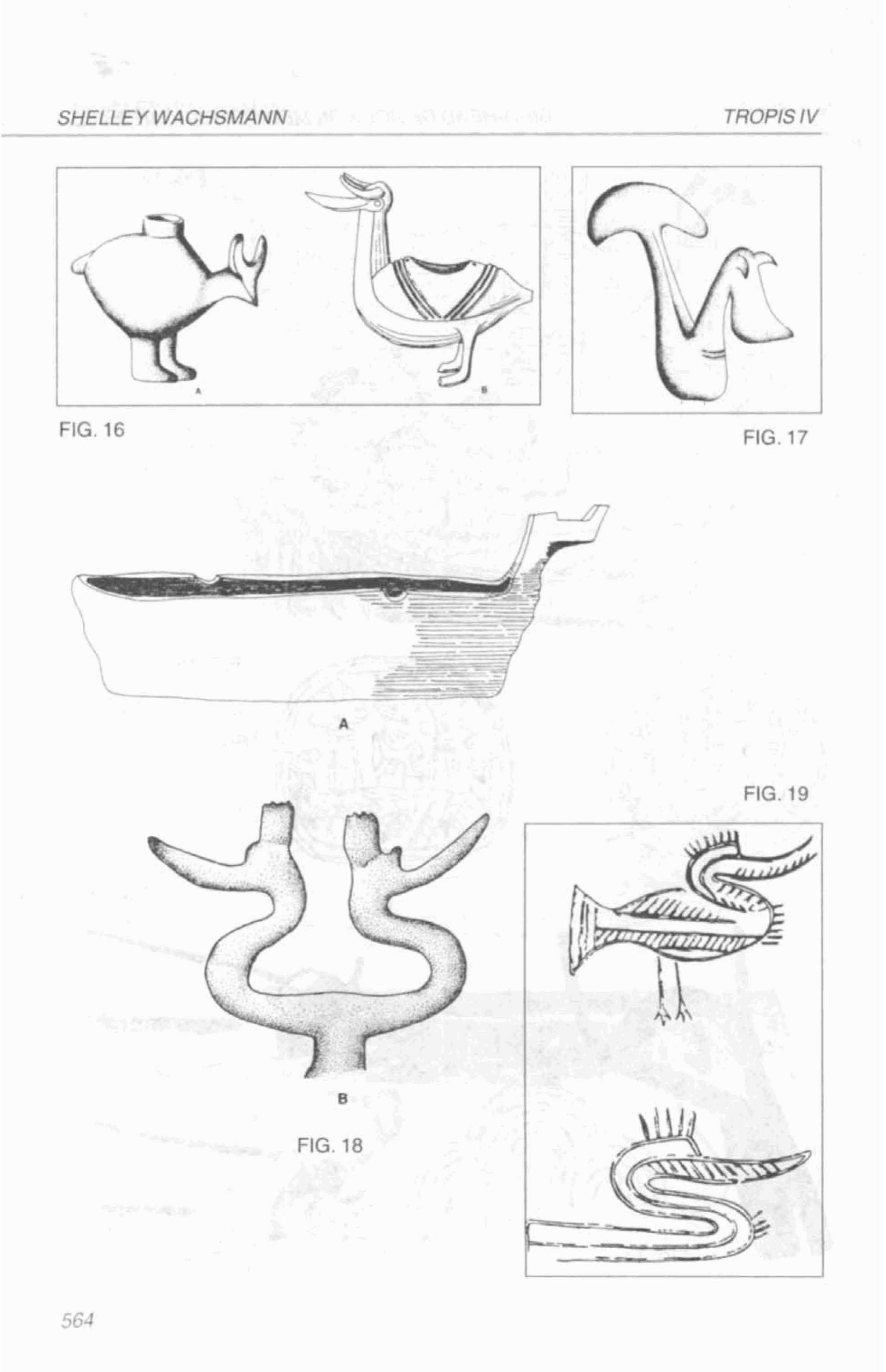
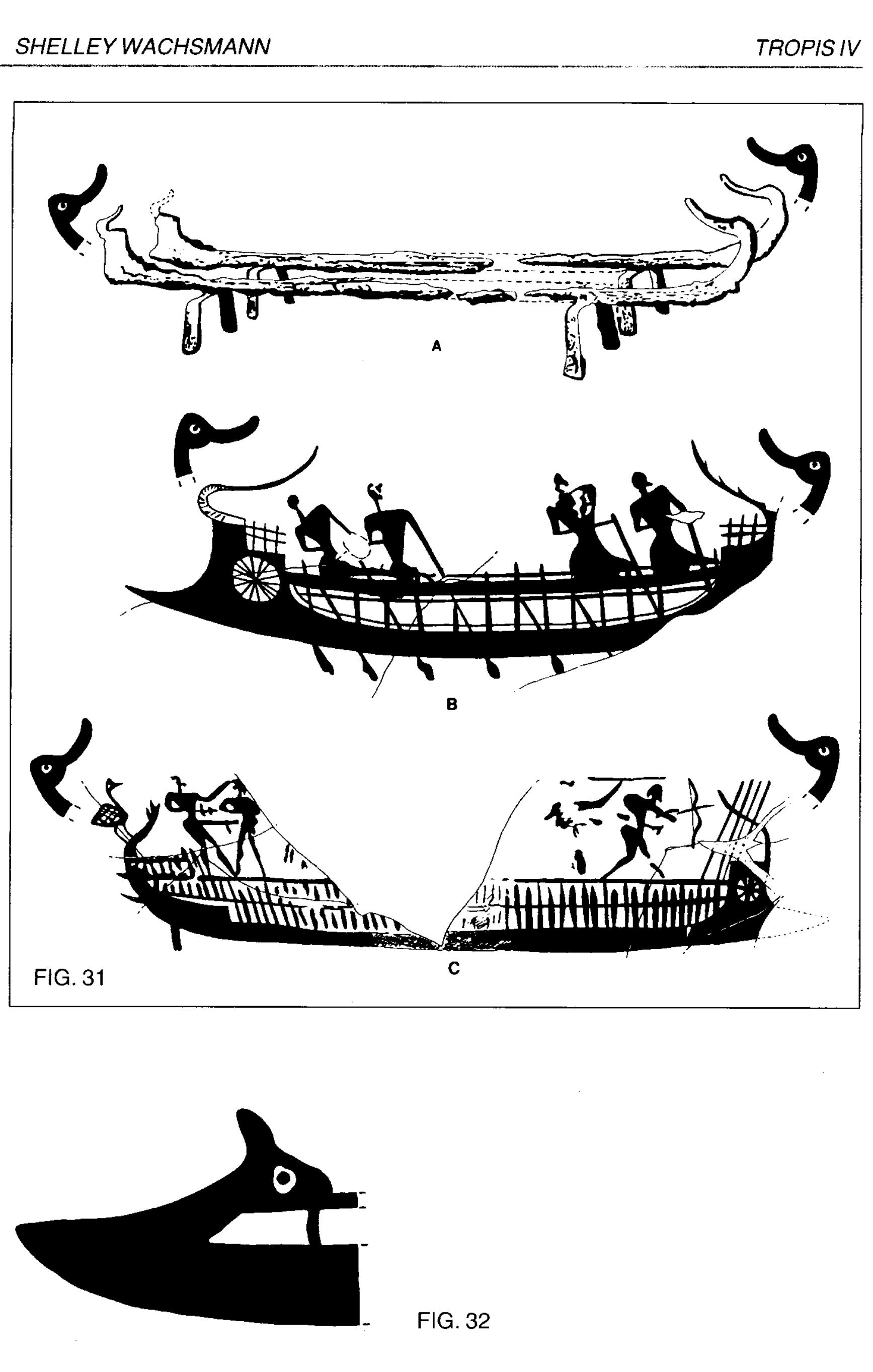
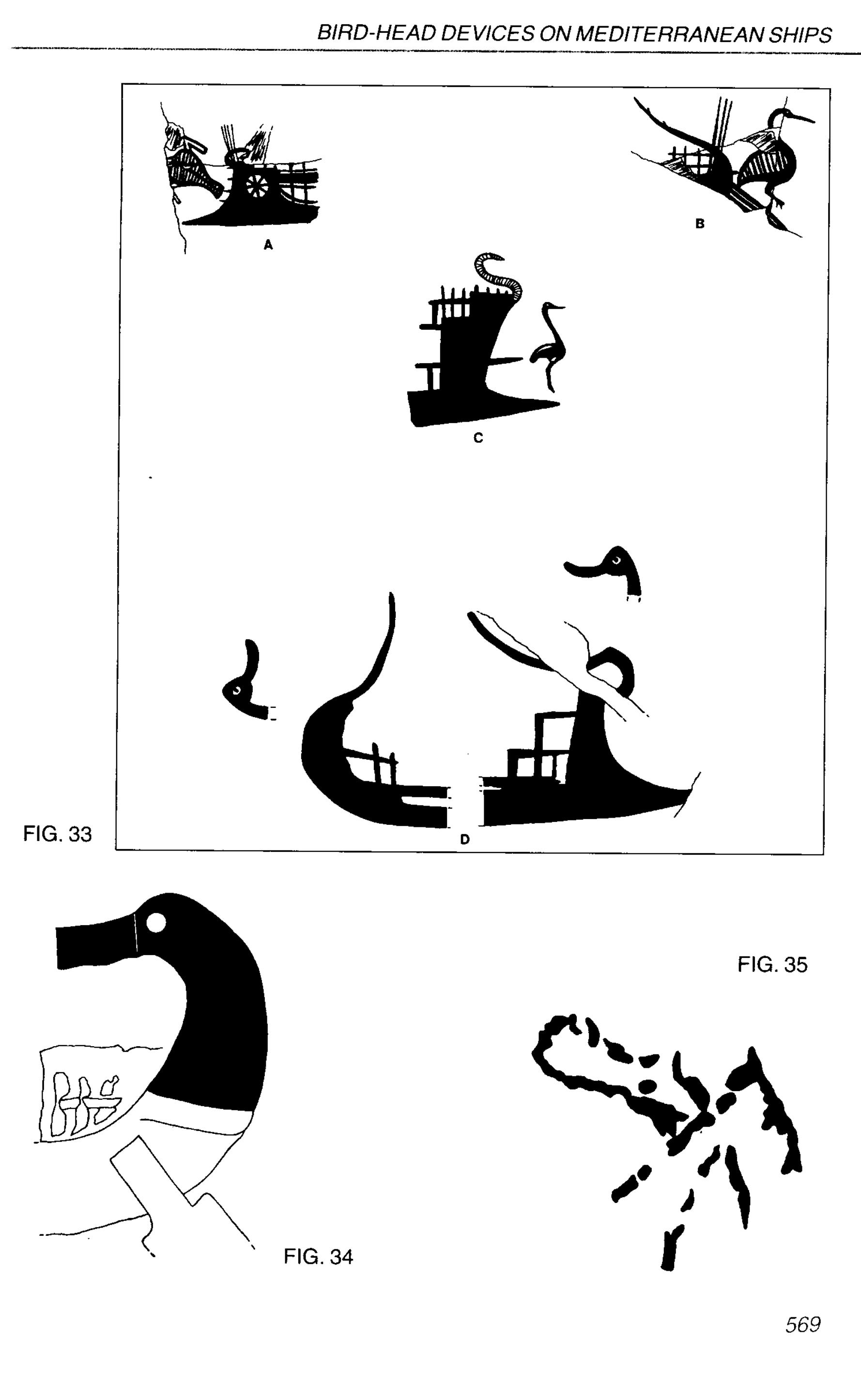
- Bronze "bird-boatnornament from Velem St. Vid in Hungary. European Bronze D (?). After Gottlicher 1978: Taf. 34:440. TROPlS IV transformation of a naturalistic bird head (A) to a stylized (B), and then abstract (C) sternpost device. After Karageorghis and des Gagniers 1974: 122-1 23 nos. XI: 2,3, 1. Ship depicted on sherds from Aegina bears a bird-head stem device. Middle Helladic. After Buchholz and Karageorghis 1973: 301 fig. 869. Ship devices in the form of birds: A. Bird stem -ornament on a ship krater from Enkomi. Late Helladic Ill B. B. Ship's bird stem -ornament on a pyxis from Tragana. Late Helladic Ill C. C. Bird ornament on the stem of a ship depicted on a Geometric Attic skyphos. Ca. 735-71 0 BC.
- D. Bird ornament portrayed twice on the sternpost of the same ship portrayed on a Geometric Attic krater. Ca. 735-710 BC. A after Sjoqvist 1940: fig 20:3. B after Korres 1989: 200 C-D after Casson 1971 : 30,6566. Birds on the stem and sternposts of an Archaic galley. Note how the shape of the stem device imitates the bird's head and neck. Ca. 700-650 BC. After Morrison and Williams 1968: pl. 8: d.
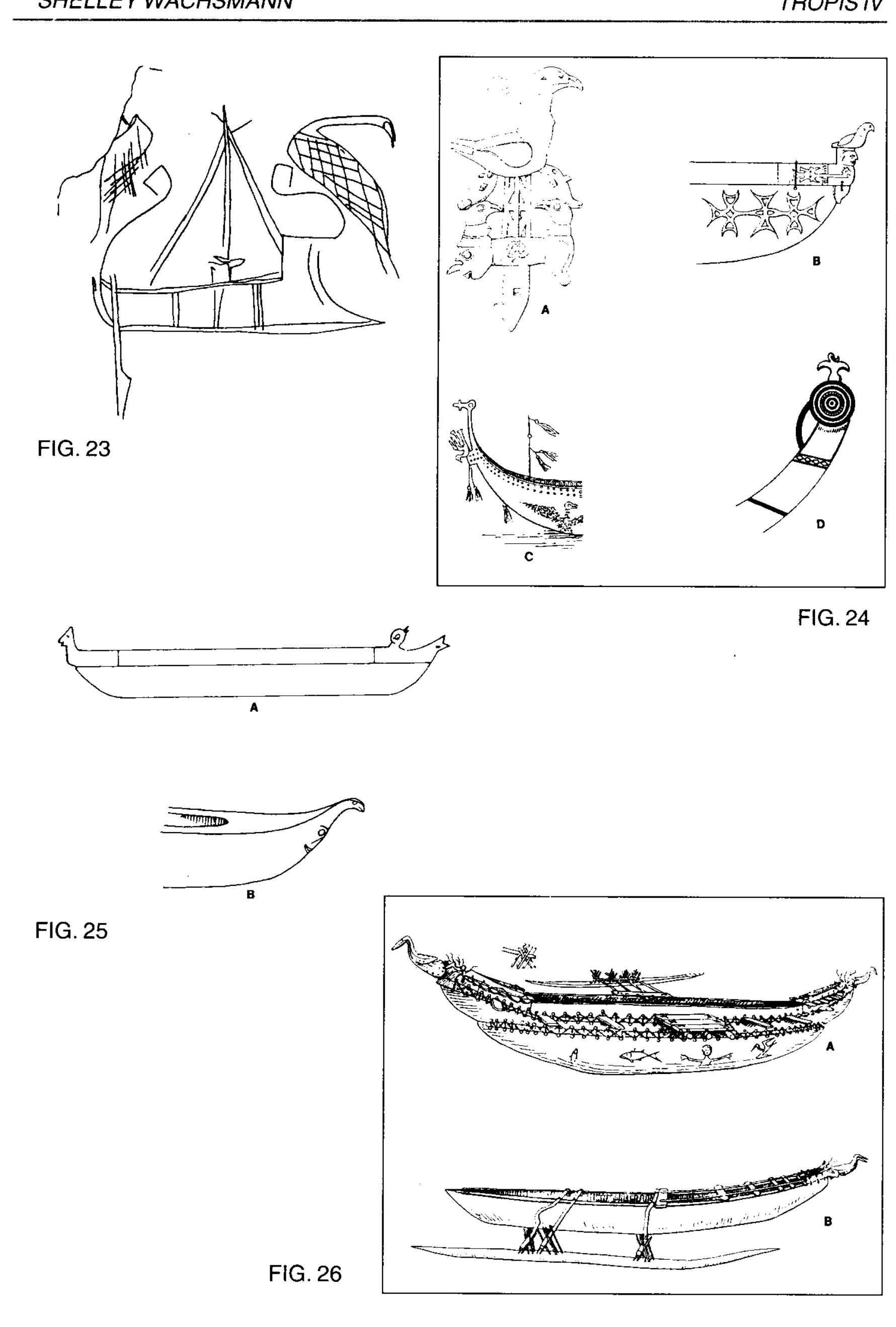
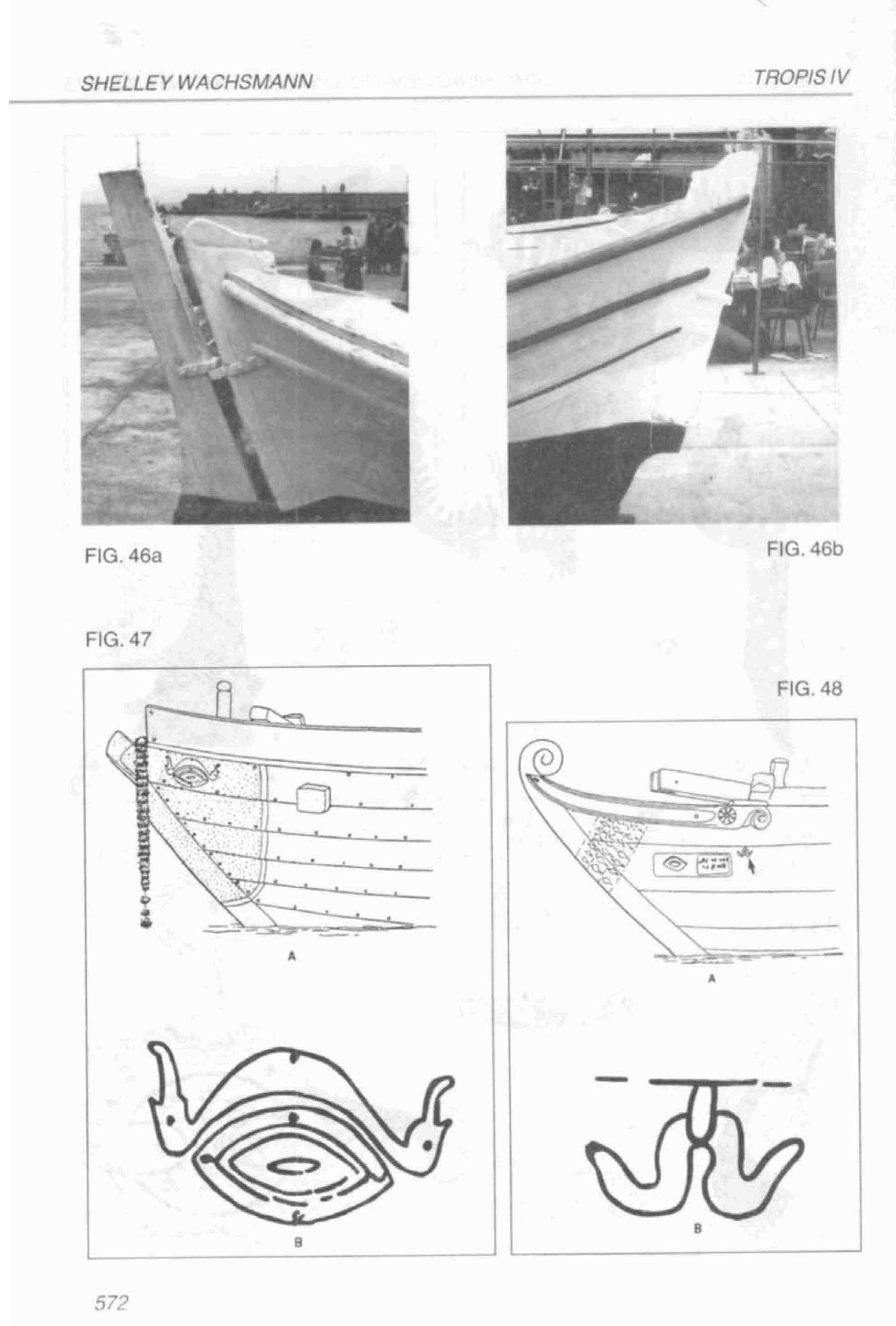
- A. Stem decoration from Walckenaer Bay, Netherlands Papua. B. Side view of a small canoe with bird device from Papua. C. Ornaments on a.0ra canoe from the Solomon Islands. D. Figurehead of an Arab ganja.
- A-C after Haddon 1937: 317fig. 180: a, 316 fig. 179: c, 88 fig. 59: a. D after Hornell 1970: 236 fig. 46.
- A. Bird-head decorations on a small canoe from Papua.
- B. Bow of aseagoing outrigger canoe (nimbembew). South-western Maleluka, New Hebrides. After Haddon 1937: 316 fig. 179: a, 22 fig. 12. Canoes of Atchin, New Hebrides.
- A. Large seagoing canoe with ordinary, single beaked solub e res figureheads. B. Coastal canoe with double bird-head solub wok wak figurehead. After Haddon 1937: 27 fig. 15: b, a. Terra-cotta ship model from Tiryns. Late Helladic Ill B. After Kilian 1988: 140 fig. 37: 8.
- Askos in the form of a ship, from Lapithos. A bird-head ornament tops the stem and faces inward, toward the stern. Late Cypriot Ill. After Gottlicher 1978: Taf. 9: 149.
- Bird-head stem of sternpost ornament of a ship model. From Maroni, Tomb 17, Cyprus. Late Helladic IIIA: 2. After Johnson 1980: pl. LXIII: 132.
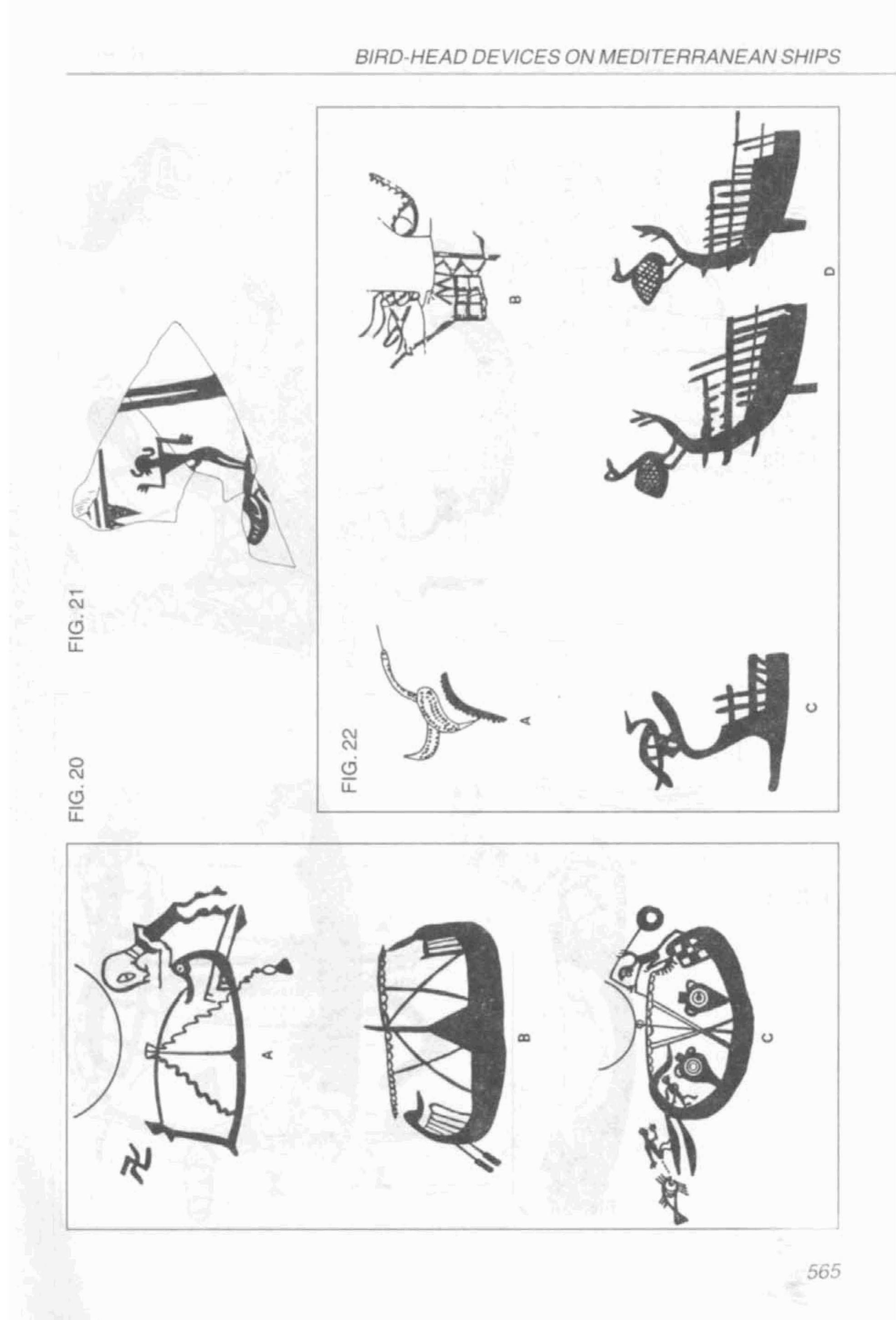
- A. One of two ships depicted on a Protogeometric krater from Fortetsa, Crete. The bird-head devices capping the stem and sternpost are compared to the device on one of the Kynos ships (see Figure 42: C).
- B. Ship painted on a Protogeometric krater from Dirmil, Turkey. A after kirk 1949: 119 fig. 6. B after van Doorninck 1982B: 279 fig. 3. Abstract bird-head ornaments in the form of a compound curve topping the stem and sternposts of representations of Geometric warships. 8th century BC. A after Gottlicher 1978: Taf. 25: 338-339.6-C after Casson 1971 :figs. 72 and 65. Bird-head stem ornament on a Geometric aphract galley. Ca. 725-700 BC. After Casson 1971 : fig. 64.
- A. Bird in front of Geometricgalley on an Attic krater. Ca. 760-735 BC.
- Bird behind a Geometric galley on the same krater.
- C. Long-necked bird before the bow of a Geometric galley. The ship's stem device copies the shape of the bird's head and neck. Ca. 735-71 0 BC.
- D. Galley with stem and stern decorations in the shape of abstract birds' heads. Ca. 760-735 BC. A and B after Morrison and Williams 1968: pl. 2: c-d; C and Dafter Casson 1971 : 74 and 62.
- Bird-head decoration on an Archaic galley. Ca. 700-650 BC. After Morrison and Williams 1968: pl. 8: b.
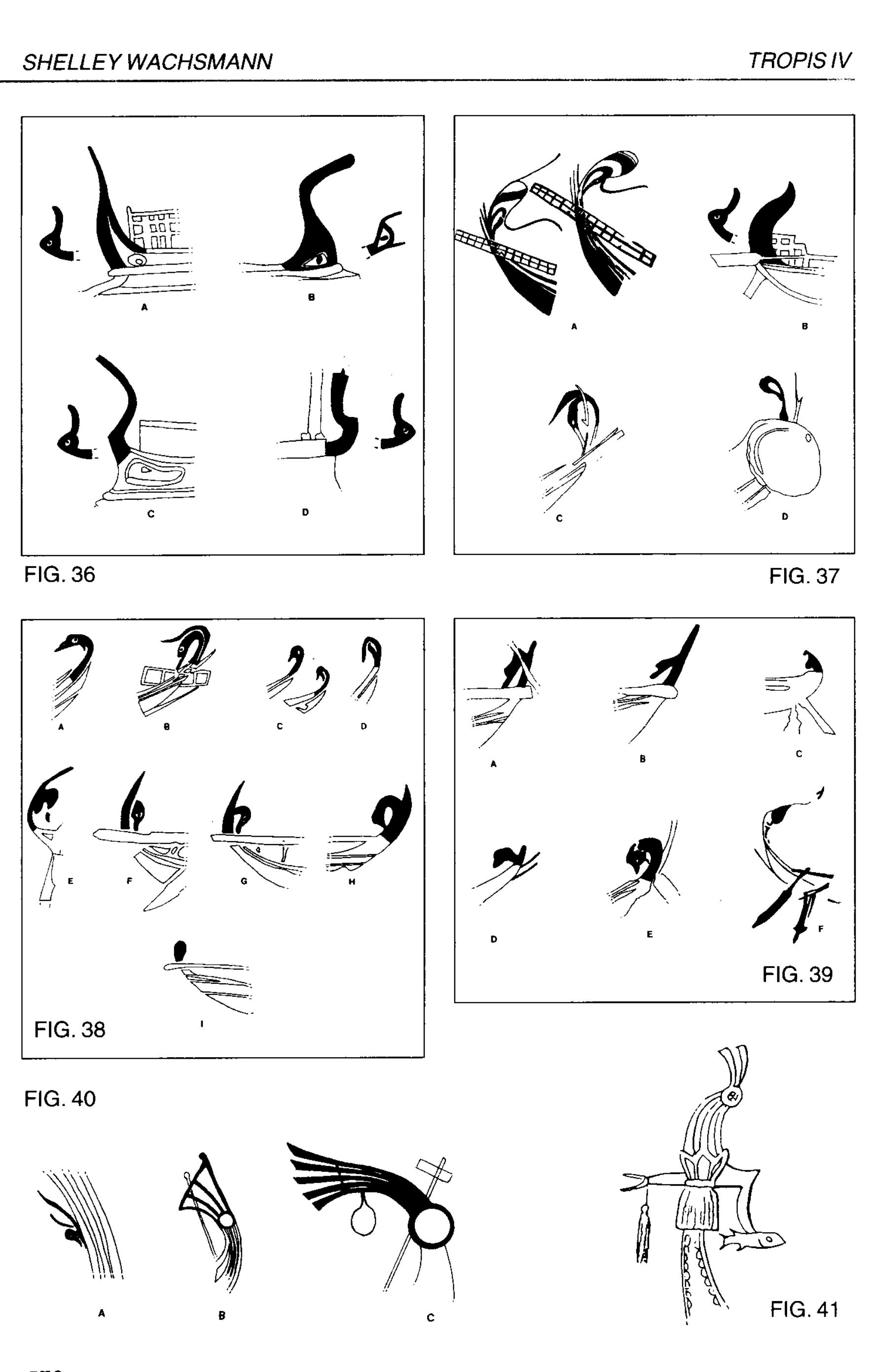
- A-C. Abstract bird-head stem decorations on Greek warships. A ca. 510 BC;
- B ca. 520-480 BC; ca. 400-322 BC. The device on ship B is compared to the bird-head device on the stem of the Skyros ship (see Figure 14).
- D. Abstract bird-head stem decoration ca. 2nd century BC.
- Aand C after Morrison and Williams 1968: pls. 20: e, 27: a. B and Dafter Casson 1971:figs. 84, 176.
- A. Bird-head stern decorations on Greek warships. Ca 530-480 BC.
- Stern of an Archaic galley on an ivory plaque from the Temple of Artemis Orthia in Sparta. Ca. 650-600 BC.
- C-D. Stern decoration on archaic Attic black-figure (C) volute krater and (D) hydria. Ca. 600-550 BC. A after Casson 1971 : fig. 90.6-D after Morrison and Williams 1968: pls. 10: d, 11 : a, d.
- Sixth-century BC stern decorations on Archaic galleys in the form of a bird's head develop into an inward curving stern volute. A-D ca. 550-530 BC; E-H ca. 530-510 BC; I ca. 510 BC.
- After Morrison and Williams 1968: pls. 14: g, 13, 14: b, a; 17: d, c, a, e; 18: d. Sixth-century BC stern bird-head devices on Archaicgalleys. Note that in C the device has developed into an inward curving volute. A-B ca. 510 BC; C -D ca. 520-480 BC; E ca. 530-480 BC. F ca. 600-550 BC. A to E after Morrison and Williams 1968: pls. 18: a, b; 21 : b, d; 16: c; F after Casson 1971 : fig. 83: Aphlastaon Greek and Roman warships. A ca. 480-400 BC. B ca. 200 BC. ca. 2nd century AD. Aafter Morrison and Williams 1968: pl. 26: a. 6-C after Casson NOTES
- Wachsmann 1981 ; 1982. See also Wachsrnann 1995: 25-33; in press A; in press B. 2. Dakoronia 1990: 122 fig. 2; 1995.
- Casson (1971 : 348 and fig. 147-center) identifies this as a "pennant on a short pole socketed into the top of the stempost". This is not a ship's light in the form of a torch. While ships carried lights in their stern, these were placed in lanterns (Casson 1971 : 247-248 ns. 91-92).
- --" ---. BIRD-HEAD DEVICES ON MEDITERRANEAN SHIPS ------------ - ---- Wachsmann 1981 : 205-206, with additional bibliography listed there. Hencken 1968: 568-570,627. De Boer (1 991) suggests a possible Thracian connection for the Sea Peoples. Bouzek 1985: 178. The Br D may be somewhat higher than previously thought (Bouzek 1994:217). Culican 1970; Tushingham 1971. Hencken 1968: 537 fig. 486. Marinatos 1933: 173 no. 16 and fn. 1,218-21 9. These sherds have been lost. Hencken 1968: 519-531.
- In Figures 30-31,33: D, 36: A, C-D and 37: B, which depict ships with abstract bird-head devices, I have included for further clarification, copies of the bird-head device from Figure 20: A to illustrate the direction of the head in each case. Similarly, in figure 30: A copies of the bird-head device on one of the Kynos ships (Fig. 42: C) have been appended at either side and in Figure 36: B a copy of the device on the Skyros ship (Fig. 14) is included. As, for example, does Artzi (1987: 80).
- Korres, 1990: 199-200,202.
- Furumark, 1941: 253 fig. 30.255fig. 31: nos. 36-52; Benson 1961; Dothan 1982: 201-202 figs. 61 -63. The festive bird shaped stem decorations portrayed on Late Bronze Age MinoanICycladic craft represent a swallow, as is evident from the bowsprit of one of the ships taking part in the festive race at Thera (Basch 1987: 107 figs. 192-193). These were apparently connected to the craft during festivities and were not a normal fixture on the bow. The Helladic ornament, on the other hand, represents a water bird and seems to have been a permanent fixture on the stem and sternposts of Helladic oared galleys. Hencken 1968: 537 fig. 486; Wachsmann 1981 : 202-203 figs. 17-18; Kilian 1988: 122- 123; Dakoronia 1990: 122 figs. 1-2. For photographs of the ships see Wachsmann 1982: 299-303 figs. 1-5 A similar, although earlier (Late Helladic Ill A:2), bird-head device that originally capped the stem or sternpost of a terra-cotta ship model was found at Maroni in Cyprus; however, it is unclear if this faced inboard or outboard (Fig. 29).
- Kirk 1949: 118-1 19 fig. 6; Morrison and Williams 1968: 12 (Geom. 1);
- Casson 1971: 36, fig. 60; van Doorninck 1982.
- 18.338; Od. 19: 182, 193. Liddel and Scott 1953: S.V. fl ~opcjvq. It is possible that this is a deliberate play on the two s~milar words and that the term implies "having curved extremities that are bird-shaped" (Lenz, in press). Morrison and Williams 1968: pls. 1 : e, 2: a, 4: c. Casson 1971 : 57-58 fn. 80. Morrison and Williams 1968: 73 (Arch. 2), pl. 8: b. Haddon 1937: 88. Morrison and Williams 1968: pls. 2: a, 4: a, c. Casson 1971 :fig. 29; Buchholz and Karageorghis 1973: 470 fig. 1720. Broodbank 1989: 328. Haddon 1937: 28. Svoronos 1914: 127. Hornell 1970: 271. Bishop 1938: 415. Hornell 1970: 272-273. Hornell 1970: 275.
- Interestingly, when Greek ship names become available in the 4th century BC, with the exception of the Argo, they are feminine in gender (Casson 1971 : 346 n. 10,350-354).
- Egypt has been suggested as the ultimate source for the European bird and sun-disk design (Hopkins 1955: 78-80; 1957: 334-335). This seems most unlikely.
- Compare a somewhat similar figure painted on a Daunian dish from Siponto in southeastern Italy of 6th-5th century BC date (Gimbutas 1989: 16 fig. 26: 8).
- A better preserved, though less decorated, version of this motif is also known (Nefer: 10).
- Casson 1971 : 348: 15.
- Clarke 1920: 51.
FAQs
AI
What explains the widespread use of bird-head devices on Mediterranean ships?
The research reveals that bird-head devices served as symbolic and prophylactic elements on Mediterranean vessels, with evidence dating back to the second millennium BC. These motifs reflected connections to cultural practices, as seen in the adoption of designs from Central European Urnfield cultures.
How did bird-head devices evolve from naturalistic to abstract forms?
The study identifies a cyclic development where bird-head devices transition from naturalistic portrayals to increasingly abstract forms, as highlighted in depictions on Cypriot jugs from the 7th century BC. This evolution showcases artistic trends that prioritizes abstraction over direct representation, revitalizing earlier designs periodically.
When did the aphlaston become a hallmark on warships?
The aphlaston emerged as a defining feature of warships by the 5th century BC, evolving from abstract bird-head devices. The research details its development, linking it to earlier designs with multiple beaks, believed to enhance protective attributes.
What connection exists between bird-head devices and Sea Peoples' origins?
The study suggests a correlation between the bird-head devices on Sea Peoples' ships and the artistic traditions of Urnfield cultures in Central Europe. Archaeological examples, such as a ship depicted on a crematory urn from Syria, support these ancestral links.
How did the bird-head devices function as protective motifs?
Research indicates that ancient mariners believed bird-head devices endowed their vessels with protective qualities, similar to practices observed in modern seafaring cultures. These motifs often symbolized tutelary deities, integrating spiritual protection into the maritime experience.
Shelley Wachsmann