Academia.eduAcademia.edu

Jarrige, J.-F., Didier, A. & Quivron, G. (2011) Shahr-i Sokhta and the Chronology of the Indo-Iranian Borderlands. Paléorient 37 (2) : 7-34.

Last updated

Abstract

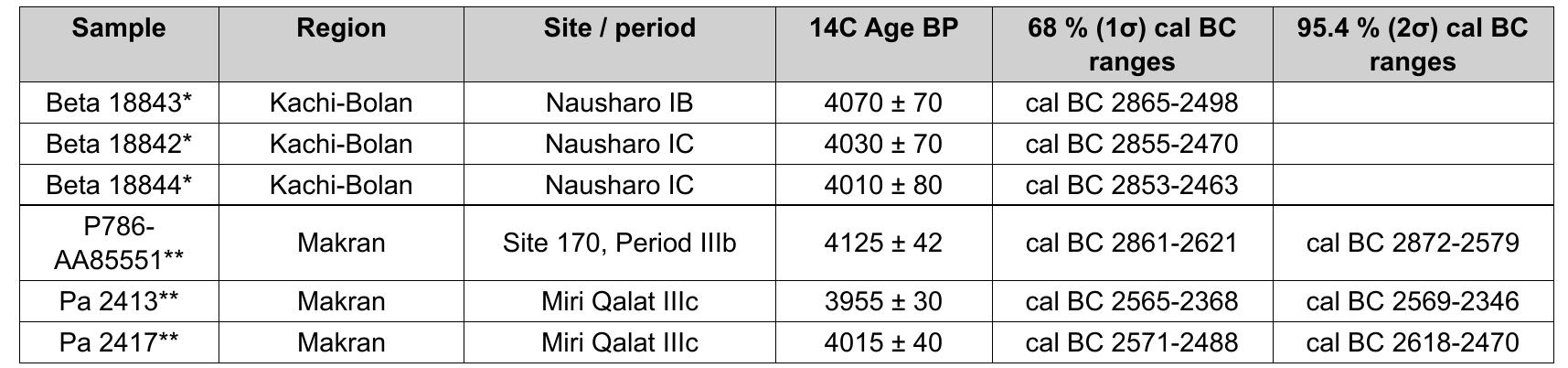
In an article published in 2008 in Paléorient, a series of arguments have been listed which would allow dating the last phase Résumé : Dans un article publié en 2008 dans Paléorient, une série d'arguments a été présentée pour dater la phase fi nale de la période III et la période IV de Shahr-i Sokhta au cours de la seconde moitié du III e millénaire et au tout début du II e millénaire av. J.-C. Une telle datation pourrait impliquer de possibles interactions entre les sites du système de l'Helmand (Shahr-i Sokhta et Mundigak) et la civilisation de l'Indus. Cet article nous conduit tout d'abord à un examen d'ensemble des questions chronologiques à l'échelle des régions indo-iraniennes. Nous passons ensuite en revue les éléments utilisés par les auteurs de l'article précédent pour soutenir une contemporanéité entre les sites de l'Helmand aux périodes III et IV de Shahr-i Sokhta et la civilisation de l'Indus. Puis, en nous fondant notamment sur la séquence des sites de la bordure occidentale de la vallée de l'Indus et du Makran, nous examinons le bienfondé de ces rapprochements proposés entre Shahr-i Sokhta et les sites de la civilisation de l'Indus. Sample Region Site / period 14C Age BP 68 % (1σ) cal BC ranges 95.4 % (2σ) cal BC ranges Beta 18843*

Key takeaways
sparkles

AI

  1. The article critiques the dating of Shahr-i Sokhta Periods III and IV, challenging claims of contemporaneity with the Indus civilization.
  2. The authors argue for a 2800-2600 BCE timeframe for both Shahr-i Sokhta and Mundigak, based on calibrated 14C dating.
  3. Significant cultural interactions likely occurred between the Helmand system and the Indus civilization during the 3rd millennium BCE.
  4. Recent excavations reveal complexity in pottery styles and technological advancements across Indo-Iranian regions.
  5. The text aims to reassess previous conclusions regarding the chronology of the Indo-Iranian borderlands based on archaeological data.

References (80)

  1. Didier et Mutin, in press; Mutin, in press.
  2. Besenval, 2000: 169-171, fi g. 11-20.
  3. Mutin, 2007; Mutin, in press; Didier et Mutin, in press.
  4. Sajjadi, 2003: 61, fi g. 26.
  5. Bonora et al., 2000: 505, fi g. 7.
  6. Mutin, 2007 (vol. 4) : fi g. II.150, n° 4 and II.167; Mutin, in press; Stein, 1931: pl. XV-XVI.
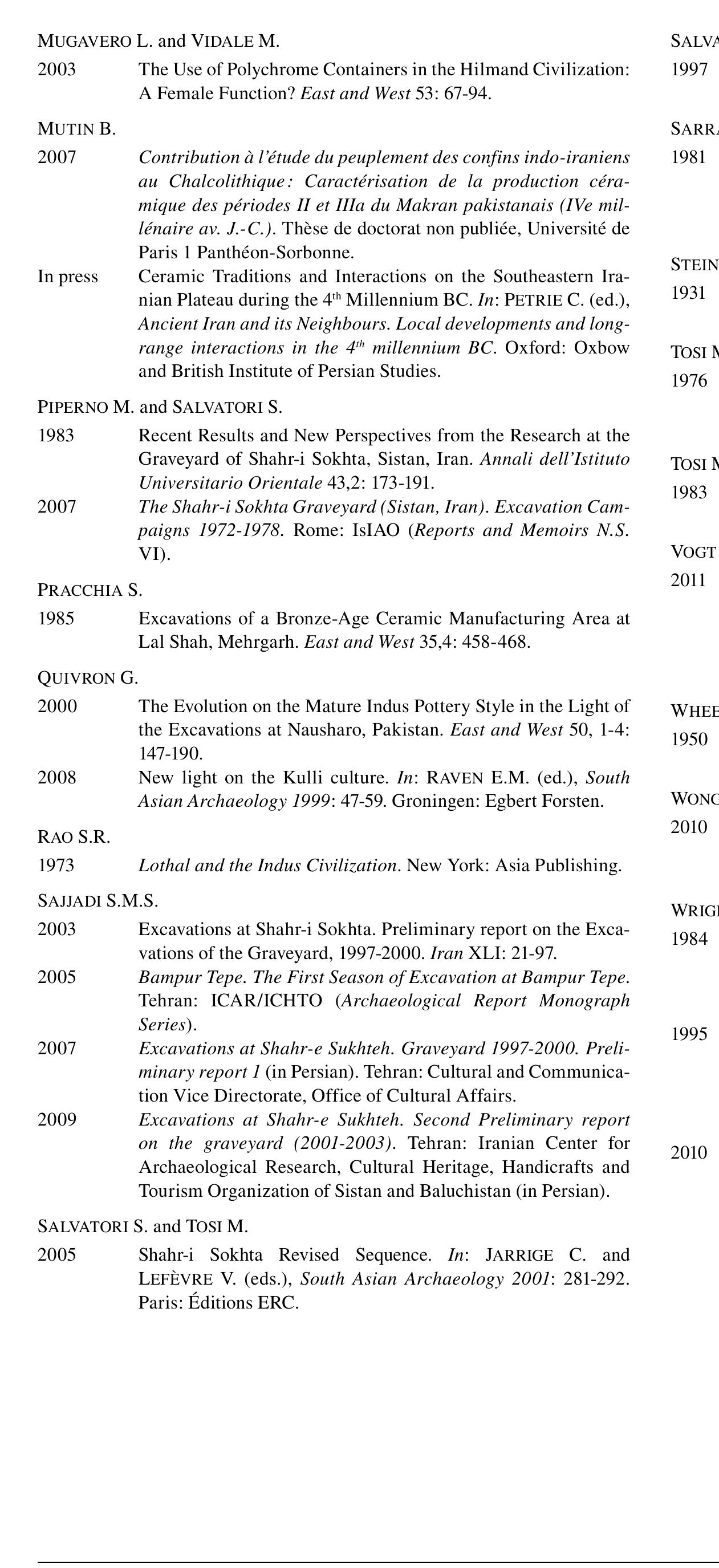
  7. BIBLIOGRAPHY AL-TIKRITI W.Y. 1981 Reconsideration of the Late Fourth and Third Millennium BC in the Arabian Gulf, with Special Reference to the United Arab Emirates. Unpublished PhD Thesis. Cambridge, Trinity Col- lege, University of Cambridge.
  8. ALLCHIN B. and ALLCHIN R. 1982 The Rise of Civilization in India and Pakistan. Cambridge: Cam- bridge University Press (Cambridge World Archaeology 19).
  9. AMIET P. and TOSI M. 1978 Phase 10 at Shahr-i Sokhta: Excavations in Square XDV and the Late 4th Millennium B.C. Assemblage of Sistān. East and West 28: 9-31.
  10. BARTHÉLEMY DE SAIZIEU B. 2003 Les Parures de Mehrgarh: Perles et Pendentifs du Néolithique précéramique à la Période pré-Indus. Fouilles 1974-1985. Paris : Éditions ERC.
  11. BARTHÉLEMY DE SAIZIEU B. and BOUQUILLON A. 1997 Evolution of glazed Materials from the Chalcolithic to the Indus Period based on the data of Mehrgarh and Nausharo. In: ALLCHIN R. and ALLCHIN B. (eds.), South Asian Archaeology 1995: 63-76. New Delhi: Oxford & IBH Publishing Co.
  12. BESENVAL R. 1994 The 1992-1993 field-seasons at Miri Qalat: New contributions to the chronology of Protohistoric settlement in Pakistani Makran. In: PARPOLA A. and KOSKIKALLIO P. (eds.), South Asian Archaeology 1993 (vol. I): 81-91. Helsinki: Suomalainen Tiedeakatemia. 1997a Entre le sud-est iranien et la plaine de l'Indus : le Kech Makran. Recherches archéologiques sur le peuplement ancien d'une marche des confins indo-iraniens. Arts Asiatiques 52 : 5-36. 1997b The Chronology of Ancient Occupation in Makran: Result of the 1994 Season at Miri Qalat, Pakistan, Makran. In: ALLCHIN R. and ALLCHIN B. (eds.), South Asian Archaeology 1995: 199- 216. New Delhi: Oxford & IBH Publishing Co. 2000 New Data for the Chronology of the Protohistory of Kech- Makran (Pakistan) from Miri Qalat 1996 and Shahi-Tump 1997
  13. Field-Seasons. In: TADDEI M. and DE MARCO G. (eds.), South Asian Archaeology 1997: 161-188. Rome: IsIAO (Serie Orien- tale Roma 90). 2005 Chronology of Protohistoric Kech-Makran. In: JARRIGE C. and LEFÈVRE V. (eds.), South Asian Archaeology 2001: 17-24. Paris: Éditions ERC.
  14. BESENVAL R. et DIDIER A. 2004 Peuplement protohistorique du Kech-Makran au 3ème millé- naire av. J.-C. : l'assemblage céramique de la période IIIC sur le site de Miri Qalat. Paléorient 30,2 : 159-178.
  15. BIBBY T.G. 1966 The Eleventh Campaign of the Danish Archaeological Expedi- tion, 1965. Kuml 1965: 75-95.
  16. J.-F. JARRIGE, A. DIDIER and G. QUIVRON
  17. Paléorient, vol. 37.2, p. 7-34 © CNRS ÉDITIONS 2011 BISCIONE R. 1974 Relative Chronology and Pottery Connections between Shahr-i Sokhta and Mundigak, eastern Iran. Memorie dell'Istituto Ita- liano di Paleontologia Umana II: 131-145.
  18. 1979 The Burnt Building of Period Shahr-I Sokhta IV. An Attempt of Functional Analysis from the Distribution of Pottery Types. In: GNOLI G. and ROSSI A.V. (eds.), Iranica: 291-306. Naples: Istituto Universitario Orientale. 1990 The Elusive Phase 2 of the Shahr-i Sokhta Sequence. In: TADDEI M. and DE MARCO G. (eds.), South Asian Archaeology 1987: 391-410. Rome: IsIAO (Serie Orientale Roma 66).
  19. BONORA G.L., DOMANIN C., SALVATORI S. and SOLDINI A. 2000 The Oldest Graves of Shahr-i Sokhta Graveyard. In: TADDEI M. and DE MARCO (eds.), South Asian Archaeology 1997: 495-513. Rome: IsIAO (Serie orientale Roma 90).
  20. CALDWELL J.R. 1967 Investigations at Tal-i Iblis. Springfield: The Illinois State Museum Society (Illinois State Museum Preliminary Report 9).
  21. CASAL J.-M. 1961 Fouilles de Mundigak. Paris : Librairie C. Klincksieck (Mémoires de la Délégation archéologique française en Afgha- nistan XVII).
  22. 1964 Fouilles d'Amri. Paris : Publication de la Commission des Fouilles archéologiques.
  23. CORTESI E., TOSI M., LAZZARI A. and VIDALE M. 2008 Cultural Relationships beyond the Iranian Plateau: The Hel- mand Civilization, Baluchistan and the Indus Valley in the 3 rd Millennium BCE. Paléorient 34,2: 5-35.
  24. DALES G.F. 1972 Prehistoric Research in Southern Afghanistan. Afghanistan XXIV: 14-40.
  25. 1977 New Excavations at Nad-i Ali (Sorkh Dagh), Afghanistan. Uni- versity of California Berkeley: Center for South and Southeast Asia (Research Monograph Series 16).
  26. 1991 Some Specialized Ceramic Studies at Harappa 2. In: MEADOW R.H. (ed.), Harappa Excavations 1986-1990. A Multidiscipli- nary Approach to Third Millennium Urbanism: 61-69. Madison, Wisc.: Prehistory Press (Monographs in World Archaeology 3).
  27. DE CARDI B. 1965 Excavation and Reconnaissance in Kalat, West Pakistan -The Prehistoric Sequence in the Surab Region. Pakistan Archaeo- logy 2: 86-182. Karachi: The Department of Archaeology, Ministry of Education, Government of Pakistan. 1970 Excavations at Bampur, a Third Millennium Settlement in Per- sian Baluchistan, 1966. New York: American Museum of Natu- ral History (Anthropological Papers of the American Museum of Natural History 51, 3).
  28. DIDIER A. 2007 Archéologie des confins indo-iraniens : Étude de la production céramique du Kech-Makran (Pakistan) dans la première moitié du IIIe millénaire av. J.-C. Thèse de doctorat non publiée. Paris, Université de Paris 1 Panthéon-Sorbonne. In press L'utilisation de la couleur dans les céramiques protohistoriques du Balochistan pakistanais et à Mundigak (Afghanistan). Iden- tités culturelles et traditions techniques. The Use of colour in the Protohistoric Pottery from Pakistani Balochistan and from Mundigak (Afghanistan). Cultural Identities and Technical Tra- ditions. Annales de la fondation Fyssen 26.
  29. DIDIER A. et MUTIN B. In press La production céramique protohistorique du Makran pakista- nais dans la compréhension des relations indo-iraniennes. In: BENDEZU-SARMIENTO J. (éd.), Archéologie française en Asie centrale post-soviétique. Un enjeu sociopolitique et culturel. Paris : De Boccard, Cahiers d'Asie centrale 21.
  30. DUPREE L. 1988 Deh Morasi Ghundai: A Chalcolithic Site in South-Central Afghanistan. New York (Anthropological Papers of the Ameri- can Museum of Natural History 50,2).
  31. DURRANI F.A. 1988 Excavations in the Gomal Valley: Rehman Dheri Excavation Report No. I. Ancient Pakistan 6: 1-204.
  32. FAIRSERVIS W.A. Jr. 1956 Excavations in the Quetta Valley, West Pakistan. New York: American Museum of Natural History (Anthropological Papers of the American Museum of Natural History 45,2). 1959 Archaeological Surveys in the Zhob and Loralai Districts, West Pakistan. New York (Anthropological Papers of the American Museum of Natural History 47,2). 1961 Archaeological Studies in the Seistan Basin of South-Western Afghanistan and Eastern Iran. New York: American Museum of Natural History (Anthropological Papers of the American Museum of Natural History 48,1).
  33. 1967 The Origin, Character, and Decline of an Early Civilization. Novitates 2302: 1-48.
  34. FIELD H. and MARTIN R.A. 1935 Painted Pottery from Jemdet Nasr, Iraq. American Journal of Archaeology 39,3: 310-320.
  35. FRANKE U. 2008 Baluchistan and the Borderlands. In: PEARSALL D. (ed.), Ency- clopedia of Archaeology 2008 (vol. 1): 651-670. New York: Elsevier.
  36. FRANKE-VOGT U. 2005 Excavations at Sohr Damb/Nal: Results of the 2002 and 2004 Seasons. In: FRANKE-VOGT U. and WEISSHAAR H.-J. (eds.), South Asian Archaeology 2003: 63-76. Aachen: Linden Soft. FRANKE-VOGT U. and IBRAHIM A. 2005 A New Perspective of an Old Site: Reopening Excavations at Sohr Damb/Nal (Balochistan). In: JARRIGE C. and LEFÈVRE V. (eds.), South Asian Archaeology 2001: 105-115. Paris: Éditions ERC. HARGREAVES H. 1929 Excavations in Baluchistan 1925. Sampur Mound, Mastung and Sohr Damb, Nal. New Delhi: Government of India (Memoirs of the Archaeological Survey of India 35).
  37. ISAKOV A. et LYONNET B. 1988 Céramiques de Sarazm (Tadjikistan, URSS) : Problèmes d'échanges et de peuplement à la fin du Chalcolithique et au début de l'âge du Bronze. Paléorient 14,1 : 31-47.
  38. JARRIGE C. 1988 Les figurines humaines au Baluchistan. In: AMIET P. (éd.), Les Cités oubliées de l'Indus : 65-70. Paris: Association Française d'Action Artistique. 1997 The figurines from Nausharo, Period I and their further deve- lopments. In: ALLCHIN R. and ALLCHIN B. (eds.), South Asian Paléorient, vol. 37.2, p. 7-34 © CNRS ÉDITIONS 2011 Archaeology 1995: 33-43. New Delhi: Oxford & IBH Publishing Co. 2008 The Figurines of the First Farmers at Mehrgarh and their Offs- hoots. Pragdhara 18: 155-166.
  39. JARRIGE C., JARRIGE J.-F., MEADOW R.H. and QUIVRON G. (eds.) 1995 Mehrgarh Field Reports 1974-1985. From Neolithic Times to the Indus Civilization. Karachi: The Department of Culture and Tourism, Government of Sindh.
  40. JARRIGE J.-F. 1987 Une jarre polychrome à tenon perforé de Mundigak. In: GNOLI G. and LANCIOTTI L. (eds.), Orientalia Iosephi Tucci Memoriae Dicata: 661-666. Rome: IsMEO (Serie orientale 56,2). 1988 Excavations at Nausharo, 1986-1987. Pakistan Archaeology 23: 149-203.
  41. 1989 Excavation at Nausharo, 1987-1988. Pakistan Archaeology 24: 21-67. 1990 Excavation at Nausharo, 1988-1989. Pakistan Archaeology 25: 193-240.
  42. 1993 The Question of the Beginnings of the Harappan Civilisa- tion as seen from the Nausharo Excavations. In: GAIL A. and MEVISSEN G. (eds.), South Asian Archaeology 1991: 149-164. Stuttgart: Franz Steiner Verlag. 1994 The final phase of the Indus occupation at Nausharo and its connection with the following cultural complex of Mehr- garh VIII. In: PARPOLA A. and KOSKIKALLIO P. (eds.), South Asian Archaeology 1993: 294-314. Helsinki: Suomalainen Tie- deakatemia.
  43. 1995 Du Néolithique à la Civilisation de l'Inde ancienne: Contribu- tion des recherches archéologiques dans le Nord-Ouest du sous- continent pakistanais. Arts Asiatiques 50 : 5-23. 'Indus. Académie des Inscriptions et Belles-Lettres, Comptes rendus des Séances de l'année 1996, III : 821-877.
  44. 1998 The beginning of pottery in Balochistan. In: PHILLIPS C.S., POTTS D.T. and SEARIGHT S. (eds.), Arabia and its Neigh- bours, Essays on Prehistorical and Historical Developments presented in honour of Beatrice de Cardi: 327-338. Turnhout: Brepols. 2008 L'origine des cités de l'Indus à la lumière des fouilles de Mehr- garh et de Nausharo au Pakistan. In : GUILAINE J. (éd.), Villes, villages, campagnes de l'Âge du Bronze : 9-22. Paris : Errance.
  45. JARRIGE J.-F. and MEADOW R.H. 1992 Mélanges Fairservis: A Discourse on Relations between Kachi and Sindh in Prehistory. In: POSSEHL G.L. (ed.), South Asian Archaeology Studies: 163-178. New Delhi: Oxford & I.B.H. Publishing Co.
  46. JARRIGE J.-F. and QUIVRON G. 2008 The Indus Valley and the Indo-Iranian Borderlands at the end of the 3rd Millennium and the beginning of the 2nd Millennium B.C. In: RAVEN E.M. (ed.), South Asian Archaeology 1999: 60-70. Groningen: Egbert Forsten.
  47. JARRIGE J.-F. and USMAN-HASSAN M. 1989 Funerary Complexes in Baluchistan at the End of the Third Millennium in the Light of Recent Discoveries at Mehrgarh and Quetta. In: FRIFELT K. and SORENSEN P. (eds.), South Asian Archaeology 1985: 150-166. London: Curzon Press.
  48. JARRIGE J.-F., QUIVRON G., JARRIGE C., with the collaboration of HAQUET J.-F., DIDIER A. and MEADOW R.H. 2011 Nindowari (Pakistan). La culture de Kulli. Ses origines et ses relations avec la civilisation de l'Indus. Nindowari (Pakistan). The Kulli Culture. Its origins and its relations with the Indus Civilization. Paris: Gingko éditeur.
  49. KENOYER J.M. and MEADOW R.H. 1997 Excavations at Harappa 1994-1995: New Perspectives on the Indus Script, Craft Activities, and City Organization. In: ALLCHIN R. and ALLCHIN B. (eds.), South Asian Archaeology 1995: 139-172. New Delhi: Oxford & IBH Publishing Co. 2005 Excavations at Harappa 2000-2001: New Insights on Chrono- logy and City Organization. In: JARRIGE C. and LEFÈVRE V. (eds.), South Asian Archaeology 2001: 207-225. Paris: Éditions ERC. 2008 Harappa Excavations 1998-1999. New Evidence for the Deve- lopment and Manifestation of the Harappan Phenomenon. In: RAVEN E.M. (ed.), South Asian Archaeology 1999: 85-110. Groningen: Egbert Forsten.
  50. KHAN F.A. 1965 Excavations at Kot Diji. Pakistan Archaeology 2: 11-85.
  51. KHLOPIN I.N. 1964 Geoksjurskaja gruppa poselenii epoki eneolita [Geoksiur group of sites from the Neolithic period]. Moscow and Leningrad: Nauka.
  52. KNOX R. 1994 A New Indus Valley Cylinder Seal. In: PARPOLA A. and KOS- KIKALLIO P. (eds.), South Asian Archaeology 1993 (vol.I): 375- 378. Helsinki: Suomalainen Tiedeakatemia.
  53. LAMBERG-KARLOVSKY C.C. and TOSI M. 1973 Shahr-i Sokhta and Tepe Yahya, Tracks on the Earliest History of the Iranian Plateau. East and West 23, 1-2: 21-58.
  54. LYONNET B. 1996 Sarazm (Tadjikistan) céramiques (Chalcolithique et Bronze ancien). Paris : De Boccard (Mémoires de la Délégation archéo- logique française en Asie centrale VII).
  55. MACKAY E.J.H. 1937 Further Excavations at Mohenjo-Daro. New Delhi: Govern- ment Press.
  56. MADJIDZADEH Y. 2003 Jiroft, the Earliest Oriental Civilization. Tehran: Ministry of Culture and Islamic Guidance: Iran Cultural Heritage Organi- zation Research Center.
  57. MASSON V.M. and MERPERT N. YA 1982 Eneolit Srednei Azii [Eneolithic of Central Asia]. In: MASSON V.M. and MERPERT N. (eds.), Eneolit SSSR: 9-92. Moscow: Nauka.
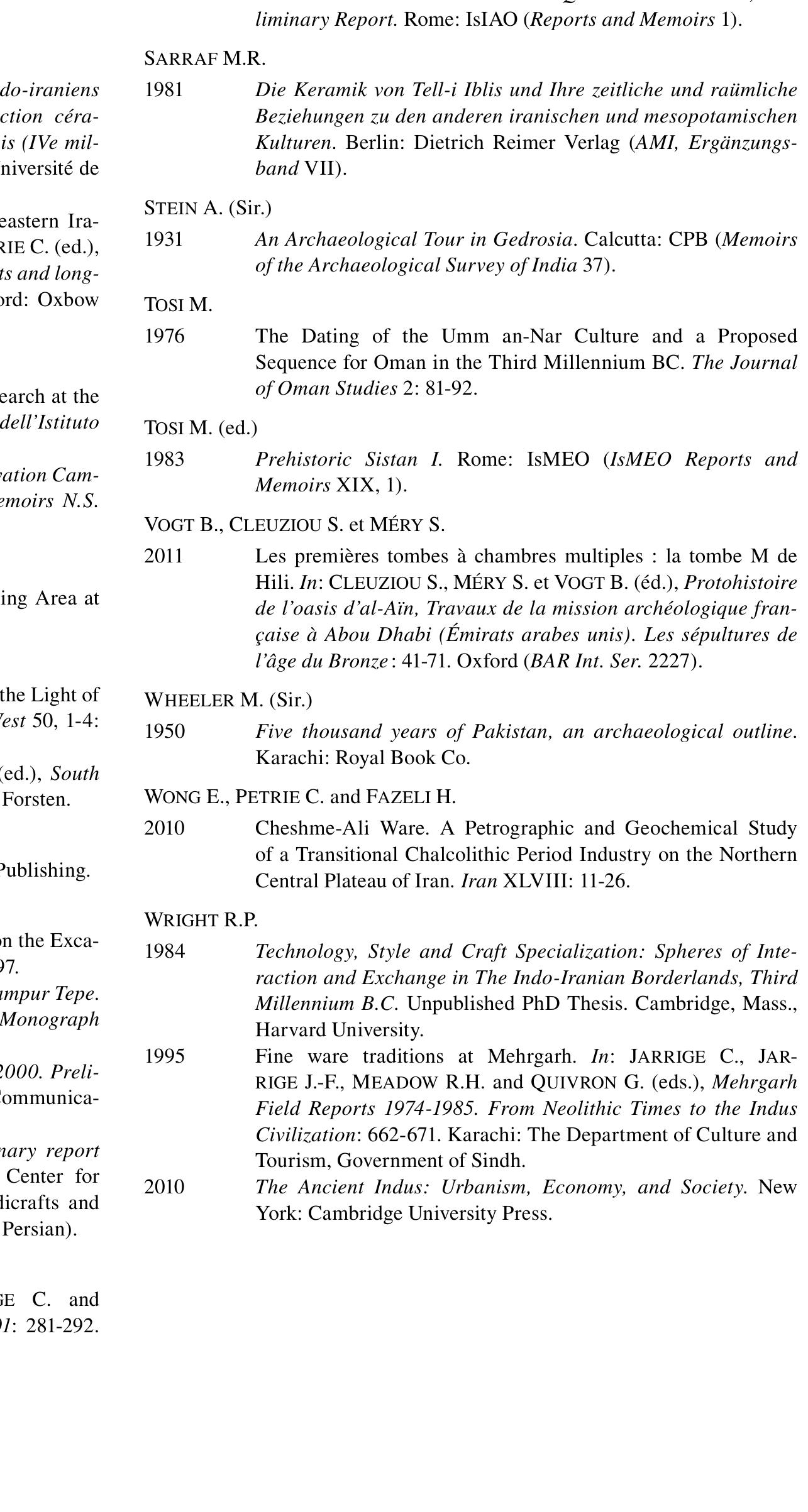
  58. MATTHEWS R.J. 1992 Defining the Style of the Period: Jemdet Nasr 1926-28. Iraq 54: 1-34.
  59. MILLE B., BOURGARIT D. and BESENVAL R. 2005 Metallurgical Study of the "Leopards Weight" from Shahi- Tump (Pakistan). In: JARRIGE C. and LEFÈVRE V. (eds.), South Asian Archaeology 2001: 237-244. Paris: Éditions ERC. J.-F. JARRIGE, A. DIDIER and G. QUIVRON
  60. Paléorient, vol. 37.2, p. 7-34 © CNRS ÉDITIONS 2011 MUGAVERO L. and VIDALE M. 2003 The Use of Polychrome Containers in the Hilmand Civilization: A Female Function? East and West 53: 67-94.
  61. MUTIN B. 2007 Contribution à l'étude du peuplement des confins indo-iraniens au Chalcolithique : Caractérisation de la production céra- mique des périodes II et IIIa du Makran pakistanais (IVe mil- lénaire av. J.-C.). Thèse de doctorat non publiée, Université de Paris 1 Panthéon-Sorbonne. In press Ceramic Traditions and Interactions on the Southeastern Ira- nian Plateau during the 4 th Millennium BC. In: PETRIE C. (ed.), Ancient Iran and its Neighbours. Local developments and long- range interactions in the 4 th millennium BC. Oxford: Oxbow and British Institute of Persian Studies.
  62. PIPERNO M. and SALVATORI S. 1983 Recent Results and New Perspectives from the Research at the Graveyard of Shahr-i Sokhta, Sistan, Iran. Annali dell'Istituto Universitario Orientale 43,2: 173-191.
  63. 2007 The Shahr-i Sokhta Graveyard (Sistan, Iran). Excavation Cam- paigns 1972-1978. Rome: IsIAO (Reports and Memoirs N.S. VI). PRACCHIA S. 1985 Excavations of a Bronze-Age Ceramic Manufacturing Area at Lal Shah, Mehrgarh. East and West 35,4: 458-468.
  64. QUIVRON G. 2000 The Evolution on the Mature Indus Pottery Style in the Light of the Excavations at Nausharo, Pakistan. East and West 50, 1-4: 147-190.
  65. 2008 New light on the Kulli culture. In: RAVEN E.M. (ed.), South Asian Archaeology 1999: 47-59. Groningen: Egbert Forsten.
  66. RAO S.R. 1973 Lothal and the Indus Civilization. New York: Asia Publishing.
  67. SAJJADI S.M.S. 2003 Excavations at Shahr-i Sokhta. Preliminary report on the Exca- vations of the Graveyard, 1997-2000. Iran XLI: 21-97.
  68. 2005 Bampur Tepe. The First Season of Excavation at Bampur Tepe. Tehran: ICAR/ICHTO (Archaeological Report Monograph Series). 2007 Excavations at Shahr-e Sukhteh. Graveyard 1997-2000. Preli- minary report 1 (in Persian). Tehran: Cultural and Communica- tion Vice Directorate, Office of Cultural Affairs. 2009 Excavations at Shahr-e Sukhteh. Second Preliminary report on the graveyard (2001-2003). Tehran: Iranian Center for Archaeological Research, Cultural Heritage, Handicrafts and Tourism Organization of Sistan and Baluchistan (in Persian).
  69. SALVATORI S. and TOSI M. 2005 Shahr-i Sokhta Revised Sequence. In: JARRIGE C. and LEFÈVRE V. (eds.), South Asian Archaeology 2001: 281-292. Paris: Éditions ERC.
  70. SALVATORI S. and VIDALE M. 1997 Shahr-i Sokhta 1975-1978: Central Quarters Excavations, Pre- liminary Report. Rome: IsIAO (Reports and Memoirs 1).
  71. SARRAF M.R. 1981 Die Keramik von Tell-i Iblis und Ihre zeitliche und raümliche Beziehungen zu den anderen iranischen und mesopotamischen Kulturen. Berlin: Dietrich Reimer Verlag (AMI, Ergänzungs- band VII).
  72. STEIN A. (Sir.)
  73. 1931 An Archaeological Tour in Gedrosia. Calcutta: CPB (Memoirs of the Archaeological Survey of India 37).
  74. TOSI M. 1976 The Dating of the Umm an-Nar Culture and a Proposed Sequence for Oman in the Third Millennium BC. The Journal of Oman Studies 2: 81-92.
  75. 1983 Prehistoric Sistan I. Rome: IsMEO (IsMEO Reports and Memoirs XIX, 1).
  76. VOGT B., CLEUZIOU S. et MÉRY S. 2011 Les premières tombes à chambres multiples : la tombe M de Hili. In: CLEUZIOU S., MÉRY S. et VOGT B. (éd.), Protohistoire de l'oasis d'al-Aïn, Travaux de la mission archéologique fran- çaise à Abou Dhabi (Émirats arabes unis). Les sépultures de l'âge du Bronze : 41-71. Oxford (BAR Int. Ser. 2227).
  77. WHEELER M. (Sir.)
  78. 1950 Five thousand years of Pakistan, an archaeological outline. Karachi: Royal Book Co.
  79. WONG E., PETRIE C. and FAZELI H. 2010 Cheshme-Ali Ware. A Petrographic and Geochemical Study of a Transitional Chalcolithic Period Industry on the Northern Central Plateau of Iran. Iran XLVIII: 11-26.
  80. WRIGHT R.P. 1984 Technology, Style and Craft Specialization: Spheres of Inte- raction and Exchange in The Indo-Iranian Borderlands, Third Millennium B.C. Unpublished PhD Thesis. Cambridge, Mass., Harvard University. 1995 Fine ware traditions at Mehrgarh. In: JARRIGE C., JAR- RIGE J.-F., MEADOW R.H. and QUIVRON G. (eds.), Mehrgarh Field Reports 1974-1985. From Neolithic Times to the Indus Civilization: 662-671. Karachi: The Department of Culture and Tourism, Government of Sindh. 2010 The Ancient Indus: Urbanism, Economy, and Society. New York: Cambridge University Press.

FAQs

sparkles

AI

What new evidence supports the dating of Shahr-i Sokhta's occupation periods?add

Recent excavations by S.M.S. Sajjadi revealed tombs at Shahr-i Sokhta dating to Period IV, providing clearer chronological links with Mehrgarh and Nausharo, suggesting continuity in cultural trends.

How does Shahr-i Sokhta relate to the Helmand civilization?add

The study indicates that Shahr-i Sokhta may be contemporaneous with key Helmand sites, with evidence linking its pottery styles and cultural artifacts to the Helmand River hydrographic system.

What is the significance of bichrome and polychrome pottery in this research?add

The introduction of bichrome and polychrome pottery in the region indicates complex exchange networks, particularly in the tradition of decoration techniques emerging around the mid-4th millennium BC.

What methodologies were used for the analysis of ceramic sequences in this study?add

The research employed calibrated radiocarbon dating and stratigraphic comparisons across various key archaeological sites to critically evaluate periods of occupation and cultural exchange.

What are the implications of vessel designs found at Shahr-i Sokhta?add

Vessels displayed stylistic links to both local and regional traditions, revealing a dynamic exchange of artistic concepts and techniques across the Indo-Iranian region during the 3rd millennium BC.

About the authors
Centre National de la Recherche Scientifique / French National Centre for Scientific Research, Faculty Member
Centre National de la Recherche Scientifique / French National Centre for Scientific Research, Department Member