References (11)
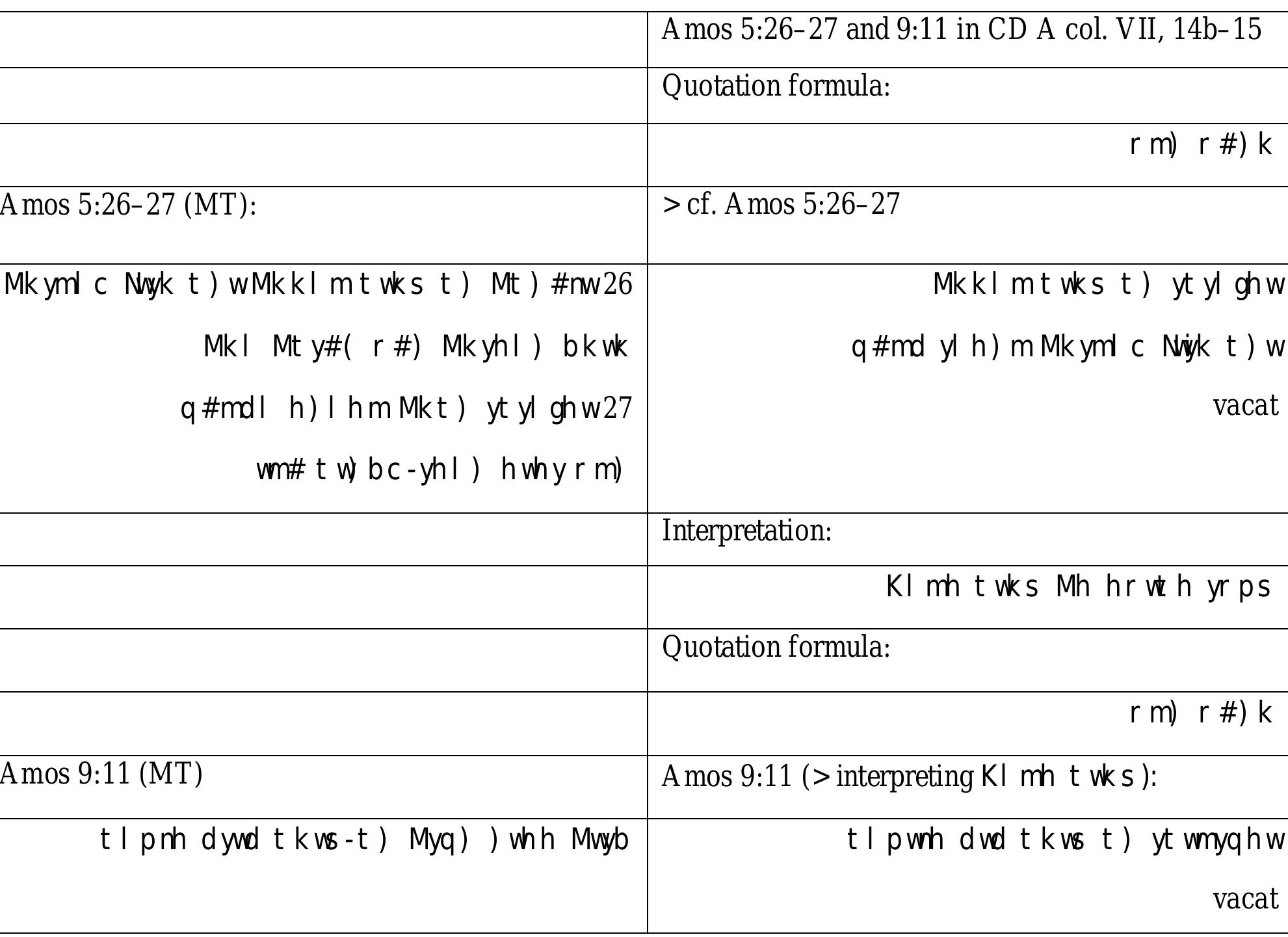
to two messianic figures, "the star" and "the staff": 53 "A star (bkwk) has left Jacob, a staff (+b#) has risen from Israel" (Num 24:17). The latter is the leader of the whole nation; when he appears, he will shatter all the sons of Seth (Num 24:17)." 54 Whereas the "biblical" verse from the Book of Amos (5:27) announces the punishment of Israel's sins, the exile, in the Damascus Document the "biblical" prophecy is transformed into a "positive message for the community, who wait for God's final judgement with eager anticipation." 55The author/redactor of the Amos-Numbers Midrash has adjusted and abbreviated the source text of Amos 5:26-27 in his quotation (CD A col. VII, 14-15). It has been suggested both that the author/redactor of the Damascus Document used his source text with considerable freedom, and that he is in fact using deliberate exegetical techniques. 56 The latter suggestion seems more credible, since it is known from other texts from the Qumran collection and from inner-biblical exegesis that abbreviation can function as an interpretative, exegetical method. The selective way of citing the source text is a deliberate way of forming an interpretation in the new context. 57 Another text citing the book of Amos, 4QFlorilegium (4Q174) is an exegetical work containing a reference to Amos 9:11: 58Collins, The Sceptre and the Star, 76, 80-82; Brooke, "The Amos-Numbers Midrash (CD7,13b- 8,1a) and Messianic Expectation," 402-404.For the identification of the messianic figures in CD and the different proposals see Charlotte Hempel, The Damascus Texts (Companion to the Qumran Scrolls 1; Sheffield: Sheffield Academic Press, 2000), 75-76.Maxine L. Grossman, Reading for History in the Damascus Document: A Methodological Study (STDJ 45; Leiden: Brill, 2002), 130, 160, 180, 197-198.Brooke, "The Amos-Numbers Midrash (CD 7,13b-8,1a) and Messianic Expectation," 400.See also Michael Fishbane, Biblical Interpretation in Ancient Israel (Oxford: Clarendon, 1985), 116-117; 188-197; 216-220; 228-230; 247-252; von Weissenberg, 4QMMT: Reevaluating the Text, the Function, and the Meaning of the Epilogue, 169-180.4QFlorilegium is also known as (a part of) the Eschatological Midrash (4QMirdEschat), attested in manuscripts 4Q174 and 4Q177. See Annette Steudel, Der Midrasch zur Eschatologie aus der Qumrangemeinde (4QMidrEschat( a.b ): Materielle Rekonstruktion, Textbestand, Gattung und traditionsgeschichtliche Einordnung des durch 4Q174 ("Florilegium") und 4Q177 ("Catena A") repräsentierten Werkes aus den Qumranfunden (STDJ 13; Leiden: Brill, 1994). 4Q 174 frgs. 1-2 col. i, 21: lines 10-13 59 10 "And Yahweh [decl]ares to you that he will build you a house. And I will raise up your offspring after you, and I will establish his royal throne 11 [fore]ver. I will be a father to him, and he shall be a son to me." (2 Sam 7:13-14) He (is) the Shoot of David who will arise with the interpreter of the Torah who 12 [ ] in Zi[on in the] latter days, as it is written, "And I will raise up the booth of David that is fallen." (Amos 9:11) He (is) the booth of 13 David that is falle[n w]ho will arise to save Israel. vacat The quotation from Amos 9:11 is used as an interpretative citation, 60 and used to illuminate the meaning of the previously cited passage of 2 Samuel. The shoot of David is described as the one who restores Israel. The brief passage is important due to its content: the interpretation identifies the shoot of David as the Son of God. 61 It is interesting that CD A and 4Q174, when making explicit use of the book of Amos, share an interest to the Davidic reference in Amos 9:11.In Damascus Document and 4QFlorilegium, certain formulae are used to set apart the quotation and the interpretation (bwtk r#)k, rm) r#)k, h)yh). The use of these f orm ulae does not, however, prevent the author/redactor from adjusting his source text. Both the Amos-Numbers Midrash, and the example from 4Q174 show how the scribes were both able and allowed to adjust their authoritative source texts for exegetical purposes. The authority of the text did no mean it 59 The translation is from the Dead Sea Scrolls Electronic Library.Brooke has suggested that the text of Amos 9:11 is identical in Acts 15:16 and in 4QFlorilegium, and both differ from the LXX and the MT; Brooke, Exegesis at Qumran: 4QFlorilegium in its Jewish Context (JSOTS 29; Sheffield: JSOT Press, 1985), 114.In another exegetical work from Qumran, in 4Q252, the shoot of David is understood as a messianic figure; Collins, The Sceptre and the Star, 61, 164. Amos 9:11 (MT) Amos 9:11 as cited in 4QFlor 1-2 col. i,21: line 12b Quotation formula:






![4Q174 ings. 1-2 col.1, 21: lines 10-13"~ 10 “And Yahweh [decl]ares to you that he will build you a house. And I will raise up your offspring after you, and I will establish his royal throne 11 [fore]ver. I will be a father to him, and he shall be a son to me.” (2 Sam 7:13-14) He (is) the Shoot of David who will arise with the interpreter of the Torah who 12[ __] in Zion in the] latter days, as it is written, “And I will raise up the booth of David that is fallen.” (Amos 9:11) He (is) the booth of 13 David that is falle[n w]ho will arise to save Israel. vacat](https://figures.academia-assets.com/1888778/table_002.jpg)


