Academia.eduAcademia.edu

Exploring the link between reading fiction and empathy: Ruling out individual differences and examining outcomes

https://doi.org/10.1515/COMM.2009.025

Abstract

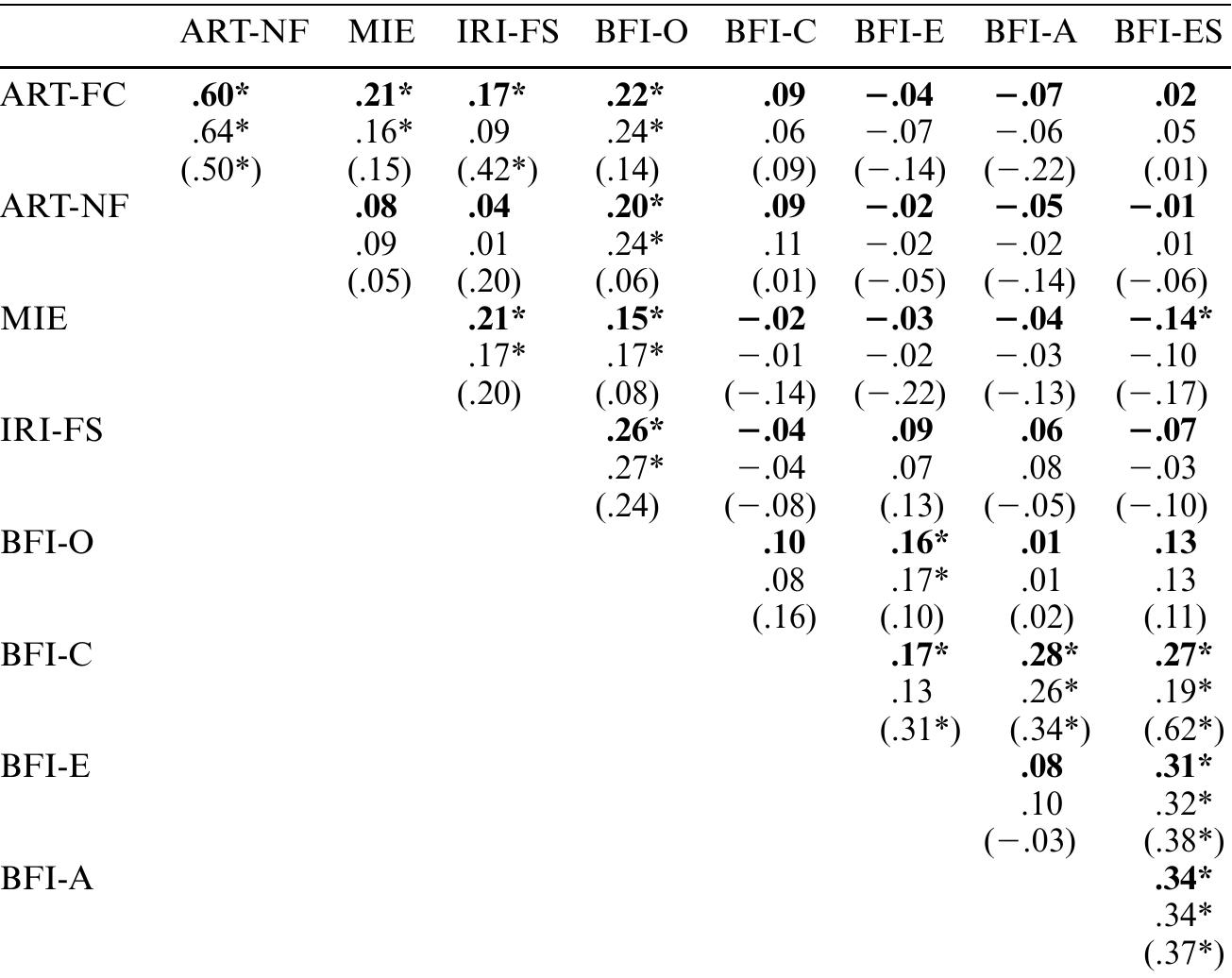
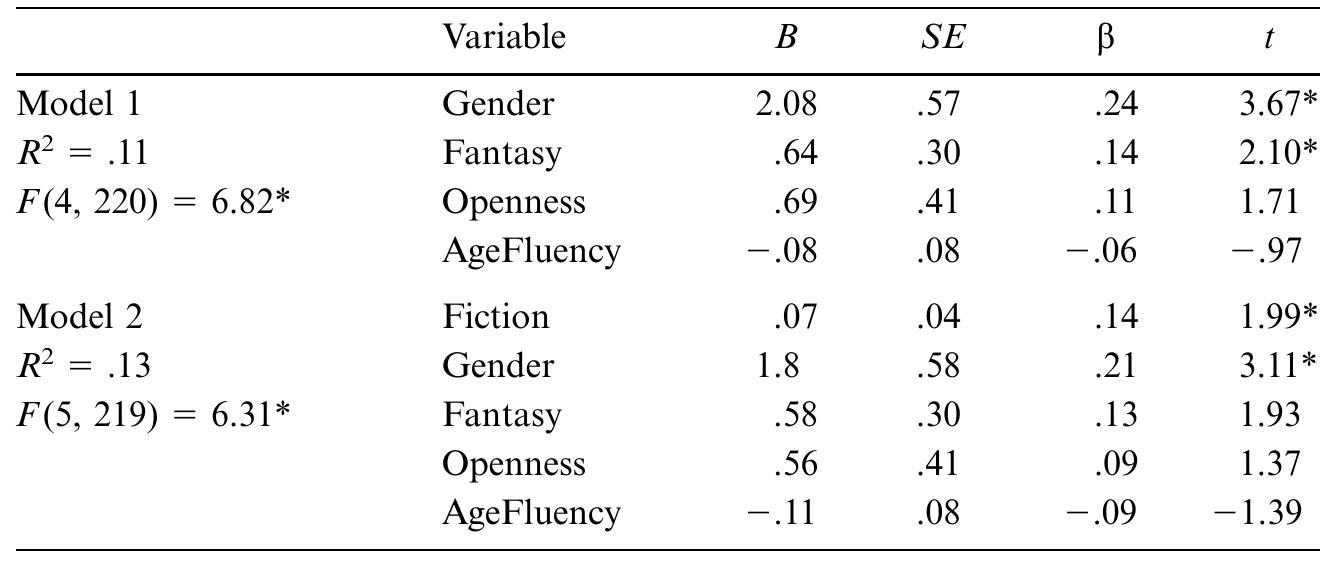
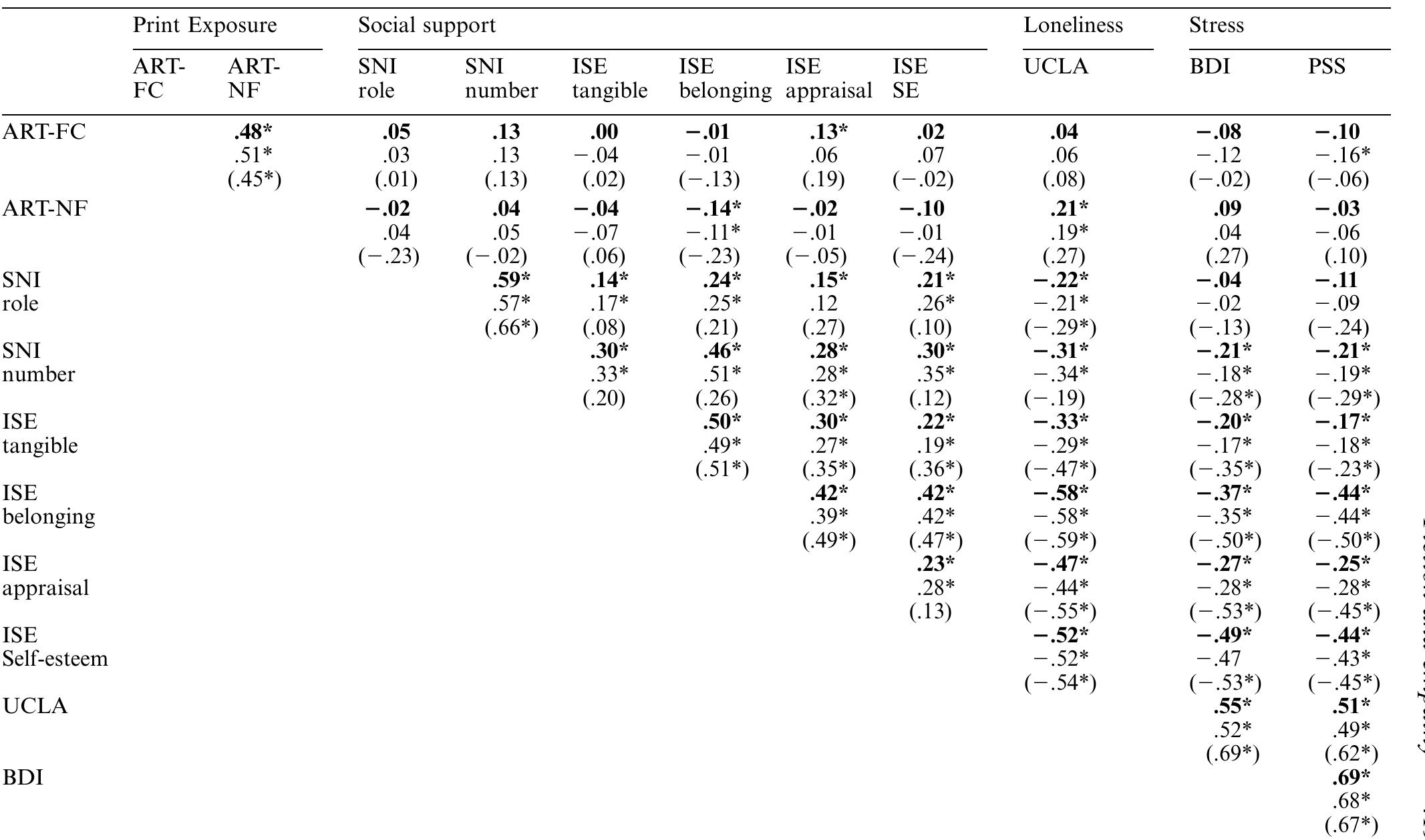
Readers of fiction tend to have better abilities of empathy and theory of mind (Mar et al., 2006). We present a study designed to replicate this finding, rule out one possible explanation, and extend the assessment of social outcomes. In order to rule out the role of personality, we first identified Openness as the most consistent correlate. This trait was then statistically controlled for, along with two other important individual differences: the tendency to be drawn into stories and gender. Even after accounting for these variables, fiction exposure still predicted performance on an em-pathy task. Extending these results, we also found that exposure to fiction was positively correlated with social support. Exposure to nonfiction, in contrast, was associated with loneliness, and negatively related to social support.

Key takeaways
sparkles

AI

  1. Exposure to narrative fiction predicts empathic accuracy even after controlling for individual differences.
  2. Openness is the only Big Five personality trait consistently correlated with exposure to narrative fiction.
  3. Frequent readers of fiction report more social support and less loneliness than those who read nonfiction.
  4. Study involved 225 participants, aged 17 to 38, with a majority being female.
  5. Reading nonfiction correlates with loneliness and negatively impacts social support.

References (60)

  1. Allen, L., Cipielewski, J., & Stanovich, K. E. (1992). Multiple indicators of children's reading habits and attitudes: Construct validity and cognitive correlates. Journal of Educational Psychology, 84, 489Ϫ503.
  2. Baron-Cohen, S. Jolliffe, T., Mortimore, C., & Robertson, M. (1997). Another ad- vanced test of theory-of-mind: Evidence from very high functioning adults with autism or Asperger syndrome. Journal of Child Psychology and Psychiatry, 38, 813Ϫ822.
  3. Baron-Cohen, S. & Wheelwright, S. (2004). The Empathy Quotient: An investigation of adults with Asperger syndrome or high-functioning autism, and normal sex differences. Journal of Autism and Developmental Disorders, 34, 163Ϫ175.
  4. Baron-Cohen, S., Wheelwright, S., Hill, J., Raste, Y., & Plumb, I. (2001). The "Read- ing the Mind in the Eyes" test revised version: A study with normal adults, and adults with Asperger syndrome or high-functioning autism. Journal of Child Psychology and Psychiatry, 42, 241Ϫ251.
  5. Beck, A. T. (1988). Psychometric properties of the Beck Depression Inventory: Twenty-five years of evaluation. Clinical Psychology Review, 8, 77Ϫ100.
  6. Buckner, R. L. & Carroll, D. C. (2007). Self-projection and the brain. Trends in Cogni- tive Sciences, 11, 49Ϫ57.
  7. Cohen, S., Doyle, W. J., Skoner, D. P., Rabin, B. S., & Gwaltney, J. M. Jr. (1997). Social ties and susceptibility to the common cold. Journal of the American Medical Association, 277, 1940Ϫ1944.
  8. Cohen, S. & Hoberman, H. (1983). Positive events and social supports as buffers of life change stress. Journal of Applied Social Psychology, 13, 99Ϫ125.
  9. Cohen, S., Kamarck & T., Mermelstein, R. (1983). A global measure of perceived stress. Journal of Health and Social Behavior, 24, 385Ϫ396.
  10. Costa, P. T. & McCrae, R. R. (1992). NEO PI-R professional manual. Odessa, FL: Psychological Assessment Resources.
  11. Cunningham, A. E. & Stanovich, K. E. (1997). Early reading acquisition and its rela- tion to reading experience and ability 10 years later. Developmental Psychology, 33, 934Ϫ945.
  12. Dal Cin, S., Zanna, M. P., & Fong, G. T. (2004). Narrative persuasion and overcoming resistance. In E. S. Knowles & J. A. Linn (Eds.), Resistance and persuasion (pp. 175Ϫ191). Mahwah, NJ: Erlbaum.
  13. Davis, M. H. (1980). A multidimensional approach to individual differences in empa- thy. JSAS Catalogue of Selected Documents in Psychology, 10, 85.
  14. Davis, M. H. (1983). Measuring individual differences in empathy: Evidence for a multidimensional approach. Journal of Personality and Social Psychology, 44, 113Ϫ126. Brought to you by | University of Toronto-Ocul Authenticated Download Date | 2/1/16 10:49 PM
  15. England, E. M. & Petro, K. D. (1998). Middle school students' perceptions of peer groups: Relative judgments about group characteristics. The Journal of Early Ado- lescence, 18, 349Ϫ373.
  16. Epley, N., Waytz, A., & Cacioppo, J. T. (2007). On seeing human: A three-factor theory of anthropomorphism. Psychological Review, 114, 864Ϫ886.
  17. Ferstl, E. C., Neumann, J., Bogler, C., & von Cramon, D. Y. (2008). The extended language network: A meta-analysis of neuroimaging studies on text comprehen- sion. Human Brain Mapping, 29, 581Ϫ593.
  18. Finn, S. (1997). The origins of media exposure. Communication Research, 24, 507Ϫ 529. Derrick, J. L., Gabriel, S., & Hugenberg, K. J. (2009). Social surrogacy: How favored television programs provide the experience of belonging. Journal of Experimental Social Psychology, 45, 352Ϫ362.
  19. Fraley, R. C. & Marks, M. J. (2007). The null hypothesis significance testing debate and its implications for personality research. In R. W. Robins, R. C. Fraley, & R. Krueger (Eds.), Handbook of Research Methods in Personality Psychology (pp. 149Ϫ169). New York: Guilford Press.
  20. Gardner, W. L. & Knowles, M. L. (2008). Love makes you real: Favorite television characters are perceived as "real" in a social facilitation paradigm. Social Cogni- tion, 26, 156Ϫ168.
  21. Gerrig, R. J. (1993). Experiencing narrative worlds. New Haven: Yale University Press.
  22. Goldberg, L. R. (1999). A broad-bandwidth, public-domain, personality inventory measuring the lower-level facets of several five-factor models. In I. Mervielde, I. Deary, F. De Fruyt, & F. Ostendorf (Eds.), Personality psychology in Europe, vol. 7. (pp. 7Ϫ28). Tilburg: Tilburg University Press.
  23. Green, M. C., Strange, J. J., & Brock, T. C. (Eds.). (2002). Narrative Impact. Mahwah, NJ: Lawrence Erlbaum Associates.
  24. Green, M. C. (2004). Transportation into narrative worlds: The role of prior knowl- edge and perceived realism. Discourse Processes, 38, 247Ϫ266.
  25. Green, M. C. & Brock, T. C. (2000). The role of transportation in the persuasiveness of public narratives. Journal of Personality and Social Psychology, 79, 701Ϫ721.
  26. Gregory, C., Lough, S., Stone, V., Erzinclioglu, S., Martin, L., Baron-Cohen, S., & Hodges, R. (2002). Theory of mind in patients with frontal variant frontotemporal dementia and Alzheimer's disease: theoretical and practical implications. Brain, 125, 751Ϫ764.
  27. Hall, A. (2005). Audience personality and the selection of media and media genres. Media Psychology, 7, 377Ϫ398.
  28. Jensen-Campbell, L. A., Adams, R., Perry, D. G., Workman, K. A., Furdella, J. Q., & Egan, S. K. (2002). Agreeableness, extraversion, and peer relations in early adoles- cence: Winning friends and deflecting aggression. Journal of Research in Personal- ity, 36, 224Ϫ251.
  29. John, O. P. & Srivastava, S. (1999). The Big Five Trait taxonomy: History, measure- ment, and theoretical perspectives. In L. A. Pervin & O. P. John (Eds.), Handbook of personality: Theory and research, 2 nd ed. (pp. 102Ϫ138). New York, NY: Guil- ford Press.
  30. Jonason, P. K., Webster, G. D., & Lindsey, A. E. (2008). Solutions to the problem of diminished social interaction. Evolutionary Psychology, 6, 637Ϫ651.
  31. Judge, T. A., Erez, A., Bono, J. E., & Thoresen, C. J. (2002). Are measures of self- esteem, neuroticism, self-control, and generalized self-efficacy indicators of a sin- gle core construct? Journal of Personality and Social Psychology, 83, 693Ϫ710.
  32. Keen, S. (2006). A theory of narrative empathy. Narrative, 14, 207Ϫ236.
  33. Koole, S. L., Jager, W., van den Berg, A. E., Vlek, C. A. J., & Hofstee, W. K. B. (2001). On the social nature of personality: Effects of extraversion, agreeableness, Brought to you by | University of Toronto-Ocul Authenticated Download Date | 2/1/16 10:49 PM and feedback about collective resource use on cooperation in a resource dilemma. Personality and Social Psychology Bulletin, 27, 289Ϫ301.
  34. Mar, R. A. (2004). The neuropsychology of narrative: Story comprehension, story production and their interrelation. Neuropsychologia, 42, 1414Ϫ1434.
  35. Mar, R. A., DeYoung, C. G., Higgins, D. M., & Peterson, J. B. (2006). Self-liking and self-competence separate self-evaluation from self-deception: Associations with personality, ability, and achievement. Journal of Personality, 74, 1047Ϫ1078
  36. Mar, R. A. & Oatley, K. (2008). The function of fiction is the abstraction and simula- tion of social experience. Perspectives on Psychological Science, 3, 173Ϫ192.
  37. Mar, R. A., Oatley, K., & Djikic, M. (2008). Effects of reading on knowledge, social abilities, and selfhood: Theory and empirical studies. In S. Zyngier, M. Bortolussi, A. Chesnokova, & J. Auracher (Eds.), Directions in Empirical Literary Studies: Essays in honor of Willie van Peer (pp. 127Ϫ137). Amsterdam: John Benjamins.
  38. Mar, R. A., Oatley, K., Hirsh, J., dela Paz, J., & Peterson, J. B. (2006). Bookworms versus nerds: Exposure to fiction versus non-fiction, divergent associations with social ability, and the simulation of fictional social worlds. Journal of Research in Personality, 40, 694Ϫ712.
  39. Mar, R. A., Oatley, K., & Peterson, J. B. (2008). The relation between vocabulary and lifetime exposure to narrative fiction versus expository nonfiction. Poster pre- sented at the 9 th Annual Conference of the Society for Personality and Social Psychology, Albuquerque, NM, USA.
  40. McManus, I. C. & Furnham, A. (2006). Aesthetic activities and aesthetic attitudes: Influence of education, background and personality on interest and involvement in the arts. British Journal of Psychology, 97, 555Ϫ587.
  41. Miall, D. S. (2000). On the necessity of empirical studies of literary reading. Frame: Utrecht Journal of Literary Theory, 14, 43Ϫ59.
  42. Nell, V. (1988). Lost in a book: The psychology of reading for pleasure. New Haven, CT: Yale University Press.
  43. Nettelbeck, T., Basian, V., & Burns, N. (2007). Is Emotional Intelligence distinct from personality and cognitive ability? In Emotional Intelligence (P. Qualter, P. Rogers, Chairs). Paper presented at the 13 th Biennial Meeting of the International Society for the Study of Individual Differences. Giessen, Germany.
  44. Oatley K. (1994). A taxonomy of the emotions of literary response and a theory of identification in fictional narrative. Poetics, 23, 53Ϫ74.
  45. Oatley, K. (1999). Why fiction may be twice as true as fact: Fiction as cognitive and emotional simulation. Review of General Psychology, 3, 101Ϫ117.
  46. Petrides, K. V., Pe ´rez-Gonza ´lez, J. C., & Furnham, A. (2007). On the criterion and incremental validity of trait emotional intelligence. Cognition and Emotion, 21, 26Ϫ55.
  47. Platek, S. M., Keenan, J. P., Gallup Jr., G. G., & Mohamed, F. B. (2004). Where am I? The neurological correlates of self and other. Cognitive Brain Research, 19, 114Ϫ122.
  48. Preacher, K. J. & Hayes, A. F. (2004). SPSS and SAS procedures for estimating indi- rect effects in simple mediation models. Behavior Research Methods, Instruments, and Computers, 36, 717Ϫ731.
  49. Preacher, K. J. & Hayes, A. F. (2008). Asymptotic and resampling strategies for assess- ing and comparing indirect effects in multiple mediator models. Behavior Research Methods, 40, 879Ϫ891
  50. Prentice, D. A., Gerrig, R. J., & Bailis, D. S. (1997). What readers bring to the process- ing of fictional texts. Psychonomic Bulletin Review, 4, 416Ϫ420.
  51. Russell, D. W. (1996). UCLA Loneliness Scale (version 3): Reliability, validity, and factor structure. Journal of Personality Assessment, 66, 20Ϫ40. Brought to you by | University of Toronto-Ocul Authenticated Download Date | 2/1/16 10:49 PM
  52. Schulte, M. J., Ree, M. J., & Carretta, T. R. (2004). Emotional intelligence: Not much more than g and personality. Personality and Individual Differences, 37, 1059Ϫ 1068. Se ´ne ´chal, M., LeFevre, J., Hudson, E., & Lawson, E. P. (1996). Knowledge of story- books as a predictor of young children's vocabulary. Journal of Educational Psychology, 88, 520Ϫ536.
  53. Spreng, R. N., Mar, R. A., & Kim, A. S. N. (2009). The common neural basis of autobiographical memory, prospection, navigation, theory of mind and the default mode: a quantitative meta-analysis. Journal of Cognitive Neuroscience, 21, 489Ϫ 510. Stanovich, K. E. & Cunningham, A. E. (1993). Where does knowledge come from? Specific associations between print exposure and information acquisition. Journal of Educational Psychology, 85, 211Ϫ229.
  54. Stanovich, K. E. & West, R. F. (1989). Exposure to print and orthographic processing. Reading Research Quarterly, 24, 402Ϫ433.
  55. Strange, J. J. & Leung, C. C. (1999). How anecdotal accounts in news and fiction can influence judgments of a social problem's urgency, causes, and cures. Personality and Social Psychology Bulletin, 25, 436Ϫ449.
  56. Taylor, M. & Carlson, S. M. (1997). The relationship between individual differences in fantasy and theory of mind. Child Development, 68, 436Ϫ455.
  57. Tirre, W. C. & Dixit, S. (1995). Reading interests: Their dimensionality and correlation with personality and cognitive factors. Personality and Individual Differences, 18, 731Ϫ738.
  58. Weaver, J. B., III (1991). Exploring the links between personality and media prefer- ences. Personality and Individual Differences, 12, 1293Ϫ1299.
  59. West, R. F., Stanovich, K. E., & Mitchell, H. R. (1993). Reading in the real world and its correlates. Reading Research Quarterly, 28, 34Ϫ50.
  60. Zillmann, D. (1994). Mechanisms of emotional involvement with drama. Poetics, 23, 33Ϫ51. Brought to you by | University of Toronto-Ocul Authenticated Download Date | 2/1/16 10:49 PM

FAQs

sparkles

AI

What explains the correlation between reading fiction and improved empathy scores?add

The study demonstrates that exposure to narrative fiction uniquely predicts empathy task performance, after controlling for individual differences like gender and personality traits.

What individual differences were ruled out in relation to empathy and fiction exposure?add

The research accounted for variables such as age, trait Openness, gender, and narrative engagement to confirm the association between fiction reading and empathy.

How does fiction reading impact social outcomes like loneliness and social support?add

Frequent readers of narrative fiction reported greater social support, while exposure to nonfiction was negatively correlated with feelings of belongingness.

Which personality traits were found to correlate with reading fiction?add

The analysis revealed that trait Openness was the only consistent personality factor associated with exposure to narrative fiction.

What methodology was used to assess exposure to fiction versus nonfiction?add

The study employed the Author Recognition Test (ART), which objectively measures exposure to literary works while controlling for biased self-reporting.

About the authors
University of Toronto, Faculty Member
University of Toronto, Emeritus